Soaring 10-fold in a year, memory chips become the "money printer" in the AI era: The Big Three feast, while domestic players get a taste.
In the past, when we talked about storage products, our first reaction was still "computer components" like memory sticks, SSDs, and mechanical hard drives. Although they are important, they are mostly just a column of parameters in the computer configuration list. For most people, the importance of memory and hard drives is far less than that of CPUs and GPUs.
However, in the age of AI, everything has changed.
At first, AI companies were only competing for GPUs. At that time, NVIDIA's flagship computing power cards were extremely hard to come by. But today, what people are competing for has changed: memory, hard drives, and CPUs. All PC-related hardware has entered a state of shortage, especially storage chips.
Data from CFM shows that the price of server memory sticks has increased by more than 10 times in the past year. In June last year, the lowest price of a 32GB DDR5 RDIMM was only $113, while in May this year, the highest price reached $1,200. Even in terms of the average transaction price, the increase was more than five times.
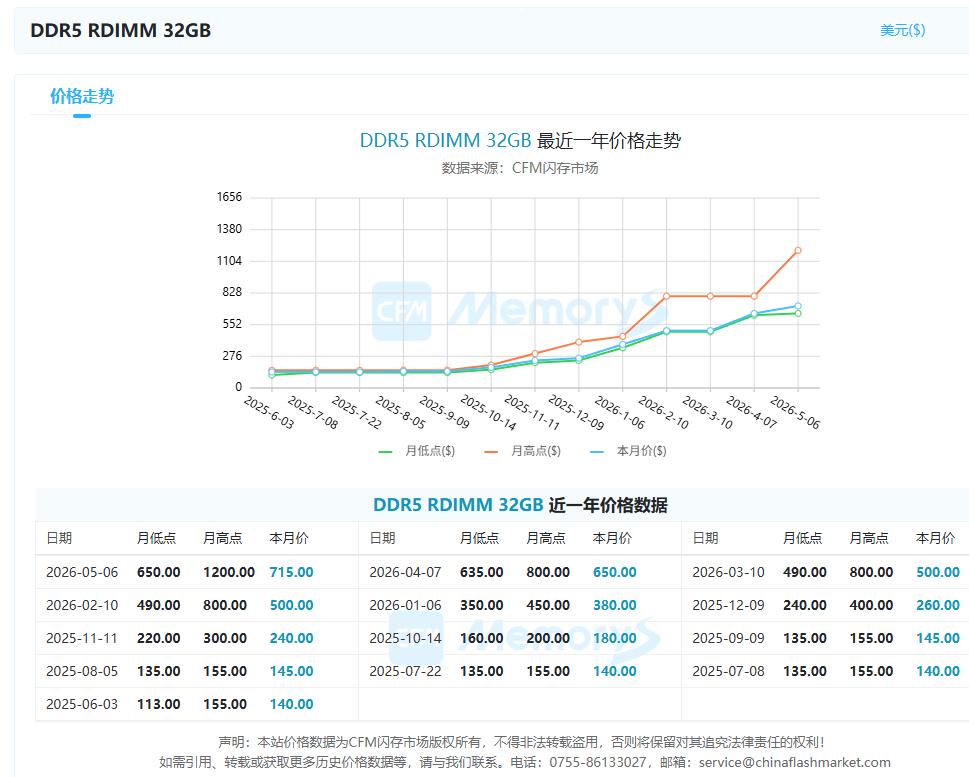
Image source: CFM
The price increase of storage chips did not happen out of thin air. The root cause lies in the increasing parameter scale of large models and the growing number of users, which require AI companies to use more storage space to save model data and user data. Meanwhile, the demand for GPUs remains strong, and a single flagship computing power card can consume dozens to hundreds of gigabytes of high-bandwidth video memory particles. The strong demand from giants like NVIDIA has led the entire market into a state of shortage.
This is why the profits and stock prices of storage giants such as Micron, Samsung, and SK Hynix have suddenly skyrocketed in the past year. They were originally typical cyclical enterprises: they make money when the industry is short of supply and their profits decline when there is an oversupply. But this time, what AI brings is not an ordinary consumer electronics replacement wave, but a systematic demand from data centers for HBM, DDR5, enterprise-level SSDs, and high-capacity HDDs. These demands will not disappear in the short term.
Moreover, Lei Technology believes that people should not only focus on "the rising price of memory" but should also see that the storage industry has been redefined by AI. In the past, the demands of the consumer and enterprise sectors were parallel; now, various manufacturers have raised the demand of the enterprise line to an unprecedented height because it has become an indispensable part of AI infrastructure. The era of severe overcapacity is likely to never return.
Why can the three flash memory giants earn so much?
In this round of storage market, the most attention has been on Micron, Samsung, and SK Hynix, commonly known as the three storage giants.
They have a fundamental difference from many storage brands we usually see: ordinary brands mostly turn DRAM and NAND particles into end products such as memory sticks, SSDs, and mobile hard drives. However, Micron, Samsung, and SK Hynix have the core particle manufacturing capabilities (and they also manufacture end products themselves).
Simply put, while others are mostly cooking, they have the rice, meat, and vegetables, control the farmland and supply chain, and are even the biggest restaurants themselves. This is the core value of the three giants in the age of AI. However, most people may only know their names but not their respective advantages in the field of AI.
Let's first look at SK Hynix. In the past few years, its most core label has been HBM, with a market share of nearly 70% at its peak; even after Samsung and Micron stepped up their efforts, its share still exceeded 50%. HBM can be understood as a super-wide highway beside AI GPUs: it vertically stacks multiple layers of DRAM chips and gets close to the GPU through advanced packaging, allowing data to flow between the GPU and memory at extremely high bandwidth.
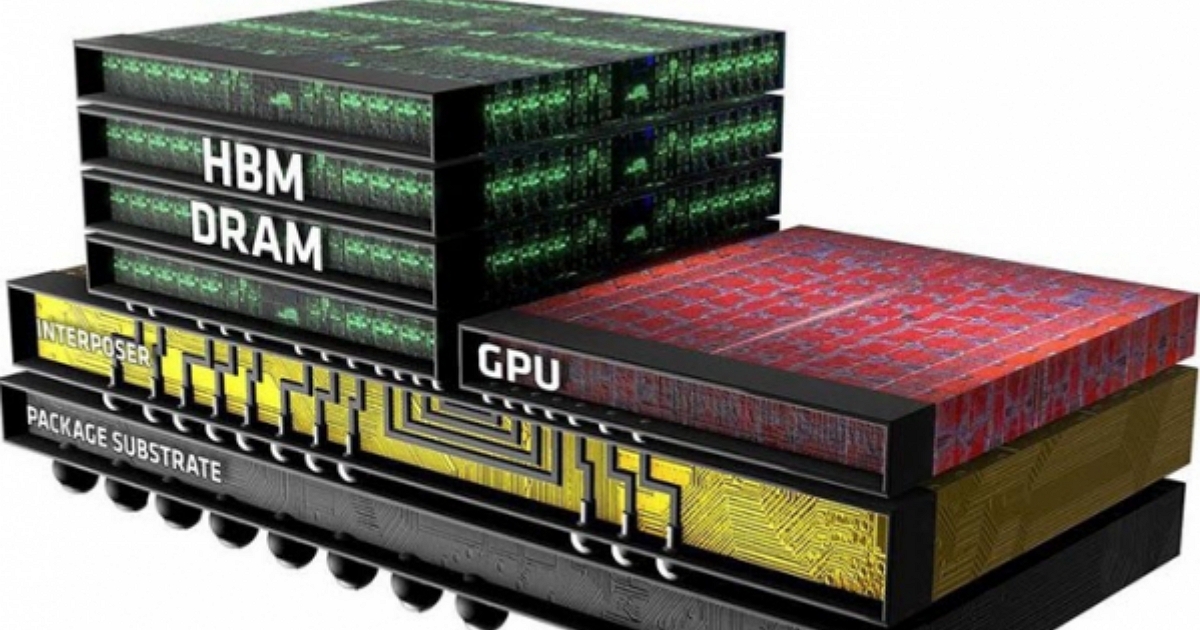
Image source: techbang
This is very important in AI applications because the data of large models can easily reach trillions. Even if technologies such as the mixture of experts architecture are used to reduce the activated parameters, there are still extremely high requirements for bandwidth, speed, and latency. This also makes HBM video memory a key foundation for top-level AI models, so the demand for HBM video memory has always been high.
The problem is that HBM is not just a simple stacking of several memory chips. Its production involves almost the improvement and optimization of the entire production line. After production, it also needs to pass the strict certification of leading customers such as NVIDIA and AMD. In other words, it has high technical thresholds, slow capacity release, and deep customer binding, which gives SK Hynix a very high market premium in the AI cycle.
Samsung's advantage lies in its "all-roundness." It produces both DRAM and NAND and covers multiple businesses such as mobile phones, consumer electronics, and wafer manufacturing. For Samsung, when the demand for AI servers is strong, it can tilt its resources towards HBM, high-capacity DDR5, and enterprise-level NAND; when the mobile phone and PC markets recover, it can also adjust its production capacity back to the consumer market, without any waste.
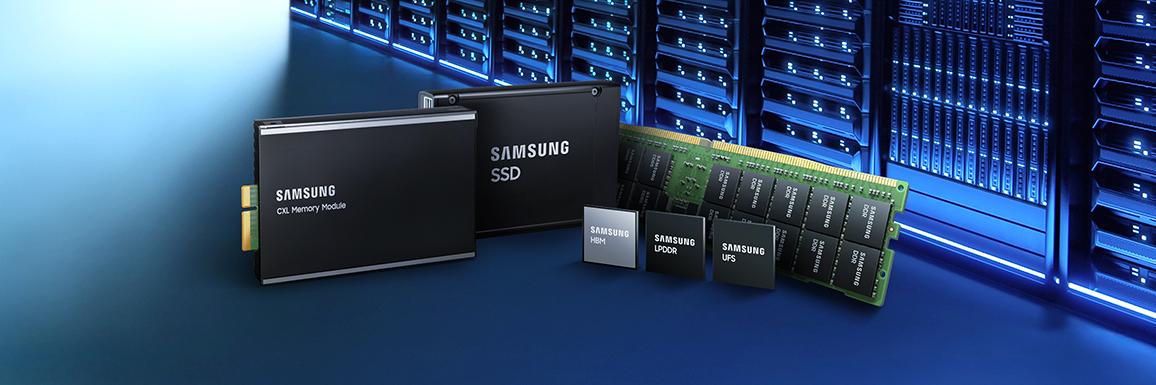
Image source: Samsung
Although Samsung is not very advanced in terms of technology, it has a wide enough industrial chain coverage and stronger risk resistance. Therefore, from an investment perspective, Samsung is a more stable choice compared to SK Hynix.
Finally, let's talk about Micron. It has a unique advantage: it is the largest domestic storage original manufacturer in the United States. Against the backdrop of the accelerated construction of AI data centers and the high importance attached to supply chain security, Micron's strategic value has actually been significantly magnified.
In the past, when looking at Micron, we mainly focused on the consumer market because Micron was not as good as Samsung and Hynix in terms of technology, and its share in the enterprise sector was not high. As a result, once the demand in the consumer market fluctuated, Micron would be in a difficult situation (it lost billions of dollars in 2023). However, now when looking at Micron, we must put it into the North American AI infrastructure supply chain for re-discussion.
Especially in the past two years, Micron has significantly shifted its R & D and production capacity focus to HBM. Coupled with the increasing demand from the domestic supply chain in the United States, its share in the HBM market is now very close to that of Samsung. At the same time, Micron has become the first brand among the three giants to "separate" its consumer end-product business (it is not stopping the production of consumer-grade flash memory chips but no longer selling finished products), and it has allocated all its production capacity to meet the enterprise demand.
Image source: Micron
This is why the stock prices of storage companies have soared collectively. In the past, people thought that storage was a "replaceable standard product," but today they have found that what AI needs is not just capacity but high bandwidth, high stability, high energy efficiency, and sustainable supply capabilities. Being able to produce it is one thing, and being able to stably supply it to leading AI customers on a large scale is another.
However, after the three giants have all rushed towards the enterprise demand, the existence of domestic Changxin Storage has become thought-provoking.
It must be admitted that there is still a significant gap between Changxin and Samsung, Hynix, and Micron, especially in terms of HBM, advanced processes, and certification by top server customers. But Changxin's opportunity lies in the fact that after the three giants have invested more production capacity and energy in AI servers, HBM, and high-end DDR5, there will be a large gap in the mid - to low - end and mainstream consumer-grade DRAM markets.
In the past, this market was dominated by low-cost overseas storage particles. Changxin's storage particles not only had no performance advantage but also no cost advantage, so it was difficult to open up the market. But now it's different. Almost all terminal manufacturers are begging Changxin to supply some chips.
For example, some overseas consumers recently found that some DDR5 memory products of the famous PC hardware brand Corsair actually use Changxin particles. Although this incident itself does not mean that Changxin has fully entered the global high-end market, it is sufficient to show that domestic DRAM has begun to enter the supply chain of first-tier consumer-grade brands and is no longer limited to the domestic market.
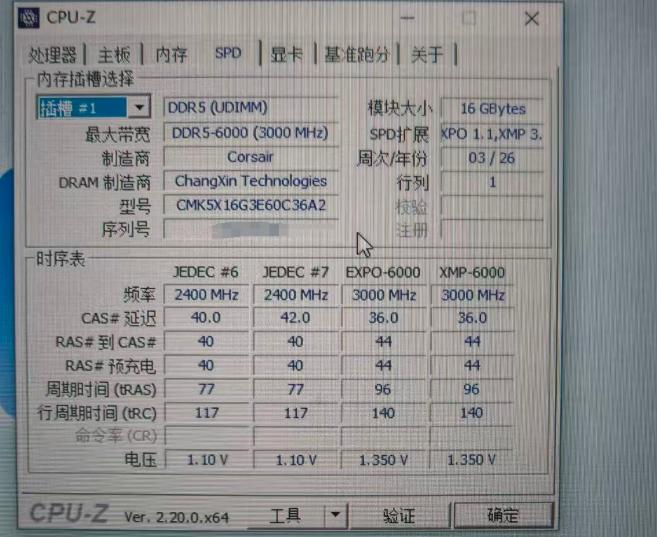
Image source: wxnod
For Changxin, this may be more realistic than directly challenging HBM: first capture the markets of ordinary DDR5, domestic PCs, consumer-grade memory, and some server memory, and then gradually move towards higher-end products, just like countless Chinese enterprises in the past, advancing step by step from low to high.
The latest news is that Changxin Technology's IPO has passed the review. Once it is successfully listed, its market value is estimated to exceed two trillion yuan, directly entering the top five of Chinese enterprises in terms of market value, ranking fourth, only after Alibaba, Industrial and Commercial Bank of China, and Tencent. It has to be said that with the dual support of the AI industry and the storage industry, Changxin can really be described as "soaring into the sky." We hope that in the future, there will be a fourth giant among the storage giants.
Don't just focus on the three giants. These manufacturers are also benefiting
If Micron, Samsung, and SK Hynix are feasting on the fattest piece of meat in AI storage, then companies like SanDisk, Seagate, Western Digital, Foresee, and Phison are enjoying the industrial dividends spilled over by AI.
SanDisk's stock price is one of the few that can match the growth of the three major giants. To be honest, this performance surprised Lei Technology. After all, in terms of product popularity, although SanDisk is a first-tier brand, it is not irreplaceable. How did it manage to skyrocket its stock price?
After researching a lot of materials, Lei Technology found the reason: the core is, of course, the skyrocketing demand for NAND, which led to revenues far exceeding investors' expectations; more importantly, after SanDisk was spun off from Western Digital, its strategic focus has completely shifted to data centers, and it has also obtained multi-year supply contracts worth up to $11 billion from leading cloud providers such as Amazon.
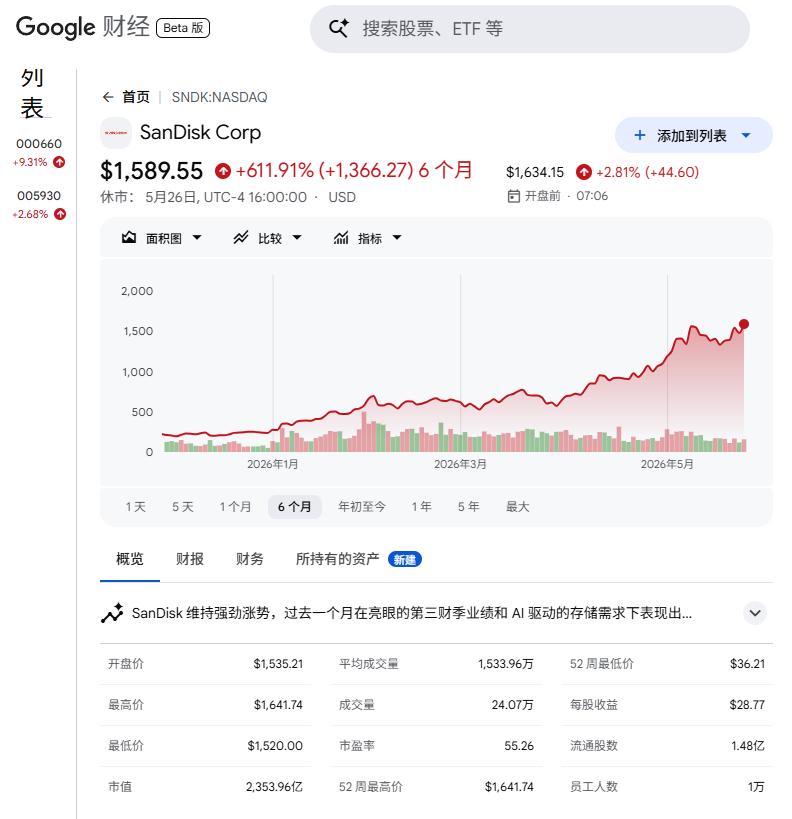
Image source: Google Finance
Since we are talking about SanDisk, we have to mention another core in this round of storage price surge - SSDs. As we all know, AI training needs to store massive data sets, and AI inference also needs to read model parameters. Moreover, when enterprises deploy Agents and vector databases, a large amount of cache, logs, and multimodal files will be generated.
In the eyes of ordinary users, SSDs used to be just "to make the computer boot faster," but in data centers, the proportion of SSDs is directly related to read and write throughput, latency, power consumption, and stability. In simple terms, it is directly related to the efficiency and inference cost of AI large models, which has forced many data centers to replace HDDs with SSDs, leading to a skyrocketing demand for SSDs.
Of course, this does not mean that HDDs are no longer in demand. Their demand is also increasing because AI is not only "consuming data (training)" but also generating more data. Model training data, video materials, historical logs, backup data, and archived data cannot all be stored in expensive SSDs, and HDDs with large capacity and low cost have become the best choice.
The increasing demand for HDDs has driven the revenues of Seagate and Western Digital, two large storage manufacturers, to skyrocket. Although they also have SSD businesses, as the two giants in HDD manufacturing (there is also Toshiba, but its market share is less than 20%), they have almost taken on all the soaring demand.
Moreover, as AI becomes more and more popular and the amount of data increases, the value of HDDs will actually be higher. Data from previous years shows that in 2010, the Internet generated 2 ZB of data throughout the year (1 ZB is equal to 1 billion TB), and in 2020, this figure increased to 64 ZB; only five years later, this number has approached 200 ZB.
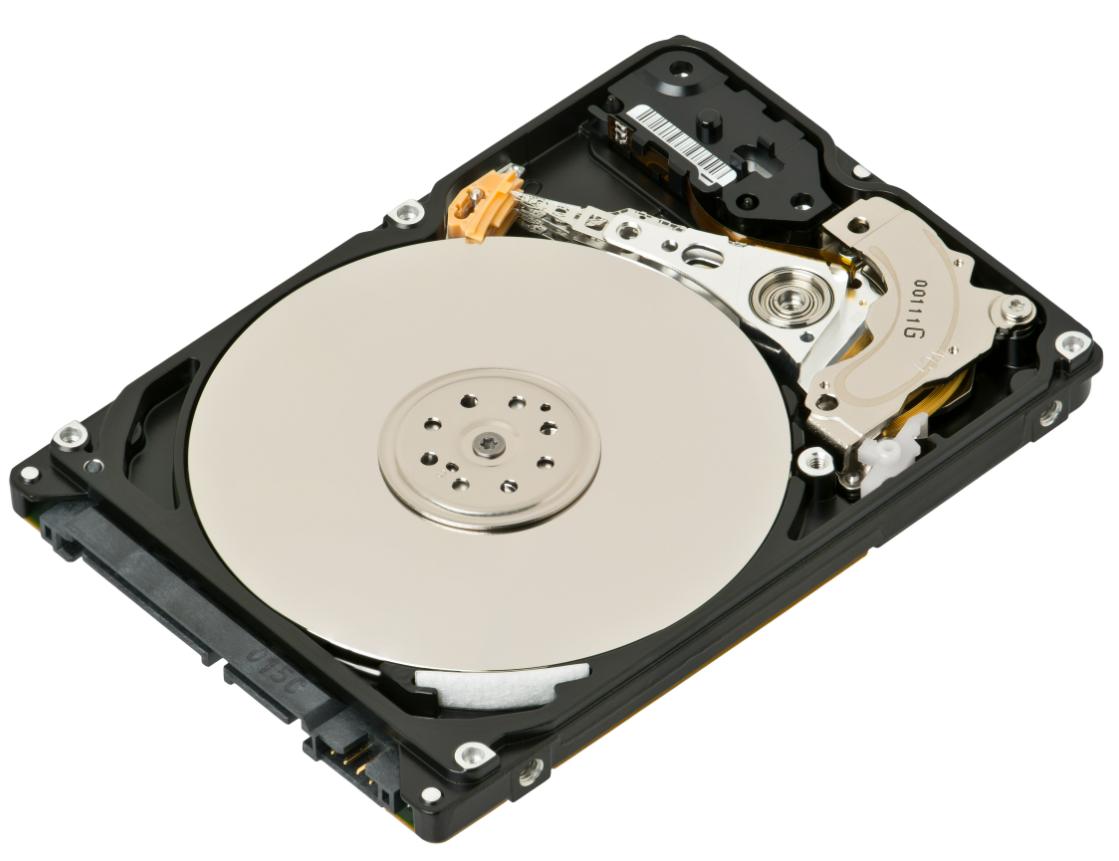
Image source: Wikipedia
In the scientific community, there is a general consensus that about 90% of the data in human history has been generated in the past two years. AI technology enables everyone to produce a large amount of data, and at the same time, data has become the most core resource in this era.
Therefore, with the development of the AI industry, it is estimated that the prices of hardware such as HDDs and SSDs will be hard to return to the low level in the future.
In addition to chip manufacturers and terminal producers, solution integrators such as Foresee are also affected. It is not an upstream original manufacturer like Samsung or Hynix, but it is closer to the terminal market. It can turn upstream particles into products such as UFS, eMMC, SSDs, memory modules, and enterprise-level storage, and then supply them to terminal producers.
Moreover, enterprises like Foresee, which have full-link firmware algorithms and independent main control development capabilities, are more popular in this market because they can customize storage solutions according to customer needs, making the product performance more in line with user needs.
Recently, Foresee has developed a number of embedded storage products for different products and scenarios in response to the needs of AI PCs and AI mobile devices.