Pope issues first encyclical on AI: 40,000 words, 10 viewpoints, fully addressing AI anxiety
On May 15, 2026, Pope Leo XIV signed his name on a document over 40,000 words long. That day happened to be the 135th anniversary of Pope Leo XIII's issuance of the encyclical "Rerum Novarum." The document signed in 1891 was the first official response of the Catholic Church to the impact of the Industrial Revolution on the labor order.
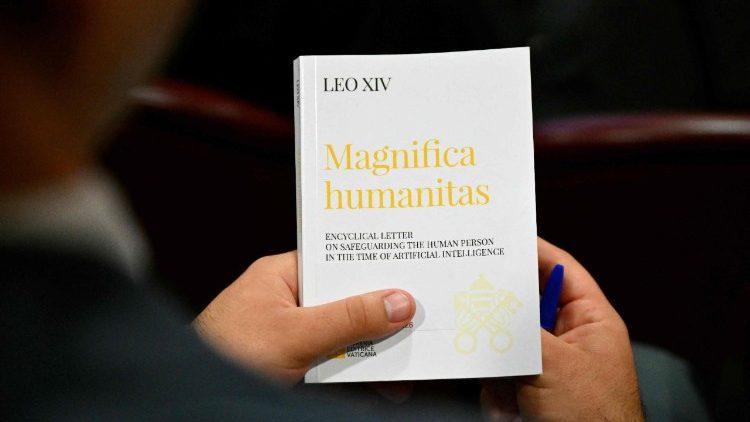
Ten days later, on May 25, 2026, Leo XIV personally attended the press conference and officially promulgated to the world the encyclical titled "Magnifica Humanitas." This is the first time in the history of the Catholic Church that an encyclical has been issued with artificial intelligence as the core topic. At the press conference, besides cardinals and theology professors, there was also Chris Olah, the co - founder of Anthropic.
(Image source: Vatican News)
Many people just find it absurd. AI is science, and the Church is theology. Although the two schools have their own moral concerns, they never seem to be on the same page. Asking the Vatican to talk about algorithms is like asking a meteorological bureau to judge philosophy; they are completely irrelevant.
However, after carefully reading the encyclical "Magnifica Humanitas," Leikeji found that this time the Vatican did not interpret AI from a lofty "God" perspective. Instead, it more realistically discussed topics such as war, employment, education, medical care, and public decision - making that the public has difficulty delving into. We extracted ten core views from it to see what the Pope said and what it means.
The ten views of the encyclical hit people's greatest anxieties about AI
The full text of "Magnifica Humanitas" exceeds 40,000 words, covering war, employment, education, medical care, information, and public decision - making. It has almost gone through all current AI disputes. However, in essence, it is not a technical document but a moral checklist. It doesn't tell you how to train a model but asks: Who is AI serving? Who is responsible? Who is left behind? We extracted ten views most directly relevant to the domestic reality from the encyclical and conducted a detailed interpretation.
1. AI is not the enemy, but it has entered the daily decision - making system
Technology itself is not the enemy of humanity, but emerging technologies have been embedded in daily life and begun to influence the decision - making process and social imagination.
As Pope Leo XIV wrote, he doesn't want to label AI as a "dangerous technology." Instead, he is describing a change that has already occurred: AI is no longer just a tool but is gradually becoming an environment.
In the past, you had to actively open a software to use a certain technology; now, many AI decisions are made in the background, and users may not even know that they have been judged by the system. In China, short - video platforms use algorithms to determine content distribution, e - commerce platforms use algorithms to determine product rankings, recruitment platforms do job matching, office software summarizes meetings and generates documents, and education platforms correct homework and analyze students' learning situations. Ordinary people think they are just occasionally asking large models, but the real change is that AI has intervened before you make a choice.

(Image source: Leikeji's graphic)
Many people may still be thinking or "resisting" the wave of artificial intelligence by not using AI themselves, but in fact, large AI models have penetrated deeply into our lives, and almost no one can truly escape.
2. The AI problem is not just about supervision, but about who holds the technological power
The problem is not limited to supervision. Many key entities driving technological development today are private institutions with transnational capabilities and huge resources.
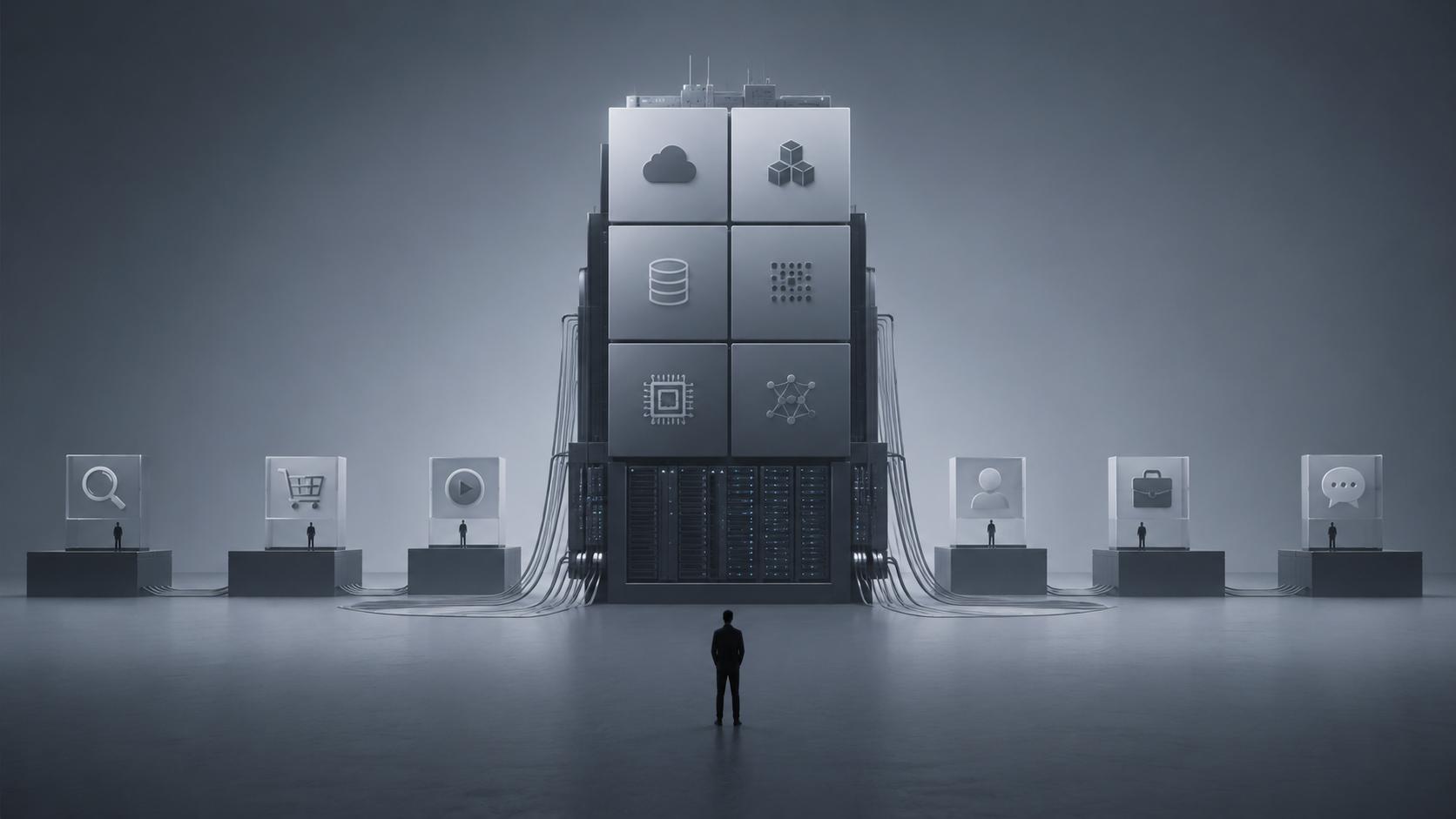
Many AI discussions stop at "whether to supervise," but the encyclical goes deeper: Who exactly holds the technological power? I think this view is the sharpest one mentioned in the more than 40,000 - word encyclical and a question that almost the entire industry has difficulty answering perfectly.
In the AI era, power comes not only from model parameters but also from computing power, data, cloud platforms, entrances, and workflows. For example, Baidu has search and intelligent cloud, Alibaba has cloud and Tongyi system, Tencent has WeChat, Enterprise WeChat, and office collaboration, ByteDance has content distribution and Feishu, and DingTalk and WPS are also embedding AI into enterprise processes. For a small and medium - sized enterprise to develop an AI application, it often cannot avoid API, cloud services, model authorization, and platform rules.
(Image source: Leikeji's graphic)
In my opinion, the competition in the AI industry is superficially about model capabilities, but at the bottom, it is about the control of infrastructure. Whoever can integrate AI into office, search, content, transaction, and enterprise management processes is not just selling tools but reshaping the next - generation digital infrastructure. So this is where the question of "whom to supervise" is really difficult to answer.
3. AI is powerful, but even developers cannot fully explain it
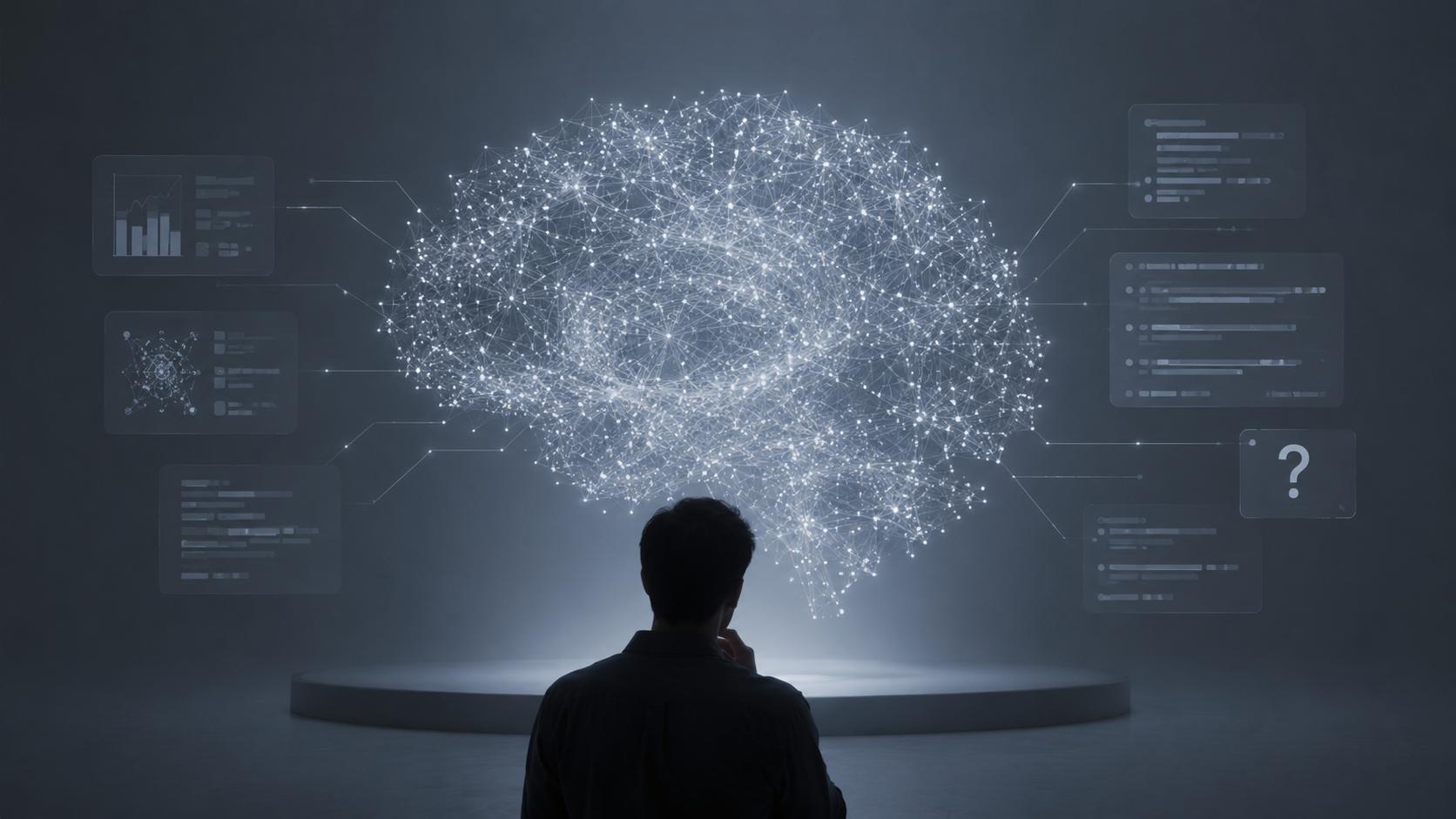
AI offers many amazing possibilities, but even designers have limited understanding of the internal operating mechanism of generative AI systems.
In the past year, domestic enterprises' attitude towards large models has changed from "must adopt AI" to "which links can be safely entrusted to AI." Customer service, marketing copywriting, meeting minutes, code assistance, and knowledge - base Q&A are relatively easy to implement because the cost of errors is controllable and it is convenient for manual modification. However, it's different for financial risk control, medical diagnosis, legal review, and government services. In these scenarios, AI not only needs to give an apparently correct answer but also explain the basis, keep logs, support audits, and allow manual takeover when necessary.
(Image source: Leikeji's graphic)
Now, when many enterprises purchase AI products, they not only look at the model's strength but also at data isolation, permission systems, private deployment, and audit - tracking capabilities. This change shows one thing: The next threshold for enterprise - level AI is not whether it can generate but whether it can be responsible. The more an AI model seems like an expert, the more users need to know when it may be unreliable.
4. AI cannot be regarded as human intelligence, let alone a moral subject
AI is not just a bunch of data but a subject with freedom, relationships, and moral responsibilities.
Now, many AI products are trying to be "more human - like." They can comfort, act coquettishly, remember preferences, and maintain long - term relationships with users. CCTV reported a reminder from the Jiangsu Provincial Consumer Protection Committee that AI companions pose risks such as privacy leakage, consumption traps, and emotional dependence. Xin Kuai Bao also reported that on platforms like "Xingye" and "Maoxiang," young people pay to buy the "exclusive right" to virtual lovers, and after popular characters are bought out, other users experience collective "heartbreak."

(Image source: Leikeji's graphic)
This actually shows that users are not just buying a piece of code but investing real emotions. AI companionship can be provided, as it does meet the needs of loneliness and companionship, but the product must clearly define the boundaries. AI can simulate relationships but cannot bear the responsibilities in real relationships. This is not just moral preaching but a boundary that should be seriously considered at the product - design level, especially when targeting minors, the elderly, and people with emotional vulnerabilities.
5. AI decisions are affecting employment, medical care, welfare, and justice
Sensitive decisions such as employment, welfare, justice, and medical care may be affected by data systems. Therefore, there must be transparent mechanisms, accountability mechanisms, and manual supervision.
Recruitment is the scenario where ordinary people can most easily feel the pressure of AI - based decisions. Yicai reported that BOSS Zhipin is testing the full - link AI recruitment agent "DeepHire," which covers AI resume polishing, automatic resume submission, batch resume parsing on the enterprise side, automatic replies, and intelligent interview invitations. The entry of AI into the recruitment process can certainly improve efficiency. HRs are no longer overwhelmed by a large number of resumes, and job seekers can better present their experiences. However, the problem is that if resumes are first parsed, scored, and ranked by AI in batches, job seekers may be filtered out by the system before being seen by real people.
In my opinion, AI can assist in screening, but job seekers should not face a completely opaque rejection. At least when it comes to affecting employment and interview opportunities, the platform should retain manual judgment, AI - generated identification, and necessary appeal channels. This is not to restrict AI but to leave a door for those rejected by the system. The same problem also exists in decisions about beneficiaries of welfare institutions and judicial determinations of illegal acts.
6. The moral AI defined by a few is not enough; AI resources should serve the common good
If moral standards are only defined by a few, then a more moral AI is still not enough. Data, knowledge, science, and technology should serve the common good.
The publicization of AI does not require all models to be free, nor does it exclude commercial companies. Instead, it means that the right to define, use, and benefit from AI should not be overly concentrated, which is similar to the long - discussed issue of model openness and closed - source.
Models such as Tongyi Qianwen and DeepSeek are continuously opening up some of their capabilities. Local intelligent computing centers and the core nodes of the National Supercomputing Internet are also emphasizing inclusive computing power and an open - source model ecosystem. Abroad, there is a national AI research resource program like NAIRR, aiming to provide computing power, data, and model resources to universities, research institutions, and small and medium - sized teams.
I think that if only a few companies can train models, access computing power, and master high - quality data, while ordinary entrepreneurs, small and medium - sized enterprises, and university teams can only develop peripheral applications, AI will create a new digital divide. A truly healthy AI ecosystem should allow more people to participate, rather than just waiting for large companies to open up a few interfaces. In fact, China's current AI environment is relatively more open, and companies like Alibaba and DeepSeek are providing help to universities and small and medium - sized enterprises.
7. Truth is a public good, and AI will amplify false information and cognitive manipulation
False information is not something new brought by AI, but AI will make false information more large - scale, more persuasive, and more difficult to distinguish from real information.
This is actually an old - fashioned problem. In the final analysis, it's not about whether AI will have hallucinations, but that the cost of using AI to create fakes has become very low.
CCTV reported that some people used AI to fabricate a false news story about a cruise ship capsizing in Yichang, Hubei, and accompanied it with false AI - processed pictures. In Dali, Yunnan, there were online rumors fabricated using AI about a traffic accident scene. After an earthquake in Kuqa, Xinjiang, some self - media used AI to generate pictures and audio - visual materials that did not match the real disaster situation and spread false information such as "houses collapsed." Pictures, videos, and so - called on - site descriptions can all be generated together, making it more difficult for ordinary people to distinguish.

(Image source: Leikeji's graphic)
The state has issued the "Measures for Identifying Artificially Generated and Synthesized Content," requiring the identification of generated and synthesized content, and platforms are also improving their ability to detect fakes. However, I think this is not the end. In the AI era, what is truly scarce is not content but trustworthy content. The more content there is, the more important the source becomes.
8. AI education should not only teach tool use but also retain the ability to question and judge
AI education cannot be simplified to technical training. Schools should still cultivate the ability to question, build relationships, and think critically.
In this regard, China is actually at the forefront of the world. For example, in 2025, the Ministry of Education issued the "Guidelines for General AI Education in Primary and Secondary Schools" and the "Guidelines for the Use of Generative AI by Primary and Secondary School Students." The former emphasizes a hierarchical and progressive general AI education system, and the latter clarifies the usage specifications and safety boundaries for each school stage.
However, if AI education only teaches students to write prompts and let the model give answers, it will not cultivate the ability to thrive in an intelligent society but rather create more skilled dependence. Now, students use AI to write essays, solve problems, and make PPTs, and teachers use AI to generate teaching plans, test questions, and comments. Although efficiency has improved, the thinking process may have been compressed.
So I also agree with the view in the encyclical that AI in the education scenario should be a tool, not a ghostwriter. Truly good AI education is not about allowing students to get answers faster but about enabling them to ask better questions, verify, compare, and express. That is to say, the process of learning to think is more important than learning how to let AI directly provide solutions.
9. AI will reshape labor, but work is not just about efficiency
AI can improve productivity by taking over daily repetitive tasks, but work is also an important place for people to develop their abilities and participate in society.
Currently, global enterprises have a unified attitude towards AI deployment, which is "cost - reduction and efficiency - improvement." This has become a common approach in almost all industries. However, the question is whether AI is enhancing people or replacing them, which has always been the reason for people's anxiety about AI. If AI - assisted office work only allows employees to complete reports and meeting minutes faster