From PC to AI: A Battle Lenovo China Must Fight
In the era of AI, the "gold content" of enterprise-level services is gradually replacing "PC shipments" as another anchor for Lenovo's valuation.
On May 26th, Lenovo Group's shares in the Hong Kong stock market soared by more than 12% during intraday trading, reaching HK$17.66, hitting a record high. Its total market value quickly exceeded HK$200 billion and approached HK$220 billion. In the previous trading day, it rose by nearly 20%.
Behind the capital market's enthusiastic response is Lenovo Group's impressive financial report in recent years, especially in the enterprise AI service market.
According to the data for the fiscal year 2025/2026 (from April 2025 to March 2026) and the fourth fiscal quarter, Lenovo Group's annual revenue reached 589.9 billion yuan, a year-on-year increase of 20.3%. The adjusted net profit was 14.55 billion yuan, a year-on-year surge of 42.1%, twice the growth rate of revenue.
Among them, the revenue of ISG (Infrastructure Solutions Group) increased by 37% year-on-year, and it achieved full-year profitability. SSG (Solutions & Services Group) maintained double-digit growth for 20 consecutive quarters. Its annual revenue exceeded 71 billion yuan, and the operating profit margin remained stable at a high level of 22.4%.
Behind the best financial report in history is that Lenovo has achieved a non-PC revenue share approaching "half of the market" in the Chinese market, completing the "structural transformation" earlier than the group as a whole.
Liu Jun, Executive Vice President of Lenovo Group and President of Lenovo China, disclosed in an internal email that in the previous fiscal year, Lenovo China's AI-related revenue soared by more than 140% year-on-year, accounting for 32% of the total revenue. AI has become the absolute core growth engine for Lenovo China.
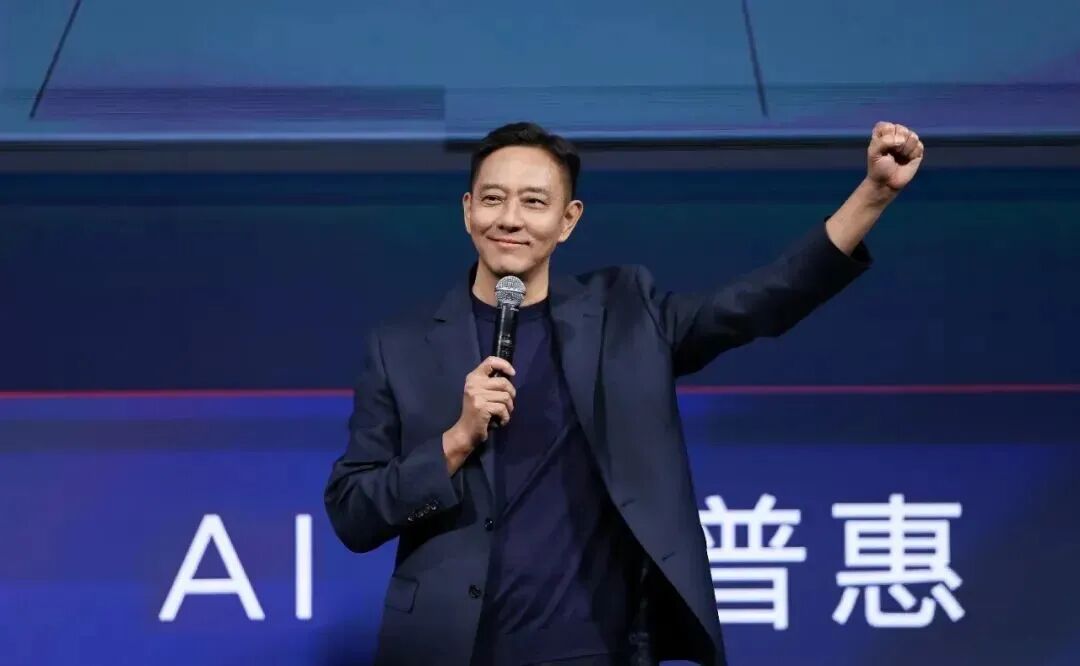
Liu Jun, Executive Vice President of Lenovo Group and President of Lenovo China
This means that Lenovo China is no longer a traditional PC manufacturer but a company with enterprise-level AI services as its core growth engine. The sharp rise in the stock price also sends a clear signal that Lenovo's transformation story is being revalued.
In fact, since 2017, from the initial 3S transformation, to building the core engine of cloud-native and mid-platform, to proposing the full-stack AI strategic layout, and then to establishing the hybrid AI strategy to accelerate China's intelligent transformation, Lenovo China's transformation has taken nearly a decade.
In the past two years, with the explosion of the intelligent agent track, AI applications have gradually shifted from "trial use" on the consumer side to "rigid demand" on the enterprise side. China's AI industry is moving from rapid development to take-off.
Liu Jun previously said that the usage rate of intelligent agents by Chinese consumers has doubled from 23% to 47%. More importantly, the adoption rate of enterprise intelligent agents has soared from 30% to 88% in one year. This obviously brings greater opportunities to the enterprise-level AI service market.
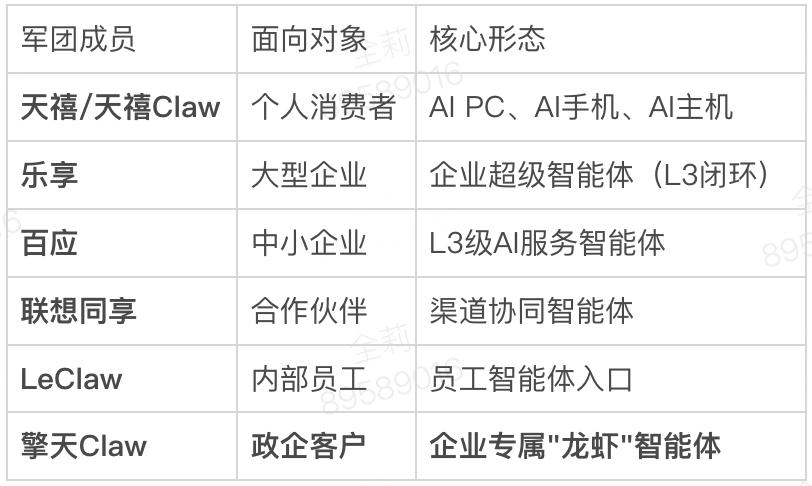
Therefore, since 2024, Lenovo China has intensively launched various intelligent agent products, forming a complete matrix for individuals, enterprises, and the ecosystem, including LeXiang Intelligent Agent, BaiYing Intelligent Agent, QingTian Claw, TianXi/TianXi Claw, Lenovo TongXiang, etc.
In essence, it upgrades AI from a "single tool" to an "organizational organ". Each intelligent agent is a "digital employee" that can operate independently and collaborate with others. The ultimate goal is to enable every enterprise to have its own "silicon-based team".
At the same time, in April this year, Lenovo China also released products such as the Token Factory and the enterprise-level LongXiaHu solution. It is trying to use "tokens" as a new unit of measurement to turn enterprise IT services into productive commodities that can be subscribed to, measured, and replicated on a large scale.
However, how is the actual implementation of this intelligent agent army in the enterprise market? Will the enterprise-level market really pay for Lenovo China's shift from selling computers to selling AI?
Mixed Fortunes of ISG and SSG Behind the Strongest Financial Report in History
It is well known in the industry that Lenovo started with PCs and has ranked first in the global PC market for decades. In the past four decades, Lenovo's business has essentially been "priced per unit". It makes money by selling one computer and one server at a time.
However, the ceiling of this model is clearly visible. The competition in the PC market has shifted from incremental competition to stock involution. Price wars have compressed profit margins. Although AI PCs have brought a wave of replacement, it is essentially a cyclical opportunity and cannot support long-term growth.
Therefore, Liu Jun's judgment is straightforward: Lenovo China must complete a structural transformation - from a hardware sales company relying on PCs to a full-stack AI service provider centered on services and solutions.
From the financial report, although IDG (Intelligent Devices Group) remains the basic business, ISG + SSG together contribute nearly 35% of the revenue and a higher proportion of the increment. Obviously, Lenovo has gradually transformed from a "PC manufacturer" to an "AI infrastructure + solution provider".
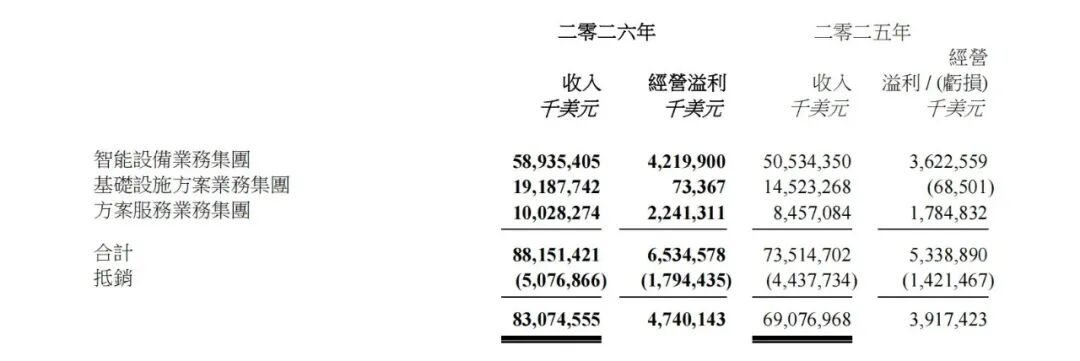
The two business groups, ISG and SSG, are also the key for Lenovo China in the enterprise-level service market. One is the underlying AI computing infrastructure, and the other is the provider of industry solutions and intelligent agent applications.
However, behind this outstanding report card, the two business groups, ISG and SSG, have shown completely different development trends. One has just climbed out of the quagmire of losses but has a worrying profit margin, while the other has achieved continuous high-quality growth but is facing an invisible scale ceiling.
On the one hand, ISG successfully turned losses into profits. In the fourth fiscal quarter, it recorded a revenue of US$5.6 billion (a year-on-year increase of 37%) and an operating profit of US$202 million, achieving the best single-quarter performance in history.
In the past two years, ISG had suffered losses due to large upfront investments in AI servers and low gross profit margins. Now that it has turned a profit, it shows that Lenovo has passed the stage of "losing money to gain market share" and has established a profitable model.
The problem is that its annual operating profit margin is only 0.4% (US$73 million in profit / US$19.2 billion in revenue). Even in the fourth quarter, the profit margin is only about 3.6%, which is in sharp contrast to industry benchmarks.
In the fiscal year 2026 (ending in January 2026), Dell's infrastructure department (ISG) had an annual revenue of US$60.8 billion and an operating profit of US$7.1 billion, with an operating profit margin of about 11.7%. Even in quarters when the profit margin was under pressure, it remained in the range of 8.8% - 10.3%.
Lenovo's ISG profit margin is less than one-third of Dell's, and even less than half of Dell's worst profit margin period.
What's more serious is the market share. According to IDC data, in the global server market in Q4 2025, Dell ranked first among OEMs with a 10.0% share, followed by Supermicro with 9.3%. Lenovo and Inspur tied at about 4.0%, and HPE had only 3.1%. The ODM direct sales model accounted for 53.2% of the overall market.
This means that although Lenovo's ISG has benefited from the explosion of AI servers, it mainly operates at the lower end of the value chain - the "assembly and delivery" stage. Its profit turnaround mainly relies on the scale effect and the revenue expansion brought by the explosion of AI demand, rather than real pricing power or technological barriers. Once the growth rate of AI server demand slows down or competition intensifies, its extremely low profit margin will put it at risk of losses again.
Compared with the ISG business, SSG has seemingly become the new profit "cow" of Lenovo Group.
In terms of growth rate, SSG has performed excellently. The global IT service market was about US$1.9 trillion in 2025 and is expected to reach about US$2.08 trillion in 2026, with a compound growth rate of about 9.7%. Lenovo's SSG growth rate of 19% is about twice the industry average, and its operating profit margin of over 22% far exceeds that of traditional IT service providers.
The problem lies in the absolute scale. The revenue of US$10 billion only accounts for 12% of the total revenue of US$83.1 billion. Its influence within the group is far less than that of IDG (US$58.9 billion, accounting for 71%) and ISG (US$19.2 billion, accounting for 23%).
More importantly, SSG's high profit margin is based on Lenovo's large hardware installation volume (Lenovo's cumulative PC sales have reached 1.1 billion units), which is a "hardware-bound service". Once the PC market declines again or enterprise IT budgets shrink, SSG's growth resilience will be tested.
Overall, Lenovo's financial report for the fiscal year 2025/26 is a "milestone in transformation". ISG's profit turnaround proves the feasibility of the infrastructure business, SSG's continuous high profit verifies the service-oriented direction, and the one-third share of AI revenue shows the effectiveness of the structural transformation.
However, this financial report is more like a report card that is "above the passing line but below the excellent line".
ISG's profit margin has not reached the industry safety line, and its server market share is still in the second echelon. SSG's high profit cannot make up for its scale shortage, and the group as a whole still relies too heavily on the PC business.
Yang Yuanqing, Chairman and CEO of Lenovo Group, has set the goal of achieving US$100 billion in revenue within two years. If ISG cannot increase its profit margin to over 5% and SSG cannot exceed the scale of US$15 billion, this may just be another "scale-first" adventure.
How Well is Lenovo Doing with Its Intelligent Agent Army in the Market?
In 2025, regarded as the "Year of Super Intelligent Agents", tech giants such as Microsoft and Alibaba Cloud have laid out intelligent agent ecosystems, competing for the right to define the "intelligent agent entrance". The implementation of intelligent agents in real enterprise scenarios has also become a battleground for all.
In the same year, Liu Jun officially proposed the concept of the intelligent agent army, also known as the "silicon-based team", which consists of one super intelligent agent and multiple professional intelligent agents in different fields. They collaborate to complete complex tasks and implement the "human-AI co-creation" model.
In this silicon-based team, the so-called one super intelligent agent is divided into two categories:
One is on the personal side, mainly the TianXi Intelligent Agent, which is the core of the "one body with multiple terminals" for C-end users and the "AI brain" of AI PCs, mobile phones, and tablets.
The other is on the enterprise side, mainly the LeXiang Intelligent Agent, which is the core brain and unified entrance of the intelligent agent army. It is responsible for understanding intentions, planning tasks, and scheduling and commanding intelligent agents in various fields (marketing, sales, service, supply chain, R & D, etc.).
In April this year, at the oath-taking meeting for the fiscal year 2026/2027 of Lenovo Group, Liu Jun announced that in addition to the original Lenovo LeXiang, the intelligent agent army has added two new super entrances, Lenovo TongXiang and LeClaw.
Among them, Lenovo TongXiang specializes in external cooperation, making it more time-saving and labor-saving for channel partners to negotiate and place orders, and improving business efficiency. LeClaw is mainly responsible for internal operations, taking over daily chores such as approvals and data inquiries for employees, and making overall office work more efficient.
Together with the original LeXiang, Lenovo has formed three super intelligent agent products on the enterprise side: "LeXiang + TongXiang + LeClaw".
It is worth mentioning that these three super intelligent agent products are mainly targeted at general scenarios of large enterprises. For small and medium-sized enterprises and government and enterprise markets, Lenovo has two other intelligent agent products.
Among them, Lenovo BaiYing Intelligent Agent is an AaaS (Intelligent Agent as a Service) platform for small and medium-sized enterprises (SMBs), delivered through a subscription model. For the government and enterprise market, Lenovo has launched QingTian Claw, which is positioned as the first enterprise-specific lobster in the industry.
QingTian Claw is not a new species independent of the army but a deep implementation form of the army in the enterprise-level market, especially in the government and enterprise track. It forms a high, medium, and low full-coverage echelon with LeXiang (general scenarios for large enterprises) and BaiYing (inclusive for small and medium-sized enterprises).
So, how is this intelligent agent army doing in the enterprise-level market?
In the current situation where artificial intelligence is moving from technological showmanship to in-depth industrial development, Lenovo China's intelligent agent army is essentially a differentiated breakthrough that deeply integrates manufacturing operation experience with AI. It doesn't sell models but "operation processes that it has used and verified to be effective".
Take the LeXiang Super Intelligent Agent as an example. It has created an economic benefit of 1.89 billion yuan within Lenovo China, replaced 400 customer service seats, and achieved an ROI of 255%. These are not POC results from the laboratory but real business operation results.
This "zero customer" model gives Lenovo China a trust asset that competitors can hardly replicate in B2B sales. When others are still talking about what AI can do, Lenovo China can directly show how much money AI has saved for itself.
More importantly, the R & D, production, sales, supply, and service Skills library encapsulated by QingTian Claw is essentially the productization of the organizational know-how of a global manufacturing enterprise with an annual revenue of nearly 600 billion yuan and a presence in over 180 countries. This is a barrier that pure technology companies cannot obtain in the short term, no matter how much computing power they invest.
However, based on the current information, Lenovo China's enterprise intelligent agent army is mainly verified internally and lacks more external industry benchmark cases.
Compared with other competitors, the external implementation of intelligent agents disclosed by Lenovo China is mainly concentrated in:
- Smart cities (Wuyishan, Yichang) - government projects, and their replicability is affected by regional policies;
- A retail customer (BaiYing) - a single case, lacking systematic disclosure of industry horizontal expansion;
- Manufacturing (cooperation with LingYang Industrial Internet) - details are not disclosed.
Liu Jun proposed that in the new fiscal year, Lenovo China will deeply cultivate five