2026 Report on the Trend of "Domestic IP Co-branding"
IP co-branding is evolving from a hot topic in the content industry to a crucial KPI in brand commercial competition. In this transformation, the most notable trend is the comprehensive rise of domestic ACGN IPs.
A decade ago, the industry's vision of creating IPs and profiting from IP content itself has now become a tangible reality through thousands of co-branding collaborations each year and over fifty commercial cases during peak seasons per week. IP co-branding has evolved from sporadic marketing events to an operational symbol for brand periodic iteration.
It can be said that currently, the most intuitive standard for measuring an IP's popularity is which brands it collaborates with, how much sales it generates, and how many fans vote with their money. When evaluating a brand's market sensitivity, the most direct indicator is whether it can accurately capture popular IPs, quickly convert traffic into sales through high-quality execution, and further build a brand moat. IP co-branding is a three-way pursuit where IP owners, brands, and consumers each get what they want and enjoy the process.

Reliable Second Dimension (WeChat ID: kpACGN) has been continuously monitoring the second dimension trend consumption. Through multiple trend reports, we have witnessed the reshaping of the consumer market by emotional value. We believe that the pan-second dimension consumption can support an industry worth hundreds of billions, and "IP +" will indirectly drive a consumer market worth trillions. As the "Three Pits" (Lolita, JK uniforms, Hanfu), trendy toys, trading cards, and merchandise economies have transitioned from niche fads to regular consumption, the market focus has collectively shifted to the IP licensing industry, which has higher entry barriers, a wider influence scope, and greater commercial potential. Undoubtedly, IP co-branding will be the most certain growth story in the content and consumption fields in the next two years.
However, for many industry practitioners, IP co-branding remains a familiar yet unfamiliar concept. We have witnessed its popularity in offline settings in first and second-tier cities and participated in discussions on relevant hot searches on social media platforms. But when it comes to cross-border implementation, we still don't know where to start. What kind of industrial logic lies behind this rapidly rising prosperity? And what are the replicable successful paths?
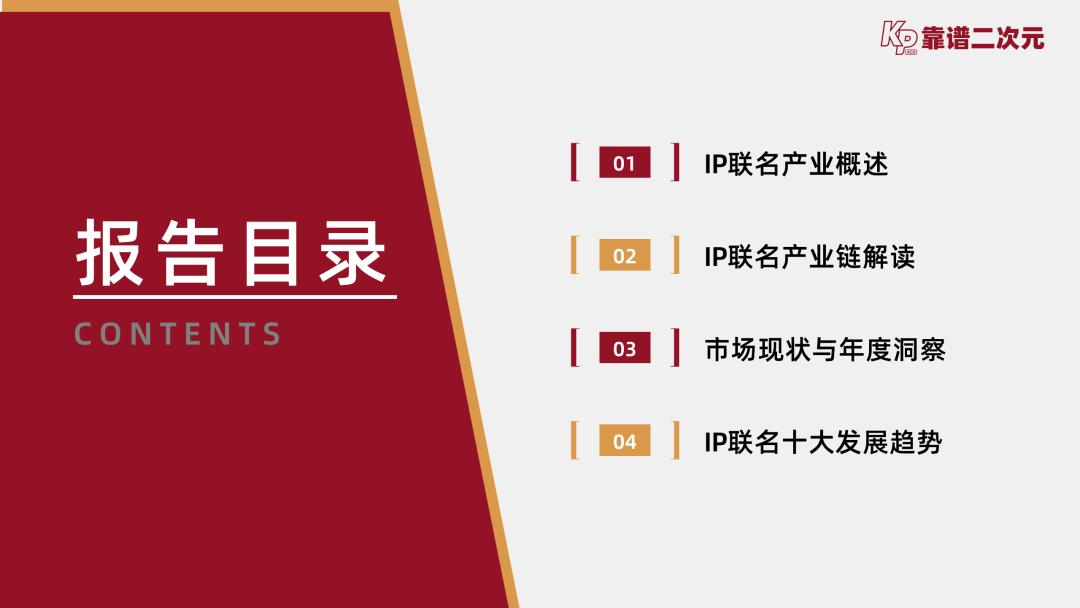
In May 2026, Reliable Second Dimension (WeChat ID: kpACGN) attempted to systematically sort out the development logic of the current domestic IP licensing industry and produced this 2026 "Domestic IP Co-branding" Trend Report. This report will start with a macro overview of the industry and an in-depth interpretation of the industrial chain, combined with an analysis of the market situation. It will focus on dissecting a case library of 100 representative domestic ACGN IPs and 100 consumer brands that love to engage in IP co-branding, and finally distill insights into the development trends of domestic IP co-branding in the next two years.
We hope that through this report, we can help IP industry practitioners and enthusiasts better grasp this opportunity closely related to "real money," find specific commercial entry points, and enable more IPs to achieve a self-sufficient positive cycle from "content to business." At the same time, we also aim to assist more brands in deeply understanding the huge commercial potential contained in ACGN IPs and exploring more new possibilities for cross-border win-win cooperation in the future.
Note: The scope of IPs discussed in this article is limited to domestic ACGN IPs, excluding live-action and film-related IPs. This article does not contain any commercial implants, so please read with confidence.
Overview of the "IP Co-branding" Industry
IP licensing refers to a commercial cooperation model in which the IP owner licenses the rights to its image, name, design, etc. to another party through a contract and charges a licensing fee. Its forms cover digital products, physical products, themed spaces, content adaptation, etc.
IP co-branding specifically refers to the cooperation between two or more brands or IPs from different fields, focusing on short-term or project-based collaborations to jointly launch co-branded products or carry out co-branded marketing activities. Its essence is to create a market explosion in a short period through cross-border co-creation, achieve mutual traffic attraction and brand rejuvenation, and ultimately achieve the effect of "1 + 1 > 2."
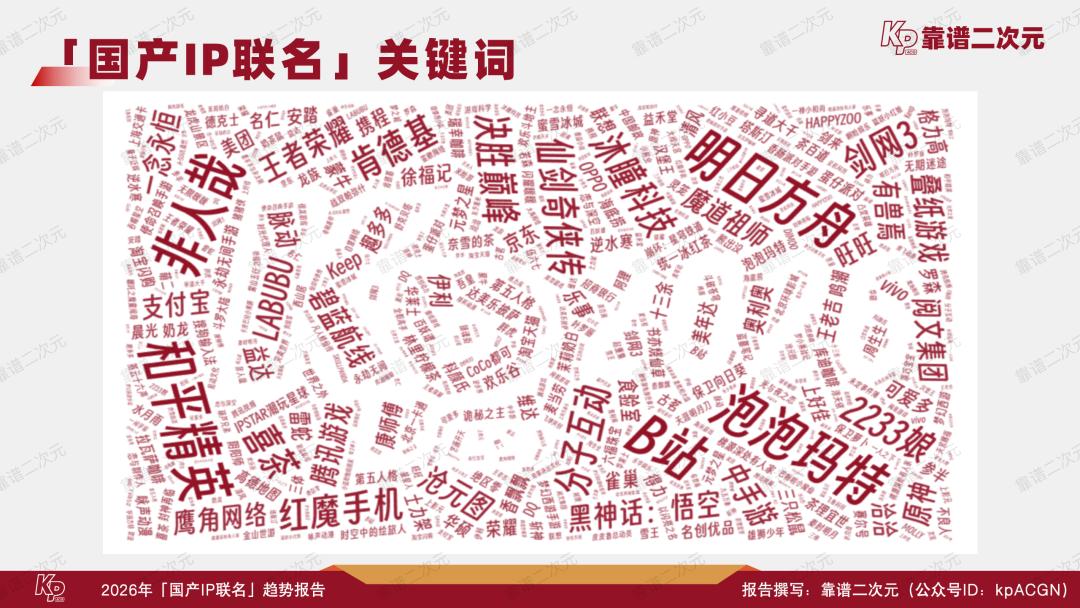
All IP co-branding is essentially an IP licensing cooperation. However, not all IP licensing activities are presented in the form of co-branding. The IP co-branding focused on in this report is the most active and commercially promising form in the current IP licensing industry.
In the past three years, co-branding activities around domestic ACGN IPs have developed rapidly and matured. Especially from 2025 to 2026, IP co-branding has gradually become normalized, continuously contributing to industry hotspots, and has become a compulsory course for content operation and brand marketing. Its forms have become increasingly diverse, integrating online and offline channels, covering various IPs and consumer brands, and successfully reaching consumers of all ages who are willing to pay for them.
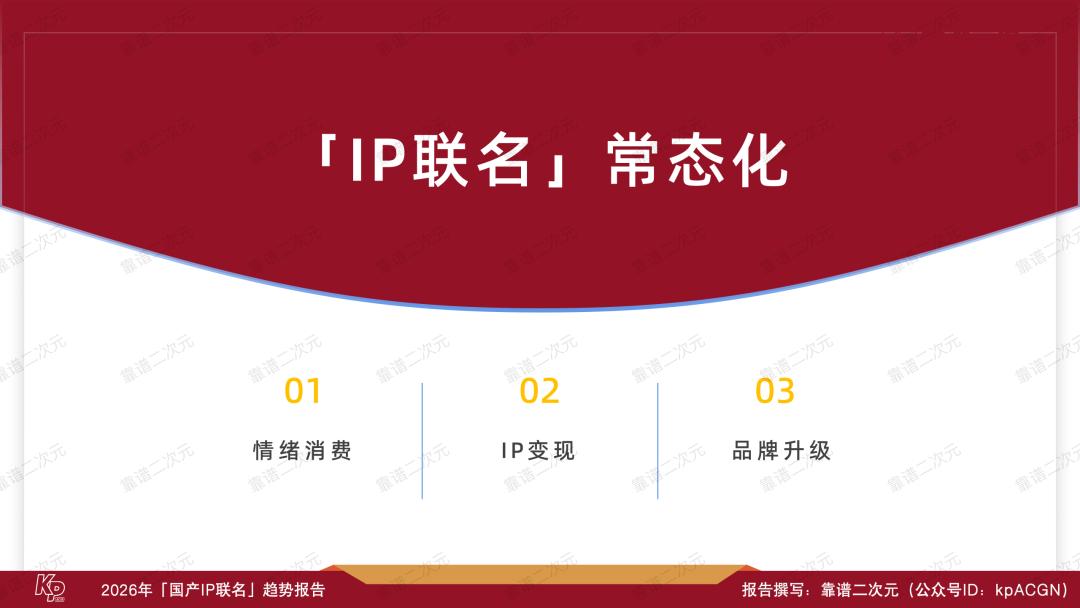
The popularity of IP co-branding is the result of market demand. When emotional consumption becomes a topic of common concern in the mass consumer market, products that can provide emotional value to consumers are more likely to receive positive feedback from the market. Combining ACGN IP images with traditional products can not only create a sense of freshness but also meet the needs for personalization and emotional identification. This makes IP co-branding one of the most direct and efficient ways to meet emotional consumption.
For the content industry, IP monetization has been a long-standing problem. Collaborating with brands to achieve cross-border influence and commercial returns has been the path that domestic IP copyright holders have been continuously exploring in the past decade. In recent years, domestic IPs represented by "Black Myth: Wukong," "Ne Zha: Reborn," LABUBU, and "Honor of Kings" have successfully broken through, breaking the deadlock in monetization and making IP co-branding a recognized new generation of business growth opportunities.
For brands, to embrace the youth trend and meet the demand for emotional value consumption, collaborating with IP owners is a must. IP co-branding has gradually evolved from an early marketing gimmick to a regular means of brand strategy and product innovation. Its operation is moving towards professionalism and scale, driving the growth of the entire licensing market.
IP licensing and IP co-branding are not entirely new concepts. Their cooperation models and execution logics are similar to those of traditional derivative product development and celebrity endorsements. Looking at the global market, overseas IP co-branding is also common. The difference is that this time, the market focus has shifted to domestic ACGN IPs. With the rapid rise of China's pan-second dimension content industry, domestic IP co-branding is receiving unprecedented attention and possibilities, and is redefining the cross-border business story of Chinese culture.
Interpretation of the "IP Co-branding" Industrial Chain
The implementation of IP co-branding activities depends on the collaborative cooperation of multiple parties in the industrial chain.
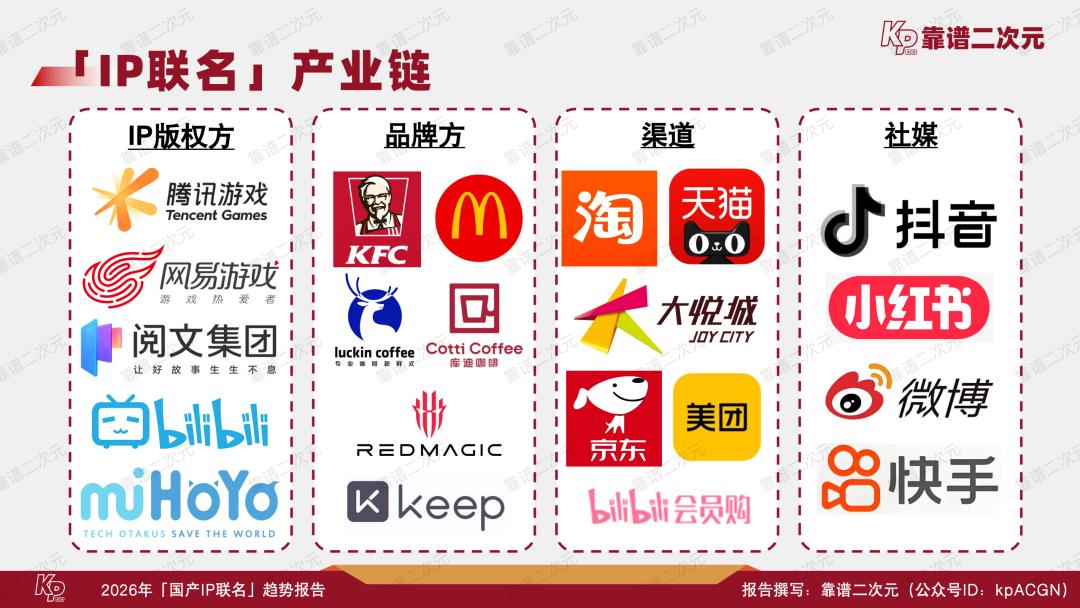
IP owners, also known as licensors, provide the IP resources required for co-branding. Representative companies include Tencent Games, NetEase Games, miHoYo, and Yuewen Group.
Brands, as licensees, are responsible for integrating IPs with their own products, completing design, production, and implementation. Representative companies include KFC, McDonald's, Luckin Coffee, Master Kong, and Alipay.
Channel providers are mainly responsible for the marketing and sales of co-branded products. Usually, the marketing and sales channels are led by brands, and IP owners also participate in promotion and conduct a small amount of distribution. The promotion is mainly online, including official social media accounts, KOL marketing accounts, and IP content advertising implants.
The sales channels are divided into two major categories: online and offline. Online channels mainly include official e-commerce platform stores, agent stores, and live-streaming e-commerce stores. Offline channels cover various distribution channels, themed stores, pop-up events, etc.
Social media is the iconic communication channel for IP co-branding. IP owners, brands, and channel providers use social media to call on target consumers to participate in IP co-branding consumption and obtain market feedback and communicate more with consumers through social media.
Based on over 500 co-branding cases in the past decade, we have selected 100 domestic ACGN IPs that are currently the most valuable for cooperation and most representative. According to this Top 100 Domestic IP List, we have summarized that the currently outstanding IPs mainly have the following characteristics.
The top 100 IPs mainly come from five categories: games, animations, comics, novels, and image IPs. Among them, games account for the highest proportion, and there are more co-branding cases with first-tier brands. Among animation, comic, and novel IPs, those widely recognized by brands are mostly top original works or IPs with the ability to develop multi-form content derivatives. That is, novel IPs that have undergone comic and animation adaptations are the most favored, which is also basically consistent with the top pattern of the domestic comic content industry. Although the total number of image IPs is not large, there are frequent phenomenon-level hot cases, mainly from the fields of trendy toys, emoticons, and short videos. Such IPs generally have strong operational capabilities.
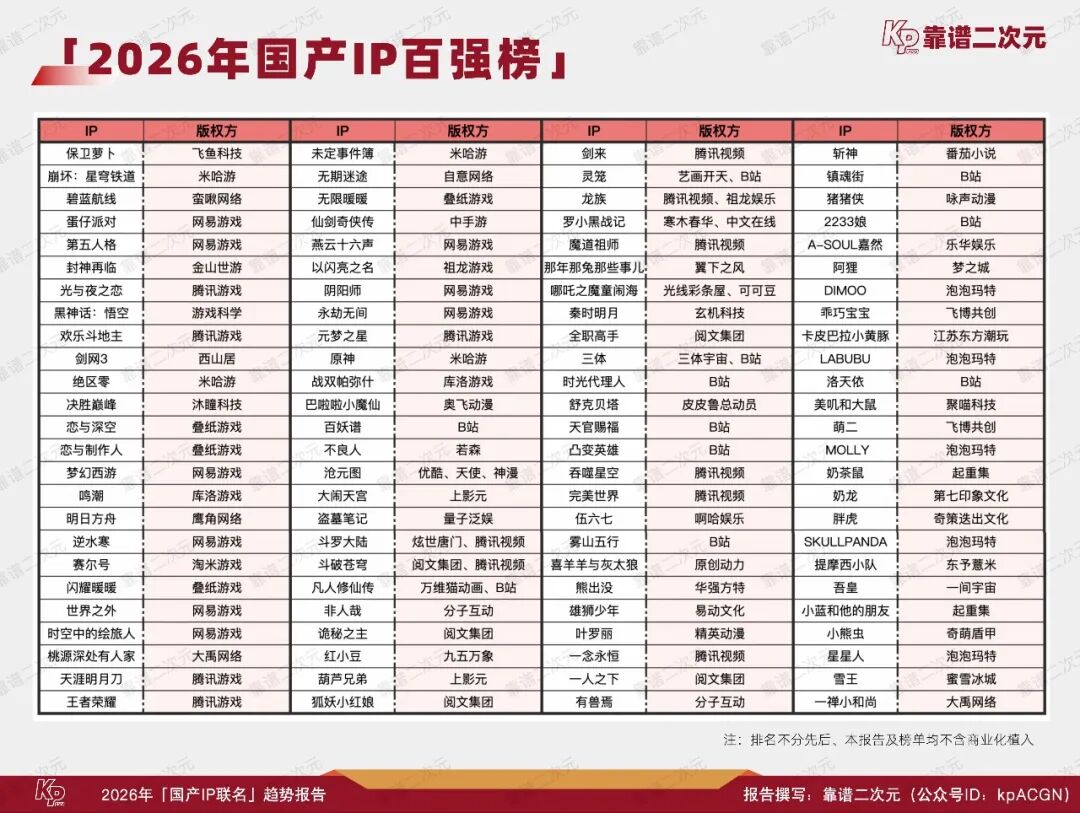
You can click to jump to the detailed version of the Top 100 IP List: Top 100 Domestic Second Dimension IPs in 2025
There are three mainstream types of top 100 IPs: popular phenomenon-level national hotspots, such as "Ne Zha: Reborn," "Black Myth: Wukong," and LABUBU; national IPs with a wide fan base and long popularity, such as "Honor of Kings," "Havoc in Heaven," and "Happy Dou Di Zhu"; leading IPs in niche fields with strong fan purchasing power, such as "Love and Producer: Deep Space," "Heaven Official's Blessing," and "Fairy Tale of the Unusual."
Successful IPs have many common characteristics: First, they have gone through time, content, and user precipitation. More than 90% of IPs have a life cycle of more than 5 years or even 10 years. New IPs have difficulty in carrying out co-branding cooperation in the short term, unless they have a strong producer with sufficient resources, or a high-level rating + market business preference + packaged cooperation with classic IPs.
Second, high-quality IPs have high recognition and strong symbolization. Rather than co-branding works, it is more about co-branding popular characters. At least, there should be iconic props. IP co-branding especially emphasizes the symbolic extraction of content to facilitate the transformation from visual to physical products. IPs with indistinguishable works, rough art, and unobvious personality characteristics, even if they have a certain level of popularity, will have difficulty in completing co-branding cooperation smoothly. Even the production of basic IP manuals can be a problem. Excellent IP co-branding cases rely on high-quality customized design, and the simple sticker mode will soon be eliminated.
Most importantly, IP co-branding depends on the promotion of mature copyright holders. At present, to do a good job in IP co-branding, it is likely to require a strong, resourceful, and experienced copyright holder to lead and promote. For example, game IPs are concentrated in manufacturers with multiple hit games, such as Tencent, NetEase, miHoYo, Hypergryph, and Papergames; anime and online literature IPs rely more on platform providers, such as Bilibili, Tencent Video, Youku, iQiyi, and Yuewen Group; image IPs are often found in copyright holders with massive professional IP operation capabilities, such as Pop Mart, Qizhongji, Dayu Network, and Seventh Impression Culture. IP co-branding requires a lot of capital and resource investment from brands. A strong copyright holder can complete resource docking, communication and coordination, and product supervision and repair more efficiently.
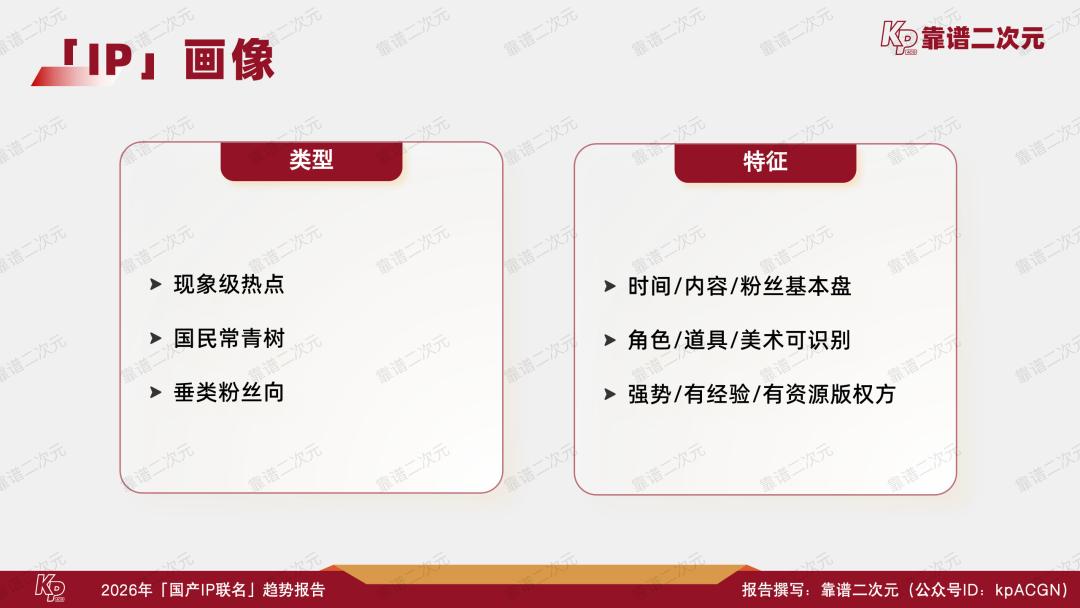
Specifically in the implementation stage, there are three main influencing factors for brands to choose IP cooperation: First is popularity and reputation. Everyone wants to pursue hot IPs because traffic means sales. Second is the preference of decision-makers. At present, there is a large information gap between brands and IP owners in the industry. They do not have a deep understanding of each other's industrial operation models. The common psychology is "like = understand = easy to operate." Except for a very small number of top IPs, the cooperation of most IPs still depends on first impressions. Another important influencing factor is the herd mentality. Brands will naturally give priority to cooperating with IPs that have successful cases, positive reviews, and strong sales on the Internet. This can quickly match needs, reduce cooperation risks, and improve cooperation efficiency.
We changed our perspective and started from the brand side. Among more than 200 popular brands that have carried out IP co-branding, we selected 100 brands that have more than three co-branding experiences with domestic ACGN IPs to form the Top 100 Brands List.
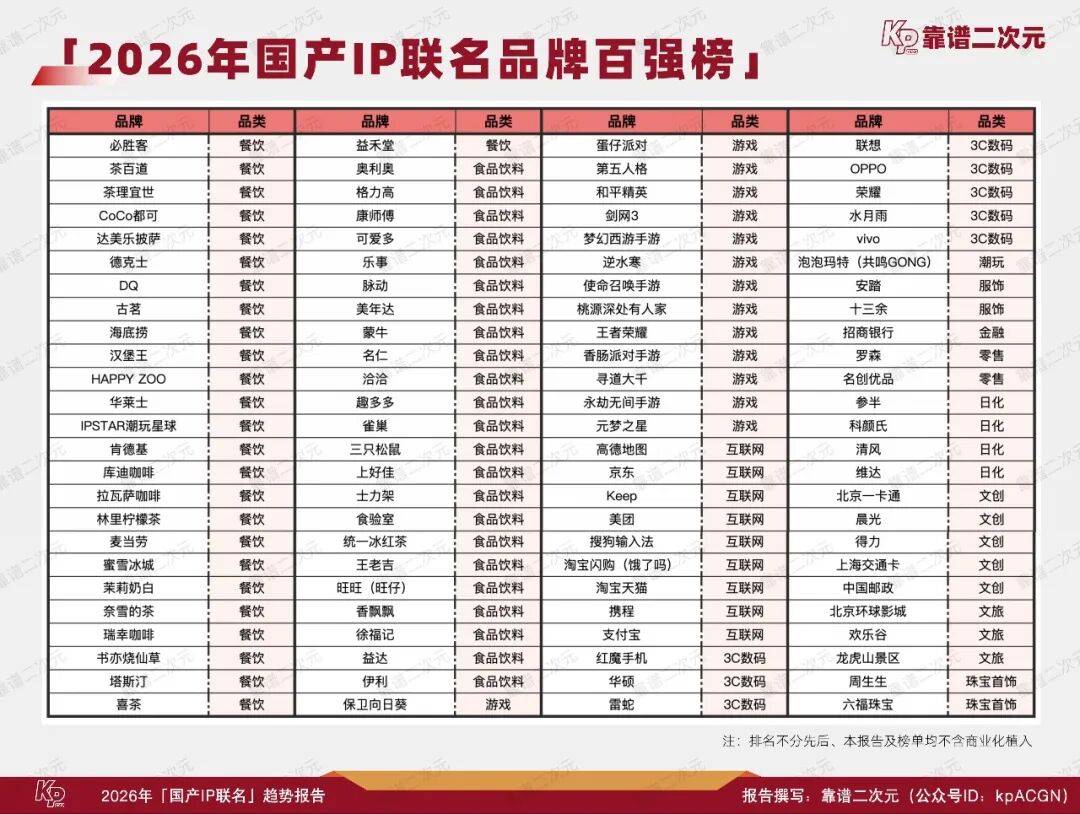
You can click to jump to the detailed version of the Top 100 Brands List: A Review of 100 Brands That Love "IP Co-branding"
There are certain characteristics in the industry distribution of these brands, which is slightly different from the relevant review we did four years ago. First, the catering industry has grown significantly and has become the most enthusiastic field for co-branding, mainly including fast food, new tea drinks, and coffee, such as Luckin Coffee, Cotti Coffee