Samsung union approves new pay package with an average bonus of 2.7 million yuan per person
After months of negotiations between labor and management at Samsung Electronics, a landmark profit-sharing agreement has finally been reached.
On Wednesday, May 27, the Samsung Electronics labor union approved a compensation agreement with a 73.7% vote in favor.
According to the plan, approximately 78,000 employees in the semiconductor division will receive 10.5% of the company's annual operating profit as stock bonuses, plus an additional 1.5% in cash bonuses, with a duration of up to ten years.
Based on the forecast of Samsung's 2026 operating profit of 327 trillion won (approximately $217 billion) by KB Securities, the average bonus per employee in the memory chip division is expected to reach approximately 600 million won (approximately $400,000 or 2.7 million yuan).
However, employees in non-chip businesses such as smartphones and home appliances can only receive approximately 6 million won (approximately $4,000) under the current bonus structure, a hundred times less than that of memory chip employees.
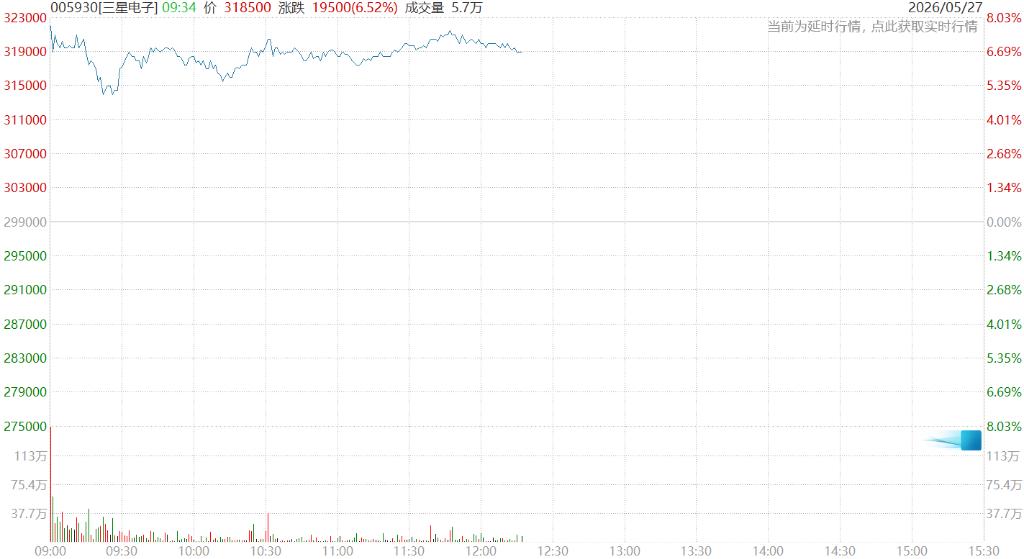
After the news of the compensation agreement was passed, Samsung Electronics' stock price rose by more than 6% on the same day.
Voting completed as scheduled, with an average of $400,000 (2.7 million yuan) per employee in the memory chip division
The Samsung Electronics Labor Union (SELU), which led the negotiations, had a total of 57,290 valid voting members, with an estimated 80% to 90% from the semiconductor division, which fundamentally determined the outcome of the vote. The final vote was approved with a 73.7% support rate.
The core terms of the agreement stipulate that 10.5% of the operating profit of Samsung's semiconductor division will be distributed in the form of stocks. The additional condition is that the division must achieve an annual operating profit of no less than 200 trillion won (approximately $132 billion) between 2026 and 2028, and no less than 100 trillion won (approximately $66 billion) from 2029 to 2035.
Based on the forecast of Samsung's 2026 operating profit of approximately 331 trillion won, the average bonus per semiconductor employee across the company is approximately 509 trillion won (approximately $370,000).
However, the distribution of bonuses among different business units varies significantly:
Employees in the memory chip division can receive approximately 600 million won per person, approximately $400,000;
Employees in the wafer foundry and Logic chip design (LSI) division, which is currently in the red, are expected to receive approximately 150 million to 200 million won, approximately $100,000 to $130,000.
Approximately 40% of the bonus pool will be evenly distributed among semiconductor employees, while the remaining 60% will be distributed according to the performance of each business unit.
Before the official approval of the agreement, it faced a legal hurdle. According to The Korea Herald, five employees from Samsung's Device eXperience (DX) division filed an injunction with the Suwon District Court to halt the union's vote, arguing that the DX division was unfairly excluded from the voting.
The court rejected the application on Tuesday, clearing the last obstacle for the vote.
Non-chip employees, the other side under the same roof
The agreement basically maintains the status quo for employees in Samsung's Device eXperience (DX) division, who are responsible for smartphones, TVs, and home appliances. Their bonuses are approximately 6 million won (approximately $4,000), nearly a hundred times less than that of memory chip employees.
According to the Financial Times, citing people familiar with the matter, Samsung's Device eXperience (DX) division is under pressure from Chinese competitors, and its profitability has been weakening. Meanwhile, the rising prices of the chips it purchases directly benefit the semiconductor division, putting it in a difficult situation.
The National Samsung Electronics Union (NSEU), which represents all Samsung employees (with approximately 20,000 members), opposed the agreement and participated in the vote against it. Woo Ha-kyung, the acting chairman of the union, publicly stated:
We admit that we failed to formulate an effective positive strategy to prevent the DX division from being treated differently. When the semiconductor business was in trouble, it was the smartphone and home appliance businesses that generated revenue and helped support the growth of the semiconductor division.
Lee Ho-seok, an official of the NSEU, also said that some wafer foundry employees within Samsung's chip division were also dissatisfied with the terms of the agreement.
Threat of shareholder lawsuits and impact on production lines
The legal risks have not dissipated.
A group of individual shareholders called the "Korean Shareholder Action Headquarters" has issued a lawsuit warning, arguing that the profit-linked bonus scheme is essentially a distribution of company funds and requires the approval of the general shareholders' meeting according to Korean commercial law.
Last week, the group held a rally near the Seoul residence of Samsung Electronics Chairman Lee Jae-yong, claiming that they would use all available legal means to stop the bonus distribution.
The internal dissatisfaction caused by the uneven bonus distribution has had a real impact on Samsung's key businesses.
According to reports, there has been a deliberate slowdown in production in Samsung's chip packaging division, directly affecting the delivery schedule of high-bandwidth memory (HBM).
In response, Samsung Electronics CEO Kwon Oh-hyun called on employees to put aside their disputes and get back on track in an internal memo.
Industry background: Profit competition in the era of the AI boom
Behind this agreement is the boom cycle in the memory chip industry driven by AI demand.
Samsung recently became the first Korean company to exceed a market value of $1 trillion. SK Hynix also joined this club on Wednesday, and the market value of US chip manufacturer Micron exceeded $1 trillion at the close on Tuesday.
According to the Financial Times, this agreement is similar to the one reached by SK Hynix last year.
SK Hynix workers have also been promised to receive 10% of the operating profit as dividends in the next ten years. Based on the expected operating profit of 250 trillion won, the average bonus per employee for SK Hynix's 35,000 employees is expected to reach 710 million won.
For Samsung, this agreement has ended the threat of strikes and stabilized the core semiconductor workforce. However, the intensified internal contradictions and the pending shareholder lawsuits will still be challenges that the management must continue to face in the game of AI dividend distribution.
This article does not constitute personal investment advice and does not represent the views of the platform. The market is risky, and investment should be made with caution. Please make independent judgments and decisions.
This article is from the WeChat official account "Wall Street Insights", written by Bao Yilong, and published by 36Kr with authorization.