The trillion-dollar feast for memory sellers, and the halved profits for memory buyers.
Two things happened simultaneously on the evening of May 26th.
Xiaomi released its financial report for the first quarter of 2026. The total revenue was 99.1 billion yuan, a year-on-year decrease of 10.9%; the adjusted net profit was 6.07 billion yuan, a year-on-year plunge of 43.1%. The revenue from the mobile phone business was 44.3 billion yuan, a year-on-year decline of 12.5%, and the gross profit margin dropped to 10.1%, a decrease of 2.3 percentage points compared with the same period last year.
At the earnings conference call, Lu Weibing, the president of Xiaomi Group, mentioned a figure: the price of memory of the same version soared nearly four times compared with the same period last year. For a mobile phone with a configuration of 12GB LPDDR5 + 512GB UFS, the memory cost alone increased by about 1,500 yuan. He said that Xiaomi "will not pass on the increased memory cost to consumers", but at the same time, he also predicted that the price increase cycle would continue until 2027 or even 2028. In order to survive, Xiaomi actively cut the entry - level models, and the quarterly shipment volume dropped to 33.8 million units.
The second thing is that Micron Technology soared by more than 19% in a single day, and its market value exceeded 1 trillion US dollars. UBS directly raised Micron's target price from 535 US dollars to 1,625 US dollars, a one - time increase of about 204%, becoming the highest target price among the 46 brokerages covering Micron at present.
A few days ago, Citigroup just raised Micron's target price from 425 US dollars to 840 US dollars, and HSBC also raised it from 750 US dollars to 1,100 US dollars. Wall Street has not seen such a unified opinion on the same cyclical stock for a long time. Micron's stock price was less than 110 US dollars 12 months ago. It has increased by eight times within a year.
On the same day, there was a trillion - dollar carnival for memory sellers, while the profits of memory buyers were halved.
Goldman Sachs played an intriguing role in this carnival. In December 2025, Goldman Sachs gave Micron a neutral rating with a target price of 205 US dollars. In the first quarter of 2026, Goldman Sachs reduced its position in Micron by nearly 20%.
On the day when Micron released its financial report on March 19th, Goldman Sachs raised the target price from 360 US dollars to 400 US dollars but maintained a neutral rating, and at this time, the stock price had far exceeded 400 US dollars. Then Micron soared by 40% in a week, and Goldman Sachs missed the opportunity precisely.
On May 17th, Goldman Sachs issued a report on the storage industry, concluding that "it is the most serious supply shortage in 15 years" and raised the overall rating of the storage industry. However, it still maintained a neutral rating on Micron with a target price of 400 US dollars. Goldman Sachs is an outlier. It is either the last sober person in this carnival or the one who missed the most.
But this strong divergence is also worth serious consideration.
01 Why is it soaring? A new story called LTA?
In the research report of Timothy Arcuri, an analyst at UBS, on May 26th, the core argument is that the Long - Term Agreement (LTA) is fundamentally eliminating the cyclicality of the storage industry.
Storage chips are the most commodity - like products in the semiconductor industry. The prices of DRAM and NAND have followed a cruel rule for forty years: two years of price increase followed by two years of price decline, and price collapses have never been absent. The profits of Micron, Samsung, and SK Hynix are like an electrocardiogram, and the market has never dared to value these companies based on "steady - state earnings". For forty years, the approximate valuation fluctuation range of cyclical stocks has been 8 to 15 times the price - to - earnings ratio.
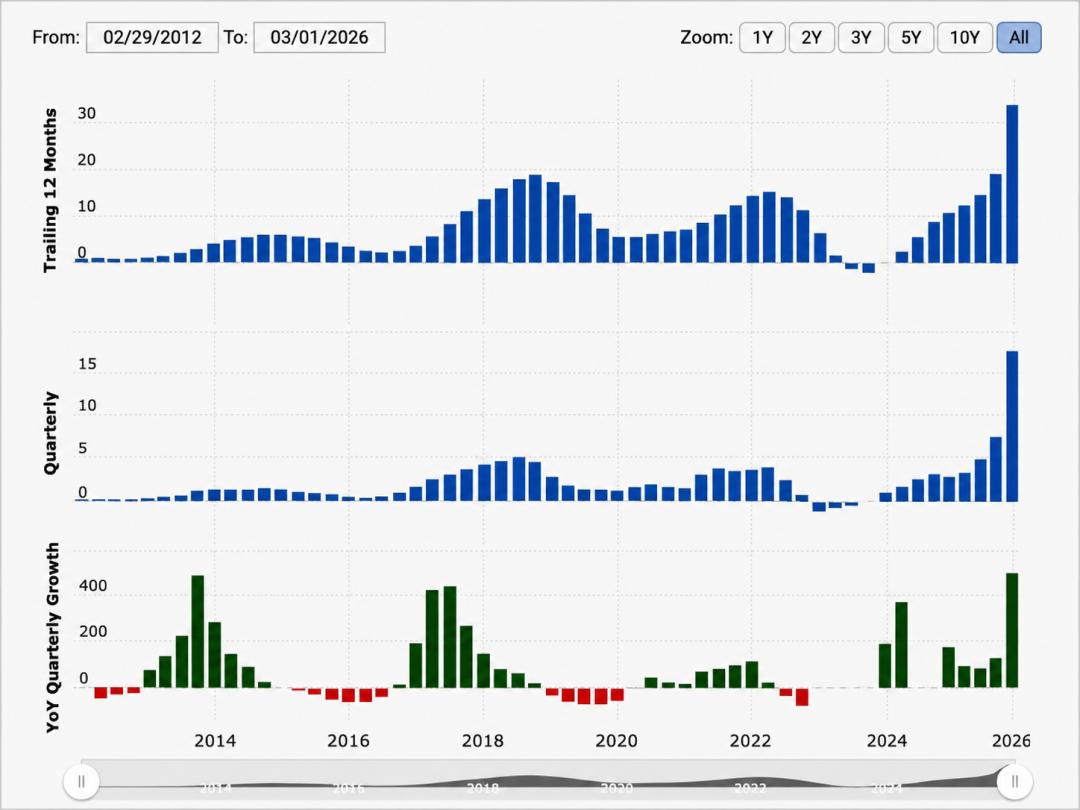
Figure: The electrocardiogram - like fluctuation of Micron's financial data
UBS's story is that the "cyclical curse" of these companies will be broken, and the protagonist behind it is "AI".
Cloud providers such as Microsoft, Google, Amazon, and Meta, in order to lock in the supply of HBM and DDR5 in the AI arms race, have begun to actively sign fixed - price long - term contracts of 3 to 5 years with storage manufacturers, and these contracts come with prepayments. These contracts are not the "intention - based" agreements in the traditional semiconductor industry but are binding procurement commitments that lock in the quantity, price, and even the wafer production capacity.
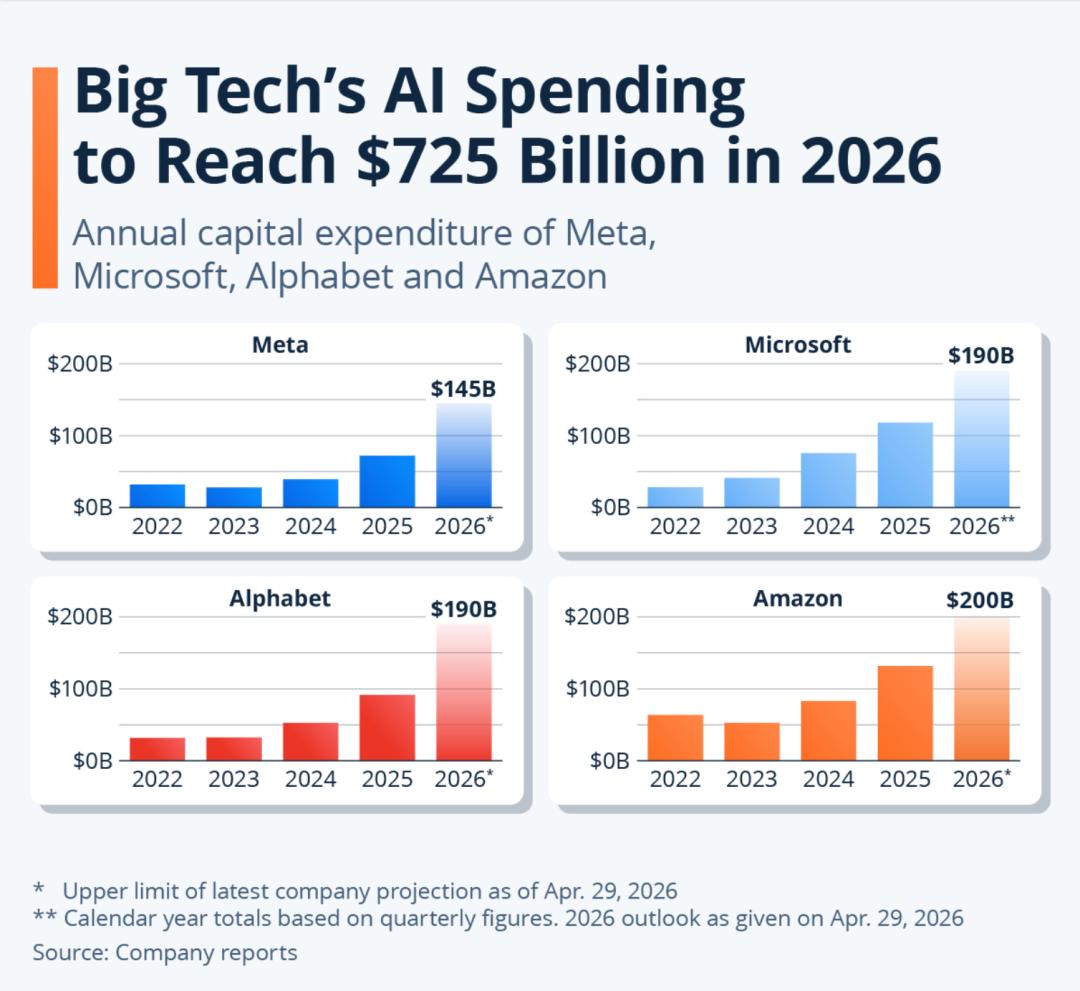
Figure: AI capital expenditure of large - scale technology companies (2022 - 2026E): The total of the four companies is expected to reach 725 billion US dollars in 2026. Individually, Amazon is 200 billion, Microsoft is 190 billion, Alphabet is 190 billion, and Meta is 145 billion US dollars. The 2026 data is the latest upper limit of the guidance of each company as of April 29th. Microsoft's data is the annual total based on quarterly data.
It was reported in April that Microsoft and Google were in talks with SK Hynix about a three - year long - term DRAM contract, which included a prepayment. In the past, manufacturers begged customers to place orders, but now customers pay a deposit to lock in production capacity. The power relationship in the industrial chain has been reversed.
UBS's model calculation shows that if LTA is included in Micron's profit forecast, even if the spot price of DRAM drops by 50% in fiscal year 2029, Micron's annual earnings per share can still remain above 100 US dollars. LTA can narrow the fluctuation range of the DDR price from the peak to the trough of the cycle by about 50%. By 2027, 20% to 30% of the total DDR bit shipments in the entire industry will be locked by fixed - price long - term contracts. Among the DDR5 purchases of leading hyperscalers, 60% to 70% may already be under fixed contracts.
From the perspective of the valuation system, if the cyclicality disappears, storage stocks should not be valued as cyclical stocks but as infrastructure utilities, with the price - to - earnings ratio jumping from 8 to 15 times to 20 to 30 times.
JPMorgan Chase also issued a research report with a similar conclusion in mid - May, with the title directly stating that "LTA is eliminating the cyclicality of the storage industry". Citigroup's logic is that HBM production will squeeze the wafer production capacity of ordinary DRAM, leading to a long - term shortage of general - purpose storage.
Micron's soaring stock price has brought a double - whammy of profit and valuation system switching.
02 This storage is not that storage
Wall Street uses the "storage super - cycle" to tell a unified bull - market narrative. But "storage" and "storage" are completely different.
The storage market in 2026 shows a three - layer differentiation.
The first layer is AI storage: HBM, server DDR5, and enterprise - level SSD. Here, price increases, out - of - stock situations, and long - term contracts locking in production capacity occur simultaneously. TrendForce predicts that in the second quarter of 2026, the contract price of DRAM will increase by 58% to 63% quarter - on - quarter, and the contract price of NAND Flash will increase by 70% to 75%; Kioxia has also publicly stated that its production capacity in 2026 has been basically sold out. This layer is the story behind Micron's trillion - dollar market value.
The second layer is mobile phone and embedded storage: mobile DRAM and mobile NAND. The prices here have also increased sharply. Counterpoint data shows that in the first quarter of 2026, the price of DRAM increased by more than 50% quarter - on - quarter, and the price of NAND Flash increased by more than 90% quarter - on - quarter. A relevant report from TrendForce shows that memory usually accounted for about 10% to 15% of the Bill of Materials (BOM) of mobile phones in the past, but now it has risen to 30% to 40%, and the pressure on low - end models is more obvious.
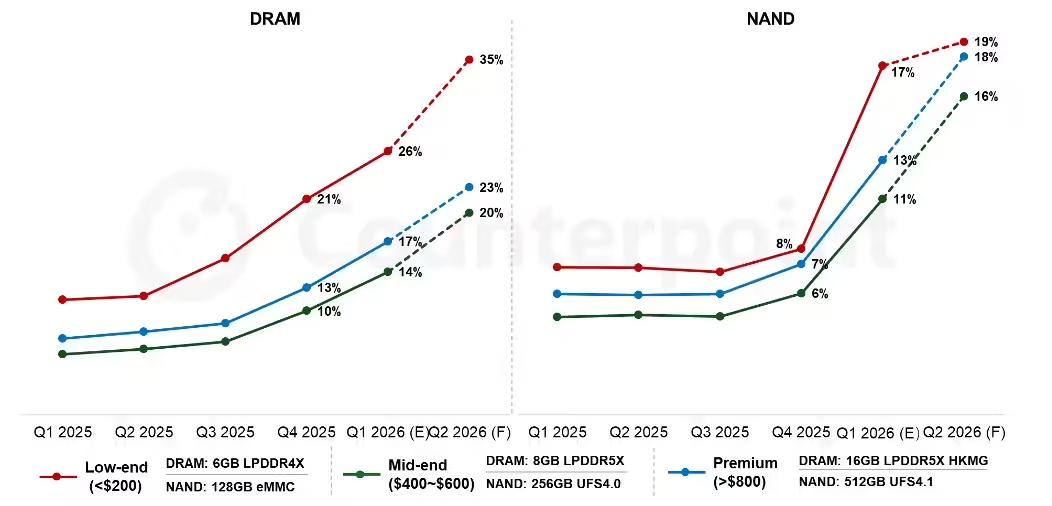
Left chart: DRAM (memory) trend: The price increase of low - end mobile phones is the most significant, rising all the way from the initial low level and is predicted to reach 35% in Q2 2026; that of high - end mobile phones will reach 23%; and that of mid - end mobile phones will reach 20%. The dotted part (after Q1 2026) is the predicted value. Right chart: NAND (flash memory) trend: The prices at all price levels were basically stable in the first three quarters of 2025 but started to rise sharply from Q4 2025.
Xiaomi is in this layer. Its pain is that "AI has taken away the production capacity, leaving less for mobile phones, and mobile phone manufacturers have to pay a higher price for the remaining production capacity".
Original equipment manufacturers give production capacity priority to AI customers, and mobile phone manufacturers have few choices in contract procurement. If you want to ship products, you have to buy at the new contract price; if you don't buy, the production line and new product rhythm will be affected.
The third layer is the PC retail spot market: DDR5 modules and consumer - grade SSDs. Here, there is an opposite - direction fluctuation. A report from TrendForce shows that at the end of March, the price of 32GB DDR5 modules in the Chinese channel dropped by 500 to 1,050 yuan from nearly 3,000 yuan, and the clearance price of some products was as low as 1,950 yuan; Tom's Hardware also reported that the prices of some DDR5 products in the Chinese and overseas retail markets dropped by 25% to 30% from the peak.
But this is mainly due to the split between retail spot and contract procurement. PC channels have inventory and can sell at a discounted price; mobile phone manufacturers purchase according to contracts and have no option to sell at a discounted price.
In the same "storage" industry, the three layers are moving in three different directions. The essence of this differentiation is that the three major storage manufacturers are shifting their wafer production capacity from the consumer - grade to the AI field. HBM production squeezes the wafer production capacity of ordinary DRAM, and enterprise - level SSDs squeeze the supply of consumer - grade NAND, leaving less production capacity for mobile phones and PCs. Mobile phone manufacturers are forced to accept price increases because they have to ship products; PC channels can lower prices and sell at a discounted price because of sufficient inventory.
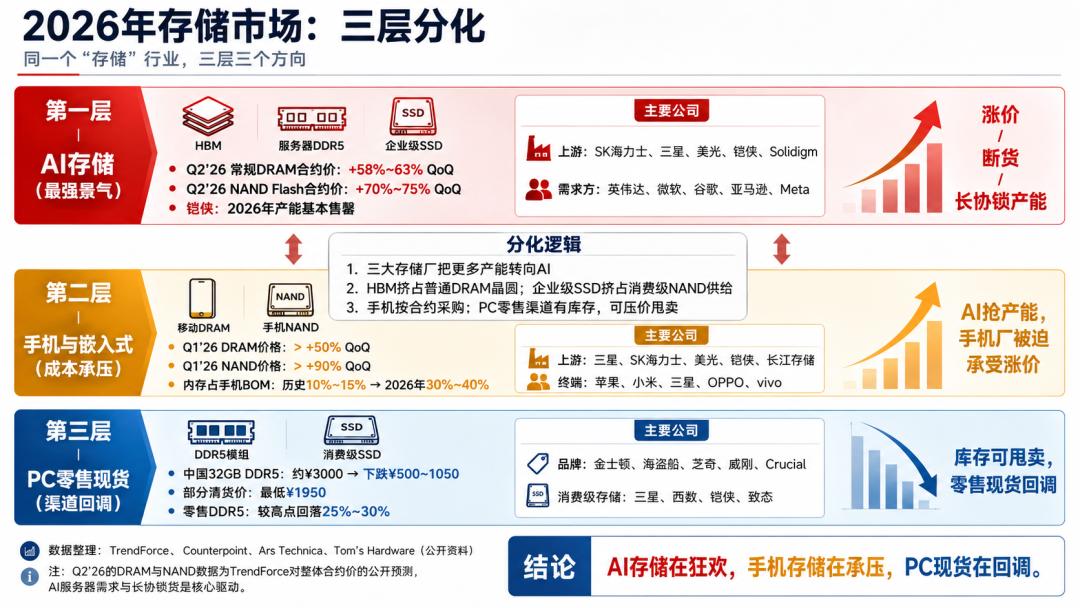
The picture is generated with the assistance of AI
Micron and other companies have actively chosen to give production capacity to AI customers who are more willing to pay. In the short term, this is a beautiful upgrade of the product structure. But it also means that Micron is blocking its retreat. Once the AI demand slows down, it may not be able to smoothly switch the production capacity back.
Micron's financial report shows that on a quarter - on - quarter basis, the DRAM bit shipments only increased by a mid - single - digit percentage, and the NAND bit shipments only increased by a low - single - digit percentage. The growth mainly comes from the increase in the average selling price (ASP). Micron's current story is only about the "extreme shortage in the AI storage segment".
Micron has bet all its chips on this segment.
03 Can long - term contracts really eliminate the cycle?
The logic of long - term contracts seems solid. Given the spending rhythm of AI, the supply elasticity of storage chips is extremely low. It takes 18 to 24 months from the planning to the production of HBM capacity, and HBM production will squeeze the wafer production capacity of general - purpose DRAM. Cloud providers sign long - term contracts because they are worried about "delays in AI projects".
But for long - term contracts to eliminate cyclicality, there is a prerequisite: the demand side does not collapse.
Different institutions have different statistical calibers for AI CapEx, but the direction is the same: AI infrastructure investment is moving from the level of hundreds of billions of US dollars to nearly one trillion US dollars. According to the calculations of some market models, this is a capital expenditure curve with an annualized growth rate of nearly 40% to 50%.
However, there is nothing in the physical world that can grow at a rate of over 40% forever. There is no need for the AI bubble to burst. If the growth rate only drops from 45% to 20%, the supply - demand balance of storage chips may reverse within 18 months. The three storage manufacturers are now expanding their production capacity crazily. Micron's capital expenditure in fiscal year 2026 is 25 billion US dollars, and it will add another 10 billion US dollars in 2027.
There is also one thing that has to be faced: when a company's revenue growth completely depends on price elasticity rather than sales volume elasticity, the story is fragile. Micron's shipments only increased by 4% to 6%, and the 196% revenue growth is mainly due to price increases. Prices can go up and down, and they can fall much faster than they rise. This is also the essence of cyclicality.
Let's do a simple arithmetic problem.
Micron's current market value is 1 trillion US dollars. Micron has increased its capital expenditure in fiscal year 2026 to more than 25 billion US dollars and expects the capital expenditure in fiscal year 2027 to continue to increase significantly. Some market reports mention that the increment may exceed 10 billion US dollars.
Micron's non - GAAP net profit in the second quarter of fiscal year 2026 was about 14 billion US dollars. Simply annualized, it is about 56 billion US dollars, corresponding to a price - to - earnings ratio of about 18 times. If the subsequent price increases and long - term contracts are extrapolated, the price - to - earnings ratio can be calculated to be around 15 times.
It seems to be "cheap". But the denominator of this price - to - earnings ratio is the earnings at the top of a super - cycle when the contract price of DDR4 increased by ten times in 15 months, HBM was sold out throughout the year, and the gross profit margin jumped from 36% to 75%.
Multiplying the earnings at the top of the cycle by a seemingly "reasonable" multiple to get a seemingly "not expensive" valuation is exactly the most classic valuation trap when cyclical stocks