Why is Ganso, a company that used to make money from gift vouchers, facing increasing difficulties?
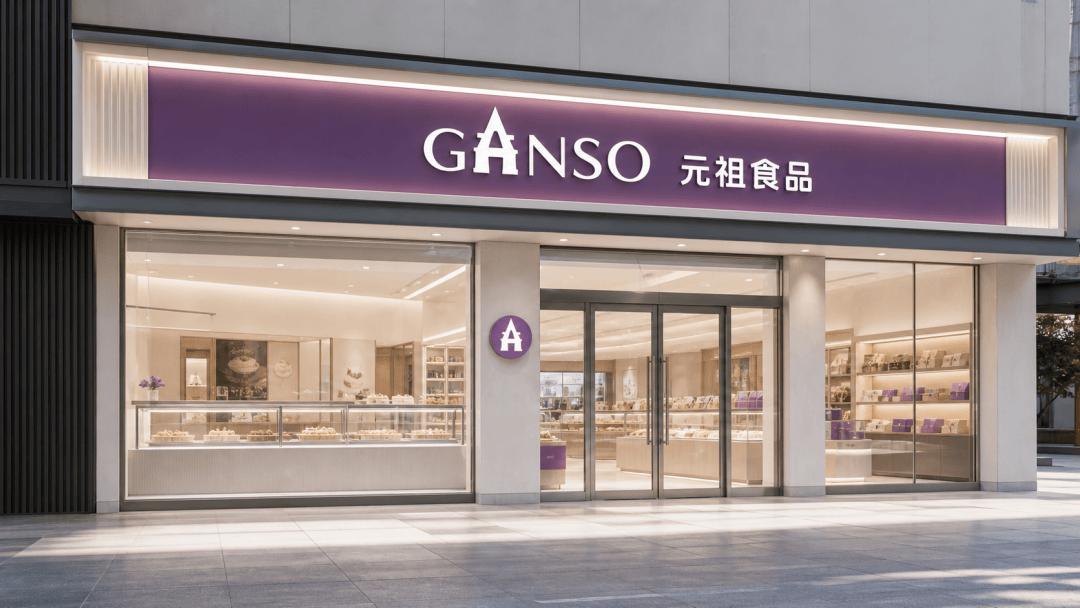
In the Chinese social dictionary, a Ganso gift voucher used to be synonymous with decency. Mooncake vouchers for the Mid - Autumn Festival, zongzi vouchers for the Dragon Boat Festival, and cake vouchers for birthdays. This thin piece of paper bears the weight of social interactions and also the 30 - year business ambition of a company.
The core of the voucher business doesn't lie in the ratio of flour to cream, but in the time - difference game of "collecting money first and redeeming later". Consumers pay several months in advance, and the company occupies the funds interest - free. When it comes to redemption, a significant portion of the liabilities can be offset through losses, forgotten redemptions, and expired vouchers.
However, the financial report for the first quarter of 2026 revealed a cruel truth: the net profit attributable to the parent company suffered a loss of 70.2354 million yuan, a year - on - year plunge of 180.76%. Behind these figures is the credit over - draft of a business model and the downward trajectory of a bakery brand from being a "social currency" to a "redemption trap".
How did gift vouchers turn from a "cost - free business" into a "brand poison"?
Mooncakes, zongzi, and cakes are typical products for seasonal and social consumption. Physical products are perishable and inconvenient to carry, while gift vouchers are light, decent, easy to give as presents, and more suitable for corporate welfare and business exchanges. The person who buys the voucher completes the act of giving a gift, the recipient gets the right of choice, and the company receives the money in advance.
This sets Ganso apart from ordinary bakeries. Ordinary stores wait for customers to come in, while Ganso can sell future consumption rights in advance. Ordinary food is sold for its current taste, while Ganso sells a gift certificate for deferred redemption.
The financial report also proves the importance of this model. At the end of 2025, the "pre - received card and voucher payments" in Ganso's contract liabilities reached as high as 710 million yuan, accounting for 97.1% of the total contract liabilities. This means that on Ganso's balance sheet, more than half of the liabilities are related to pre - received card and voucher payments. This is an "interest - free loan" that doesn't require paying interest and is also the most fatal temptation of the voucher model.
All pre - sale models share a common weakness: they postpone problems but don't eliminate them.
When the vouchers are sold, the company gets the cash. The real test comes later. Are consumers willing to redeem the vouchers? Is it convenient to pick up the goods at the store? Is the product worth the price? Does the experience live up to the face of the gift - giver? These problems won't surface at the moment of selling the vouchers but will emerge during the redemption process.
In recent years, there have been frequent complaints about Ganso's card vouchers, redemption, refund, customer service, and product experience. When consumers' complaints focus on aspects such as "how to redeem the vouchers, whether the goods are worth the price, what to do when the vouchers expire, and how the store explains", it points to the root problem of the voucher business model.
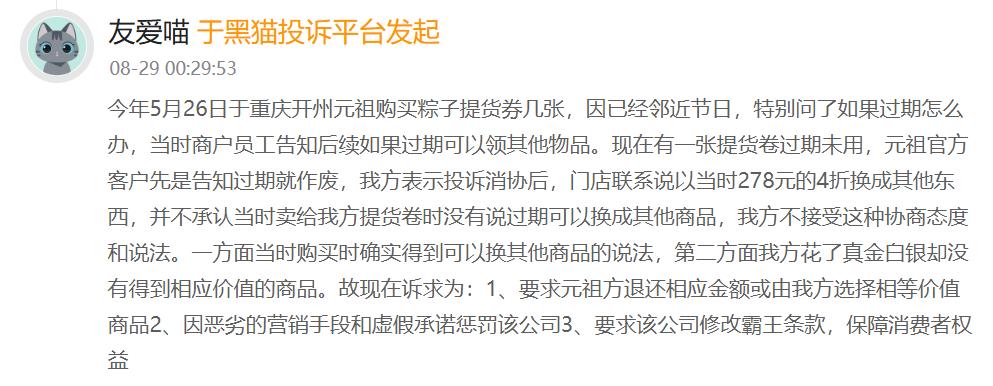
The special feature of gift vouchers is that the gift - giver and the user are often not the same person. The gift - giver pays the money but may not experience the redemption personally. The recipient may be reluctant to question due to social etiquette. This disconnection, which was originally a convenience of the voucher model, may now become a gray area with unclear responsibilities. The company enjoys the pre - collection benefits brought by the "gift - giving scenario" but must also bear the credit cost brought by the redemption experience.
A data point that deserves attention is that at the end of 2025, Ganso's total contract liabilities were 731 million yuan, a decrease from 755 million yuan at the end of 2024. Among them, the pre - received card and voucher payments decreased from 734 million yuan to 710 million yuan, a reduction of about 23.84 million yuan.
This shows that the growth engine of voucher sales is stalling. When consumers' confidence in redemption declines, their willingness to buy vouchers in advance naturally shrinks, and the collapse of the voucher model will directly impact Ganso's most core cash - flow source.
From the redemption crisis to the systematic collapse of the business model
The redemption crisis is never an isolated event. It is the first domino to fall in the collapse of Ganso's underlying business - model logic.
When "giving a gift with face" turns into "redeeming a gift without satisfaction", the slow - selling of vouchers will turn from a possibility into a real threat. Once the cushion of pre - received payments starts to loosen, the real pressure on the company's cash flow will be rapidly magnified.
In 2025, Ganso achieved an operating income of 2.081 billion yuan, a year - on - year decrease of 10.08%. The net profit attributable to the parent company was 140 million yuan, a year - on - year decrease of 43.88%. The non - recurring profit after deduction was 108 million yuan, a year - on - year decrease of 53.48%.
The data directly shows the reality of a simultaneous decline in revenue and profit. Ganso's profitability has been pulled back to the lowest level since its listing.
The deeper problem lies in the rigidity of the cost - expense structure. Although the revenue has declined significantly, the operating costs, selling expenses, and management expenses have not shrunk accordingly. In other words, Ganso's revenue elasticity is getting worse, while the inertia of expenses remains heavy, and the profit margin is being squeezed layer by layer.
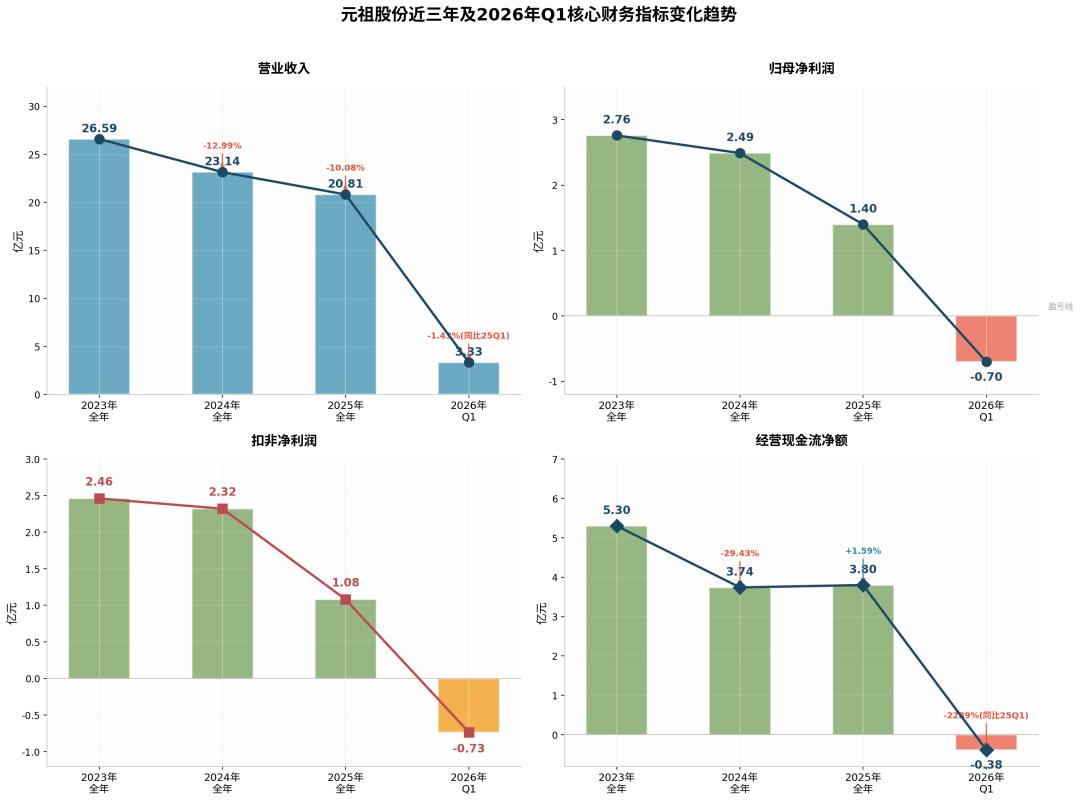
The data for the first quarter of 2026 further confirms this slowdown.
The first quarter is usually the off - season for the bakery industry, but the expansion of the loss to this extent shows that Ganso can hardly rely on the peak seasonal sales to naturally repair the annual performance curve. What's even more striking is that the selling expenses in the first quarter reached as high as 245 million yuan, accounting for about 73.5% of the revenue. This is sufficient to show that the consumption of sales channels such as stores, manpower, distribution channels, and marketing is too heavy, and the efficiency of the channels has seriously deteriorated.
Behind this set of data is a clear "trust - performance" transmission chain: frequent redemption pressure leads to a decline in voucher sales, a decline in voucher sales leads to a shrinkage of pre - received funds, a shrinkage of funds forces the contraction of offline stores, the contraction of stores weakens brand exposure, and ultimately the full - price products also get stuck in the quagmire of slow - selling.
The gift vouchers used to be Ganso's moat that distinguished it from ordinary bakeries. Once this moat starts to dry up, Ganso reveals a more embarrassing situation: the prices are not low, the attractiveness of the stores is declining, and there is a lack of product innovation. The R & D expenses for the whole year of 2025 were 22.56 million yuan, and the R & D expense ratio was only 1.08%. This at least shows that Ganso is not aggressive in making up for the lack of product strength.
The restructuring of the competitive landscape has made Ganso's situation even worse. The bakery sections of membership stores such as Sam's Club and Hema are diverting family - consumption scenarios with cost - effective products. Tea - drink brands such as Nayuki and Heytea are encroaching on the afternoon - tea market. Corporate welfare and business gift - giving are also accelerating the shift to more flexible and transparent digital forms such as JD gift cards and e - gift cards.
At the same time, a generational gap is emerging. Generation Z lacks resonance with the traditional narrative of "giving cake vouchers as gifts". They care more about immediacy, sense of experience, and shareable consumption content. The gift - giving culture that Ganso has cultivated for many years is becoming an outdated, cumbersome, and even uncertain symbol of redemption in the eyes of the new generation of consumers.
Ganso is now caught in a strategic dead - end after being backfired by the voucher model.
The pre - received voucher payments once provided the company with low - cost cash flow. However, when consumers start to doubt the redemption experience and brand credit, actively reducing the use of vouchers will cause pain in revenue and cash flow, while continuing to rely on vouchers will further over - draft trust.
Embarrassingly, although the increase in the proportion of online - channel revenue seems to fill the growth gap, it weakens the offline redemption network on which the voucher model depends. The online transformation and the voucher model no longer complement each other but instead expose Ganso's underlying contradictions.
This contradiction is spreading to the organizational and governance levels. The increase in disputes related to labor contracts, advertising contracts, and unfair competition shows that the pressure is not only at the store level but also invading the company's internal operations. When the external credit is damaged and the internal governance is under pressure, the window period for Ganso to adjust its course is shortening.
A further risk is that if the voucher crisis continues to ferment, stricter supervision of prepaid cards is not a distant possibility. At that time, the "collect money first, redeem later" model that Ganso has relied on for many years may be forced to be re - evaluated.
Even if the supervision is delayed, the loss of brand reputation is enough to rewrite the market pricing: from a national gift - bakery brand to a regional business with limited growth, from a growth narrative to a defensive valuation, and the high - dividend strategy will also lose its persuasiveness as the profit weakens.
Ganso's problem has long gone beyond the decline in taste or product aging and has now evolved into a collapse of the underlying credit of the business model. When gift vouchers turn from a "symbol of decency" to a "risk certificate", the brand premium will be quickly eroded. The warning it leaves for the market is straightforward: all enterprises that rely on pre - received payments cannot treat credit as an asset that can be pawned indefinitely.
This article is from the WeChat official account "Market Value Crystal", author: Market Value Crystal. Republished by 36Kr with permission.