Withstanding the storage cycle and embracing the AI era, Xiaomi's cards have changed.
On May 26, Xiaomi released its financial report for the first quarter of 2026.
In this quarter, Xiaomi's revenue reached 99.1 billion yuan, a year-on-year decrease of 10.9%; the adjusted net profit was 6.1 billion yuan, a year-on-year decrease of 43.1%. The price increase of storage chips has continued for more than a year, and all mobile phone manufacturers are facing cost pressures. Xiaomi is no exception.
However, several data points indicate that Xiaomi has not been disrupted by the cost cycle. In the mobile phone business, the ASP (Average Selling Price) rose to 1,310 yuan, reaching a new historical high. By moving upmarket, Xiaomi mitigated the impact of the storage price increase. In the automotive business, against the backdrop of a significant decline in the industry's sales volume and the discontinuation of the old SU7, 81,000 new cars were delivered. The revenue from automotive and AI-related innovative businesses reached nearly 20 billion yuan, a year-on-year increase of about 7%, and the gross profit margin remained stable at over 20%. The revenue from Internet services was 9.5 billion yuan, a year-on-year increase of 4.3%, and the gross profit margin remained stable at over 76%.
When many people discuss Xiaomi, they tend to focus on the immediate storage price increase and profit fluctuations, while overlooking one point: Xiaomi is now at the intersection of two cycles. One is the storage cycle that will eventually pass, and the other is the AI cycle that has just begun.
The market is good at pricing things that are easy to quantify. However, some changes often require time for the market to adjust its view until the user experience, user habits, and business results gradually emerge. The impact of AI on Xiaomi falls into the latter category.
At the quarterly earnings conference call, Xiaomi's management referred to AI as the biggest incremental opportunity in the mobile phone industry and summarized the direction for the next five years as using AI to connect the entire ecosystem of cars, homes, and mobile devices. Although this may not be immediately reflected in the financial report, it is changing the game for Xiaomi.
The management has demonstrated its confidence in the company's long-term value with real money. CFO Lin Shiwei said at the conference call that the board of directors has launched a share repurchase program with a total value of no more than HK$20 billion. As of the disclosure at the conference call, Xiaomi's cumulative share repurchases in 2026 have exceeded HK$8 billion, more than the total for last year, and the repurchase intensity ranks second among Hong Kong-listed companies.
With this perspective, let's look at this financial report. There are three questions worth exploring: Under cost pressure, has Xiaomi maintained its core business? Have the investments in upmarket positioning, the automotive business, and globalization in the past few years paid off? When the AI cycle arrives, how well-positioned is Xiaomi?
01. Costs have risen, but the rhythm remains steady
Over the past year or so, the price increase of storage chips has been a challenge that all mobile phone manufacturers have to face. DRAM and NAND Flash entered a price increase cycle in the second half of 2024 and remained at a high level in Q1 this year. Storage costs can account for more than 10% of the BOM. Mobile phone manufacturers have limited options: either increase the terminal price and pass the cost on to consumers or absorb the cost themselves. The key is that the mobile phone industry has entered a mature stage, and the user replacement cycle has lengthened. It is difficult for manufacturers to dilute the cost pressure simply by increasing the shipment volume as they did in the early days.
Therefore, the first thing to look at for Xiaomi in this quarter is whether it has maintained its rhythm under pressure.
Judging from the results, Xiaomi has maintained a revenue scale close to 100 billion yuan. The group's revenue reached 99.1 billion yuan, and the group's gross profit margin was 22%, a 1.2-percentage-point increase from the previous quarter. The adjusted net profit was 6.1 billion yuan, with only a slight 4.4% decline from the previous quarter.
This shows that although the price increase of storage and other components has compressed the short-term profit margin, the profit of Xiaomi's core business has actually improved quarter-on-quarter. The operating profit of the mobile phone × AIoT business has nearly tripled quarter-on-quarter.
First, the structural adjustment of the mobile phone business has absorbed some of the pressure from rising costs.
The revenue from Xiaomi's smartphones was 44.27 billion yuan, and the ASP reached 1,310.1 yuan, a year-on-year increase of 8.2% and a quarter-on-quarter increase of 11.4%, reaching a new historical high. During the same period, affected by factors such as the active reduction of entry-level models and the increase in storage costs, Xiaomi's mobile phone shipments decreased to 33.8 million units. However, the gross profit margin of the mobile phone business increased to 10.1% quarter-on-quarter.

Image source / Xiaomi's official Weibo account
As costs rise, the average price and gross profit margin are still increasing. This indicates that during the storage cycle, Xiaomi actively controlled inventory, reduced the shipments of mid- and low-end models, and offset some of the cost pressure through product structure adjustment.
At the conference call, Lu Weibing, President and Partner of Xiaomi Group, also clearly stated that in the face of the storage price increase cycle, it is not advisable to simply pass on the increased memory costs to consumers. Instead, the products need to be repositioned, and a balance needs to be achieved between scale and profit through product matrix upgrading and software optimization.
Some industry observers said that in the past few years, domestic mobile phone manufacturers collectively aimed for the high-end market, and there was an obvious replacement dividend in the market. Now, the window is narrowing, and users are more cautious and picky. In this environment, the fact that the ASP can reach a new historical high is more valuable than a few years ago. This shows that Xiaomi is no longer just a "cost-effective option" in the eyes of users but a brand that can be compared in a higher price range.
IoT and Internet services provide a more stable source of gross profit.
In this quarter, the revenue from IoT and consumer products was 24.68 billion yuan, with a gross profit margin of 25.2%, unchanged year-on-year and a 5.1-percentage-point increase from the previous quarter.
The revenue from Internet services was 9.47 billion yuan, a year-on-year increase of 4.3%, and the gross profit margin was 76.1%. Although the revenue scale of this part is smaller than that of hardware, it has a high gross profit margin. In the cost cycle, high-margin service revenue can play the role of a profit stabilizer. In the long run, after the hardware is sold, users stay in the system, and there is room for continuous monetization of advertising, games, memberships, content, and various services.
The much-anticipated automotive business has begun to contribute a larger revenue scale.
The revenue from innovative businesses such as smart electric vehicles was 19.86 billion yuan, a year-on-year increase of 6.9%. Among them, the revenue from smart electric vehicles was 19 billion yuan, and 81,000 vehicles were delivered. Despite the pressure of the reduction of new energy vehicle subsidies and the company's initiative to bear part of the purchase tax costs, the gross profit margin remained stable at 20.1%. For Xiaomi, the automotive business has passed the stage of only focusing on popularity and has entered the stage of truly focusing on revenue, delivery, and operational quality.
02. The investments in upmarket positioning and globalization are paying off
The price increase of storage chips has put pressure on the entire industry. Why can Xiaomi withstand it?
It is not enough to explain it simply by "business diversification." The fundamental reason is that the value of the investments in upmarket positioning and globalization in the past few years has begun to be realized.
Let's start with upmarket positioning. The fact that the ASP of mobile phones has reached a new high has already explained the situation. What is easily overlooked is the value of the automotive business in upmarket positioning.
When Xiaomi's first car, the SU7, was launched in the price range of over 300,000 yuan, there were many doubts from the outside world: How dare Xiaomi set such a high price right from the start? However, the actual situation is that the SU7 has almost always been in a state of "delivering and waiting for orders" since its launch. At the conference call, Lu Weibing mentioned that the sales volume of the SU7 has far exceeded that of the Model 3, and it became the best-selling sedan priced over 200,000 yuan in 2025.
With the YU7 series, the price range has continued to rise. At the end of May this year, Xiaomi launched the YU7 GT, a sports car-level SUV with a maximum power of over 1,000 horsepower. At the conference call, Lu Weibing also mentioned that after the release of the new models in the YU7 series, more than half of the users chose the fully equipped YU7 GT priced at 429,900 yuan.
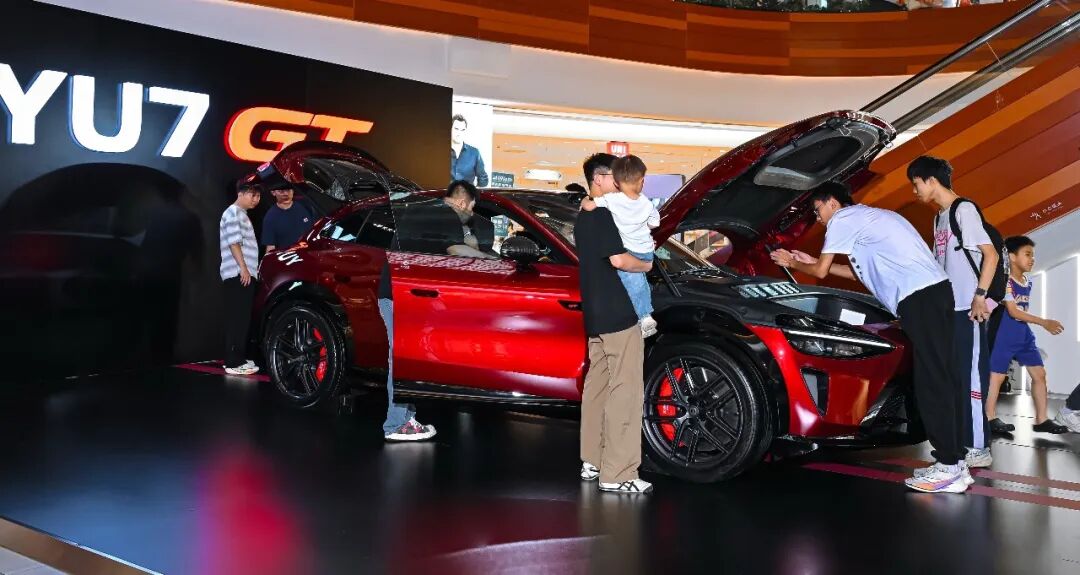
Image source / Xiaomi Auto's official Weibo account
A person in the automotive supply chain sighed, "It takes traditional automakers many years to build a high-end brand image, but Xiaomi has achieved this so quickly and has directly entered a price range significantly higher than that of traditional brands." In his view, since users have been using Xiaomi's high-end mobile phones and smart TVs at home for several years, they have formed an expectation of the brand's product capabilities, and this trust has naturally extended to the automotive business.
More precisely, the automotive business has raised the upper limit of users' trust in the Xiaomi brand. Against the backdrop of the storage price increase, the mobile phone business can absorb cost pressure through product structure adjustment, and the automotive business can support the profit margin with a higher unit price. This allows Xiaomi to make pricing decisions more calmly.
If upmarket positioning leaves room for profit, globalization disperses risks in the market.
The initial stage of going global is to "sell products overseas," and the advanced stage is to establish brands, channels, and even R & D centers overseas. The former is more like trade, while the latter is true global operation. Xiaomi is now taking the latter path.
Mobile phones still form the foundation of this global system. In the first quarter, Xiaomi's smartphone shipments ranked among the top three globally for 23 consecutive quarters, ranking among the top three in 47 countries and regions and among the top five in 65 countries and regions.
What is more worthy of attention is IoT. The overseas revenue of Xiaomi's IoT and consumer products achieved double-digit growth in Q1 and reached a new historical high. The shipments of wearable wristband devices ranked third globally, the shipments of TWS earphones ranked second globally, and the shipments of tablets ranked among the top five globally for eight consecutive quarters.
The channels and brand recognition established by mobile phones going global can help IoT products enter overseas households at a lower cost. In turn, IoT brings Xiaomi from a mobile phone into living rooms, kitchens, bedrooms, and office scenarios, creating room for imagination for subsequent services, product replacements, and ecological linkages.
Going global with the automotive business is more complex and tests Xiaomi's accumulated global capabilities.
Xiaomi's plan is to enter the European market in the second half of 2027 and the right-hand drive market in the first half of 2028. To this end, Xiaomi has established a European R & D center in Munich, attracting top experts from luxury car manufacturers such as Porsche, Lamborghini, Mercedes-Benz, and BMW.
Europe is the base of the global high-end automotive market. Xiaomi's choice to make Europe its first stop for going global and setting up an R & D center and recruiting top foreign experts from the start has two implications. On the one hand, Xiaomi Auto has designed its products, organization, and supply chain in a global brand way from the very beginning. On the other hand, Xiaomi's more than a decade of experience in going global with mobile phones and IoT has developed a mature operating system. The team knows how to deal with local regulations, how to make local adaptations, and how to build brand trust in foreign countries. The reuse of this methodology can help Xiaomi Auto avoid many detours in going global.
It is understood that many European countries are trying to persuade Xiaomi to build factories locally. An investor who focuses on the overseas expansion of new energy vehicles said that if Xiaomi can establish a deeper production or supply chain layout in Europe and integrate into the local industrial system, Xiaomi Auto will have the opportunity to transform from a "Chinese brand exporter" to a "global brand operator." In the long run, this model also has the potential to be replicated in right-hand drive markets, as well as in regions such as Southeast Asia and the Middle East.
By now, the reason why Xiaomi can "withstand" the pressure is quite clear. Upmarket positioning gives it more pricing flexibility when costs rise. The automotive business extends the revenue structure to higher unit prices and more complex hardware scenarios. Globalization disperses regional risks. In the short term, these changes help Xiaomi cope with the storage cycle. In the long term, they also determine Xiaomi's position in the next round of AI competition.
03. How well-positioned is Xiaomi in the next round?
The accumulations in upmarket positioning, the automotive business, and globalization were moats in the era without AI. In the AI cycle, they are the preconditions for implementation.
In the past, when people looked at Xiaomi, they were used to first noticing the hardware, such as mobile phones, TVs, air conditioners, bracelets, and then cars. In the AI cycle, the role of hardware has changed. It not only undertakes sales and revenue functions but also serves as a user entry point that all major manufacturers and platforms are competing for.
As of March 31, 2026, the number of IoT devices connected to Xiaomi's AIoT platform has exceeded 1.1 billion, a year-on-year increase of 18.5%. The number of users with five or more connected devices reached 23.6 million, a year-on-year increase of 22.3%. At the same time, Xiaomi's global monthly active users reached 746 million, the monthly active users in the Chinese mainland reached 196 million, the monthly active users of the Mi Home app reached 117 million, and the monthly active users of Xiao AI reached 169 million.
Mobile phones are the portable entry point, cars are the travel entry point, home appliances are the home entry point, and Mi Home and Xiao AI are the operating layers that connect these entry points. The main activities of a person in a day are basically covered.
Having multiple entry points is just the first step. The real challenge is to enable these devices to understand users and respond to their needs in the same system. One of the common criticisms of smart homes in the past is that users have to set rules themselves, remember entry points, and make repeated adjustments. The more devices there are, the more complex the experience may become. AI can play a valuable role here. It can hide complex operations in the background, allowing users to express their needs in a more natural way, and then the system can determine which devices to call.

Image source / Xiaomi's official Weibo account
In other words, without AI, Xiaomi's "car-home-mobile device ecosystem" is just a convenience. With the addition of AI, this ecosystem can develop into a service system that is closest to daily life.
To achieve this, Xiaomi plans to invest at least 16 billion yuan in the AI field this year and more than 60 billion yuan in the next three years.
For AI to truly enter mobile phones, cars, and homes, it cannot rely solely on external model calls. It ultimately depends on system capabilities