Xiaomi: Have you fallen to the point of doubting your life? The worst is over.
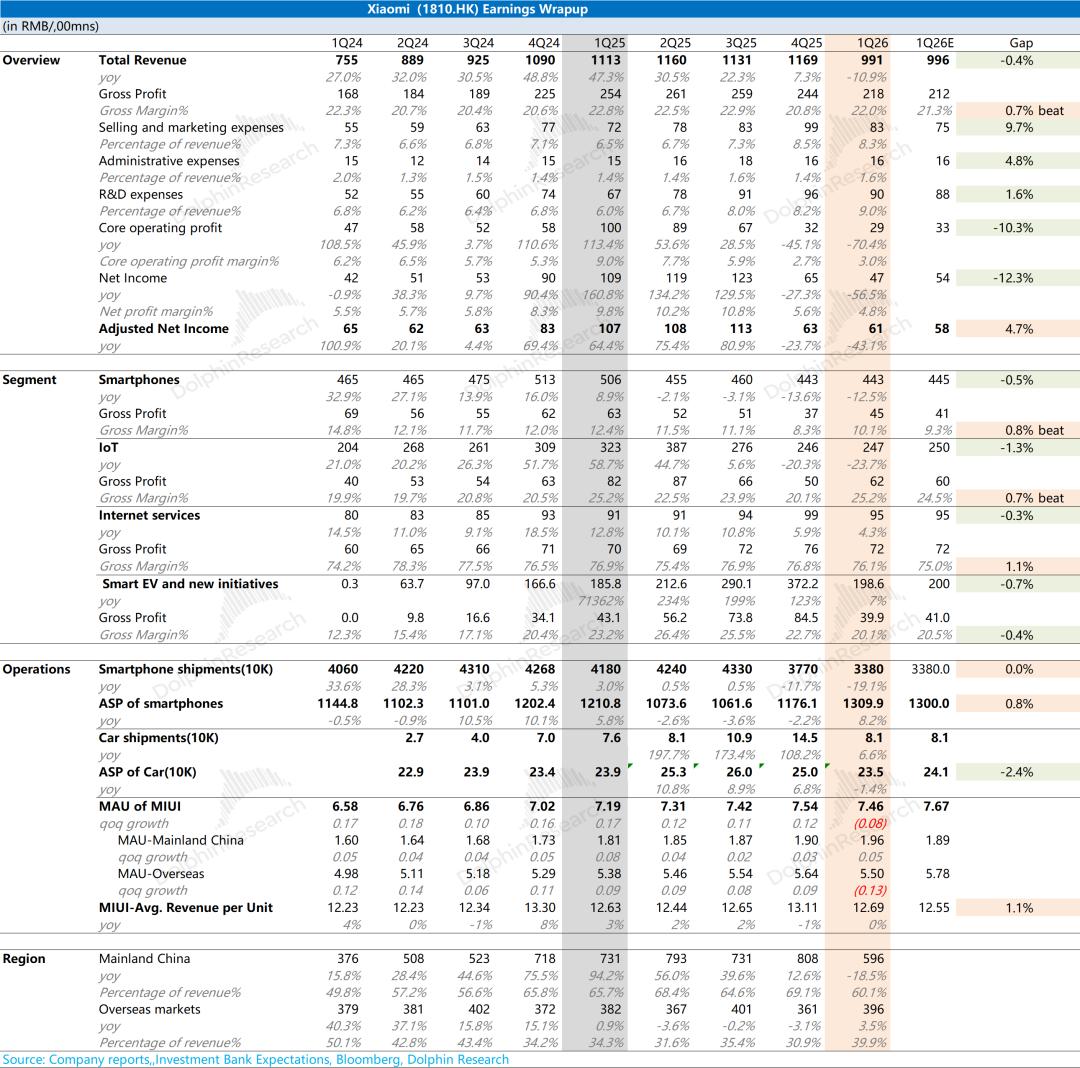
Xiaomi Group (1810.HK) released its financial report for the first quarter of 2026 (as of March 2026) after the Hong Kong stock market closed on the evening of May 26, 2026, Beijing time. The key points are as follows:
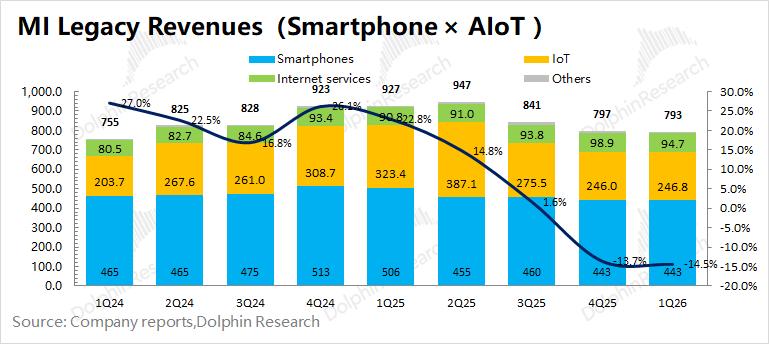
1. Overall performance: Revenue was 99.1 billion yuan, a year-on-year decline of 11%. The company's decline this quarter was mainly dragged down by the mobile phone and other businesses. Among them, the revenue of the company's traditional business (mobile phones x AIoT) this quarter decreased by 14.5% year-on-year.
The gross profit margin this quarter was 22%, a year-on-year decline of 0.8 percentage points, mainly affected by the year-on-year decline in the gross profit margins of mobile phones and automobiles.
2. Automobile business: The automobile-related revenue this quarter was 19.86 billion yuan, basically in line with expectations. Among them, the company's automobile shipments this quarter were 81,000 units, and the average price per vehicle dropped to 235,000 yuan.
The decline in sales volume was affected by factors such as the discontinuation of the old - model SU7 and capacity allocation this quarter, while the decline in the average price was due to the purchase tax subsidy and the increase in the proportion of in - stock vehicle sales with a lower average selling price (ASP).
The gross profit margin of the automobile business this quarter dropped to 20.1%, close to the market expectation (20.5%), mainly affected by the decline in the average price, which included the impact of Xiaomi's purchase tax subsidy and the sale of a part of low - price in - stock vehicles this quarter. Due to the gross profit margin falling again, Dolphin Research estimates that the core operating profit of Xiaomi's automobile business fell into a loss of 3.1 billion yuan again this quarter.
Impact of purchase tax subsidy: Xiaomi previously announced that for orders locked before 24:00 on November 30, 2025, if the vehicle is invoiced and delivered in 2026 due to production or transportation reasons of Xiaomi cars, the difference will be subsidized by reducing the final payment for car purchase . Taking the YU7 as an example, the impact of the purchase tax subsidy on the ASP of a single YU7 is approximately 12,000 yuan.
3. Mobile phones: Revenue was 44.3 billion yuan, a year-on-year decline of 12.5%, in line with the market expectation of 44.5 billion yuan. Among them, the shipments of Xiaomi mobile phones this quarter decreased by 19% year-on-year, while the average price of Xiaomi mobile phones increased by 8% year-on-year.
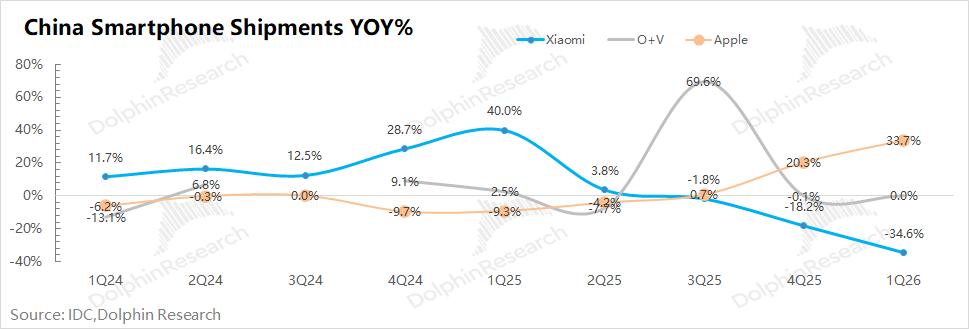
Looking at different markets: The shipments of Xiaomi mobile phones in the domestic market decreased by 34.6% year-on-year, while the shipments in the overseas market decreased by 12% year-on-year. In the case of storage shortage, it had a direct impact on mobile phone shipments. Considering the company's mobile phone gross profit margin's sequential increase, Dolphin Research believes that the company gave priority to allocating storage to high - price models, which drove up the company's ASP.
4. IoT: Revenue was 24.7 billion yuan, a year-on-year decline of 24%, close to the market expectation of 25 billion yuan, mainly affected by the reduction of national subsidies and storage issues. In particular, the company's large home appliance business was more affected by national subsidy policies (the subsidy for some products might reach 1,000 - 2,000 yuan).
5. Internet services: Revenue was 9.5 billion yuan, a year-on-year increase of 4%, in line with the market expectation of 9.5 billion yuan. The growth was mainly driven by the advertising business. Among them, the number of MIUI users increased by 4% year-on-year, while the ARPU value increased slightly by 0.5% year-on-year.
Looking at different regions: The overseas Internet revenue this quarter was 2.97 billion yuan, while the domestic Internet revenue was approximately 6.5 billion yuan. The number of MIUI users in China continued to grow this quarter, while the number of overseas MIUI users decreased.
6. Profit side: Core profit was 2.9 billion yuan, and the adjusted net profit was 6.1 billion yuan. Among them, the core profit of Xiaomi's traditional business was approximately 6 billion yuan, and the automobile business suffered a loss of 3.1 billion yuan this quarter.
In the case of storage shortage, the company gave priority to allocating storage to models with a higher ASP, thus achieving a sequential increase in the gross profit margin and the core profit of the traditional business. Affected by the purchase tax subsidy and the decline in sales volume, the automobile business returned to a loss this quarter.
Dolphin Research's overall view: The stock price has been halved, but the actual situation is not as bad as expected
Xiaomi's financial report this quarter is basically in line with market expectations. The year-on-year decline in the company's revenue this quarter is basically due to the drag of the mobile phone and IoT businesses in the traditional business.
Judging from the data performance this quarter, Xiaomi still faces great pressure in terms of operations. For example, the mobile phone and IoT businesses still showed double - digit year-on-year declines, and the growth rate and gross profit margin of the automobile business also significantly declined.
Xiaomi's stock price has dropped from HK$60 to around HK$30, which has reflected the negative impacts of storage shortage, the sluggish mobile phone market, and the "cooling down" of Xiaomi cars. For the company's stock price to rise again, the company needs to show improvement in its operations. Pay attention to the progress of the automobile, mobile phone, and IoT businesses:
1) Automobile business: The annual target is 550,000 vehicles
Xiaomi cars sold 81,000 units in the first quarter of 2026, a significant sequential decline of 44%. Since the company discontinued the old - model SU7 and launched a new generation of SU7 this quarter, it had a certain impact on the production capacity this quarter. Driven by the new SU7, the company's sales volume returned to around 50,000 units in April.
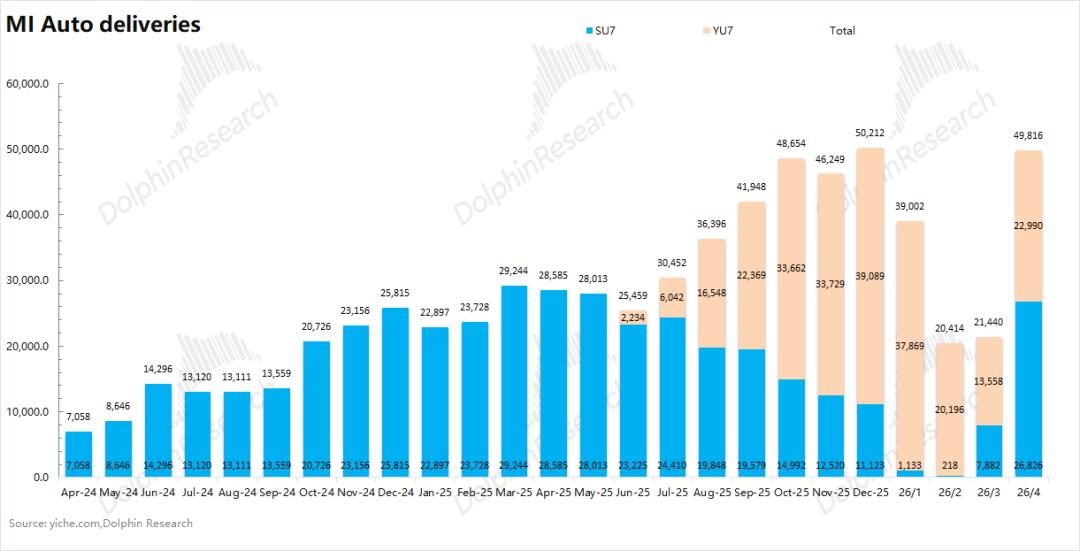
Although the monthly sales volume of Xiaomi cars returned to around 50,000 units after the release of the new SU7, judging from the change in the company's "delivery cycle", this is just a "transitional product" and not as "popular" as the previous YU7.
The current delivery cycle of the YU7 has been reduced to less than 10 weeks, indicating that the large number of previously backlogged orders have basically been digested. The delivery cycle of the new SU7 has been extended after the "May Day holiday", and the current delivery cycle of about 3 months is still relatively normal.

The company's management previously set an annual automobile sales target of 550,000 vehicles. Since the sales volume in the first quarter was only 81,000 units, it means that the sales volume in the next three quarters will need to reach 470,000 units (i.e., more than 155,000 units per quarter), which is challenging. After the "order pool" of the YU7 was digested, the situation of "short supply" of Xiaomi cars has changed to "demand - driven", and the sales volume will be directly affected by "order demand".
b) Traditional business (mobile phones x AIoT): The storage pressure remains, and the gross profit margin has stabilized at a low level.
① Mobile phone and IoT businesses: There was still a significant decline this quarter, mainly affected by factors such as the increase in storage prices and the tightening of national subsidies.
The shipments of Xiaomi mobile phones in the Chinese market decreased significantly by 34% this quarter, mainly affected by the "more features without price increase" strategy of the Apple 17 series and the shortage of storage. During the same period, the shipments of Apple mobile phones in the Chinese market increased by 34% year-on-year (the market decreased by 3.6% year-on-year).
During a communication with Qualcomm's management, it was mentioned that "the destocking of channel inventory will ease, the Chinese Android mobile phone market will bottom out in the next quarter, and will resume sequential growth in the second half of the year".
The current demand in the mobile phone market has not recovered, but the impact of storage has been reflected in the company's falling stock price and fully digested by the market. Considering the gross profit margins of mobile phones and IoT, even though the storage price is still rising, the gross profit margin of the company's traditional hardware has stabilized and stopped declining, and the operating situation is unlikely to deteriorate further.
Overall, Xiaomi still faces great pressure in the traditional fields (mobile phone and IoT fields), and the gross profit margin will still be at a relatively low level. However, the good news is that the gross profit margin of hardware increased sequentially this quarter. As for the automobile business, the company has set an annual target of 550,000 vehicles, which is the main focus at present. Pay attention to the performance of the company's new cars in the future.
Under the influence of multiple pressures, Xiaomi's stock price has been "halved" from the relatively high level of HK$60.
Under the assumption of a relatively pessimistic scenario (a 9% decline in Xiaomi's mobile phone revenue and a slight year-on-year decline in IoT), the traditional business will experience a single - digit year-on-year decline. If the automobile business achieves the company's target of 550,000 vehicles, but the average price and gross profit margin decline, it is estimated that the after - tax core operating profit of Xiaomi's traditional business in 2026 will be approximately 20 billion yuan, a year-on-year decline of 16%; the revenue of the automobile business will be approximately 140 billion yuan, a year-on-year increase of 32%.
In the above scenario, the company's management needs to achieve the target of 550,000 vehicles. If it is difficult to achieve or the target is lowered in the future, it may cause the company's stock price to "fall into a trough". As for the traditional fields, the relatively pessimistic situation has basically been reflected in the stock price. We are waiting for the recovery of demand to drive up the performance.
The following is a detailed analysis
I. Overall performance: Revenue declined again, but the gross profit margin stabilized
With the addition of the automobile business, in addition to the previous "Mobile phones X AIoT", Xiaomi's financial report now also includes two new major categories, "Automobiles and Innovation Business".
Xiaomi's separate disclosure of the "Automobiles and Innovation Business" shows the company's high level of attention to the automobile business. The company's market value was able to break through the trillion - yuan ceiling mainly because of the expectations brought by the automobile business.
1.1 Revenue side
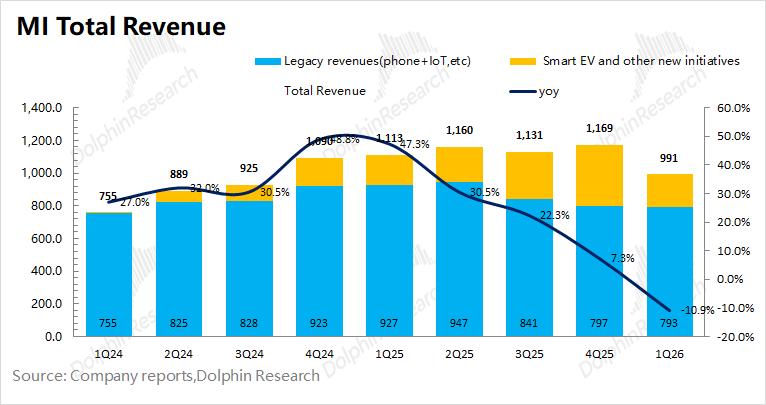
Xiaomi Group's total revenue in the first quarter of 2026 was 99.1 billion yuan, a year-on-year decline of 11%, basically in line with the market expectation of 99.6 billion yuan. The decline this quarter was mainly dragged down by the mobile phone and IoT businesses.
1) The original business - the Mobile phones X AIoT business (traditional business) achieved revenue of 79.3 billion yuan, a year-on-year decline of 14.5%. The performance of the hardware business was still "poor", with the mobile phone business declining by 12.5% year-on-year and the IoT business declining by 24% year-on-year;
2) This quarter, Xiaomi's new businesses such as intelligent cars achieved revenue of 19.86 billion yuan, a year-on-year increase of 7%, mainly affected by the delivery of the YU7, the discontinuation of the old - model SU7, and the preparation period for the new - generation SU7.
1.2 Gross profit margin
Xiaomi Group's gross profit margin in the first quarter of 2026 was 22%, better than the market expectation of 21.3%. Among them, the gross profit margins of the mobile phone and IoT businesses declined sequentially this quarter, and the gross profit margin of the automobile business continued to decline.
a) The gross profit margin of Xiaomi's old business was 22.5%, a sequential increase of 2.5 percentage points. This was mainly because the company gave priority to allocating storage to products with a higher average price. The mobile phone business increased sequentially to 10.1% this quarter, and the IoT gross profit margin increased to 25.2%.
The other businesses in the company's traditional business still had a gross loss of 80 million yuan this quarter, which included services such as air - conditioner installation. If this part of the gross loss is included in the IoT business, the real gross profit margin of the IoT should be around 24.9%.
2) The gross profit margin of new businesses such as automobiles was 20.1%, close to the market expectation of 20.5%. The gross profit margin of the automobile business declined sequentially this quarter, mainly affected by Xiaomi's purchase tax subsidy and the sale of a part of low - price in - stock vehicles this quarter.
Impact of purchase tax subsidy: Xiaomi previously announced that for orders locked before 24:00 on November 30, 2025, if the vehicle is invoiced and delivered in 2026 due to production or transportation reasons of Xiaomi cars, the difference will be subsidized by reducing the final payment for car purchase . Taking the YU7 as an example,