Work 100 hours a week, sleep on the factory floor for three years, and be on the verge of bankruptcy three times: Elon Musk's "extremely hardcore" success formula
According to a report by CCTV.com, the White House of the United States announced on the 11th the list of business leaders who will visit China with Donald Trump.
A total of 16 American business representatives will come to Beijing, including Elon Musk, the CEO of Tesla and the CEO and CTO of SpaceX.
This month, Musk has once again set off a technological wave: integrating xAI into SpaceX to create space AI, promoting the mass production of Tesla's Optimus humanoid robot, and making simultaneous breakthroughs in three major directions: starships, autonomous driving, and super computing power.
Musk was not destined for success from birth. This path of extreme practical action began in a darkest moment unimaginable to ordinary people.
He slept on the factory floor for three years, worked 100 hours a week, and faced three rocket explosions that almost bankrupted him. However, he used a set of "extremely hardcore" principles for achieving things to rewrite the fate of humanity's future.
"In a year, I may only have two or three days when I don't work much. I work 80 - 100 hours a week.
No one can change the world by working from 9 to 5 with weekends off."
This is exactly the best image of a contemporary super doer: taking a grand mission as the direction, breaking through the situation with the first - principles thinking, and achieving things through extreme focus and perseverance. All the underlying logic of Musk's rise from Zip2 and PayPal to Tesla and SpaceX is fully recorded in the book The Musk Principles.
The book has obtained the personal authorization of Musk. On the first day of its release, Musk and Naval Ravikant strongly recommended it.
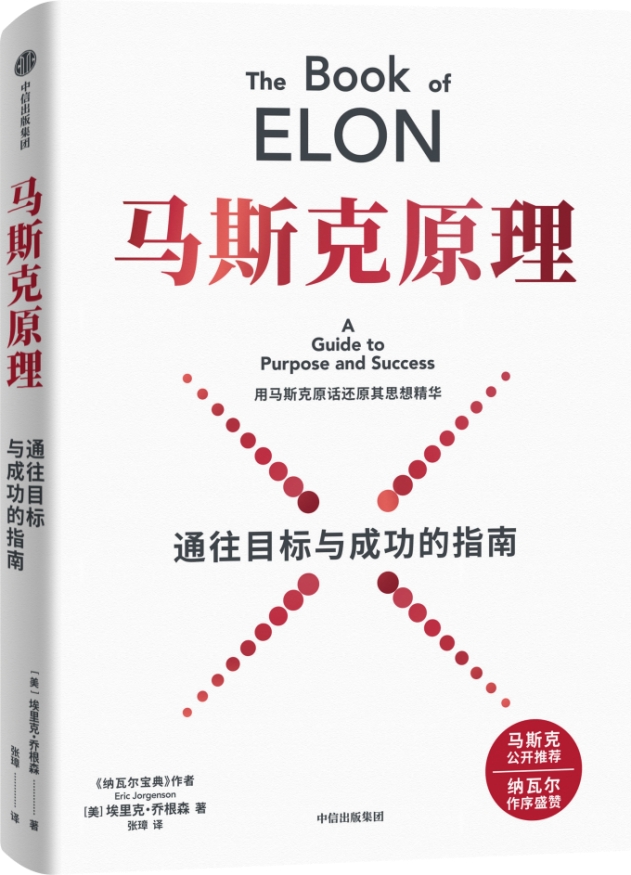
Naval wrote in the preface: "Hard - working people are everywhere, wise people are not common, and truly courageous people are even rarer. And Musk combines all three qualities."
This book is dedicated to every aspiring entrepreneur, entrepreneur, and doer who is not willing to be mediocre, aims to create, and change reality through practical action.
*The following content is excerpted from The Musk Principles: A Guide to Purpose and Success by Eric Jorgenson.
01. Stop daydreaming and find the thing you "have to do".
Musk's life goal has never been to make money. His goal is to contribute to the survival and prosperity of all humanity.
He said: "Our potential far exceeds our imagination. As long as we work together, we can achieve what seems impossible at present."
Which fields are most worth investing in? Musk's answer is: the Internet, the transition to sustainable energy, space exploration (to achieve human multi - planetary survival), and then artificial intelligence and gene editing.
So, how should one choose a startup direction? Musk gives a golden rule:
"A better starting point for entrepreneurship is to think: Is there anything that hasn't appeared yet, which I think is of great benefit to humanity and which I have the ability to create?"
Then, find the intersection of your talents and interests, find a group of like - minded partners, build this business together, and constantly strive for excellence.
"If you are creating something you love and believe others will also love, you will naturally invest a lot of time and energy in it, and you won't regret it even if it fails in the end."
Ø Musk's first startup: Zip2 - starting from "helping newspapers go online"
When Musk started his business, it wasn't because he really wanted to be a boss, but because he wanted to participate in the construction of the Internet. After failing to get a job at several Internet companies, he thought: Since I can't get into an Internet company, I'll start one myself.
"In terms of probability, the possibility of achieving a great cause is very small, but I have to give it a try at least."
His first idea was to help traditional media move their printed content to the Internet. That's Zip2.
Zip2 had strong technology, but the actual control was in the hands of traditional media companies, and they didn't make full use of it. Musk realized for the first time: You should sell the product directly to end - consumers. If you have advanced technology, don't sell it to those stupid and stubborn traditional enterprises.
Fortunately, Compaq acquired Zip2 for a little over $300 million. Musk's advice to entrepreneurs is that when selling a company, you must take cash.
After getting the cash, he didn't stop.
"I always want to bet the chips I've won on an even bigger bet. I just can't stay idle."
Ø Musk's second startup: PayPal - regarding money as information
He invested almost all of his remaining money in X.com (the predecessor of PayPal).
At that time, he was thinking: "What is essentially digital? What exists in the form of information but doesn't require high - bandwidth transmission?" The answer is: money.
"Money is just information. Money is a database used to allocate resources in time and space."
Think about it with extreme thinking: If you're trapped on a tropical desert island, even $100 billion won't be useful. The real function of PayPal is to increase the speed of capital flow - people no longer need to mail checks and can conduct real - time online transactions.
Zip2 originated from "helping newspapers with digital transformation", and PayPal originated from "money is information". Musk is always looking for things that are "of great benefit to humanity and which he has the ability to create", and then bets all his chips on them.
However, finding the right thing is just the first step. What really makes the difference is how to think about it.
02. Physical laws are "objective laws", and the rest are "subjective suggestions".
Musk said: "I strive to be extremely rational.
If what you want to do is logically valid and does not violate physical laws, you should do it.
Once you start, be ready to question your assumptions at all times, correct your mistakes, and adjust according to the actual situation.
Physical laws are objective laws, and the rest are subjective suggestions."
He encourages everyone to widely apply physical thinking tools in life. In daily life, we are used to using analogical reasoning - others do it this way, so I do it too. It's okay for daily small things, but in major decisions, analogical reasoning will tie you to tradition.
"Don't blindly follow the trend. By using physical thinking and starting from first - principles, you can avoid blind following."
The logic of first - principles thinking is very simple: first establish the basic principles, build the reasoning process on this basis, and then draw a conclusion. Break things down to the most basic principles.
First, ask yourself: What are the basic laws that I'm most certain are true? Then use these axioms to test your conclusions.
Ø "First - principles thinking" reduces the cost of Tesla's batteries - saving $520 per kilowatt - hour
Early on, everyone said that electric cars couldn't be made because the battery packs were too expensive - $600 per kilowatt - hour. Musk didn't believe it.
He asked: What raw materials does a battery consist of? Cobalt, nickel, aluminum, carbon, polymers, and a steel shell.
He checked the prices at the London Metal Exchange - the raw material cost was only $80 per kilowatt - hour!
"We just need to come up with a clever way to combine these materials into a battery more efficiently, and we can significantly reduce the battery cost.
The battery cost of electric cars can be much lower than everyone's imagination."
Ø SpaceX - a masterpiece created by "first - principles thinking" and "extreme thinking"
Similarly, Musk believes that "first - principles thinking created SpaceX".
He asked: What raw materials does a rocket consist of? Aluminum, titanium, copper, carbon fiber, etc.
Then he asked: How much of each raw material is needed? What is the total cost of all the raw materials?
Suppose you pile up the raw materials on the ground and wave a magic wand to turn them into a rocket - this is the "magic wand number", that is, the theoretical minimum cost. It turns out that this number is often only 1% - 5% of the actual cost of a rocket.
He proposed the "idiot index": the cost of the finished product ÷ the cost of the raw materials.
"If the cost of a component is as high as $1000, but the cost of the aluminum it needs is only $10, then it is probably over - designed. If the idiot index of the component you're in charge of is high, then you're an idiot."
There is a component on the rocket called the "nozzle half - sleeve", which costs $13,000, and the steel it needs is only $200. Musk requires all engineers to continuously evaluate each component using the idiot index.
"This is first - principles thinking. If you use analogical reasoning, you'll ask 'How do other rocket companies do it?'
- Then you'll never be able to see the real potential."
Another useful tool is "extreme thinking". Push it to the extreme of the smallest or largest, and see how the situation will change.
Take tunnel excavation as an example: It costs about $1 billion to extend the Los Angeles subway by one mile.
Musk first reduced the tunnel diameter - reducing the cross - sectional area to 25% of the original, and the cost can be reduced to 20% - 25% of the original.
Then he designed a device that can continuously dig, doubling the efficiency.
Finally, the existing equipment is far from reaching the thermodynamic limit, and the power can be doubled.
"'Impossible' is an arbitrary word.
I think from a physical perspective, and in physics, we hardly ever say 'impossible'."
If a team member says a certain goal is impossible, he will ask back: "What should be done to make it possible?"
"Physical thinking also warns us: First assume that you're wrong, and then try to make fewer mistakes."
With first - principles thinking, you also need a set of "algorithms" for daily execution. This set of algorithms, which Musk calls the "five - step work method".
03. The five - step work method: Musk's "algorithm"
Musk requires the whole company to strictly follow a set of processes, which he calls the "algorithm". The order must not be messed up.
Step 1: Question each requirement and make it less stupid.
"Dare to assume that the requirement you're facing is definitely stupid, no matter who proposed it.
The requirements proposed by smart people are the most dangerous because you're less likely to question them. Even if the requirement is proposed by myself, it should be questioned."
Step 2: Try your best to delete parts and processes.
"If less than 10% of the things you deleted need to be restored in the end, you haven't deleted enough."
People always keep useless things on the grounds of "just in case".
"If you're too conservative when deleting, you'll only end up with a lot of useless things."
Step 3: Simplify or optimize.
Note that this step must be done after deletion.
"The most common mistake smart engineers make is to optimize something that shouldn't exist in the first place."
Step 4: Accelerate.
Once the direction is right and the efficiency is high, then speed up.
Step 5: Automate.
You must wait until the first four steps are completed before introducing automation.
Musk admitted that he made a mistake:
"I've reversed the order many times - first automate, then accelerate, then simplify,
and finally found that the requirement itself was stupid. It was all in vain."
The production line of Tesla Model 3 was originally designed to have a weekly production capacity of 5,000 vehicles, but it actually reached 7,000 vehicles per week.
"This leap was achieved through streamlining.
The best part is to reduce a part. The best process is to save a process."
No matter how perfect the process is, it still needs the right people and action principles to implement it. Just having the "algorithm" is not enough; you also need a "special forces" team that can execute the algorithm.
04. Entrepreneurship is about assembling a "special forces" team and then creating high - quality and affordable products
Ø Team: A few elite soldiers are better than a large number of mediocre ones
"A company is a group of people getting together to create products or provide services. The so - called 'enterprise' is just a name; in essence, it's a group of people going forward together."
Musk's principle of hiring is very simple: A small group of technical elites is always better than a large number of mediocre people.
PayPal had only about 30 engineers, but he thought "the system we created is more reliable than the Federal Reserve's clearing system". Both Zip2 and PayPal adopted a flat structure, with desks having no hierarchy, and everyone could communicate directly.
"We follow the concept of 'the best solution wins'. We won't adopt a proposal just because the proposer is a company leader."
Every employee has equity and is the owner of the company.
When recruiting, he values two things: extraordinary ability or lofty ambition.
"Skills can be taught, but human nature is hard to change."
His management philosophy is: "I don't think I'm managing smart people; they can manage themselves.
I'll tell them: Look, this is the goal we're pursuing.
Do you agree? If you do, let's work together to achieve it."
Ø Feedback: First assume that you're wrong
"It's very important to accept external feedback. If we don't adjust our direction according to people's feedback, we're likely not to succeed."
The key is to actively seek feedback, focus on solving it, and then make adjustments as quickly and clearly as possible.
"I've always been trying to build an accurate understanding of the real world.
If my view on something is wrong or there is room for improvement, I'll say:
I used to think this way, but I found I was wrong - thank goodness, I've corrected it now."
Musk is a firm believer in the feedback mechanism.
"All bad news should be said loudly and repeatedly, while good news only needs to be said quietly once."
Ø Action: Get it running first and allow failure
"If there is no obvious difference between two options, it's better to just choose one and start implementing it.
We may choose the wrong one and take a detour, but at least we act fast.
Get it running first - the primary goal is to get this thing running first, and worry about optimization later."
To innovate, you must accept failure.
"If you don't allow failure, you'll make extremely conservative choices, and the result will be worse than not innovating."
When SpaceX's early rocket launches failed, Musk didn't fire anyone. "They are smart and hard - working, and it's unfair to fire them." It's only fair to fire an employee when they lose their motivation, are no longer enthusiastic about the mission, or don't give their all.
"If we don't occasionally blow up the engine during test launches, it means we're not working hard enough."
Ø Product: Make a prototype first, with high quality