Is Lenovo on a Steady Path in Its AI Journey?
On April 1st this year, Yang Yuanqing, the Chairman and CEO of Lenovo Group, set two new goals at the new fiscal year's oath - taking meeting: one is to exceed $100 billion in revenue within two years, and the other is to comprehensively transform into an AI - native company.
At that time, Lenovo had not disclosed its performance for the fiscal year 2025/26 (from April 1st, 2025, to March 31st, 2026). The company had just ended the downward trend in performance in the previous fiscal year. In the first three fiscal quarters of the 2025/26 fiscal year, it recorded revenue of $61.486 billion. To achieve the annual revenue target of $100 billion, it means the company has to maintain the current growth trend in the following two years.
Meanwhile, for Lenovo, whose current main business still consists of hardware devices such as computers and tablets, announcing a comprehensive transformation into an AI - native company is also a rather challenging decision.
Since 2017 when Yang Yuanqing said "betting everything on AI", Lenovo's AI strategy has changed several times. The proportion of R & D investment in revenue is relatively low, and there are not many AI - related technological achievements. This company, known for its "strong execution ability", has given people the impression of "starting early but arriving late" in the AI field.
For Lenovo, which has weak technological support, relies on hardware as the mainstay, and has a low profile in the AI track, the above two goals seem a bit radical.
However, on May 22nd, the performance report of Lenovo Group for the 2025/26 fiscal year gave Yang Yuanqing some grounds for confidence to a certain extent.
During the reporting period, the company achieved revenue of $83.075 billion (about 589.9 billion yuan), a year - on - year increase of 20%; the adjusted net profit was $2 billion (about 14.55 billion yuan), a year - on - year increase of 42%, and the growth rate was about twice that of revenue. The company's three major business groups: IDG (Intelligent Devices Group), ISG (Infrastructure Solutions Group), and SSG (Solution & Service Group) achieved full - year profitability for the first time, and all achieved double - digit revenue growth.
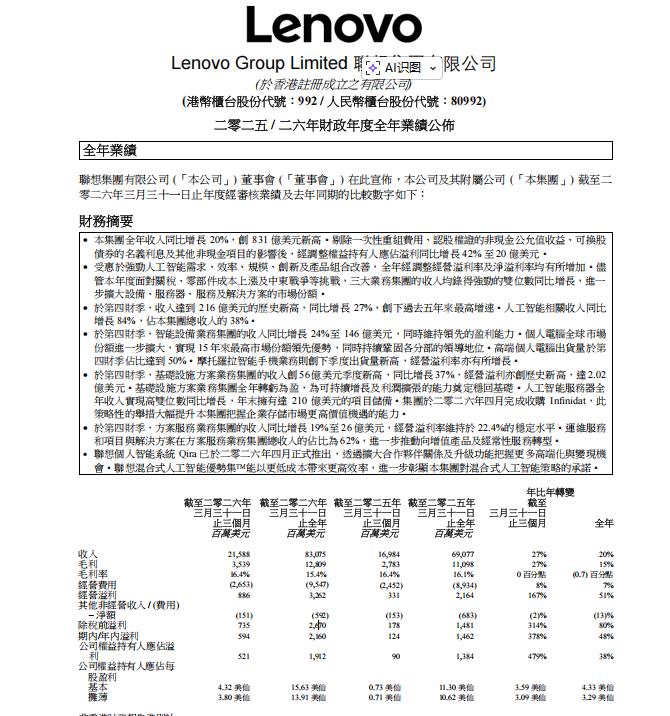
Image source: Lenovo Group's 2025/26 fiscal year financial report
More importantly, in the 2025/26 fiscal year, the AI - related revenue increased by 105% year - on - year. This means that after eight years of efforts in AI, Lenovo has finally found its place in the track.
Really making money from AI has also boosted Lenovo's imagination in the capital market. After the release of the financial report, the company's stock price soared rapidly, reaching a nearly 20% increase during the session and hitting a record high.
However, is this a trend reversal or just a brief moment of glory? It depends on whether Lenovo can walk more steadily in the future.
Lenovo Stabilized Its Performance
Actually, at the same time last year, Lenovo also released a fairly good financial report.
Lenovo Group achieved revenue of 498.5 billion yuan in the 2024/25 fiscal year, a year - on - year increase of 21.5%; the net profit under non - Hong Kong Financial Reporting Standards increased by 36% year - on - year, reaching 10.4 billion yuan.
This financial report meant that Lenovo ended the trend of year - on - year decline in both revenue and net profit for two consecutive fiscal years. Whether it could stabilize the growth was a question it needed to consider at that time.
The financial report of the 2025/26 fiscal year, which shows an increase in both revenue and net profit, proves the stability of Lenovo's profitability.
It is worth paying attention to the performance in the fourth fiscal quarter (the first quarter of 2026).
In the fourth fiscal quarter of the 2024/25 fiscal year, Lenovo's revenue increased by 23% year - on - year, but the net profit decreased by 64% year - on - year due to the non - cash fair value loss of warrants. After excluding non - cash expenses, the attributable net profit increased by 25%, which was regarded as a signal of performance pressure at that time.
In the fourth fiscal quarter of the 2025/26 fiscal year, Lenovo's revenue increased by 27% year - on - year to $21.6 billion, and the adjusted net profit increased by 101% year - on - year, achieving a double - digit growth.
In addition, the 2025/26 fiscal year's financial report also revealed two positive signals. First, Lenovo's core business, the IDG business mainly composed of PC, mobile phone, and tablet businesses, still achieved double - digit revenue growth and could support the overall performance of the group. Second, the non - PC business grew at a faster pace, which means Lenovo has opened up a new growth curve.
Specifically, in the 2025/26 fiscal year, Lenovo's IDG business achieved revenue of $58.9 billion, accounting for 70% of the total revenue, with a year - on - year increase of 17%. In the previous fiscal year, the growth rate of this revenue was 13%.
Image source: Lenovo Group's official website
The PC business, the main revenue source of this business, also showed a growth trend. In the fourth fiscal quarter of the 2025/26 fiscal year, the company's global market share of personal computers climbed from 23.7% to 24.2%, hitting a record high.
At the same time, Lenovo also disclosed in the financial report that the proportion of high - end PC shipments reached 50%, which means that its PC business is no longer just "selling in large quantities" but also "selling at high prices".
Besides the IDG business, Lenovo's other two businesses showed a faster growth rate.
Among them, the ISG, whose core business includes infrastructure solutions such as AI servers, data centers, and liquid - cooling technology, became the biggest structural change in this financial report. The annual revenue of this business was $19.2 billion, a year - on - year increase of 32%, and it was the fastest - growing business among the three.
More importantly, this business successfully turned losses into profits in the 2025/26 fiscal year, changing from a loss of $68.5 million in the previous fiscal year to a profit of $73 million.
It is understood that the hardware infrastructure such as AI servers, storage devices, and liquid - cooling solutions provided by Lenovo's ISG is the computing power carrier required for AI model training and inference, and it is in the upstream position of the AI industry chain.
At the beginning of April this year, Lenovo also announced the completion of the acquisition of Infinidat, a global provider of high - end enterprise - level storage solutions. In the current situation of the explosion of global storage demand and the continuous increase in costs, this is beneficial for Lenovo's ISG business to make up for its short - board in high - end storage.
The other business, SSG, mainly provides customized AI solution services for customers in different industries. The annual revenue of this business exceeded $10 billion for the first time, a year - on - year increase of 19%.
The financial report shows that this business has achieved double - digit growth for 20 consecutive quarters. In the fourth fiscal quarter of the 2025/26 fiscal year, the revenue of SSG was $2.6 billion, a year - on - year increase of 19%, and the operating profit margin remained stable at 22.4%. Among them, the proportion of operation and maintenance services, projects, and solutions in the total revenue of SSG reached 62%, further transforming into value - added products and recurring services.
In addition, the proportion of these two emerging businesses in the total revenue has been increasing year by year, and in the 2025/26 fiscal year, it has approached 40%. This means that Lenovo may shift from "selling devices" to "selling services", which has more imagination than the former "computer assembly factory" model.
How Did Lenovo, Which Once Vacillated in the AI Direction, Make Money from AI?
Another set of figures in the financial report also reveals a more imaginative signal for Lenovo. In the 2025/26 fiscal year, the company's AI - related revenue increased by 105% year - on - year, accounting for 33% of the group's total revenue.
Among them, both AI devices and AI services recorded triple - digit year - on - year revenue growth; the revenue of AI servers also achieved high double - digit year - on - year growth.
However, if we look back at Lenovo's exploration in AI, its current achievements in AI do not seem to be a result of gradual progress.
Lenovo realized the importance of AI not too late. Yang Yuanqing once placed AI at a very high strategic position. He once said at a conference in 2017 that "Lenovo has bet everything on AI".
Image source: Lenovo Group's official website
Lenovo also proposed a "Three - Wave" strategy at that time. In addition to maintaining the core PC business and expanding the smartphone and data center businesses, the third wave was to bet on natural language interaction and artificial intelligence.
To show Lenovo's emphasis on AI, Yang Yuanqing gave the market a "pre - warning". "Lenovo's recent financial reports may not be very good. If we hadn't invested in the Three - Wave strategy, we could have presented very good financial reports, but we didn't hesitate for the sake of transformation."
It seems that Lenovo has been "shouting" such loud slogans in the years after 2017. The strategic content has changed frequently, but there has been no long - term and consistent strategic main line.
In 2019, the "Three - Wave" strategy, which mainly focused on general AI, devices + cloud, was changed to the "3S Strategy", which was more inclined to hardware intelligent Internet of Things, intelligent infrastructure, and industry intelligence. In 2023, Lenovo proposed the "Hybrid AI" strategy, the core of which is to combine personal intelligence, enterprise intelligence, and public intelligence, by keeping sensitive data locally while using large - scale cloud computing power to perform complex tasks.
This year, Yang Yuanqing announced that Lenovo will comprehensively transform into an "AI - native company". According to his own understanding of "AI - native", it means "not regarding AI as an add - on or supplementary item, but re - thinking, constructing, and operating an enterprise based on AI." However, this explanation still seems a bit vague.
Combined with Lenovo's R & D investment, these strategies are more like "shouting slogans".
A most typical case is that in 2021, Lenovo announced the termination of its listing on the STAR Market after only one working day, setting the fastest withdrawal record in the history of the STAR Market. The reason for the market's doubt was precisely the insufficient R & D investment, which did not meet the positioning of the STAR Market.
The prospectus shows that Lenovo's R & D investments in the 2018/19, 2019/20, and 2020/21 fiscal years were 10.203 billion yuan, 11.517 billion yuan, and 12.038 billion yuan respectively, and the proportions of R & D investment in the revenue of each period were 2.98%, 3.27%, and 2.92% respectively.
Since then, the proportion of Lenovo's R & D investment has been hovering around 3% for a long time, and it is still the same in the 2025/26 fiscal year. The company's R & D expenses were $2.49 billion, accounting for less than 3% of the total revenue. Taking Huawei as an example for comparison, in 2025, Huawei's R & D investment reached 192.31 billion yuan, and the proportion of R & D investment exceeded 20%.
This time, Lenovo's ability to make money from AI is not the result of its long - term increase in AI investment. It is mainly because its ISG business has just hit the industrial inflection point of AI shifting from training to inference.
From the end of 2024 to 2025, the upsurge of large - model training gradually cooled down, and the demand for AI inference began to explode. Gartner data shows that since 2025, the proportion of AI inference computing power has exceeded 50%, and it is expected to account for 65% of the overall AI computing power in 2029.
Lenovo also found its position in the AI era under such a trend - to do a good job in the construction of the AI industry's infrastructure layer. It started to layout its ISG business earlier than the explosion of AI, so it already has a relatively complete system in helping customers build the computing power base for AI operation.
IDC data shows that in the fourth quarter of 2025, Lenovo's server revenue increased by 34.0% year - on - year and 26.6% quarter - on - quarter. Both growth rates were the highest among the top five manufacturers. In terms of shipments, Lenovo increased by 30.3% year - on - year and 23.2% quarter - on - quarter, also ranking first in the industry.
In the 2025/26 fiscal year, Lenovo's AI server business revenue increased by 50% year - on - year, and the annual order backlog reached $21 billion.
Now, Lenovo has established advantages in AI super - computing systems and liquid - cooling technology. It has the ability to assemble GPUs and build AI super - computing systems with a scale of tens of thousands or even hundreds of thousands of cards that can run stably. The company's self - developed sixth - generation "Poseidon" liquid - cooling solution has achieved 100% full - coverage liquid - cooling heat dissipation design for key components such as CPUs, GPUs, memory, IO devices, and power supplies, and the mechanical failure rate of the heat dissipation system is close to 0.
Based on these capabilities, and considering that Lenovo is one of the few local leading manufacturers with cross - border compliance qualifications and a global supply chain network, and can obtain restricted NVIDIA chips in compliance, it has maintained a long - term cooperative relationship with NVIDIA.
Currently, Lenovo has become the global first - launch partner of NVIDIA Vera Rubin NVL72 and has delivered a fully liquid - cooled, rack - level AI system based on this platform. This means that Lenovo has officially entered NVIDIA's latest - generation AI server system.
In the future, the cooperation between the two sides may become closer. NVIDIA is shifting from "selling chips" to "selling a whole set of systems" - from chips, networks, liquid - cooling, cabinets to software stacks and deployment methodologies.
This change has also magnified the value of manufacturers like Lenovo, which have the capabilities of complete machine integration and large - scale delivery.
Can Lenovo's AI Path Be Stable?
In addition to the ISG business catching up with the demand trend in the new era, Lenovo's AI layout also focuses on the IDG business.
For example, in recent years, it has launched Lenovo AI Host P7, Mini;