74.7 billion. A ring is going for an IPO.
A ring valued at $11 billion (approximately 74.7 billion RMB) is about to go public.
Recently, the smart ring company Oura secretly submitted an IPO application in the United States.
When you wear an Oura ring, it monitors how well you sleep, when you're under the most stress, when you're fatigued, and what changes are happening to your body. Oura's latest valuation is about $11 billion, surpassing many consumer electronics star companies.
It's not an "AI story company" that loses money to drive growth. Its revenue is quite substantial: In 2024, its revenue exceeded $500 million. In 2025, it's expected to exceed $1 billion, and the internal target for 2026 is about $1.5 - $2 billion.
Why is Oura worth so much?
The Secret of Earning $1 Billion Annually
In 2013, in the northern Finnish city of Oulu, several engineers created a somewhat peculiar product: a metal ring. All it does is record your sleep, heart rate, and physical condition.
This product is Oura.
The company's growth was not rapid in the first few years. In 2016, the first - generation product was launched on the crowdfunding platform Kickstarter, and the second - generation was launched in 2018.
The real turning point came during the pandemic. In 2020, the NBA distributed about 2,000 Oura rings to players and staff to monitor physical changes and potential health risks. This event brought Oura into the mainstream view for the first time. Later, a large number of professional athletes, celebrities, and entrepreneurs started wearing it.
After that, Oura began to expand its product boundaries.
Sleep monitoring is just the entry point. Later, it added features such as female cycle prediction, stress management, and cardiovascular load analysis. In 2024, it cooperated with Dexcom to enter the field of metabolic health. It also launched an AI feature called "Oura Meals" to analyze the diet structure through photos. It even acquired the gesture interaction company Doublepoint, hoping to make the ring a new interaction entry in the future.
As an AI - enabled wearable device, Oura makes money from hardware sales and membership fees.
Currently, the main product, Oura Ring 4, is priced at about $349 - $499. The price varies depending on the material and color. For example, the basic version costs more than $300, and the high - end titanium version is more expensive.
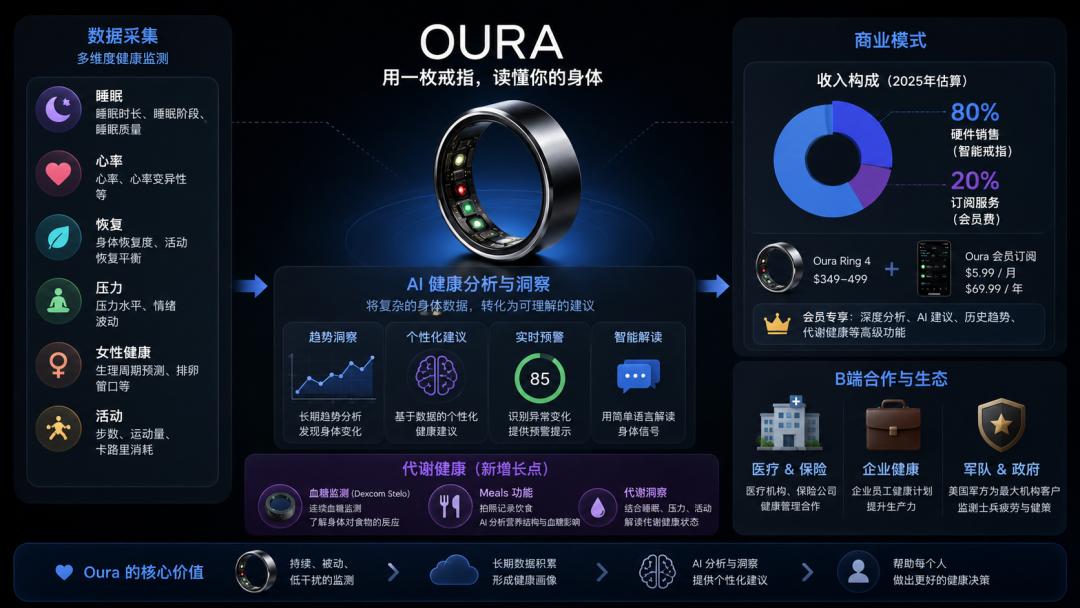
Based on the currently disclosed data, hardware sales remain the largest source of revenue. The industry research institution Sacra estimates that the revenue in 2025 will be about $1 billion, of which about 80% comes from hardware sales and about 20% from subscriptions.
The second source of revenue is membership fees, which are $5.99 per month or about $70 per year. Many core functions are included in the membership system, such as sleep analysis, recovery level, stress trends, AI health advice, and long - term physical change trends. Oura knows what you eat, how your body metabolizes, and how your stress changes.
Wall Street's valuation of Oura is mainly based on the potential of membership fees. The capital market likes this model because membership subscriptions are more like collecting rent. As long as users stay, the revenue will be generated repeatedly.
The third source of revenue is from the B - side. Medical institutions, insurance companies, scientific research projects, corporate health programs, and the US military are all Oura's customers. Oura's CEO once revealed that the US military is one of its largest institutional customers, and tens of thousands of military personnel use Oura to track fatigue and health data.
Becoming an AI Personal Doctor
Among many AI - enabled smart hardware, why does the capital give a high valuation to a ring?
Oura's real asset is not the hardware but continuous physical data. Oura has sold more than 5.5 million rings in total, and it's expected that the number of paying members will exceed 5 million this quarter.
If a user wears the ring for one day, it only generates a few numbers. But if 5 million people wear it continuously for several years, the significance is completely different.
Moreover, Oura has solved a problem that smartwatches have never fully addressed.
Many smartwatch users take them off to charge at night, and yet sleep is one of the most valuable data sources.
The smart ring is passive, continuous, and causes little interference. Users don't need to operate it frequently and don't have to charge it every day. More importantly, fingers may be naturally more suitable for measuring physical data than wrists.
There are dense blood vessels in the fingers, and optical sensors can more easily read data such as heart rate, body temperature changes, and blood flow. Industry research and analyses by multiple media have mentioned that rings are often more stable than wrist - worn devices in terms of indicators such as sleep, recovery level, and heart rate variability.
In the past, wearable devices recorded exercise, but now they may record the body.
Oura wants to go further and understand stress, sleep, recovery ability, metabolic state, and physiological cycles. If AI is smart enough, can it become a person's "personal doctor"?
An ordinary user may not know what "a 15% decrease in heart rate variability" means, but he will care about another sentence: "You've been under relatively high stress recently. It's recommended that you reduce high - intensity exercise and go to bed earlier." The role of AI is to translate complex physiological signals into language that people can understand.
Previously, Oura knew how well you slept. Now, it knows how stressed you are. In the future, Oura may know why your body is in a certain state.
The vision is good, but Wall Street has also pointed out the risks.
First, smart rings are still a niche product. The entire wearable market is still dominated by smartwatches. Rings are more of a supplement rather than a replacement.
Second, the membership model is controversial. Previously, when Oura put some functions into the subscription system, it caused dissatisfaction among users.
Third, privacy issues are becoming more and more sensitive. Because in the future, it will record not only steps but also sleep, stress, physiological cycles, and even deeper health information.
A New Opportunity Worth $41.4 Billion
When discussing Oura's money - making opportunities, many people overlook non - invasive blood glucose monitoring.
In 2024, medical device giant Dexcom invested $75 million in Oura and reached a strategic cooperation. Oura itself also acquired the continuous blood glucose monitoring startup Veri.
Dexcom has a consumer - grade non - invasive blood glucose monitoring device called Stelo, which can continuously monitor blood glucose when attached to the skin. In 2025, Oura launched a new metabolic health function that can interpret the blood glucose data monitored by Stelo through AI.
Previously, you could only see the blood glucose numbers. Now, Oura will tell you: "You slept 2 hours less last night, had a high - carbohydrate lunch, and were under relatively high stress in the afternoon, so your blood glucose fluctuations are more obvious today." Further, Oura will remind you that a recent decline in sleep may be affecting your metabolic state.
Non - invasive blood glucose monitoring is one of the biggest areas of potential in the next few years, simply because it's a necessity.
According to data from the International Diabetes Federation (IDF), by 2030, the number of adults with diabetes globally is expected to reach 643 million.
Meanwhile, the market has begun to expand from diabetes patients to ordinary people. The market for continuous blood glucose monitoring (non - invasive) alone is expected to reach about $41.4 billion by 2033.
In recent years, a large number of people without diabetes have started to actively monitor their blood glucose in an attempt to optimize the effects of weight loss, diet, and exercise. Axios reported that driven by the weight - loss drug craze and health bloggers, real - time blood glucose monitoring has gradually changed from a medical tool to a health consumer product.
In the past, continuous blood glucose monitoring was mainly done by Dexcom and Abbott. But in recent years, technology giants have started to enter the field in large numbers. A Samsung executive publicly stated that the company is "investing a large amount of resources" in researching non - invasive blood glucose monitoring and hopes to commercialize it in the next five years. Apple has been researching it for more than a decade and it's known as an internal "moonshot project".
Although the opportunity is generally optimistic, the industry is very cautious about technical issues. The FDA has even publicly warned that currently, there are no approved smartwatches or smart rings that can directly and accurately measure blood glucose non - invasively.
The reason is that heart rate is a direct signal, while blood glucose is not. The changes in human blood glucose are very complex and need to be indirectly calculated through spectra, optics, and biological signals, and the cost of error is high.
Non - invasive blood glucose monitoring hardware is very similar to early - stage autonomous driving. Everyone knows where the end goal is, and everyone believes it has great value. Once someone achieves it first, it may not only add a function but also define the next - generation wearable devices.
This is also what big companies are really betting on.
This article does not constitute any investment advice.
In the AI era, "one - person companies" are booming. Now, Huawei Cloud has launched the "2026 Artificial Intelligence OPC Application Innovation Contest". Companies at all stages can sign up. Click on the picture to participate immediately.
This article is from the WeChat official account “Pencil News” (ID: pencilnews). The author is Huang Xiaogui, and it is published by 36Kr with authorization.