On the eve of its IPO, Unitree launched a "legitimate scheme".
Introduction: While rushing into the secondary market, Unitree is also trying to leverage a small number of stores to attract distributors and quickly expand its offline channels. This layout must be completed as soon as possible; otherwise, when large companies like Xiaomi enter the market, Unitree's first-mover advantage will be significantly compressed.
Unitree has taken another step towards the secondary market.
On May 25th, the Shanghai Stock Exchange issued an announcement stating that it is scheduled to hold the 31st listing review committee meeting in 2026 on June 1st to review the initial public offering (IPO) of Unitree Technology Co., Ltd.
In addition to the capital market, Unitree has also stepped on the accelerator on another front.
At the end of May, the first Asian store of Unitree's Embodied Intelligence Experience Hall will open at Jing'an Joy City. Less than a month ago, Unitree's first direct store opened on the first floor of Yintai in88 in Wangfujing, Beijing. Wang Qixin, the CMO of Unitree, said that direct stores will also be opened in other major cities in the future.
Although Unitree has not opened many stores this year, this move is quite aggressive in the robotics industry. Currently, none of its competitors such as Zhipu Robotics and Songyan Power have opened both direct stores and experience stores at the same time.
Unitree's move is undoubtedly aimed at exploring the consumer market, thereby consolidating its own advantages and maintaining high-speed growth.
Currently, Unitree's performance has shown a slowdown in growth rate and even a year-on-year decline. According to the latest announced performance, in the first quarter of this year, the company's revenue was 423 million yuan, and the growth rate dropped from 332.64% in the same period last year to 68.69%; the net profit after deducting non-recurring gains and losses was 40.3 million yuan, a year-on-year decline of 52.55%.
Compared with its peer startups, Unitree has undoubtedly gained a first-mover advantage in offline layout. However, how long can this advantage be maintained when large companies enter the market?
01 What other functions do offline stores have besides selling products?
One month before the opening of Unitree's store at Yintai in88 in Wangfujing, Beijing, the company's application for listing on the Science and Technology Innovation Board was accepted by the Shanghai Stock Exchange. It plans to raise 4.202 billion yuan and is expected to become the "first A-share humanoid robot stock."
Currently, the valuation logic of the market for robotics companies has shifted from "expectation-driven" to "cash flow-driven." Companies with strong self-hematopoietic capabilities will enjoy a premium.
Unitree can use its direct stores to emphasize its profitability and scarcity to the market again.
On the opening day, when Wang Qixin was asked whether Unitree's opening of offline stores would trigger a follow-up trend, he said, "I think first of all, there must be sufficient product strength, and the sales volume can support the operation of offline direct stores."
Regarding the operating performance of the stores, Wang Qixin revealed that the company has made calculations on the profitability of a single store, and "it is basically achievable."

From his statement, it can be seen that Unitree is trying to send such a signal to the market through this direct store: the competitiveness of the company's products is sufficient to support a direct store to form a positive business cycle.
In the case where competitors such as Zhipu Robotics and Songyan Power have not opened direct stores, if Unitree can achieve the feat of "the first profitable direct robot store in the industry," it will undoubtedly further demonstrate the competitiveness of its products, strengthen its scarcity in the capital market, and increase its valuation.
According to Unitree's latest announced performance, the company is the only leading robotics company in the industry that has achieved profitability. Last year, its net profit after deducting non-recurring gains and losses was 591 million yuan.
At the same time, Unitree's direct stores and experience halls also help the company enhance its brand power. Currently, the exploration of the consumer market for robots is still in its early stage. Therefore, in consumers' minds, the perception of "which company is a high-end robot brand" has not yet been formed.
Unitree intends to take the initiative in this regard.
For new brands, opening stores in the core business districts of big cities is an important measure to establish their high-end image and reach high-net-worth individuals. New car-making brand NIO and gold and jewelry brand Laopu Gold (founded in 2009, regarded as the "Hermès of the gold industry") have both adopted this strategy.
Unitree is no exception. Its Beijing direct store is located at Yintai in88 in Wangfujing, Beijing, which is a gathering place for many brand flagship stores in Beijing. The upcoming first Asian store of Unitree's Embodied Intelligence Experience Hall is also located in the Nanjing West Road business district in Shanghai. This business district covers an area of only 1.8 square kilometers but brings together nearly 3,000 well-known brands from around the world. In 2025, the total retail sales here exceeded 100 billion yuan, making it the first business district in China to achieve this feat.
02 Leveraging distributors at low cost, Unitree needs to run faster than large companies
Currently, Unitree has established a sales model that combines online and offline, direct sales and distribution.
According to the prospectus, Unitree's offline channels contribute the vast majority of its revenue. During the reporting period, the revenue from this model accounted for more than 85% of the total revenue.
This proportion is not surprising. After all, for consumer products in the C-end market, robots are not cheap. In 2025, the average unit price of Unitree's quadruped robots was 30,300 yuan, and the average unit price of humanoid robots was 166,400 yuan. This means that customers need to experience the products offline before making a consumption decision.
Among the revenue contributed by offline channels, direct sales are still the main source, but the proportion of the distribution model in the total revenue has also remained above 35% in recent years.
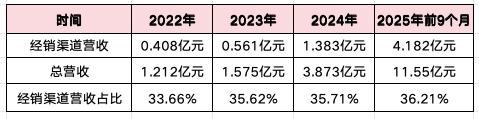
Data source: Unitree's prospectus
After Unitree has run through the profitability of its direct stores and established a high-end brand image, the attractiveness of its products to distributors and the company's bargaining power in negotiations with distributors will both be enhanced.
By then, Unitree can achieve rapid expansion of its offline channels without opening too many direct stores or experience halls.
Compared with opening expensive direct stores, the distribution model has lower costs because the distributors handle the pre-opening preparations such as store location, decoration, and employee recruitment.
At the same time, the sales model of robot distributors is usually similar to that of automobile 4S stores, providing a place for robot sales, leasing, and after-sales services. Considering the interoperability between robots and automobiles in terms of technology, many automobile 4S stores can seamlessly integrate robot products.
Therefore, in the expansion of its distribution channels, Unitree can directly utilize the historical accumulation of automobile 4S stores without investing too much cost in recruiting or training "robot 4S stores." According to data from the China Automobile Dealers Association, as of the end of 2025, the total number of automobile 4S stores in the country was 32,432.
However, in the robotics track, Unitree, Zhipu, and Songyan are not the only emerging players. Xiaomi plans to announce the mass production progress of its robot CyberOne's Yizhuang production line in the second half of this year, and Honor plans to launch a commercial pilot for consumer-grade robots from the end of 2026 to the beginning of 2027.
When cash-rich large companies offer olive branches and more favorable sales policies to distributors, the latter will surely not refuse.
Therefore, although Unitree has gained a first-mover advantage in offline layout, it also needs to quickly convert this advantage into C-end sales, so that distributors can make real money and maintain its first-mover advantage.
03 At present, "strengthening the brain" is as important as opening stores
Unitree needs to accelerate not only the store-opening layout but also the "strengthening of the brain."
A humanoid robot consists of three architectures:
l Brain: Represented by the embodied large model, it is responsible for perceiving the outside world and simulating human decision-making thinking;
l Cerebellum: Represented by the embodied body intelligence, it is responsible for complex bionic motion control;
l Body: The physical structure and execution device of the robot.
Unitree is in the leading position in the cerebellum and body frameworks. Therefore, Unitree's robots have been on the Spring Festival Gala stage for two consecutive years, and the company has continuously reduced costs through a self-research rate of more than 90% of core components, thereby leading in market share through price advantages.
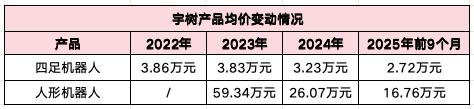
Data source: Unitree's prospectus
However, Unitree's "brain" is not as prominent as the other two. Recently, Wang Xingxing, the founder of Unitree, said at the 2026 Yabuli Forum that if a robot has been trained in one or a few scenarios in advance, its work success rate can basically reach 100%. However, if it is placed in an unfamiliar scenario, the success rate will drop significantly. "So we must improve the generalization ability of humanoid robots or embodied intelligence."
In other words, only by doing a good job in the "brain" can robots truly enter the C-end scenarios such as households and companions on a large scale. Unitree is trying to solve this problem, and the fundraising plan of this IPO shows the company's priorities.
In this IPO, Unitree plans to raise a total of 4.201 billion yuan. The largest amount, 2.022 billion yuan, will be used for the R & D project of intelligent robot models, 1.11 billion yuan will be used for the R & D project of robot bodies, and the remaining funds will be used for new product development and manufacturing base construction projects.
If Unitree fails to make up for its deficiencies in the "brain" as expected and its competitors take the opportunity to widen the gap, the company may lose its leading position in the industry. After all, in a rapidly developing emerging industry, anything can happen.
Currently, Zhipu Robotics is Unitree's biggest domestic competitor. According to data from market research firm Omdia, in 2025, Zhipu's shipments were 5,100 units, not far behind Unitree (over 5,500 units).
In addition to the threats from startups, when large companies achieve large-scale mass production of robots, they can also achieve cost reduction in the supply chain due to their scale. By then, Unitree's price advantage may no longer be as prominent as before.
Moreover, although large companies started late, there are many common technologies between mobile phones, automobiles, and robots, and their catching-up speed may be beyond imagination.
In April this year, in the Beijing Yizhuang Humanoid Robot Half Marathon, the favorite to win, Unitree's H1 robot lost control and fell, and was carried off the track on a stretcher. Meanwhile, Honor's humanoid robot "Lightning," which was not initially favored, took the top three places. At that time, Honor's robotics department had only been established for about 10 months (around June 2025).
It is not difficult to see that Unitree, which has grown into a leading player in the industry, is facing a new major test.
This article is from the WeChat official account "Alpha Factory Research Institute," written by Si Che and published by 36Kr with permission.