In 2026, the Hong Kong stock market ushers in the "Southeast Asia Moment".
Southeast Asian enterprises are flocking to Hong Kong for IPOs.
This is the most interesting change in the "circle of friends" of the Hong Kong stock market since 2026.
Chen Yiting, the Chief Executive Officer of the Hong Kong Stock Exchange, revealed in February that currently, 488 enterprises are waiting to list in Hong Kong, among which more than 10 are international companies. According to the big - data summary of LiveReport, the international enterprises going public in Hong Kong mainly come from Southeast Asia, covering multiple fields such as fintech, food and beverage retail, and travel services.
Yes, you read it right. A large number of Southeast Asian enterprises are regarding Hong Kong as their top choice for listing. This includes leading players in various fields such as Yongkang Holdings, the second - largest container yard operator in Southeast Asia, Keli, a mother - and - baby and nutritional supplements enterprise, and MNC Digital, a leading digital media and entertainment group in Southeast Asia.
There are also rumors that more than a dozen well - known Southeast Asian enterprises are planning to list in Hong Kong, covering multiple industries such as catering, digital currency, aerospace, and mining.
The "Circle of Friends" of the Hong Kong Stock Market is Expanding Rapidly
Let's first look at a set of figures.
Statistics show that in the first four months of 2026, about 317 enterprises (excluding those submitting confidential listing applications) submitted listing applications to the Hong Kong Stock Exchange. Among them, 312 applied for the Main Board, with an average of more than 2.6 applications submitted per day. The successful cases of Southeast Asian companies that have already listed have sent out very positive signals.
On January 13 this year, BBSB International Limited, a Malaysian civil engineering contractor (abbreviated as "BBSB"), officially listed in Hong Kong at an issue price of HK$0.60 per share. On the first day of listing, its stock price opened 400% higher and closed at HK$3.00 per share, becoming a hot topic among many investors.
Even more exaggeratedly, it received an over - subscription of 10,745.13 times during the public offering stage, becoming a rare "over - ten - thousand - times" over - subscription in the Hong Kong stock market recently.
It is a miracle that a small - and - medium - sized construction company from Malaysia (BBSB is the enterprise with the smallest fundraising scale on the Hong Kong Stock Exchange in the first quarter) can trigger such a huge subscription frenzy in Hong Kong.
Earlier - listed Southeast Asian enterprises also achieved good results. For example, Mirxes, a Singaporean RNA technology company, and IFBH, a Thai coconut water giant, saw their stock prices rise by 27.9% and 42.09% respectively on the listing day.
Behind the high market expectations is the extension of a new wave of Hong Kong IPO boom to the global market.
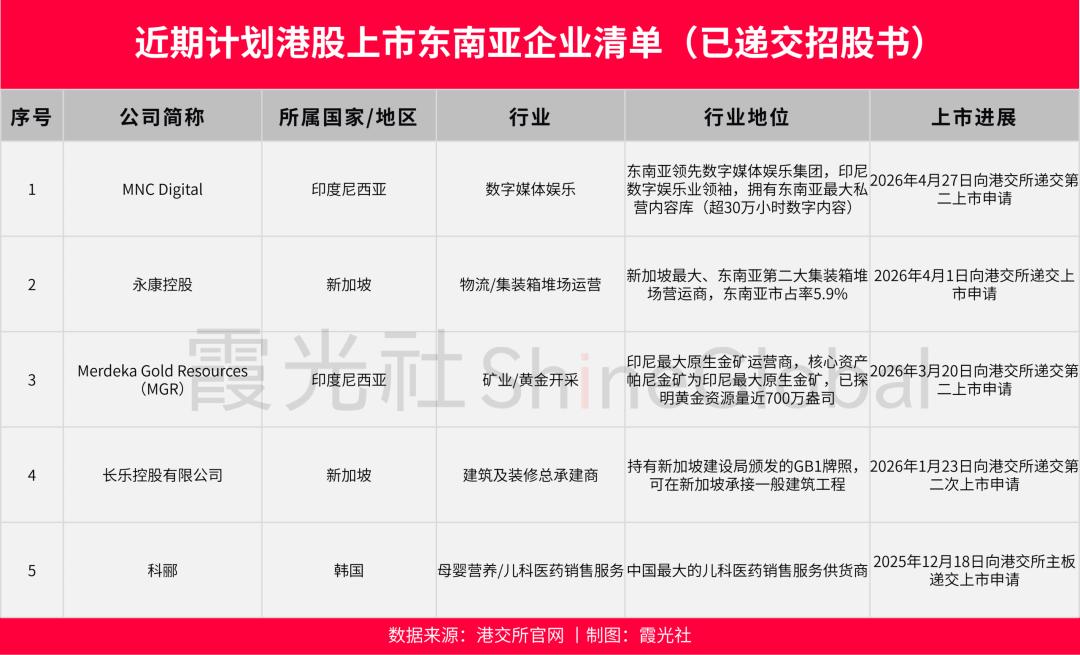
Data shows that there are already more than 10 international enterprises in the queuing list, mainly from Southeast Asia, with their businesses covering multiple popular fields such as fintech, food and beverage retail, and travel services.
For example, Yongkang Holdings, which has submitted its listing application, is the leading container yard operator in Singapore and the second - largest in Southeast Asia, with the highest market share of 16.2% in Singapore and a 5.9% market share in Southeast Asia. It mainly provides services for container shipping companies and container leasing companies operating in the ASEAN region and China. There is also MNC Digital, a digital media and entertainment group from Indonesia, which owns the largest private content library in Southeast Asia, with a total digital content duration of over 300,000 hours. It also operates RCTI+ and the SVOD platform Vision+, with a combined monthly active user base of about 110 million for the two platforms, and it is already listed on the Indonesian Stock Exchange.
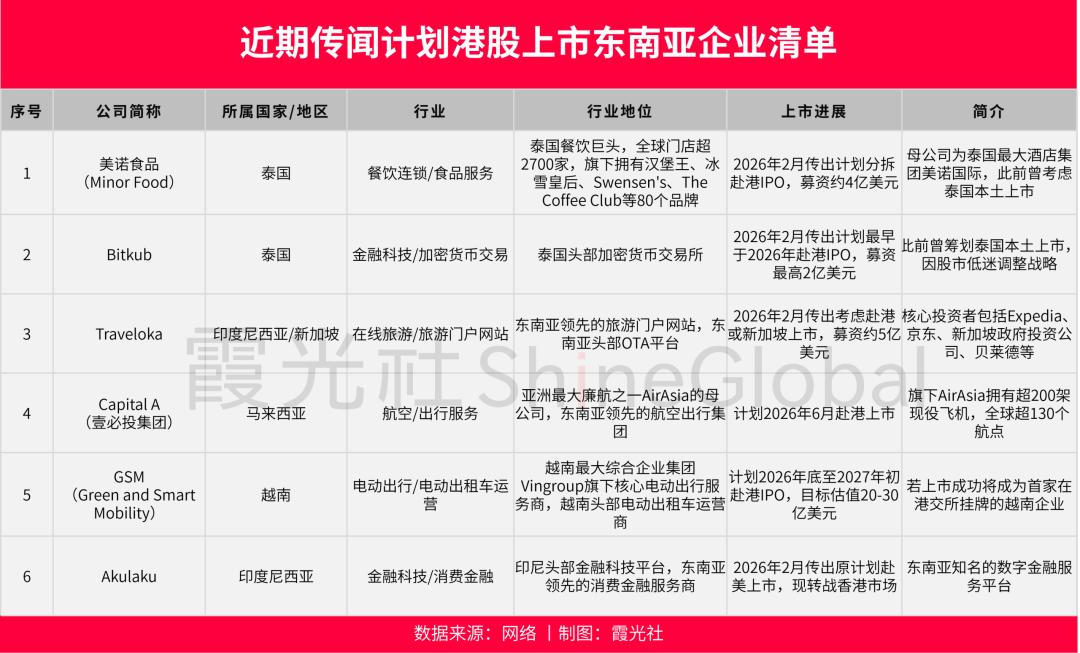
There are also rumors that many well - known companies, including Minor Food Group, a Thai fast - food giant that owns international brands such as Burger King, Dairy Queen, and Swensen's; Bitkub, a well - known cryptocurrency exchange; Traveloka, a well - known travel portal; Merdeka Gold Resources, a listed Indonesian mining company; Capital A, the parent company of AirAsia, a Malaysian low - cost airline; and GSM, an electric taxi operator under Vingroup, a Vietnamese conglomerate, are all planning to seek listing in Hong Kong.
These well - known names are setting off from Bangkok, Jakarta, Kuala Lumpur, and Ho Chi Minh City and heading towards Hong Kong's capital market, staging a new story of "going north".
Some analysts said that for international enterprises, choosing a market with high liquidity for listing is more in the interests of shareholders, and the activity of the Hong Kong IPO market and the secondary market just meets these requirements. In addition, companies listed in Hong Kong also have the opportunity to be included in the Hong Kong - stock Connect program, which will further expand the investor channels and enhance their brand awareness in the mainland market.
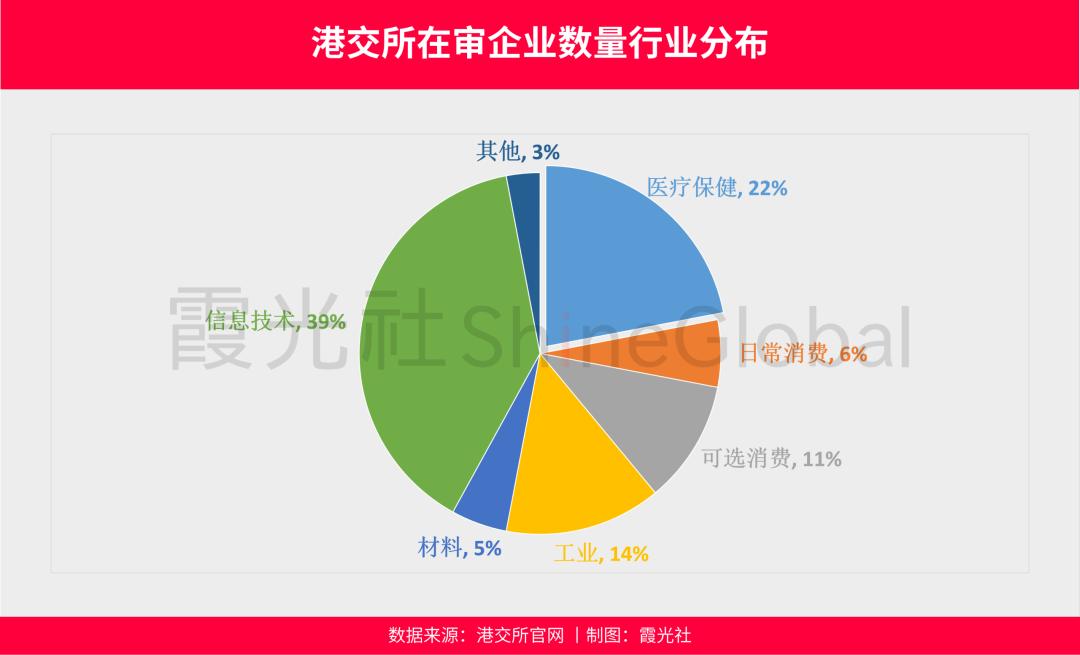
Chen Yiting, the Chief Executive of the Hong Kong Stock Exchange, said that in recent years, the Hong Kong Stock Exchange has received increasing attention in international arenas. This reflects that global investors are actively seeking diversified asset allocation and hope to seize investment opportunities in Hong Kong, the Chinese mainland, and the Asian market.
With the Hong Kong IPO market achieving a successful start, many institutions hold an optimistic outlook for the Hong Kong IPO market in 2026.
Li Zhenguo, the Vice Chairman of the Global Investment Banking Department of UBS and the Co - Head of the Asian Corporate Client Department, said that he is optimistic about the Hong Kong stock market in the second half of the year and is confident that the market can break through the 30,000 - point mark this year. He also estimates that the fundraising amount of the Hong Kong new - share market can reach HK$350 billion to HK$400 billion, and the number of IPOs will be between 150 and 200.
Huatai Securities predicts that the IPO financing scale of the Main Board of the Hong Kong stock market in 2026 will be about HK$310 billion, and the number of listed companies will be about 100. Deloitte forecasts that about 160 new shares will be listed in the Hong Kong new - share market in 2026, with a fundraising amount of no less than HK$300 billion.
Why Hong Kong?
It is not accidental that so many Southeast Asian enterprises are targeting Hong Kong for listing.
Yuan Mei, the Investment Research Director of Sullivan Jieli (Shenzhen) Cloud Technology Co., Ltd., analyzed that the active performance of the Hong Kong IPO market and the secondary market is the core factor attracting Southeast Asian companies to list in Hong Kong.
Specifically, when enterprises choose a listing location, they mainly value three things - abundant capital, high valuation, and convenient financing. The current Hong Kong stock market meets all these requirements.
Let's first look at the capital aspect. In 2025, the Hong Kong IPO market recorded a total fundraising amount of HK$286.7 billion, a year - on - year surge of 225.9%, and it regained the top position in global fundraising after four years. Hu Linghan, the Co - Head of the Asia - Pacific Equity Capital Markets of the Global Investment Banking Department of UBS, pointed out that since the beginning of 2026, the Hong Kong new - shares (IPO) have raised HK$152 billion so far, a year - on - year increase of 130.5%.
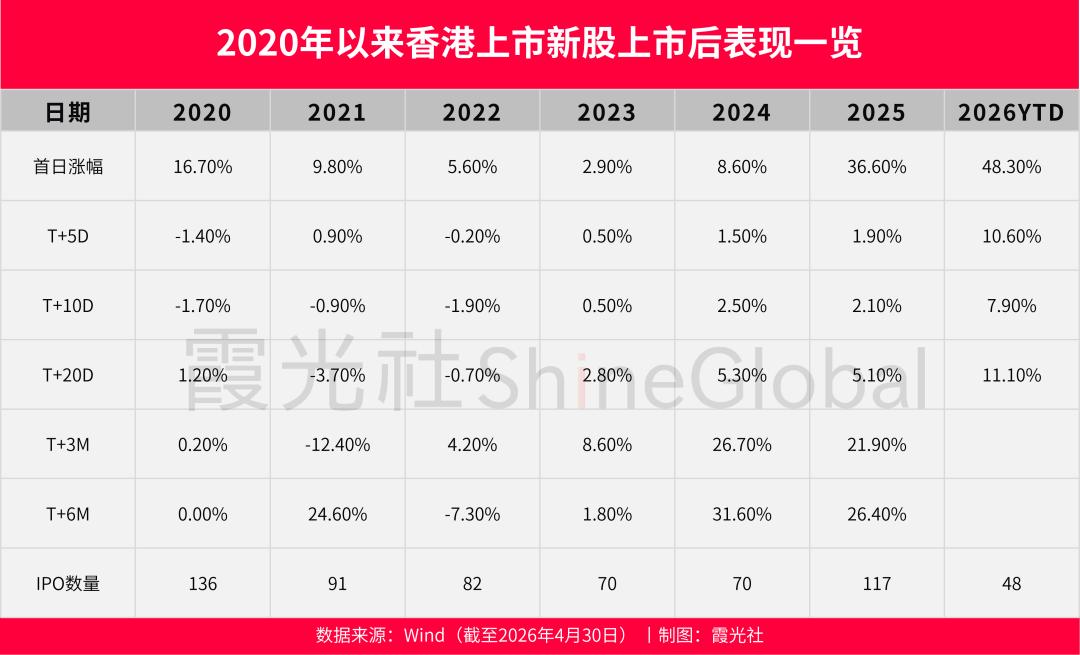
Then, look at the investment returns. From 2025 to 2026, the profit - making effect of new shares in the Hong Kong stock market reached the highest level in recent years. As of the end of April, the average first - day return rate of new shares listed in 2026 was about 48.3%, further rising from 36.6% last year, far higher than the average level (about 8%) from 2019 to 2024. The average break - even rate has further dropped from 27% last year to 12%. It is worth noting that the short - term performance of new shares after listing this year is relatively good, with an average increase of 10.6% in the first 5 days after listing and an average increase of 11.1% in the first 20 days after listing.
Finally, there is the convenience of financing. The Hong Kong Stock Exchange officially launched a new platform, STAGE, earlier, which is Asia's first sustainable financial product platform for multiple asset classes, aiming to attract international enterprises to list in Hong Kong. In addition, the Hong Kong Stock Exchange has entered into arrangements with recognized stock exchanges such as the Stock Exchange of Thailand, the Indonesia Stock Exchange, the Singapore Exchange, and Bursa Malaysia.
Chen Yiting publicly stated: "The cooperation memorandum we signed with Bursa Malaysia will explore how to develop more dual - listing channels. Currently, more than 150 Southeast Asian companies have listed in Hong Kong, with a total fundraising amount of more than US$4.3 billion. Hong Kong has become the most popular overseas listing destination for Southeast Asian companies."
Moreover, since 2025, international funds have been flowing back to the Hong Kong stock market significantly. According to Goldman Sachs' observation, when the market was at a low point at the beginning of 2024, the participation rate of major international long - term funds in IPO projects of Chinese issuers was only 10% - 15%, while recently, the participation rate has climbed to 85% - 90%.
It has become the best time to list and raise funds in Hong Kong.
Yang Tao, the Deputy Director of the National Institute of Finance and Development, pointed out that objectively, Hong Kong is favored by global capital. On the one hand, it still maintains outstanding attractiveness. For example, in many international financial center evaluation indices in recent years, Hong Kong has consistently ranked third, only after New York and London. On the other hand, the steady progress, quality improvement, and efficiency enhancement of the mainland economy have played an important supporting role in Hong Kong's economic status.
Strategic Value More Important Than Money
If it's just about "abundant capital", the story would be too superficial.
What really attracts the Southeast Asian giants is the unique strategic value that Hong Kong can provide.
MNC Digital clearly stated in its prospectus that choosing to list in Hong Kong is to "create a strategic gateway to enter the Asian market" and regards Hong Kong as "one of the most convenient and accessible financial centers in Asia" to enhance regional awareness and connect with international capital.
In other words, "I'm not just here to raise funds. I'm here to use Hong Kong as a platform to open up a larger market."
Indeed, Hong Kong has a "unique" dual identity - it belongs to the global capital system and is also deeply connected to the Chinese mainland market. On the one hand, as a global free - capital port, Hong Kong has unrestricted capital flow, a legal system in line with international standards, and a diversified investor structure (institutional investors account for more than 60%), which can meet the basic needs of enterprises for international financing. On the other hand, through the Shanghai - Hong Kong and Shenzhen - Hong Kong Stock Connect mechanisms, the Hong Kong stock market can directly connect with the over - one - hundred - trillion - level resident wealth and institutional funds on the mainland. In 2025, the cumulative net inflow of south - bound funds through the Stock Connect programs exceeded HK$1.4 trillion, and the allocation ratio of south - bound funds to Hong Kong stocks has been continuously increasing, providing continuous liquidity support for enterprises.
However, although 2026 is a big year for IPOs in the Hong Kong stock market, it may also be a year of adjustment, especially for enterprises from outside Southeast Asia.
First of all, public data shows that nearly 20 Malaysian enterprises have listed in Hong Kong, but most of them have a market value of only between HK$100 million and HK$1 billion, and some are even below HK$300 million for a long time, seemingly excluded from the mainstream capital ecosystem of the Hong Kong stock market.
An investment banker also pointed out a practical problem. If foreign companies lack "Chinese elements", it may be difficult for them to attract investors in Hong Kong. In other words, having only a Southeast Asian background is not enough. They need to make investors in Hong Kong and the mainland understand and be willing to invest.
Secondly, there is the potential impact of the global economic environment. Huatai Securities released a Hong Kong stock strategy, stating that the Hong Kong stock market currently faces two major external tests. On the one hand, the impact of the crude oil supply shock is approaching the critical point of concentrated release. On the other hand, inflation expectations are pushing up global government bond yields, and monetary policy has limitations in dealing with supply shocks. Huatai Securities suggests coping with the headwinds of valuation and liquidity with the certainty of the profit side and laying out along two main lines: the certainty of cash - flow and the certainty of industrial trends.
Finally, there is the upcoming "lock - up expiration wave". According to Wind data, as of May 19, the scale of lock - up expirations in the Hong Kong stock market this year is as high as HK$1.55 trillion. Looking at the monthly data, the peak of lock - up expirations is concentrated in the second half of this year, with the scale from July to December reaching HK$1.15 trillion, accounting for more than 70%. Among them, September this year will see the peak of lock - up expirations.
This wave of lock - up expirations in the Hong Kong stock market features cross - year and batch - by - batch releases. The market is worried that the unlocking pressure of over one trillion Hong Kong dollars will drag down the market trend, especially having a greater impact on small - cap stocks with weaker liquidity.
Liu Chenming, the Chief Strategy Analyst of GF Securities, believes that the capital withdrawal from the primary market usually does not have an absolute impact on the trend of the Hong Kong stock market. In 2025, during the two IPO peaks in May and September, the Hang Seng Index and the Hang Seng Tech Index both achieved positive returns, and the market even saw a volume - increasing rise in September. Looking over a longer period, IPO peaks and fundraising peaks (including post - listing fundraising, i.e., placings + rights issues + consideration issues) will not reverse the trend of the Hong Kong stock market. For example, in 2010, 2014 - 2015, 2017, 2020, and 2025, the fundraising peaks in the Hong Kong stock market all corresponded to bull markets in the Hong Kong stock market. This may be because the Hong Kong stock market improved significantly, and some enterprises had expansion needs and chose to raise funds in the capital market at a relatively high point.
"Hong Kong IPOs will not cause the market to turn bearish. Instead, due to the surge in the market's demand for Hong Kong dollars,