From "selling computers" to "selling AI", where has Lenovo reached?
"Achieve over $100 billion in revenue in two years", "Double the net profit margin", and "Fully transform into an AI-native company". These are the strategic goals set at Lenovo Group's 2026/27 fiscal year oath-taking conference held in Beijing on April 1st.
The just-concluded 2025/26 fiscal year (April 1, 2025 - March 31, 2026) is also defined as the "starting year of Lenovo's new AI decade".
In this year, Lenovo Group's revenue reached 589.9 billion yuan (approximately $83.1 billion), a year-on-year increase of 20%. The adjusted net profit increased by 42% year-on-year. For the first time in history, the three major business groups, IDG (Intelligent Devices), ISG (Infrastructure Solutions), and SSG (Solutions & Services), all achieved full-year profitability.
What's more crucial is the structure. The proportion of non-personal computer business revenue has been increasing year by year. The annual AI-related revenue increased by 105% year-on-year, accounting for 33% of the total revenue. In the fourth fiscal quarter, this proportion further increased to 38%.
On the day the financial report was released, Lenovo Group's stock price closed up 19.77%.
This financial report, which represents significant achievements in the transformation, also has its vulnerabilities. For example, the profit foundation of ISG is not yet solid. Soaring storage costs, industrial migration, and industry competition are all real constraints that are difficult to avoid.
I. Structural Changes: No Longer Just a Computer Seller
Lenovo as a "computer seller" is becoming a thing of the past.
With the release of Lenovo Group's 2025/26 fiscal year performance, this trend is becoming clearer.
The IDG business, which is also the most well-known part of Lenovo to the outside world, sells PCs, mobile phones, and tablets. Its full-year revenue was $58.9 billion, contributing about two-thirds of the income. However, the growth rate of this segment was 17%, the lowest among the three major businesses, and its share of revenue also declined.
In response to this, the proportion of non-personal PC business has approached half of the total revenue.
The ISG business had a revenue of $19.2 billion, with a growth rate of over 32%, leading the three major segments. The SSG revenue exceeded $10 billion, with a growth rate of 19%, and it has maintained double-digit growth for 20 consecutive quarters.
In other words, the fastest-growing part is no longer Lenovo's most "traditional" business.
This structural change has a profound impact on profits.
In the past few fiscal years, Lenovo's profit pattern was typically "two making money and one burning money", that is, IDG and SSG contributed profits, while ISG suffered losses. In FY25/26, this pattern was broken for the first time.
IDG's full-year operating profit was approximately $4.22 billion, with an operating profit margin of 7.2%. It is still the major contributor to profits, accounting for about 64.6% of the operating profit.
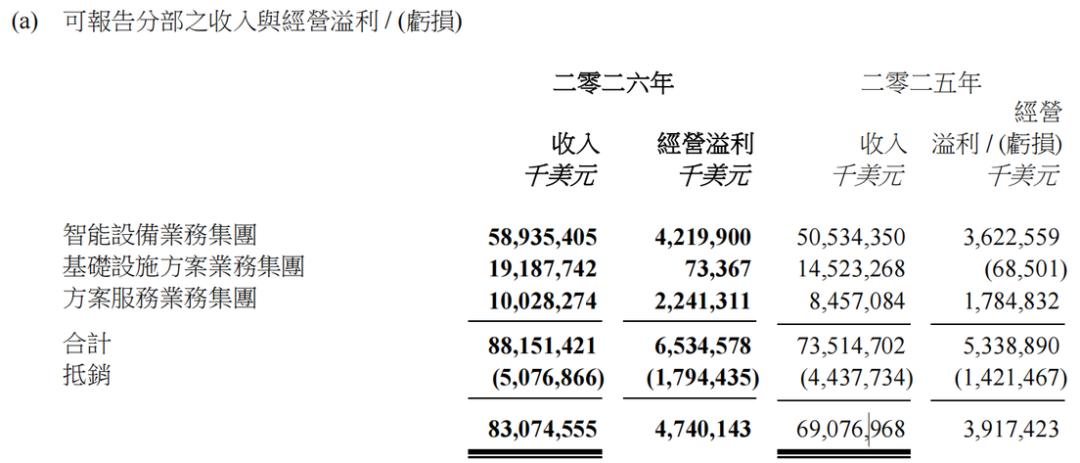
SSG's full-year operating profit was approximately $2.24 billion, with an operating profit margin of 22.4%. This segment, which accounts for less than 12% of the group's revenue, contributed one-third of the operating profit and is the most stable high-profit source in Lenovo's profit statement.
ISG's full-year operating profit was $73 million, turning from a loss of $68.5 million in the same period of the previous year to a profit, with an operating profit margin of approximately 0.38%. If we look at the trend, the operating profit margin in the last quarter reached 3.58%, showing an obvious improvement trend.
SSG serves as the ballast for profits, IDG provides the scale base, and ISG's switch from "dragging down" to "positive contribution" is the core change in the profit structure of this annual report.
Coupled with the increase in the proportion of AI revenue, AI has changed from a vague strategic narrative to a separately measurable revenue line in the financial report, which together constitutes the logic for Lenovo's revaluation.
However, the transformation is not entirely safe. The goal of reaching $100 billion in revenue in two years requires an average annual revenue growth rate of 10%. Although it is not overly aggressive, there are still uncertain factors.
Firstly, there is a historic surge in memory prices.
TrendForce data shows that in the first quarter of 2026, the global general DRAM contract price increased by 90% to 95% quarter-on-quarter. The single-quarter increase in PC DRAM reached 110% to 115%, and the spot price of DDR5 increased by more than 300%. The price of some DDR4 chips soared from a low of $3.2 in 2025 to $15, a cumulative increase of 369%.
The cost pressure is directly reflected in the finished product. According to TrendForce's calculation, based on a mainstream notebook with a recommended retail price of $900 in Q1 2025, by Q1 2026, the proportion of memory and solid-state drives in the material cost has increased from 15% to 30%. After the CPU price increase, the combined proportion of the three has jumped from 45% to 58%. To maintain the profit structure of each link in the supply chain, the price of this product needs to be increased by nearly 40%.
Lenovo's COO also admitted in a public statement before the financial report: "The cost pressure of memory and solid-state drives is greater than ever."
Lenovo's response is to stockpile goods. CFO Zheng Xiaoming previously revealed that the storage inventory at the end of the third fiscal quarter was equivalent to 7 - 8 months of usage, far exceeding the industry average of 2 - 3 months.
However, stockpiling can only postpone the pressure, not eliminate it.
As the inventory is gradually consumed, the cost pressure will fully enter the cost side in Q1 FY27. Whether Lenovo can maintain the 16.4% gross profit margin in the fourth fiscal quarter will be a real test for the company.
Tariff uncertainty is another variable. The revenue in the Americas region accounts for about 34% of Lenovo's annual total revenue, making it the largest regional market. A significant part of Lenovo's production bases are in China, and the direction of tariff policies will affect its sales performance in the North American market.
As Yang Yuanqing said, in the first half of the year, Lenovo needs to deal with the dynamic changes in tariff pressure, and in the second half of the year, it also needs to face the challenges brought by component shortages.
II. IDG: Can the 17% Growth Rate Be Sustained?
IDG's year-on-year growth rate was 17%. The revenue of the PC and intelligent device business increased by 26% year-on-year, setting a new high in the past five years. In the fourth fiscal quarter, Lenovo's global PC market share was 24.4%, an increase of 1.3 percentage points compared with the same period of the previous year, reaching the highest level in 15 years. The proportion of high-end PC shipments reached 50%, a year-on-year increase of 29%.
When discussing IDG, we have to talk about the PC business.
Against the backdrop of the industry, the global PC market recovered in 2025, with an annual shipment of approximately 279 million units, a year-on-year increase of about 9%. Lenovo's growth rate during the same period was significantly higher than the industry average. IDC data shows that Lenovo's PC shipments in 2025 were 70.85 million units, a year-on-year increase of 14.6%.
This shows that Lenovo is not only benefiting from the industry's recovery but also seizing market share from its competitors in the stock competition.
However, the PC is ultimately a mature industry, and the global annual shipment has long fluctuated in the range of 250 million to 280 million units. Can Lenovo maintain such a growth rate?
Let's first look at the reasons for the recovery of the PC market this time.
The most rigid driving force comes from Microsoft. On October 14, 2025, Microsoft officially terminated its support for Windows 10. Currently, about 40% of the world's PCs still run Windows 10. These existing devices are facing a cut-off of security updates. For commercial customers, replacing the devices is a necessary option. Many industry analysts believe that "the market growth is mainly driven by the replacement of the operating system."
The second factor is the natural replacement of devices purchased during the pandemic. A large number of PCs were purchased during the pandemic from 2020 to 2021. According to the 3 - 5 year replacement cycle of commercial devices, they are now entering the stage of concentrated replacement. This wave of demand has a clear time window, but the window will not always be open.
The third factor is AI PCs. Huang Renxun's judgment at CES 2025 was that the sales of AI PCs in 2024 were mediocre. The root cause was that the investment in the AI ecosystem on the terminal side was far less than that in the cloud, and the demand had not been effectively met.
In other words, enterprises' current procurement of AI PCs is more of a "forward-looking configuration" for fear of falling behind in the next 1 - 2 years, rather than having a scenario where AI PCs can solve real - time needs today.
The first two factors are cyclical, and the third is the endogenous variable driving the growth of PC sales.
Whether AI PCs can take over independently and at what speed their penetration rate will increase are affected by multiple factors, such as the matching degree between price and performance and the existence of applications that can only be used locally.
Gartner predicted in the second half of 2025 that the penetration rate of AI PCs would reach 55% in 2026, optimistic about the replacement wave driven by AI PCs. However, due to the increase in BOM (bill of materials) costs, it was said that the market penetration rate of 50% could only be achieved from 2026 to 2028.
The situation on the profit side also needs to be examined in detail.
The terminal price of AI PCs is indeed higher, but the cost is also more expensive.
Industry data shows that AI PCs with the same configuration are 20% to 40% more expensive than traditional PCs, and commercial models are generally priced above $1000. However, AI PCs need to be additionally equipped with AI - specific hardware such as NPUs, which also increases the material cost.
In terms of data, against the background of continuous product structure upgrading and the proportion of high - end PC shipments reaching 50%, IDG's operating profit margin of 7.2% is almost the same as that of the previous fiscal year.
Considering the soaring storage costs, it is indeed not easy to maintain a 7.2% profit margin in such an environment. But this also shows that the current contribution of AI PCs is more about maintaining the status quo rather than opening up new space or becoming a new growth pole.
III. ISG: Turned a Profit, but the Profitability Is Still Insufficient
ISG's turnaround from loss to profit is an important turning point in Lenovo's AI narrative.
Where does the turning point come from?
First, global AI capital expenditure has entered a period of rapid growth. The total AI capital expenditure of the four major North American cloud service providers exceeded $340 billion in 2025, a year-on-year increase of 68%, and it is expected to further increase in 2026. Domestic cloud providers have also stepped up their efforts. ByteDance, Tencent, and Alibaba have all accelerated their AI infrastructure layout.
The explosive growth on the demand side has directly driven Lenovo's ISG business. The full-year revenue of AI servers increased by more than 50% year-on-year, and the reserve orders for AI servers reached $21 billion by the end of the fiscal year.
More importantly, this round of procurement is no longer a simple increase in the volume of standardized servers. Public information shows that NVIDIA's GB300 NVL72 rack solution began to be delivered in the fourth fiscal quarter, and the next-generation platform based on the Rubin architecture will also be launched in the second half of the year. This means that Lenovo has upgraded from selling standardized servers to delivering rack-level systems and has officially entered NVIDIA's latest generation of supply systems.
Second, enterprise customers have started to pay for AI. Traditional enterprises such as banks and the manufacturing industry have also started to deploy AI servers. The gross profit margin of the E/SMB business targeting such customers is much higher than that of CSP (cloud infrastructure). For example, in the third fiscal quarter, Lenovo's E/SMB business in the Chinese region increased by 52% year-on-year, far exceeding the growth rate of CSP.
However, the profit is still thin.
The annual operating profit margin is only 0.38%, which is still very low in the server industry. For reference, the operating profit margin of Dell's ISG department in the most recent fiscal quarter reached 14.8%. Lenovo's ISG still has a long way to go to reach the mature level of the industry.

The thin profit is related to Lenovo's customer structure.
The main revenue of ISG comes from CSP orders, which are large in volume but have extremely low gross profit margins. In other words, for ISG to truly achieve stable profitability, the proportion of E/SMB in the revenue structure is more important than the size of CSP orders.
The AI demand is shifting from "training" to "inference", and this trend is acting on both of ISG's business lines.
This is not a unique opportunity or risk for Lenovo's ISG but a structural shift that the entire AI infrastructure industry has to face. In 2026, the total AI inference computing power of the top five North American CSPs is expected to increase by nearly 1.22 times, far exceeding the 56% growth rate of training.
For Lenovo, there are both positive and negative impacts.
The positive aspect is that the expansion of inference demand means that more traditional enterprises have a demand for deploying AI servers, which is exactly the target market of E/SMB. If this trend continues, the proportion of E/SMB in ISG's revenue is expected to naturally increase, thereby improving the overall profit structure.
In addition, inference has a greater demand for memory. Lenovo completed the acquisition of the Israeli high - end storage company Infinidat in April, leaving a card for the subsequent optimization of the profit structure.
The negative aspect is that the requirements for servers in the inference era are different from those in the training era.
On the one hand, inference servers usually do not require top - of - the - line GPUs, and the brand premium space is narrower. On the other hand, cloud providers are more inclined to self - develop chips (such as Google's TPU and Amazon's Trainium) or switch to lower - cost ODM white - label servers during the inference stage. These may squeeze the revenue of Lenovo and other manufacturers as integrators.
At the same time, Huawei has formed a closed - loop in the domestic - substitution market with its full - stack self - developed ecosystem of Ascend AI chips, and Inspur Group has deep roots in the Internet and government affairs fields. Lenovo still mainly relies on external chips such as NVIDIA and does not have an advantage in terms of cost and supply chain security.
ISG's turnaround from loss to profit proves that Lenovo has obtained a ticket in the wave of AI infrastructure, but there are still new challenges ahead. Only by overcoming them can Lenovo firmly stay at the table.