Von "Computer verkaufen" zu "KI verkaufen": Wie weit ist Lenovo inzwischen gekommen?
„Within two years, exceed the annual turnover of 10 billion US dollars“, „Double the net margin“ and „Completely transform into an AI-native company“ – these are the strategic goals that Lenovo Group set at the commitment statement conference for the fiscal year 2026/27 on April 1st in Beijing.
The just-ended fiscal year 2025/26 (April 1st, 2025 – March 31st, 2026) was also defined by Lenovo as the „beginning year of the new AI decade“.
In this year, Lenovo Group achieved an annual turnover of 589.9 billion yuan (about 83.1 billion US dollars), which corresponds to a year-on-year increase of 20%. The net profit calculated after deducting special items increased by 42% compared with the previous year. The three business groups, IDG (Intelligent Devices), ISG (Infrastructure), and SSG (Solution Services), achieved an annual profit simultaneously for the first time in history.
What is even more important is the structure. The proportion of the turnover from non-PC businesses is increasing year by year. The annual turnover from AI-related businesses increased by 105% compared with the previous year and accounted for 33% of the total turnover. In the fourth business quarter, this proportion further increased to 38%.
On the day of the release of the annual report, the stock price of Lenovo Group increased by 19.77%.
This annual report, which represents a significant success in the transformation, also has its weaknesses. For example, the profit base of ISG is not yet stable. The sudden increase in storage costs, industrial migration, and industry competition are all inevitable real constraints.
I. The Structural Change: No Longer Just a PC Manufacturer
Lenovo as a „PC manufacturer“ belongs to the past.
With the release of Lenovo Group's results for the fiscal year 2025/26, this trend is becoming increasingly clear.
The IDG business, which is also the best-known to the public, is Lenovo, which sells PCs, mobile phones, and tablets. The annual turnover was 5.89 billion US dollars and accounted for about two-thirds of the total turnover. However, the growth rate of this area was 17%, the lowest among the three business areas, and its share of the turnover also declined.
Correspondingly, the share of the non-PC business is almost half of the total turnover.
The turnover of the ISG business was 1.92 billion US dollars, with a growth rate of over 32%, making it the leading area among the three business areas. The turnover of SSG exceeded 1 billion US dollars, with a growth rate of 19%, and it has maintained double-digit growth for 20 consecutive quarters.
That is to say, the areas that are growing faster are no longer Lenovo's „most traditional“ business areas.
This structural change has a profound impact on profits.
In previous fiscal years, Lenovo's profit model was typically „two make a profit, one burns money“, i.e., IDG and SSG contributed to the profit, while ISG had losses. In the fiscal year 2025/26, this model was broken for the first time.
The operating profit of IDG for the entire fiscal year was about 422 million US dollars, with an operating margin of 7.2%. It is still the main source of profit, and its share of the operating profit is about 64.6%.
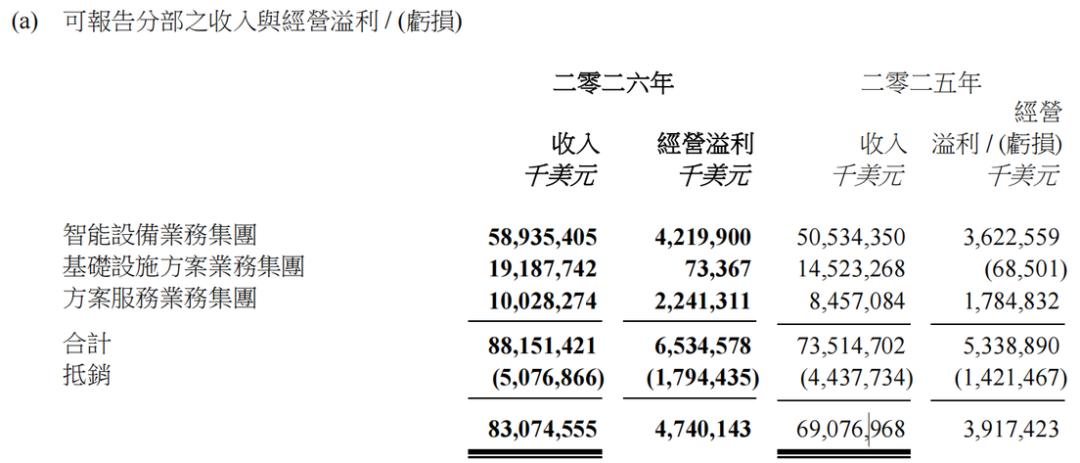
The operating profit of SSG for the entire fiscal year was about 224 million US dollars, with an operating margin of 22.4%. This area, which accounts for less than 12% of the company's turnover, contributed one-third of the operating profit and is the most stable high-profit source in Lenovo's profit and loss statement.
The operating profit of ISG for the entire fiscal year was 73 million US dollars. Compared with the previous year, it changed from a loss of 68.5 million US dollars to a profit, with an operating margin of about 0.38%. Looking at the trend, the operating margin reached 3.58% in the last quarter, showing a significant improvement.
SSG stabilizes the profits, IDG provides the scale basis, and the change of ISG from a „drag“ to a „positive contribution“ is the core change in the profit structure of this annual report.
In addition to the increasing proportion of AI turnover, which has changed from a vague strategic narrative to a separately measurable income line in the annual report, these factors together form the logic for the revaluation of Lenovo.
But the transformation is not entirely certain. The goal of achieving a turnover of one billion within two years requires an average annual turnover growth rate of 10%. Although this is not too aggressive, there are still uncertain factors.
Firstly, it is the historical volatility of storage prices.
Data from TrendForce shows that the global standard DRAM contract price in the first quarter of 2026 increased by 90% to 95% compared with the previous quarter. The increase in PC-DRAM in one quarter even reached 110% to 115%, and the spot price of DDR5 increased by over 300%. The price of some DDR4 chips increased from 3.2 US dollars at the low point in 2025 to 15 US dollars, corresponding to a cumulative increase of 369%.
The cost pressure is directly reflected at the device level. According to estimates by TrendForce, the proportion of storage and SSDs in the material cost of a mainstream laptop with a recommended selling price of 900 US dollars increased from 15% in the first quarter of 2025 to 30% in the first quarter of 2026. After the increase in the CPU price, the total proportion of these three components increased from 45% to 58%. To maintain the profit structure in all parts of the supply chain, the price of this product would have to be increased by almost 40%.
The public statement of Lenovo's COO before the release of the annual report also admitted: „The cost pressure of storage and SSDs is greater than ever before.“
Lenovo's reaction was inventory management. CFO Zheng Xiaoming previously revealed that the storage inventory at the end of the third business quarter corresponded to 7 to 8 months of consumption, far above the industry average of 2 to 3 months.
But inventory management can only shift the pressure, not eliminate it.
With the gradual reduction of inventory, the cost pressure in the first quarter of the fiscal year 2027 will fully flow into the cost side. Whether the gross margin of 16.4% in the fourth quarter can be maintained will be the real test for Lenovo.
The uncertainty of tariffs is another factor. The turnover in the American region accounts for about 34% of Lenovo's total annual turnover and is the largest regional market. A large part of Lenovo's production facilities are located in China. The direction of tariff policy will affect its sales performance in the North American market.
As Yang Yuanqing said, one has to deal with the dynamic tariff pressure in the first half of the year, and in the second half of the year, the challenges due to the shortage of components still have to be overcome.
II. IDG: Can the Growth Rate of 17% Be Maintained?
IDG grew by 17% compared with the previous year. The turnover of the PC and intelligent device business increased by 26% compared with the previous year, which is the highest growth rate in five years. In the fourth business quarter, Lenovo achieved a market share of 24.4% in the global PC market, which increased by 1.3 percentage points compared with the previous year and is the highest value in 15 years. The proportion of high-end PC deliveries reached 50%, corresponding to an increase of 29% compared with the previous year.
When talking about IDG, one cannot avoid the PC business.
In the industry context, it was seen that the global PC market recovered in 2025. The annual delivery volume was about 279 million devices, corresponding to an increase of about 9% compared with the previous year. Lenovo's growth rate was significantly higher than the industry average. According to data from IDC, Lenovo's PC delivery volume in 2025 was 70.85 million devices, corresponding to an increase of 14.6% compared with the previous year.
This shows that Lenovo not only benefits from the industry recovery but also captures market shares from competitors.
But the PC area is ultimately a mature industry. The global annual delivery volume has fluctuated in the range of 250 to 280 million devices for a long time. Can Lenovo maintain such a growth rate?
Let's first look at the reasons for the recovery of the PC market in this round.
The strongest driving force comes from Microsoft. On October 14th, 2025, Microsoft officially ended the support for Windows 10. Currently, about 40% of the global PCs still run Windows 10. These existing devices are excluded from the security update supply. For business customers, replacing the devices is a mandatory option. Many industry analysts believe that „the market growth is mainly driven by the replacement of the operating system.“
The second factor is the natural renewal of devices from the pandemic period. Many PCs purchased during the pandemic from 2020 to 2021 have now reached the phase of concentrated renewal, measured by the renewal cycle of 3 to 5 years for business devices. This demand has a defined time window, but this window will not remain open forever.
The third factor is the AI PC. Huang Renxun judged at CES 2025 that the sales volume of AI PCs in 2024 was disappointing because the investments in the AI ecosystem on the end-device side lagged far behind those in the cloud, and the demand was not effectively satisfied.
In other words, companies currently buy AI PCs more as a „forward-looking configuration“ to avoid falling behind in the next 1 to 2 years than because there are already application scenarios where AI PCs are urgently needed today.
The first two factors are cyclical, and only the third is the endogenous variable that drives the growth of PC sales.
Can the AI PC independently take on the growth role, and at what speed will its penetration rate increase? This will be affected by many factors, such as the match between price and performance and whether there are applications that can only function locally.
Gartner predicted in the second half of 2025 that the penetration rate of AI PCs will reach 55% in 2026 and is optimistic about the replacement wave driven by the AI PC. Due to the increase in BOM costs (material costs), the 50% market introduction will only be achieved between 2026 and 2028.
The profits also need to be examined more closely.
The end-selling price of AI PCs is actually higher, but the costs are also higher.
Industry figures show that AI PCs with the same configuration are 20% to 40% more expensive than traditional PCs. The prices of business models are usually over 1000 US dollars. But AI PCs have to install additional AI-specific hardware such as NPU, which also increases the material costs.
Looking at the figures, the operating margin of IDG is almost the same as in the previous year at 7.2%, although the product structure has been continuously improved and the proportion of high-end PC deliveries reached 50%.
In view of the sudden increase in storage costs, it is actually remarkable to maintain the operating margin of 7.2%. But this also shows that the AI PC currently mainly contributes to maintaining the existing position rather than opening up new markets or becoming a growth engine again.
III. ISG: The Deficit Has Been Eliminated, but the Profitability Is Not Sufficient Yet
The turnaround of ISG from loss to profit is an important turning point in Lenovo's AI narrative.
Where does this turning point come from?
Firstly, global AI capital expenditures have entered a phase of leapfrog growth. The AI capital expenditures of the four major cloud providers in North America totaled over 34 billion US dollars in 2025, corresponding to an increase of 68% compared with the previous year, and it is expected that they will continue to increase in 2026. Chinese cloud providers have also accelerated. ByteDance, Tencent, and Alibaba have all accelerated their AI infrastructure investments.
The explosive growth of demand has directly driven Lenovo ISG's business. The annual turnover from AI servers increased by over 50% compared with the previous year, and the reservation orders for AI servers totaled 2.1 billion US dollars at the end of the fiscal year.
What is even more important is that this round of procurement is no longer simply the mass production of standard servers. Revealed information shows that the Nvidia GB300 NVL72 rack system was delivered in the fourth business quarter, and the next generation of the platform based on the Rubin architecture will be introduced in the second half of the year. This means that Lenovo has upgraded from the marketing of standard servers to the delivery of rack systems and has officially entered Nvidia's latest delivery system.
Secondly, corporate customers are starting to pay for AI. Traditional companies such as banks and the manufacturing industry are also starting to install AI servers. The gross margin of the E/SMB business for this type of customer