Why is programming still a weak point for Google and ByteDance, despite their comprehensive product offerings?
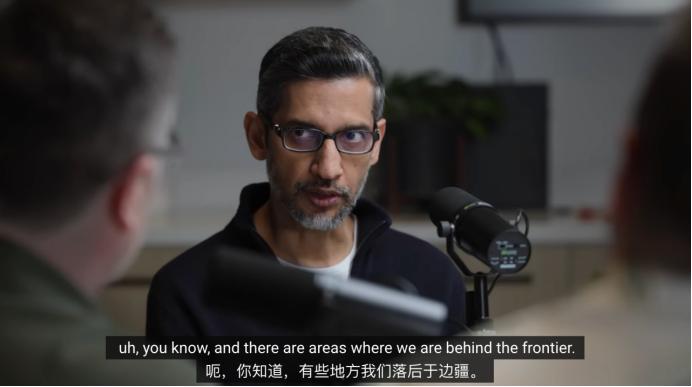
In an interview on a podcast under The New York Times, Google CEO Sundar Pichai admitted that Google has indeed fallen behind in Coding.
Google is quite strong in AI. It has Gemini, a very large Google ecosystem, and its self - developed TPU. At the recent I/O Conference, Google almost integrated AI into all core entrances.
It's not that Google hasn't worked on AI Coding. Antigravity has been brought to the forefront, and Gemini CLI and Gemini Code Assist have also been serving developers. However, having worked on it doesn't mean having achieved success; having a comprehensive ecosystem doesn't mean automatically winning the market.
When it comes to AI Coding, Claude Code, Codex, and Cursor are often the first to come to mind.
Coding has become the earliest battlefield where AI Agents have achieved success. Almost all cutting - edge AI companies are moving in this direction. Even DeepSeek, which didn't gain popularity through programming, has started recruiting around Agent Harness.
It can be said that AI Coding may not be the starting point for every AI company, but it is becoming the common destination for cutting - edge AI companies.
In China, ByteDance's situation is quite similar to Google's. They both have a complete AI ecosystem, but in the field of AI Coding, Trae, like Antigravity, is just one of many replaceable development tools.
If they want to continue to be the all - in - one giants in the Agent era, they need to quickly make up for this shortcoming.
01 Failed to Win Over Programmers
The problem with Google in AI Coding is not the lack of products, but the lack of users.
Codex has over 4 million weekly active users, and Claude Code has won the hearts of developers. A survey of AI tools for software engineers by The Pragmatic Engineer in February this year showed that Claude Code was the most popular tool, accounting for 46%. According to a report by Business Insider on May 23, within startups, Claude Code has become the preferred tool for complex engineering tasks.
In contrast, Antigravity has nothing remarkable. It is just an AI Coding product backed by Google's ecosystem.
In terms of user experience, Antigravity has also failed to gain the trust of developers.
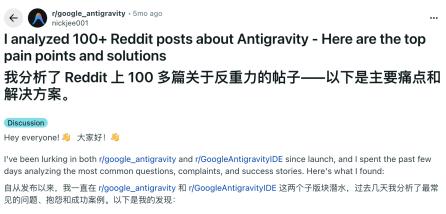
Five months ago, someone specifically compiled more than 100 Antigravity - related posts and classified the most common pain points in the Reddit community into several categories: quota confusion, high resource consumption for performance, security concerns, model selection issues, and the Agent deleting or corrupting code.
These pain points should have been resolved after the update. The release of Antigravity 2.0 was supposed to be an important milestone for Google to catch up in AI Coding. However, the community's response after the update was not very positive.
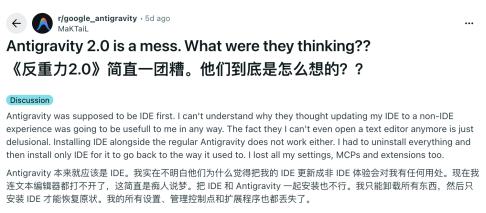
The biggest current controversy is that Antigravity 2.0 suddenly changed the originally IDE - like experience to a more Agent - Manager - like interface. Users couldn't find the familiar editor, file tree, terminal, version control, and extension environment and had to adapt to the new interface.
Perhaps Google thought this was progress towards a more intelligent direction. However, the fact is that before fully establishing trust, Google tried to make developers jump from "controllable IDE collaboration" to "black - box Agent scheduling", which is equivalent to completely abandoning the previous model and the original group of users.
The problem of quota confusion still exists and has become even worse.
Since May 20th, Gemini's quota mechanism has shifted from a per - item basis to a more computing - power - consumption - based one. Antigravity's official statement says that Pro users have a 5 - hour refresh mechanism, but there is also a weekly limit. Users don't know how much a single Agent task will consume, nor do they know when they will reach the weekly limit. Once the quota is reached midway, the development process may be directly interrupted.
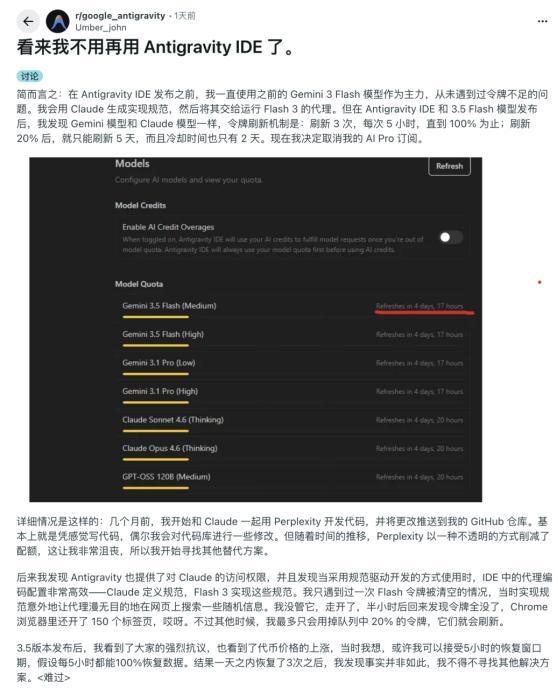
Even more critically, Google's newly released Gemini 3.5 Flash, although fast, is not stable enough in programming.
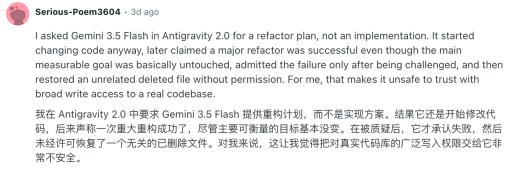
Some users complained that when they just asked Gemini 3.5 Flash for a refactoring plan, it directly started modifying the code. Then it claimed that the refactoring was successful, but the core goals were hardly achieved. Finally, it even restored an irrelevant file without permission.
Other users complained that after clearly specifying the target file, line number, and modification requirements, 3.5 Flash still repeatedly explored the same group of files instead of directly making the code changes. And tokens were burned as if they were free during this process.
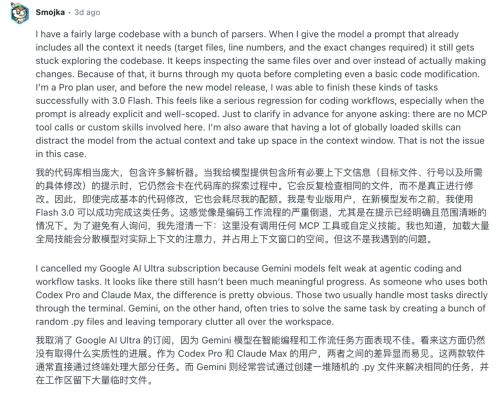
On one hand, the product form suddenly changed from IDE collaboration to Agent Manager, and users felt that their original workbench was removed. On the other hand, the quota rules were opaque, and long - term tasks might be interrupted halfway. Coupled with the fact that the execution stability of Gemini 3.5 Flash in real code repositories is still in question, Antigravity has not been able to prove to developers that it is trustworthy.
02 Google Has Started to Make Up for the Shortcomings
However, Google is not unaware of the problems.
In the latest interview, Google CEO Pichai actually clearly pointed out Google's shortcomings: In terms of text, multi - modality, voice, audio, reasoning, and overall intelligence, Google is still very competitive. But in AI Coding, tool usage, instruction following, and long - term tasks, Google has indeed fallen a bit behind.
Pichai specifically mentioned that Google may have lacked data streams and products similar to Claude Code or Cursor in Coding in the past.
This is also the logic behind Google's current catch - up actions.
For a long time in the past, Google's AI tools for developers were relatively scattered: Gemini Code Assist, Gemini CLI, Antigravity, and Firebase - related tools all existed, but it was difficult to form a clear main entrance. After the I/O Conference, Google started to centralize this line around Antigravity. The relevant capabilities of Gemini CLI and Gemini Code Assist for individual users will gradually shift to Antigravity CLI and Antigravity 2.0.
Google needs a unified entrance to truly integrate Gemini into complex software engineering processes and obtain enough real - world tasks, failure cases, tool invocations, and long - term task data.
However, when it comes to entering the real - world workflow, Claude Code allows the Agent to work closely with the developer's original terminal and code repository, and Cursor integrates AI into the IDE, allowing users to view, modify, and take over at any time. The product form of Antigravity 2.0 is a bit too radical. It directly pushes developers up one level to an Agent Manager to view task progress and wait for result delivery.
This is not impossible, and it may even be one of the future directions. However, the premise is that users have enough trust in this Agent. Antigravity has not established such trust but has first weakened the familiar IDE collaboration experience.
It can only be said that there is no gain without pain, and it may take some time to transition.
In addition to centralizing the product entrance around Antigravity, Google is also strengthening the Agent base behind it. The official has released a preview version of the Antigravity SDK, and developers can build their own Agents based on this framework.
We can somewhat see the "lessons from others" of Claude Code behind this.
What makes Claude Code successful is not only the Claude model itself but also that Anthropic has integrated the model into a mature Agent Harness. Many developers like Claude Code because it is very close to the real development scene, with the terminal, code repository, Git, testing, and error reporting all in sight. Google is obviously also absorbing this experience.
At the organizational level, according to The Information, Google DeepMind has formed a dedicated action team for the AI Coding model capabilities. Researchers and engineers are concentrated on improving Gemini's code capabilities. This team is led by Google DeepMind research engineer Sebastian Borgeaud, and DeepMind CTO Koray Kavukcuoglu and Google co - founder Sergey Brin are also reported to be involved.
These actions prove that Google has started to make up for its shortcomings, but it doesn't prove that it can catch up.
Google has not lacked moments of "concentrating efforts to make up for shortcomings" in its history. In the era of social networks, it once used Google+ to catch up with Facebook; in the era of mobile communication, it also tried to use Allo to catch up with WhatsApp, iMessage, and Messenger. They also had Google's account system, search traffic, Android entrance, and powerful engineering resources behind them, but they ultimately didn't really change the market pattern.
It doesn't mean that Antigravity will repeat these failures. AI Coding is not the same market as social and communication. Google does have assets closer to software engineering, such as Gemini, cloud services, developer tools, and enterprise customers. However, it reminds us of one thing: The resources of a giant can only bring the product in front of users, but cannot help the product win users' habits.
Now, Antigravity has been placed in a more important position by Google. But it still needs to prove that it is not a forcibly integrated entrance but a tool that can truly handle developers' daily work.
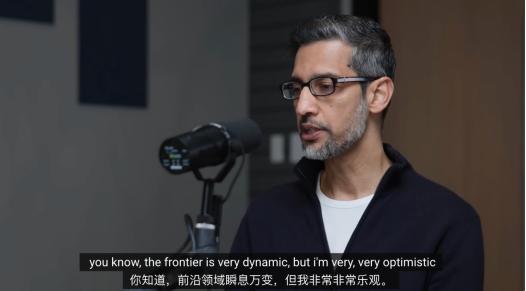
Pichai is quite confident about this. He said in the interview that he is "very, very optimistic" and believes that Google will "get through this."
03 The All - in - One Package Can't Save an Unstable Agent
ByteDance's situation is very similar to Google's.
ByteDance also has a quite complete AI all - in - one package: Doubao, Jimeng, Jianying, CapCut, Feishu, Volcengine, Kouzi, and Trae. From ordinary users to content production, from enterprise collaboration to cloud services, from the Agent platform to AI programming tools, ByteDance has made moves at almost every level.
However, in AI Coding, Trae, like Antigravity, has not become a name that developers can't avoid.
ByteDance is of course also catching up.
Trae is no longer just an AI IDE. It has Trae SOLO, which tries to integrate into users' real - world workflows, and an open - source Trae Agent to make up for developers' trust in terms of mentality and technology. Judging from recruitment and product actions, Trae has been developed by ByteDance into a complete product line, covering directions such as Agent infrastructure, AI Coding environment, model algorithms, developer operations, and enterprise customers.
Google has Gemini, Antigravity, Google Cloud, Firebase, Android, and Workspace; ByteDance has Doubao, Trae, Feishu, Volcengine, Kouzi, and a content ecosystem. They are not single - point tool companies but platform - type companies.
In Google's financial reports, Google Services is still the absolute dominant part. Search, YouTube, subscriptions, and platform services support the main revenue, and Google Cloud is one of the fastest - growing key businesses.
Although ByteDance has not publicly released its financial reports, according to Reuters and third - party institutions, its main revenue still comes from advertising, e - commerce, live - streaming, and local - life monetization on content platforms such as Douyin/TikTok.
For them, AI Coding is more like an entrance: an entrance for developers, an entrance for cloud services, and an entrance for enterprise R & D.
In terms of business revenue, Google can still do well without Antigravity, and ByteDance won't be severely affected without Trae. However, if they want to continue to be platform - level companies in the Agent era, they can't lack this entrance for a long time.
Microsoft has proven that the value of development tools doesn't necessarily lie in direct revenue. VS Code is free, and GitHub has not relied on single - software licensing for a long time, but they have allowed Microsoft to lock in developers' workflows. Where an engineer writes code, manages code, and invokes AI, they are likely to deploy applications, purchase cloud services, and access enterprise tools there.
The same logic applies to AI Coding. Whoever captures the workbench that developers open every day will be more likely to connect to cloud services, models, databases, deployment, monitoring, security, and enterprise collaboration later.
Both Google and ByteDance have very powerful ecosystems, but AI Coding is not a market that can be developed simply by diverting traffic from the ecosystem. For developers, what matters is whether the model can actually work in real code repositories.
A Coding Agent needs to solve more than just "generating a piece of code" (this can also be done by a chatbot). It needs to know which files to look at and which ones not to; it needs to understand what the user really wants to change instead of repeatedly exploring; it needs to be able to continue to fix based on error reports; it needs to know when to take action and when to ask first; it needs to generate fewer junk files, make fewer incorrect changes to production code, and burn fewer tokens on invalid searches.
Ultimately, all these capabilities come down to the underlying model.
Many of Antigravity's problems seem to be product - related on the surface: the Agent Manager is too much of a black box, the quota is opaque, tasks are easily interrupted, and file changes are uncontrollable. However, looking deeper, many are also model - related problems: if the model is strong enough to know where to look, where to change, and when to stop, users won't feel "unreliable" so strongly.
This is why Claude Code and Codex were able to take the lead. The success of Claude Code is mainly due to the fact that the Claude model itself is strong enough in code understanding, long - context processing, tool invocation, and complex task planning. The same is true for Codex. OpenAI was able to make it a large - scale developer entrance by continuously iterating the model in software engineering tasks.
Product design is of course important. Harness, permissions,