One person raised 200 million in financing: with 72 million in revenue, the Silicon Valley AI circle is in an uproar.
Recently, an AI startup project called Polsia has made a bit of a splash in Silicon Valley.
The reason is quite simple: it has almost pushed the concept of a "One-Person Company (OPC)" to the extreme.
According to the public information from the founder, Ben Cera, Polsia was founded at the end of 2025 and has been online for only about five months. In just these few months, it has completed a $30 million (approximately 216 million RMB) financing round and has a valuation of $250 million (approximately 1.8 billion RMB). The investors include Silicon Valley VCs such as Sound Ventures and True Ventures.
What's even more astonishing is that Ben claims that the entire company consists of only him, with no full-time employees; yet, Polsia's ARR (Annual Run Rate) is already approaching $10 million (approximately 72 million RMB).
In the AI circle, this combination is almost a magnet for attention: one person, AI-driven automatic operation, nearly $10 million in ARR, and a valuation in the hundreds of millions of dollars.
Many people's first reaction is: Is this an AI revolution or a large-scale performance art?
What's the business? AI runs your company for you
The core message of Polsia is: "AI That Runs Your Company While You Sleep."
In the past, most AI products were about AI writing copy, AI doing design, AI writing code, and AI customer service. Essentially, they were still "tools."
But Polsia aims to create an "AI employee team."
Users only need to input a startup idea, and the AI will handle the rest, such as conducting market research, writing code, building websites, running Meta ads, sending cold emails, providing customer service, driving growth, fixing bugs, and optimizing conversion rates.

The official website interface of the company (already translated)
Ben Cera defines it as an "Agent orchestration system for end-to-end company operation."
Put simply, if Shopify is a platform that helps you open an online store, then Polsia is more like "helping you directly open an AI company with automatic operation."
What's most interesting about Polsia is not just "AI opening a company," but that it has designed a model of "AI making money for you, and then taking a cut." This is completely different from traditional AI SaaS.
In the past, the money-making logic of most AI products was quite simple: monthly subscriptions, charging by tokens, or charging by usage. But Polsia is not satisfied with just selling tools. It wants to "let AI operate the company for you, help you make money, and then the platform takes a cut."
How does it make money? AI makes money for you and then takes a cut
Currently, Polsia has three main sources of income.
The first is the subscription fee. Users pay $49 per month, and the platform will automatically build a website for you, configure a database, set up an email system, a marketing system, an advertising account, and assign AI employees. It's like "renting an AI startup team for $49 a month."
According to Ben Cera, the founder, after five months of launch, there are approximately 7,600 customers on the platform. If we simply calculate based on 7,600 companies at $49 per month, the theoretical monthly income from basic subscriptions is nearly $370,000, with an annualized ARR of approximately $4.5 million.
This is why many outsiders question that a significant portion of Polsia's so-called "nearly $10 million ARR" actually comes from basic subscriptions, task packages, and advertising fees, rather than true and continuous corporate profit sharing.
The second is the advertising commission, which is actually one of Polsia's most crucial sources of income.
Ben Cera publicly mentioned that the platform will automatically run Meta ads for users, test ad materials, optimize ROI, and scale up campaigns. Polsia will take a 20% cut from the user's advertising spending.
This means that, in essence, Polsia is no longer like a typical SaaS but more like an AI version of an advertising agency, or even an "automatic traffic acquisition platform" in the AI era.
Current public data shows that advertising fees have become one of the fastest-growing parts of Polsia's revenue structure.
Only when users believe that "this AI company can really make money" will they continue to invest in advertising. Therefore, many observers believe that what really matters is not the subscription fee but whether the users' advertising spending continues to grow, as this indicates that there are truly profitable AI companies emerging on the platform.
The third is the revenue sharing, which is also the most "VC-like" aspect of Polsia.
If users make money through the platform, Polsia will take a 20% cut. This means that it is not just selling software but directly participating in the users' company revenues.
Ben even publicly stated that in the future, the platform's major source of income will not be the subscription fee but the successful companies that emerge on the platform. This model is a bit like a combination of Shopify, YC, advertising platforms, and an AI employee company.
Traditional SaaS companies are most afraid of users stopping using their services, but Polsia's logic is "the more money users make, the more it makes."
A crucial detail is that many people think Polsia is selling an "AI startup dream," but in fact, its real core for making money is likely advertising.
Currently, a large number of users are creating AI products, automatically generating ads, and running Meta campaigns. Advertising itself is a huge cash flow.
This is why Ben publicly stated after the financing that the new funds will mainly be invested in two areas: AI computing power and marketing.
Why do VCs invest: Growth?
Why can a company with only one founder and no full-time employees raise $30 million? The answer might be: it has achieved what VCs are most sensitive to - growth.
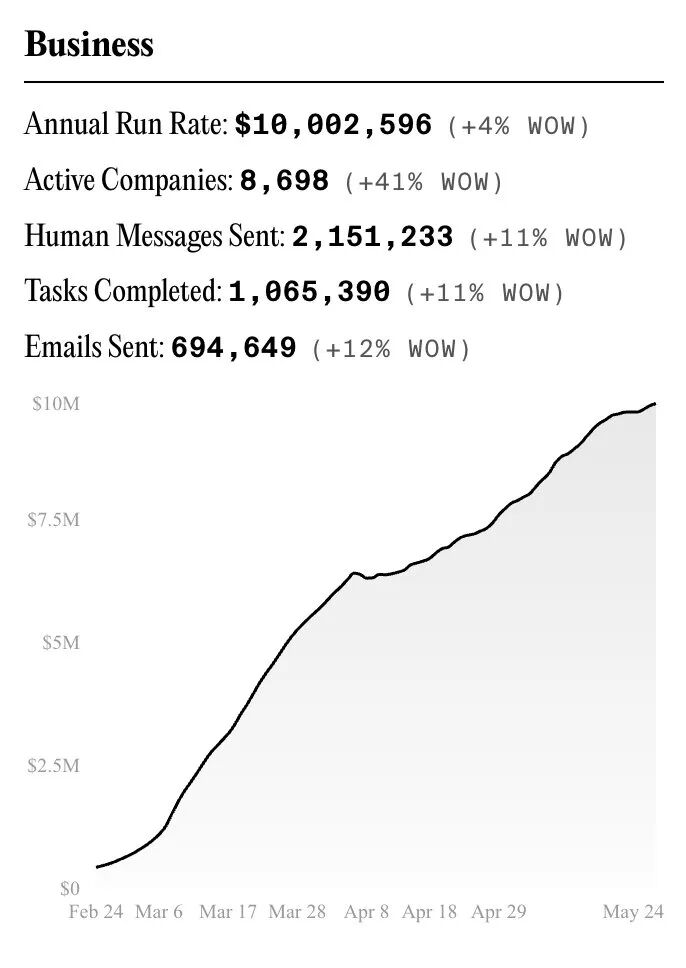
The business data posted by the founder on X
According to Ben Cera's public disclosure, Polsia has been online for only about five months, and its ARR is approaching $10 million.
In the VC world, the growth rate itself is the strongest financing ability. Especially in the AI industry, many investment institutions are more afraid of "missing the next AI platform" than the high cost of a project.
More importantly, Polsia is not an ordinary AI tool. It tells a bigger story: "AI is starting to replace the corporate organizational structure."
This is why many investors are willing to place their bets. In their view, if this concept holds true, what might be disrupted in the future is not just a certain job position but the "small company" itself.
Another data point that VCs are particularly sensitive to is labor efficiency.
For a traditional SaaS company to achieve an ARR of $10 million, it may require dozens or even hundreds of people, a large sales team, and a large customer service team. But Polsia currently claims that with one person and no employees, it has an ARR approaching $10 million, which means its per capita ARR is theoretically close to $10 million.
In comparison, the per capita ARR of many excellent SaaS companies is usually only between $200,000 and $500,000, and an ARR of over $1 million is considered extremely high. Polsia's model is, to some extent, like "using AI as employees."
This is also one of the hottest trends in Silicon Valley recently: AI Native Company, which means the company is organized around AI.
Ben even publicly said that during this round of financing, Polsia's own AI was involved in managing the Data Room, answering investors' questions, conducting due diligence, and coordinating financing communications. He said, "I just went to sign at the end." For VCs, this is not just an AI tool but an experiment on "what the future company will look like."
Controversies and doubts: ARR fraud, high churn rate
The faster Polsia becomes popular, the more controversies it generates. Many people even think it doesn't seem like a normal AI company.
The biggest controversy first comes from whether the ARR is real.
Ben Cera publicly claims that Polsia's current ARR is approaching $10 million. However, some overseas users have specifically prepared an income breakdown report, arguing that Polsia's so-called "nearly $10 million ARR" is not all recurring subscription revenue in the traditional SaaS sense. It includes approximately $4.6 million in subscription ARR, about $2 million in one-time task packages, around $2 million in user advertising spending, and the remaining part in other miscellaneous revenues.
Some skeptics believe that Polsia calculates the ARR by multiplying all these revenues by 12, which is why many people question its "over-packaging of numbers." Strictly speaking, advertising agency services and one-time task packages do not necessarily fall within the standard SaaS ARR scope.
The second controversy is the high user churn rate.
Some skeptics on the X platform claim that the Polsia platform has generated approximately 120,000 projects in total, with about 8,500 active projects.
In other words, many users subscribe, create AI products, run a few rounds of ads, and then quickly give up. This is why many people think Polsia is more like an "AI startup slot machine," where users keep creating new products, testing, and failing.
The third controversy is whether it is "real AI."
Polsia promotes that AI can automatically operate a company. However, some skeptical reports suggest that there is a large amount of manual review behind the platform, including manual scoring, manual checking of Agent results, and manual intervention in the advertising process.
Meanwhile, some developers point out that many of Polsia's underlying capabilities are actually based on Anthropic's Claude model. Some even describe it as a "Claude wrapper product," meaning that the real underlying AI capabilities may not belong to Polsia itself.
The fourth controversy is whether it is creating "AI internet junk."
Since Polsia automatically generates websites, ads, SEO content, tweets, and marketing pages, many people have found that the platform produces a large number of AI blogs, AI ads, AI tweets, and AI marketing pages every day, but the interaction rate is extremely low.
Some people even joke that "Polsia" spelled backward is "AI SLOP (AI junk)." Ben himself didn't completely deny this. He publicly responded, "Most of it is indeed junk, but the quality of the junk is improving every week." This statement has even become a hot meme in the AI circle.
What's really interesting is that despite the huge controversies, VCs still invested.
In the view of many investors, what really matters about Polsia may not be the current product quality but "whether AI has started to replace the corporate organizational structure."
Even if most of the products are junk today, as long as the generation speed continues to increase, the advertising ROI continues to improve, and the AI operation ability continues to strengthen, there may be truly profitable "AI companies" emerging in the future. This is where VCs are really placing their bets.
This article does not constitute any investment advice.
This article is from the WeChat official account “Pencil News” (ID: pencilnews), written by Xi Wen, and published by 36Kr with authorization.