Real estate giants have collectively missed the AI era.
A few days ago, a piece of news shocked China's semiconductor industry. A company named "Changxin Technology" achieved a net profit attributable to the parent company of 24.76 billion yuan in the first quarter of this year. This figure has exceeded the total net profit attributable to the parent company of 605 listed companies on the Science and Technology Innovation Board. Subsequently, Changxin Technology updated its prospectus for the initial public offering (IPO) on the Science and Technology Innovation Board and submitted relevant financial data. It is estimated that the company will achieve an operating income of 110 billion to 120 billion yuan in the first half of the year.
The explosive performance has made the valuation of Changxin Technology potentially reach one trillion yuan. The investment institutions behind it have also welcomed a "bumper harvest" of wealth, but Country Garden is not included here.
Two years ago, Country Garden announced that it had cleared its holdings in Changxin Technology and cashed out 2 billion yuan. Now, this equity is probably worth 30 billion yuan.
"You think your opponent is your competitor, but actually your opponent is the era." This sentence by Li Shanyou, a professor at Hundun University, once reflected in the diversification strategies of every real estate enterprise. In the diversification strategies of real estate enterprises, high - tech, including hardcore technology, was once a sector that the giants valued the most, and its strategic position was extraordinary. However, as more and more projects, especially high - quality projects in the AI track, are abandoned, what they miss is not just the wealth return.
It may also be the dividends of this new era.
Do AI companies making money benefit the real estate industry?
In the intersection of AI and real estate, the hottest news is not which star AI company a real estate giant has invested in, but that AI companies are spending money to buy buildings.
Some time ago, Zhipu AI, the "first stock of global large - models", spent 360 million yuan to buy the Diamond Building in Zhongguancun in one go. As soon as the news came out, it quickly sparked heated discussions in the AI industry and the real estate circle. The Diamond Building has changed hands several times in the past decade. In 2011, the Cailongrui Fund acquired it for 268 million yuan, and in 2014, the Bank of China Group acquired it for about 420 million yuan. The transaction price of Zhipu this time has dropped compared with the high point in 2014.
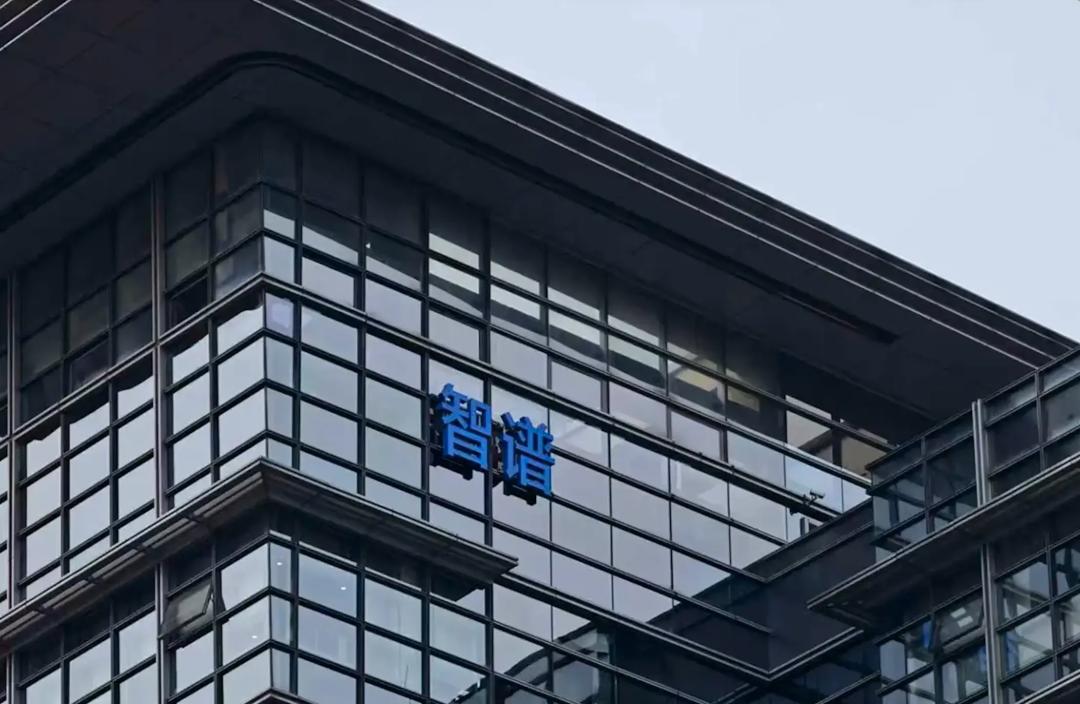
Although Zhipu AI clearly stated that buying the building is for its own use as the company's headquarters, more and more star companies emerging from tracks such as large - models, humanoid robots, and AI hardware inevitably make real estate people have wild imaginations. When the money earned or raised by AI companies is finally spent in the real estate market, will it bring new recovery?
In Haidian, a new AI innovation cluster has been formed in the Zhongguancun area. In this street with a total area of only 5.28 square kilometers, 86 artificial intelligence companies are gathered.
UBS has given an optimistic expectation. In the report, UBS said that historical data shows that there is a high correlation between the profits of industrial enterprises and the housing prices in first - tier cities, with a correlation coefficient of 0.63. In the first quarter of this year, the profits of industrial enterprises increased by 15% year - on - year, and the Producer Price Index (PPI) turned positive. By industry, the industries with the fastest profit growth are AI - related industries. Most of the companies in these profit - growing industries have their headquarters in Beijing, Shanghai, Suzhou, and Dongguan, which echoes the higher second - hand housing transaction volume in these cities compared with other cities.
However, AI companies will ultimately not be able to reproduce the grand occasion of the Internet "sweeping buildings".
On the one hand, in the golden age of real estate, Internet companies and some industry giants "crossed over" into the real estate industry with obvious investment purposes. Most AI companies, although highly sought after, are still in a loss state at present. Whether due to their financial situation or the nature of technology - based companies, buying buildings is basically for their own use.
On the other hand, the prosperity of the Internet economy was a huge "wealth - creating" movement. Many employees of the giants numbered in the tens of thousands, and many people held thousands of stock options, achieving wealth growth and then contributing to the real estate market. Looking at AI companies, even the leading ones have only a few hundred to at most a few thousand employees. The rigid demand for housing they bring is incomparable to that of Internet companies.
What's even more terrifying is that if AI becomes more and more intelligent and brings about productivity innovation, resulting in companies no longer needing so many employees, then who will buy these houses?
Real estate companies "lose" potential AI stocks
Long before the downturn of the real estate economy, some developers with a keen sense had realized that there was a ceiling effect in new housing construction, while technology could continuously bring greater imagination space. Giants such as Country Garden and Greenland even directly took "real estate + technology" as the direction of enterprise transformation, using capital means to weave high - tech dreams.
However, when faced with the debt crisis, the investment projects that were once favored have been forced to become a source of funds, including the emerging "stars" in the AI track.
Changxin Technology is a most obvious example. When Country Garden held shares in Changxin Technology, the company had been in a loss state, with a cumulative loss of more than 30 billion yuan in three years. No one expected that the memory chip market would enter a super cycle, and the company reversed its performance overnight and then launched a listing plan. Unfortunately, Country Garden had cleared its holdings before that.
Among real estate enterprises, Country Garden is the giant with the most investment vision and has truly promoted venture capital as a core business. It invested in more than 90 projects in three years and caught up with multiple trends such as semiconductors, commercial aerospace, AI, and robots, holding many star companies. However, it didn't wait for the fruits to ripen and had to "cut losses" and transfer some high - quality technology assets at the absolute bottom of the cycle.
For example, Country Garden once held 11.063% of the equity of LandSpace Technology, and the corresponding latest value exceeds 8 billion yuan. However, when Country Garden sold its shares in LandSpace Technology in April 2025, the transaction price was 1.305 billion yuan. Another example is Dreame Technology. In 2024, Country Garden officially withdrew from the shareholder list of Dreame, completing the clearance. Now, Dreame's "value" has more than doubled.
Greenland also actively crossed over into the AI field. First, it took a stake in Shenlan Technology with a profound background. Then, within one day, it invested in two star AI companies in Hangzhou - CityCloud International and Tuya Smart, and also became the second - largest shareholder of BaicaiBang and Ruiwei Technology. At that time, Greenland high - profilely joined hands with Shenlan Technology to establish a joint - venture company, claiming to promote the implementation of "intelligent construction robots". However, to this day, there has been no significant result disclosed from this joint - venture company.
What's more intriguing is that Chen Haibo, the actual controller of Shenlan Technology, had multiple consumption restriction orders and historical consumption restriction orders last year, and the company was also involved in a salary - arrears scandal. This makes the future of this well - known AI company look rather bleak, and also makes Greenland, which still holds shares, not know when it will get a return.
Vanke's biggest investment was in GLP, a Singaporean logistics giant, which was a key piece in Vanke's "de - real - estate" strategy. To become the largest shareholder, Vanke spent about 16.9 billion yuan. Since 2024, Vanke has been rumored to sell GLP. Fortunately, it didn't actually do so. Now, GLP has become Vanke's most valuable asset. However, other invested companies don't have this "honor".
Some time ago, Vanke just issued an announcement, planning to list and transfer all the equity of Huanshan Group.
In the past, powerful real estate enterprises were keen on technology and made frequent investments, becoming an important and non - negligible force in the primary market. Especially among AI companies that are in great need of "blood transfusion", the deep - pocketed real estate enterprises are hard to resist. According to the statistics of the CRIC Research Center, in 2021, 29 out of the top 200 real estate enterprises chose to establish capital platforms and set up funds to participate in the VC/PE market, and the number of external investment projects increased by 53.3% year - on - year.
But now, in the AI track, it is almost impossible to see the figures of real estate enterprises behind those popular companies.
Real estate needs AI, but can AI make any progress in real estate?
Compared with financial investment, the more long - term goal of real estate giants investing in AI companies is naturally to find new directions for improving efficiency and services in the application of AI technology in the real estate field.
For example, AI can help real estate enterprises make more accurate investment decisions, such as determining which piece of land has more appreciation potential. In the marketing and sales process, it can help real estate agents sell houses. In property management, the value that AI can play seems to be even greater. At present, some intelligent robots have entered residential communities and started to help property management companies with their work.
Undoubtedly, the huge real estate field provides various scenarios for AI to move from the laboratory to practical application. However, it may still be unknown how much real commercial value AI can bring to the real estate market. According to the Chinese - version report of the global real - estate technology research "AI Empowering Commercial Real Estate: Challenges, Practices, and Future Layout" officially released by JLL, the report shows that the penetration rate of AI pilots in the global corporate real - estate field has soared from less than 5% in 2023 to 92%. However, a more critical figure is that only 5% of enterprises have achieved large - scale value realization of AI.
This figure reveals that the actual application of AI in real estate mostly stays at the shallow level of efficiency optimization and is difficult to touch the core of the core business.
Taking AI's participation in investment decision - making as an example, most real - estate enterprises' practices are still in the primary stage of using AI for data collection and information integration. The final decision - making still heavily relies on the original digital investment - decision - making model and the experience of senior investment and expansion teams.
On the one hand, real - estate people's distrust of AI technology is a factor. More importantly, the AI investment - decision - making model itself is not intelligent enough, which has a lot to do with the lack of reliable data. And data is precisely the biggest bottleneck that the real - estate industry faces in its exploration of AI.
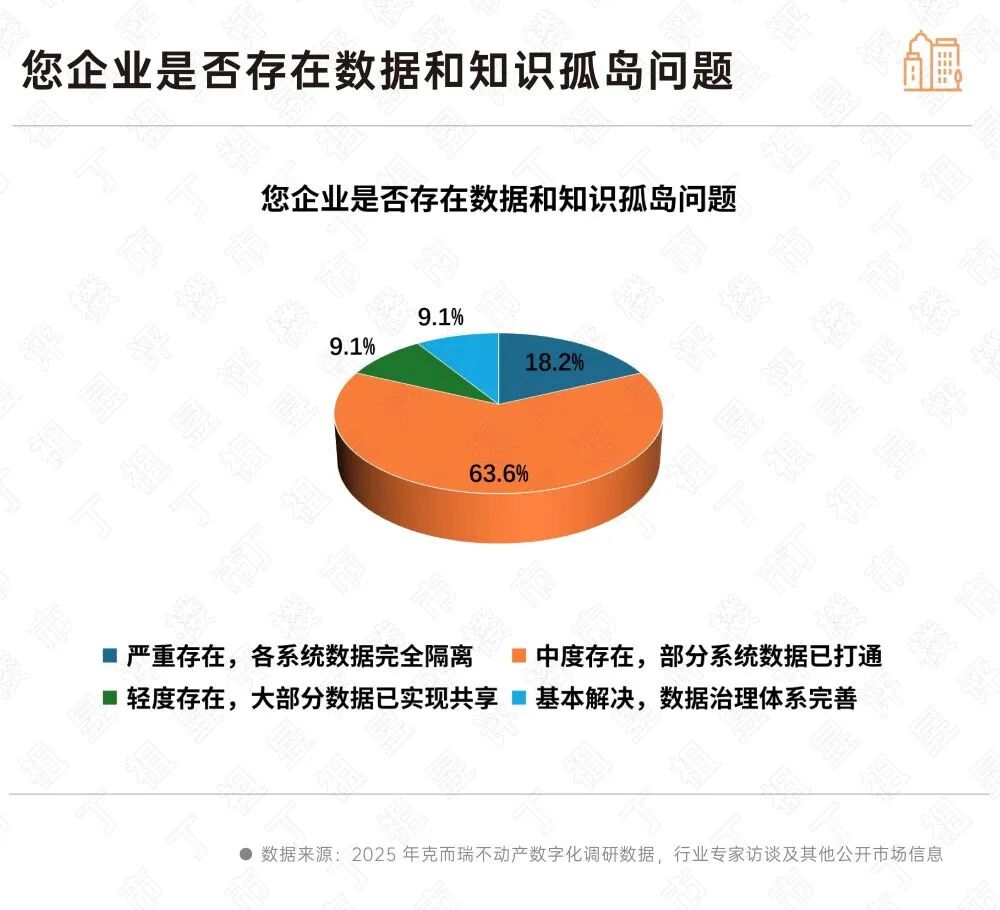
In the real - estate industry, the problem of data silos is very serious. Inside the enterprise, core data is usually scattered in different business systems (such as CRM, ERP, and cost systems), and the AI model cannot obtain global and continuous data input. In the industry, data such as land - acquisition costs, customer data, and marketing strategies generally involve core business secrets, and real - estate companies are reluctant to share data with any other enterprises.
Looking at property management, since real - estate giants started to increase their investment in technology companies, many enterprises have shown a strong interest in robots. The popularity of humanoid robots now seems to provide impetus for their application in community management. However, after years of efforts, the development process can only be described as "slow".
Taking Country Garden Services as an example, as of October 20, 2025, more than 130 of its "No. 0 Resident" cleaning robots have been put into use in 17 projects in cities such as Guangzhou, Beijing, and Shanghai. Even according to Country Garden Services' plan, this number will only exceed 1,000 within this year. Selling or renting a few products or systems for small - scale demonstration business operations can be achieved in a short time. However, large - scale civilian and commercial use may still take a long time.
Whether it is AI's participation in investment decision - making, architectural design, or property management, there is actually a core contradiction. That is, the operation mode of real estate highly depends on human operation and effort. Especially when facing property owners or homebuyers, it is essentially about meeting people's needs and handling people's problems, and AI is difficult to play a role in the scenario of "communicating" with people.
This inevitably makes people question how much value AI can actually generate in the real - estate industry.
We are in an unprecedented new era. The breakthrough of AI technology brings both beautiful imagination and unknown fear, but no one wants to miss this era. Real estate is no exception. However, when real - estate enterprises are still deeply trapped in the life - and - death dilemma brought about by the past high - turnover model, they may not have the time to catch up with this era.
This article is from the WeChat official account "Dao Zong You Li" (ID: daotmt), author: Dao Zong, published by 36Kr with authorization.