Just now, a domestic Agent model has entered the world's top-tier group. It's available for free for a limited time.
Who can understand this, folks?
In the Agent era, large companies are using "how many tokens are burned" as a KPI. As a small employee, I'm still stuck in another quagmire:
The smart models are unaffordable, and the cheap models aren't smart enough.
Looking for a model that is both powerful and affordable, and can be plug-and-play in the mainstream Agent environment? There were basically none in the past.

However, just now, I found that a domestic player has quietly broken this "impossible triangle".
The newly released Agent model has reached the global first - tier in terms of performance. No matter whether the opponents are open - source or closed - source, as long as they are top - notch models you can name, it can compete with them.
Moreover, the price really surprised me. It's only half or even less than that of the mainstream top - notch models.
More importantly, the model is deeply adapted to mainstream Agent frameworks such as OpenClaw, Claude Code, Hermes, and Nanobot, and is also compatible with the OpenAI interface. Developers hardly need to change the architecture and code. In many cases, they can just change the baseURL and API Key to run it directly.
Having said so much, I'm sure you're very curious about who it is? ⊙.☉
The answer is revealed: Kunlun Wanwei. The specific models are SkyClaw - v1.0 and its lightweight version SkyClaw - v1.0 - lite.
Let me quietly reveal that both models are now available for free for a limited time.
However, I'm still curious. How can the same model be smart, cheap, and easy to use at the same time? I have to dig deeper into this.
What was released? Two Agent models were launched at once
To understand why Kunlun Wanwei's SkyClaw series models are powerful, we first need to understand a difference that many people overlook.
For most models on the market now, their Agent capabilities are essentially added later. First, a general large - scale model is trained, and then a tool - calling shell is added.
It's really convenient, but since the model itself is not trained to "complete tasks" but to "generate language", it can handle simple tasks okay, but it tends to fall short when the tasks get complex.
However, SkyClaw takes a completely different approach. From the first day of training, its goal is not to chat but to work. The abilities of how to call tools, how to pass parameters, and how to disassemble and execute multi - step tasks are not acquired through later - stage supplementary training but are innate.
This difference at the starting point directly determines the upper limit later.
In fact, many players in the industry have realized this problem and are starting to shift from "general model + tool shell" to models specifically designed for Agent scenarios.
The SkyClaw - v1.0 and SkyClaw - v1.0 - lite released by Kunlun Wanwei this time are the products of this new approach.
The two models, one heavy and one light, have their own divisions of labor.
Let's start with the flagship version, SkyClaw - v1.0, the main force for complex tasks.
It has been deeply optimized for OpenClaw - related tasks and is suitable for enterprise - level multi - step and tool - dependent scenarios.
In Claw - related tasks, it is understood that SkyClaw - v1.0 can compete head - on with closed - source top - notch models like Claude Opus 4.6.
Since it can be compared with Opus 4.6, I couldn't help but go to the official website to look at a few demos. Once I saw them, I was really impressed.
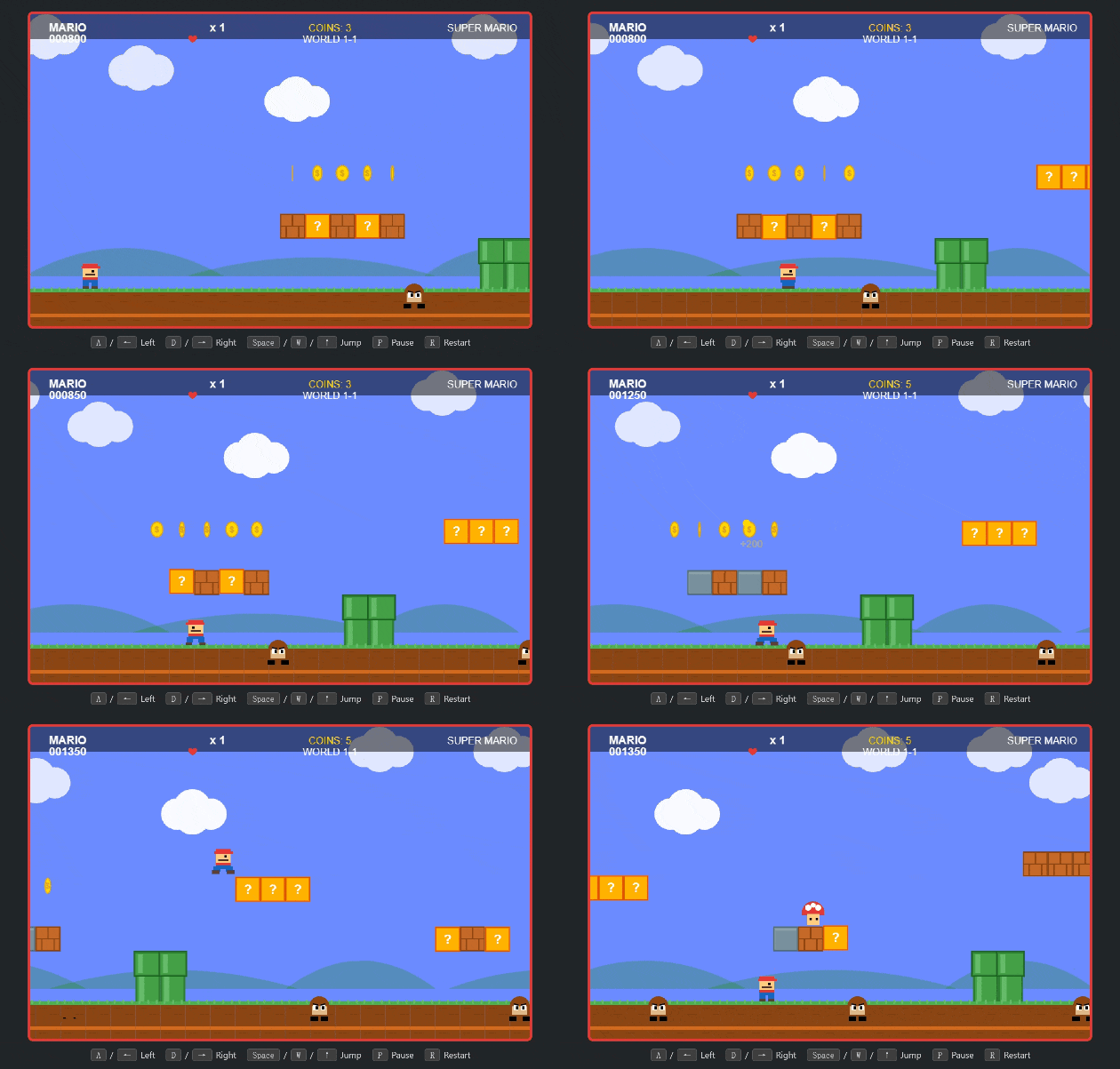
At first glance, SkyClaw - v1.0 seems to love playing games (just kidding). The page is full of various "classic games" it generated.
I casually opened Super Mario Bros. and found that I could play it directly using the computer keyboard -
Move forward, backward, jump to get coins. The whole process was smooth without any lag.
Do you think the game is just a display of skills? Let's look at a more serious task.
Look at the completion level of this financial terminal. There are global indices scrolling at the top, channel navigation on the left, a news stream with sources and related stocks in the middle, a self - selected stock list with mini - K line charts on the right, and even pop - up windows for breaking news.
Previously, the front - end team would take at least a few days to complete an interface with multiple module linkages, but SkyClaw - v1.0 quickly completed it on its own.
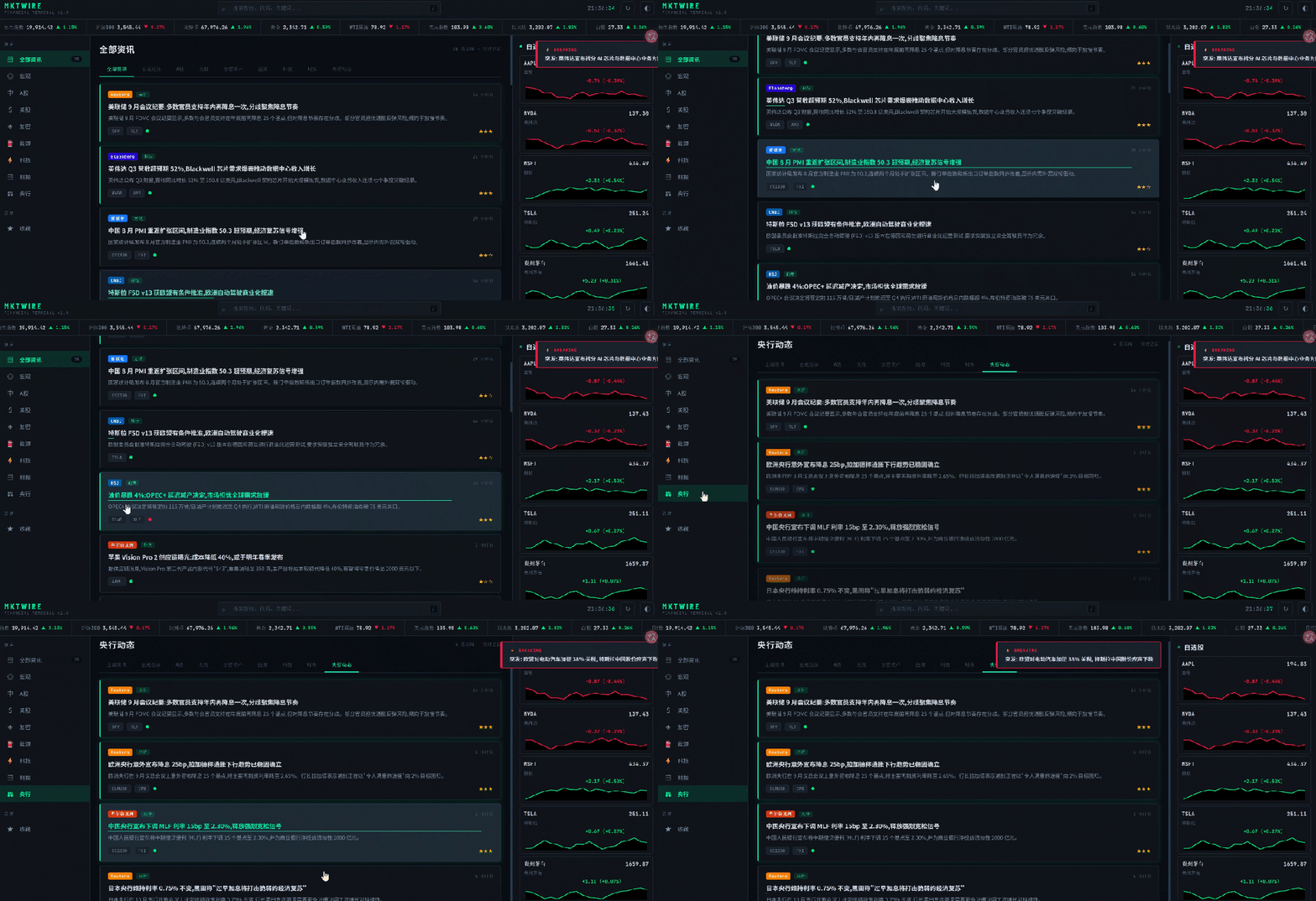
Of course, these market data are simulated and generated by the model, not real data.
But this is actually the key point. What SkyClaw - v1.0 does is to build the framework from scratch - the interface, components, and interaction logic. It writes all the code at once. Developers only need to connect the real data to make the page run.
From Super Mario Bros. to the financial terminal, from entertainment to productivity, the complexity differs by several orders of magnitude, but SkyClaw - v1.0 can handle them all.
Perhaps this is the gap between the so - called native Agent model and the general model used for Agent tasks casually.
Now let's talk about the lightweight version, SkyClaw - v1.0 - lite. It doesn't compromise on the core Agent capabilities, but it's faster and cheaper.
It is targeted at high - frequency and cost - sensitive scenarios, such as batch API calls and lightweight automation processes.
Have you noticed that since the model entered the Agent era, most players will introduce a lightweight version when promoting their main models. This is easy to understand, just as a former machine - learning engineer at Snapchat said recently:
If you always use the most expensive model by default to complete every task when developing with AI, then 80% of your work is a waste of money.
People who often use Agent to run tasks probably deeply agree with this.
With these two models, one for the performance ceiling and the other for cost control, who wouldn't be well - supported by AI (doge)?
To be honest, what really attracts me to this model is its price.
For SkyClaw - v1.0, the input costs 0.5 yuan per million tokens, and the output costs 4 yuan per million tokens; for the lightweight version, the input is only 0.3 yuan, and the output is 2 yuan.
I quietly compared it, and this price is only half or even less than that of the mainstream top - notch models.
Moreover, during the release period, there is also a limited - time free offer. Yes, you read that right, it's free.

What's even more amazing is what comes next - after the trial period, Kunlun Wanwei plans to gradually open - source each model version.
It has the performance of top - notch closed - source models, the price is cut to the middle level of the industry, and there is open - source support in the future.
After this combination of moves, I can only say: This is going to significantly lower the threshold for the implementation of Agent models.
How to get started? It's ready to use right out of the box
By now, as a person who wants it all, I have a general idea in mind. The next thing to do is:
Try it myself. After all, you have to test a horse to know if it's good.
How to test it? Currently, there are two ways in summary:
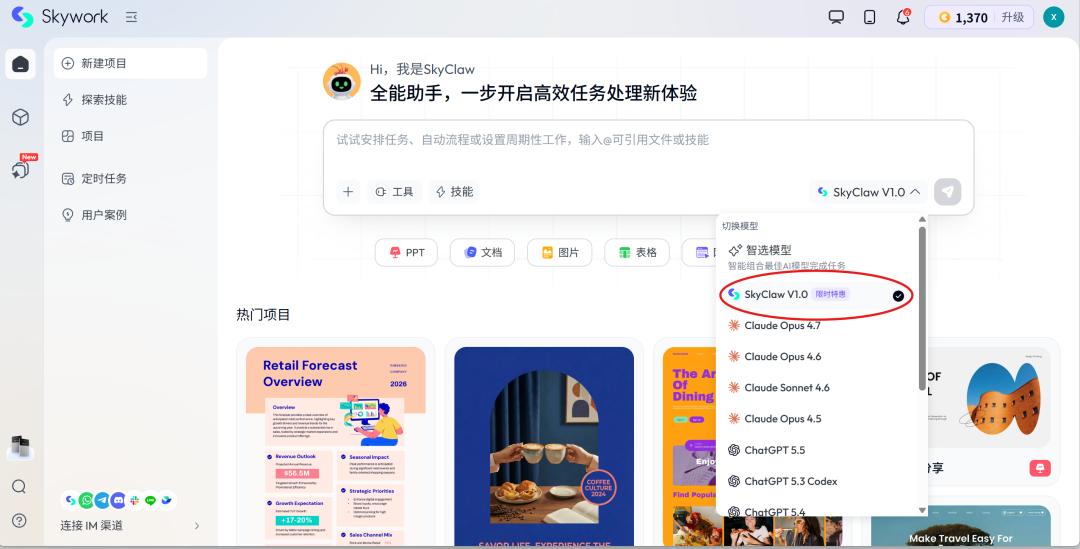
The fastest way is to go directly to the Tiangong Skywork platform (tiangong.cn). SkyClaw - v1.0 was connected to Tiangong Skywork on May 22nd. You don't need to install anything or configure the environment. You can use it just by opening it in the browser.
Moreover, it's currently on a limited - time special offer with a very low price. It seems very suitable for those who want to try the Agent capabilities first and then decide whether to integrate deeply.
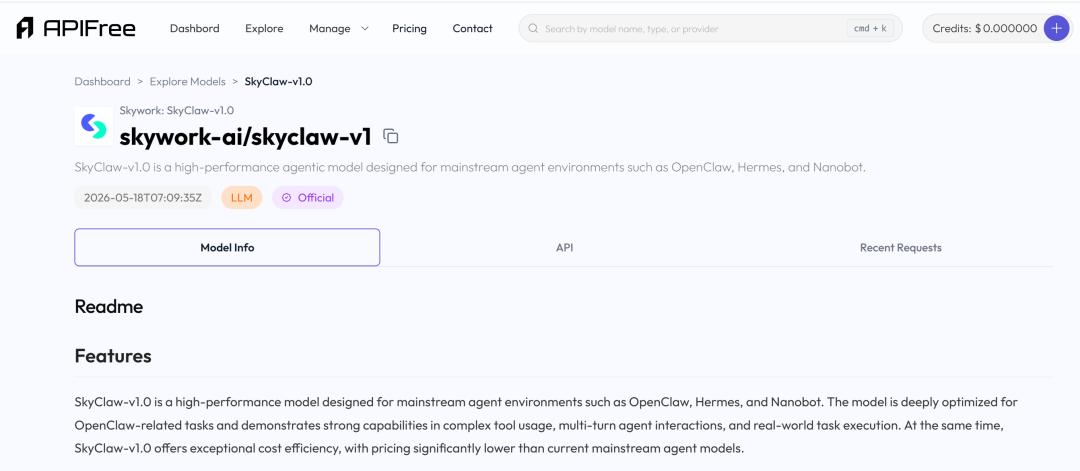
If you want to integrate deeply, then use the API (the API is currently free). Register for a free APIFree account, get the API Key, and you can make calls. The interface is compatible with the OpenAI format, supporting streaming output, tool calls, and multi - round conversations. For developers who are already using the OpenAI interface, it's basically just a matter of changing the baseURL and the model name.
(P.S. APIFree is Kunlun Wanwei's own model aggregation platform, supporting the call of various mainstream models at home and abroad.)
Without further ado, I'll choose two typical Agent scenarios to test.
First, I want to "raise" an electronic desktop pet that can both work and accompany me during breaks. The requirements are roughly as follows:
A kitten that can randomly stroll on the screen. When clicked, it will say some quotes for office workers. Right - clicking can switch between work mode and break mode. The work mode has a Pomodoro timer countdown, and there are also health reminders such as drinking water, looking into the distance, and stretching.
After I stated the requirements, SkyClaw - v1.0 directly started working on the Skywork platform. When I came back after watching some short videos, I found that it had already generated the entire source code file.
Looking at the finished product, the kitten is drawn with SVG gradients, with a pink body, triangular ears, and big eyes. It's quite cute.
Right - clicking to open the Focus Mode panel, the Pomodoro timer supports three levels of 25/45/60 minutes. Below are the task list and the health reminder module. After the countdown ends, the kitten automatically switches to break mode and pops up a bubble saying: I'm not slacking off; I'm saving electricity for the company...
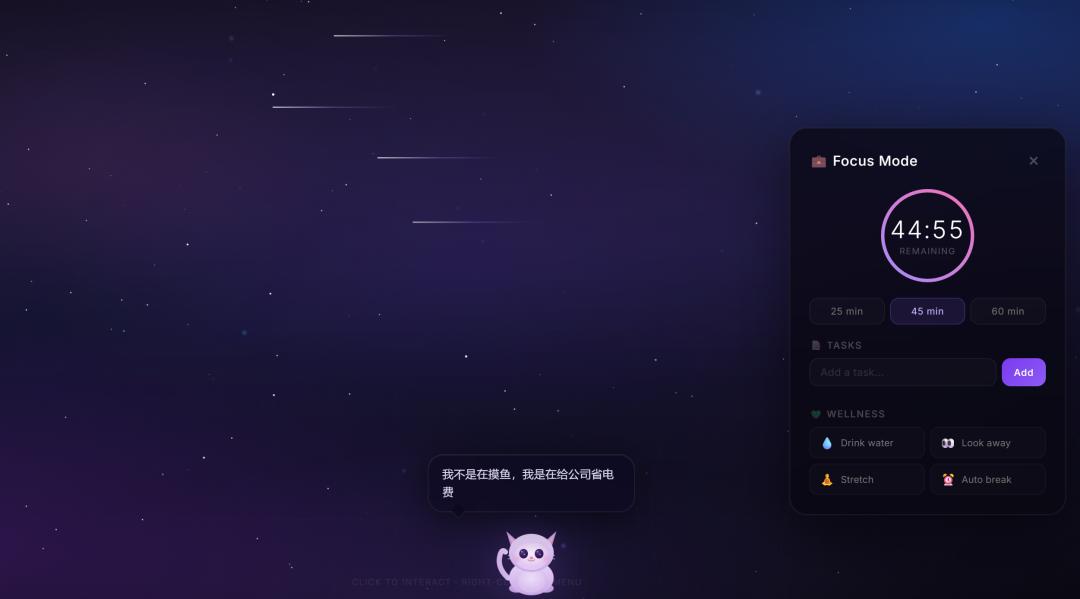
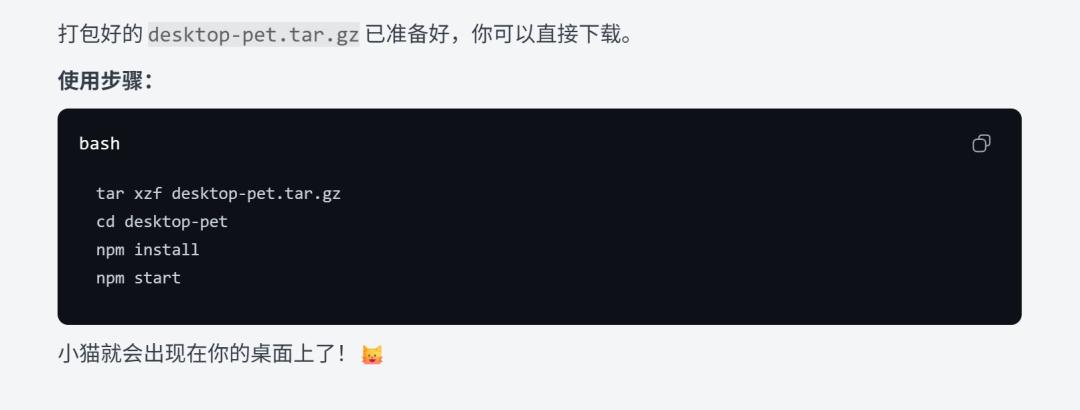
Of course, to quickly see the effect, I first let it generate the HTML version, which can be played by opening it in the browser. If I want to make it a real native desktop pet, I can continue to let it generate the Electron packaging plan, and by running a few commands in the terminal, it can become a desktop application that stays in the taskbar.
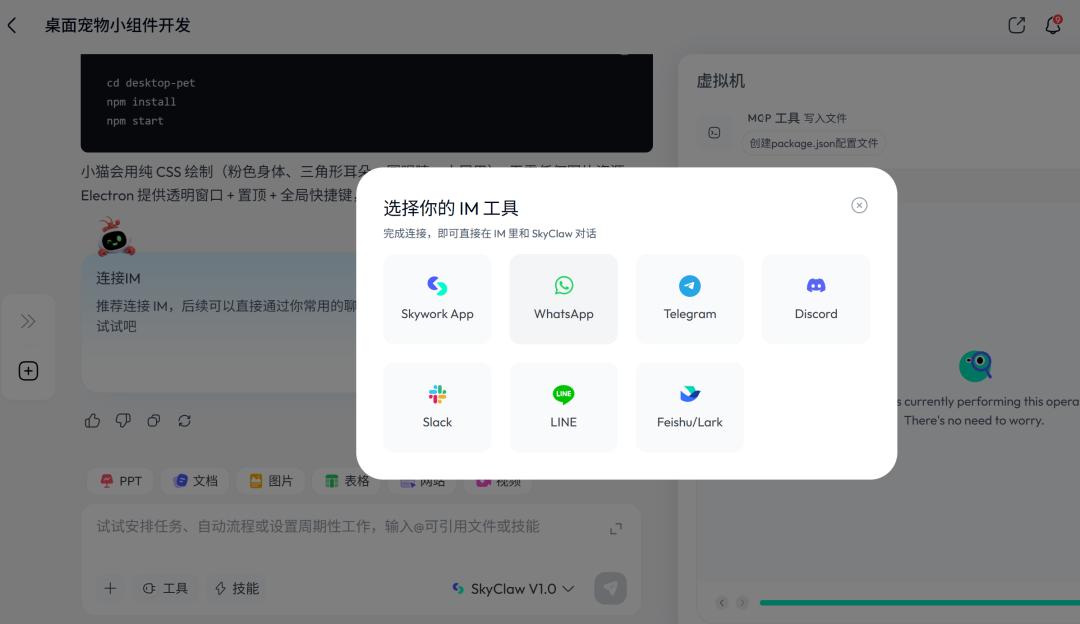
What surprised me even more is that after it finished, it actively popped up an IM connection panel, supporting direct connections to seven chat tools such as Skywork App, Feishu, Slack, Discord, and Telegram.
That means that in subsequent further development and docking, this kitten can theoretically interact with me directly in my daily chat window.
Okay, the break - time test is over. As usual, let's do a more serious one.
Our editorial department has a weekly meeting, and one of the items is to summarize the AI trends of the previous week.
To avoid scratching my head before the meeting, this time I'm going to create an AI industry weekly report automatic generation system. The requirements are simple but also a bit greedy:
Automatically grab the AI hotspots of the past week, classify them by topic, extract trend signals, and finally generate an interactive weekly report page.
Guess what? SkyClaw - v1.0 actually managed to do it.
There's no need to say much about the front - end. The UI and function layout are clear at a glance.
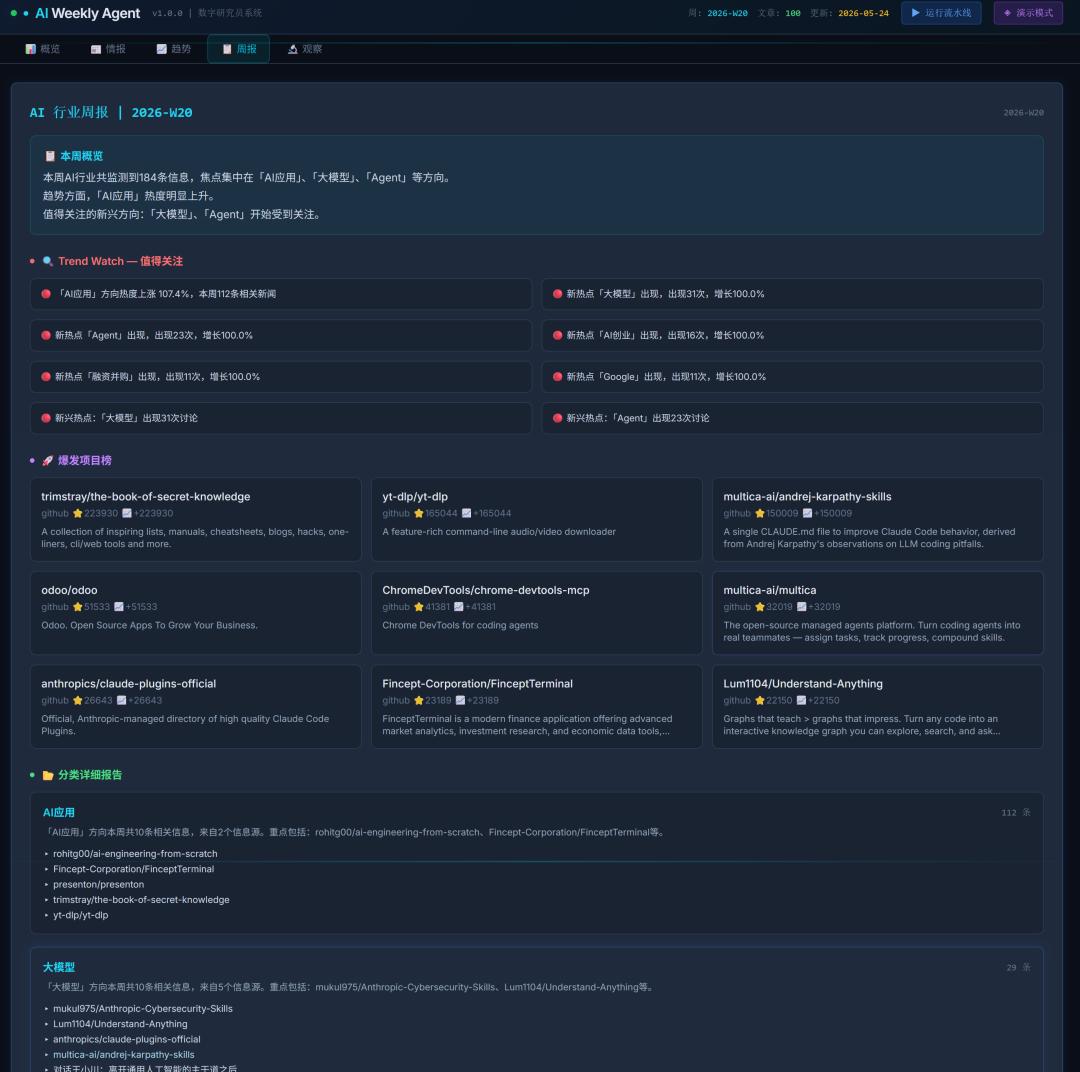
The key is the back - end. After observing SkyClaw - v1.0's working process, I found that it