In the arena where giants worth trillions emerge, the game has changed.
On April 16, 2026, the market value of Contemporary Amperex Technology Co., Limited (CATL) reached a record high, exceeding 2 trillion yuan, making it one of the biggest beneficiaries in the new energy era.
However, in the battery market where a 2-trillion-yuan giant has emerged, the battle is far from over, and the competition strategies are quietly changing.
Currently, commercial vehicles have become an important growth engine for the power battery industry.
In 2025, the installed capacity of new energy commercial vehicle batteries in the Chinese market reached 148.6 GWh, a significant year-on-year increase of 124.6%. The new energy penetration rate in this field has just reached 30% and is still growing rapidly.
Injecting AI into core business has become a strategic deployment for many manufacturing companies.
After establishing an AI business group in July last year and fully introducing AI and robot technologies, EVE Energy Co., Ltd. has now introduced AI into the product level of power batteries.
On May 9th, EVE Energy launched the Open Source Battery 4.0 product at the Second Commercial Vehicle Battery Technology Day, with the main highlight being the AI Battery.
The application of AI in the intelligent electric vehicle industry chain is no longer rare, and an AI wave has also begun to sweep across the power battery field. Not long ago, Sunwoda released its "AI + Battery" strategy at its first technology day, announcing that it will empower multiple business dimensions such as R & D, manufacturing, quality, and products with AI.
The AI battery launched by EVE Energy this time is an application of AI technology in commercial vehicle battery products. By implanting an AI chip, the operating conditions of the battery can be more accurately adapted to different scenarios, improving the operational efficiency of commercial vehicles.
Commercial vehicles have become an important growth engine for the power battery industry.
Data shows that in 2025, the installed capacity of new energy commercial vehicle batteries in the Chinese market reached 148.6 GWh, a significant year-on-year increase of 124.6%. The new energy penetration rate in this field has just reached 30% and is still growing rapidly.
While the passenger car market is in fierce competition, the battle is also heating up in the commercial vehicle market. In the past two years, leading power battery companies have invested heavily in an attempt to seize a share of the commercial vehicle market, especially the long - haul heavy - truck market.
EVE Energy is an important player in this field.
Last year, EVE Energy held its first Commercial Vehicle Battery Technology Day and launched the commercial battery brand - Open Source Battery, which implies opening up more sources of wealth and increasing profits for users. EVE Energy has also become the second - ranked power battery company in terms of commercial vehicle shipments, second only to CATL.
EVE Energy's outstanding performance in the commercial vehicle field has also consolidated its industry position. Throughout last year, EVE Energy's power battery installed capacity ranked fifth in China, with a market share of approximately 4.1% - 4.2%.
AI Battery Solves Commercial Vehicle Problems
Commercial vehicles have become a key market that domestic power battery manufacturers cannot bypass.
In the past two years, the new energy penetration rate of commercial vehicles has continuously achieved breakthroughs, reaching the 20% and 30% thresholds respectively. In 2025, the sales volume exceeded 950,000 units.
However, while the vehicle sales volume and battery installed capacity are growing rapidly, the industry has inevitably fallen into fierce competition. Similar to the passenger car market, commercial vehicle power batteries are also competing with each other in terms of large battery capacity, high parameters, and low cost.
However, even to this day, the pain points in the new energy commercial vehicle industry still exist.
Dr. Huang Hongliang, the general manager of the domestic sales of EVE Energy's commercial vehicle battery product line, summarized for EqualOcean Auto that new energy commercial vehicles have three major pain points: complex scenarios, high operational consumption, and unclear value and returns. Existing battery products are difficult to fully address these challenges.
This time, EVE Energy has brought a brand - new solution with AI. The Open Source Battery 4.0 does not elaborate too much on the amazing parameters of the battery cells and systems, but uses a platform - based technology system to try to inject more intelligent capabilities into power battery products.
This is a platform - based technology that can be applied to the entire product line of commercial vehicles.
In comparison, the AI Battery launched by EVE Energy this year includes one battery cell (815Ah) and two system products (605kWh and 640kWh, targeting rear - mounted and bottom - mounted applications respectively), which can cover six core scenarios such as inter - city transportation, urban distribution, and mine heavy - load operations. At last year's first Commercial Vehicle Battery Technology Day, EVE Energy launched a total of 8 batteries for different scenarios.
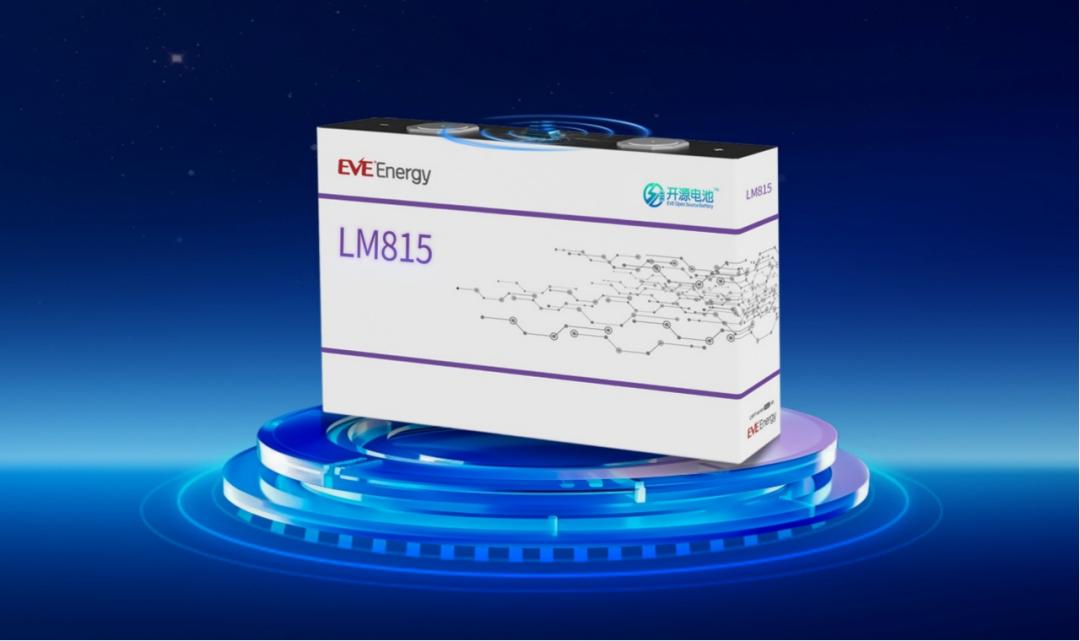
So, what makes the AI Battery special?
The perception dimension of the traditional BMS (Battery Management System) is relatively limited, with only basic data such as voltage, current, and temperature. The AI Battery integrates an air pressure sensor into the mass - produced battery cell for the first time, which can sense multi - dimensional information such as air pressure and temperature, supporting the battery to operate more efficiently and healthily.
Huang Xiaobin, the deputy general manager of the product application department of EVE Energy's commercial vehicle battery product line, pointed out in an interview with the media that the AI Battery has the "full - perception" ability. It not only collects data from the battery cell itself but also collects key external variables such as ambient temperature, altitude, and real - time road conditions, and jointly constructs a "360 - degree state perception network" with the vehicle and the map.
In this way, the battery can provide instant feedback and operate efficiently according to different operating conditions. EVE Energy calls this "thousands of strategies for thousands of vehicles".
Huang Xiaobin gave an example. "In the downhill scenario of a mine, the traditional strategy is passive energy feedback. AI can actively amplify the feedback strategy, making each downhill an efficient 'charging' process."
The operating environment of commercial vehicles is complex and changeable, such as heavy - load uphill, gravel roads, extremely cold areas, high - temperature and high - humidity environments. Currently, standardized batteries obviously cannot truly meet the needs of commercial vehicles. The injection of AI technology allows the battery to actively learn and adapt to different operating conditions and automatically switch strategies to optimize energy consumption or performance.
Equally important, the AI Battery also has the capabilities of "self - diagnosis" and "self - repair". By processing the battery cell status in real - time through the edge - side AI chip and continuously generating the optimal control strategy through the cloud - based digital twin, the battery can intervene before a fault occurs and even delay the attenuation of side reactions.
Battery attenuation and failure rate are both "hidden pains" of new energy commercial vehicles. Huang Hongliang said that the harsh operating conditions and large charge - discharge rates of commercial vehicles make "no attenuation" a high threshold. The goal of no attenuation in the first year and the same lifespan as the vehicle are currently unattainable for new energy commercial vehicles, and the failure rate is a direct killer of profits.
The traditional BMS is a passive response system, which only alarms after a fault occurs instead of taking preventive measures. However, the AI Battery is expected to identify and avoid faults in advance, which has real economic value for commercial vehicle operators.
From a long - term perspective and the entire life cycle of the battery, AI can also play an important role in the value of power batteries.
The "unclear value and returns" mentioned by Huang Hongliang refers to the chaotic economic accounts in the operation process of new energy commercial vehicles:
In the initial purchase cost, new energy commercial vehicles are only 20% to 30% more expensive than fuel - powered vehicles, which is still acceptable.
In the medium - term holding cost, the high failure rate drives up insurance premiums and maintenance costs.
In the final residual value, including the vehicle body and the battery, there is a lack of effective evaluation, and the industry is also suffering unreasonable losses.
With the support of AI, the health status of the battery becomes more transparent, which is expected to improve the valuation of the second - hand residual value and enhance the value of new energy commercial vehicles throughout their life cycle.
Heavy - Trucks: The Next "Peak"
Currently, the new energy commercial vehicle market has shifted from policy - driven to market - driven and has entered a period of industry explosion. Huang Hongliang predicts that in 2026, the new energy penetration rate of the commercial vehicle market will exceed 36%, and the total volume will exceed 1.1 million units.
Different from the passenger car market, although the number of commercial vehicles is smaller, the battery capacity per vehicle is higher. If we calculate based on an annual sales volume of 1 million vehicles and an average of 300 kWh per vehicle, the battery demand in the commercial vehicle field this year will be as high as about 300 GWh, which is almost half of the installed capacity of domestic new energy vehicle batteries last year.
After several years of incubation and development, the core battlefield of new energy commercial vehicles has shifted to the heavy - truck field.
Huang Hongliang said that currently, the explosion of new energy commercial vehicles is almost entirely concentrated in urban and short - distance scenarios. The electrification of trunk heavy - trucks, which run on the main arteries of highways and bear the largest share of transportation capacity, has not been truly promoted.
However, the new energy transformation of the heavy - truck market has begun to show signs. Industry data shows that in 2025, the installed capacity of new energy heavy - truck batteries in the Chinese market reached 94.8 GWh, accounting for 64% of the total installed capacity of new energy commercial vehicles. Compared with the installed capacity of 29.6 GWh in 2024, it increased by 220% year - on - year.
No battery company wants to miss this blue - ocean market. In recent years, power battery companies such as CATL, EVE Energy, Sunwoda, Ruipu Lanjun, and Guoxuan High - tech have increased their investment in this field and launched special products.
EVE Energy's commercial vehicle business started in 2016. It first cooperated with Nanjing Golden Dragon and entered the bus market. Then in 2019, it officially entered the freight field and cooperated with automobile companies such as Sany Heavy Industry to launch heavy - truck models.
However, the current competitive environment is very different from that at that time.
CATL firmly holds the top position in the industry. Last year, with an installed capacity of 65.5 GWh, it ranked first in the installed capacity of heavy - truck power batteries and supplied power batteries to almost all mainstream electric heavy - truck companies.
In terms of technical routes and product strategies, CATL launched a battery - swapping solution with its abundant resources. It announced that it will build an "Eight Horizontal and Ten Vertical" green battery - swapping network covering 80% of the trunk transportation capacity across the country by 2030 and plans to promote the electrification of heavy - trucks to exceed a 50% market penetration rate within three years.
Leading battery manufacturers such as Sunwoda, Ruipu Lanjun, and Guoxuan High - tech have also put forward core features such as ultra - fast charging, large battery capacity, and long service life in the heavy - truck field to meet the core demands of new energy heavy - trucks. Take Sunwoda as an example, the charging rate of its commercial vehicle batteries has reached 3.5C or even 4.2C, and it can complete energy replenishment in 10 minutes.
This means that, similar to the passenger car market, the commercial vehicle market will ultimately inevitably fall into an ultimate competition in performance parameters.
Huang Hongliang believes that from 2027 to 2030, medium - and long - distance trunk heavy - trucks will achieve breakthroughs, driving the overall new energy penetration rate of commercial vehicles to reach 60%. "Only when it reaches 60% can we say that new energy commercial vehicles have outperformed fuel - powered vehicles."
The prerequisite for this to happen is that large - capacity and fast - charging technologies will be implemented in the next two years.
In the heavy - truck segment market, EVE Energy's Open Source Battery has also built two product platforms, "Rear - Mounted Short - Haul" and "Bottom - Mounted Trunk", forming a product matrix of 332 - 842 kWh. It has made arrangements in terms of weight reduction, fast charging, strong low - temperature performance, and long - range capabilities, which are the demands of heavy - trucks.
The injection of AI technology will further boost EVE Energy's commercial vehicle products and enhance their economic value. It is reported that the AI Battery system launched this time is 1 ton lighter than similar products in the market and has achieved a performance leap with an overall SOC error of < 2% and a fault prediction accuracy rate of > 99%.
The AI Battery is a bold attempt by EVE Energy to overtake in the curve in the fierce competition and a strategic investment for the future. Its actual implementation effect will largely determine whether EVE Energy can gain a larger share in the commercial vehicle battery field, especially in the upcoming medium - and long - distance trunk market.
This article is from the WeChat official account "EqualOcean Auto", author: Peng Suping, editor: Hao Qiuhui, published by 36Kr with authorization.