Three out of every four electric vehicles globally are made in China, and overseas authoritative institutions are raving about China's new energy industry.
For every 10 electric vehicles sold globally, 6 are from Chinese automakers; for every 4 electric vehicles produced globally, 3 are made in China.
According to a report from CheDongXi on May 25th, recently, the International Energy Agency (IEA) released the "Global EV Outlook 2026" report, analyzing the current development status of the global electric vehicle industry from the perspective of an international organization.
▲Global EV Outlook 2026 Report
The report shows that Chinese automakers accounted for 60% of the global electric vehicle sales in 2025; among the nearly 22 million electric vehicles produced globally, nearly 75% were produced in China. That is to say, China is not only the world's largest electric vehicle consumer market but is also becoming the world's most important source of electric vehicle supply.
More importantly, exports are becoming a new variable for China's electric vehicle industry.
The report points out that in 2025, China's electric vehicle production exceeded domestic demand, so exports became an important growth point. In that year, China's electric vehicle exports exceeded 2.5 million units, doubling year-on-year; in the first quarter of 2026, despite the temporary pressure on domestic sales, China's electric vehicle exports doubled again year-on-year.
In terms of export destinations, China's electric vehicle exports are moving from a single market to multiple markets. After Europe, Southeast Asia, the Middle East, and Latin America are becoming new growth areas, with Southeast Asia growing by about 130% year-on-year, the Middle East by about 60%, and Latin America by about 55%.
This means that China's electric vehicle exports are no longer just a trial by a few enterprises overseas but are becoming an important growth direction for the entire industry.
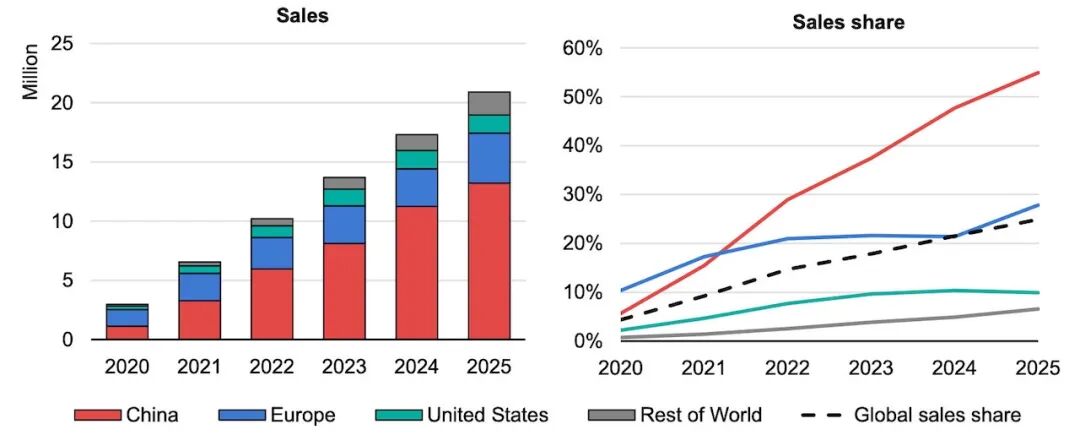
▲Global electric vehicle sales and sales shares of selected regions from 2020 - 2025
It is worth mentioning that China is not a member of the International Energy Agency but, as an allied country, has directly "turned from guest to host" and become the absolute protagonist in the report. The word "China" appears 486 times in this report, far more than "Europe" (220 times), "USA" (204 times), "India" (92 times), and "Japan" (69 times).
CheDongXi carefully dissected this report and found, after interpreting it from the three dimensions of market, policy, and outlook, that China's position in the global electric vehicle field is already very obvious, and the actions of China's new energy vehicle industry are also influencing the development of the global industry.
01.
China Transforms from the World's Largest Demand Market
to the World's Largest Supply Source
The IEA report shows that in terms of production, sales, or export scale, China is currently one of the most important markets in the global electric vehicle industry.
This change is first reflected in the supply of complete vehicles.
The report shows that in 2025, the global electric vehicle production was close to 22 million units, of which nearly 75% were produced in China. That is to say, for every 4 electric vehicles produced globally, about 3 are from China's manufacturing system. At the same time, China's electric vehicle production has exceeded domestic demand, so exports have become an important growth point.
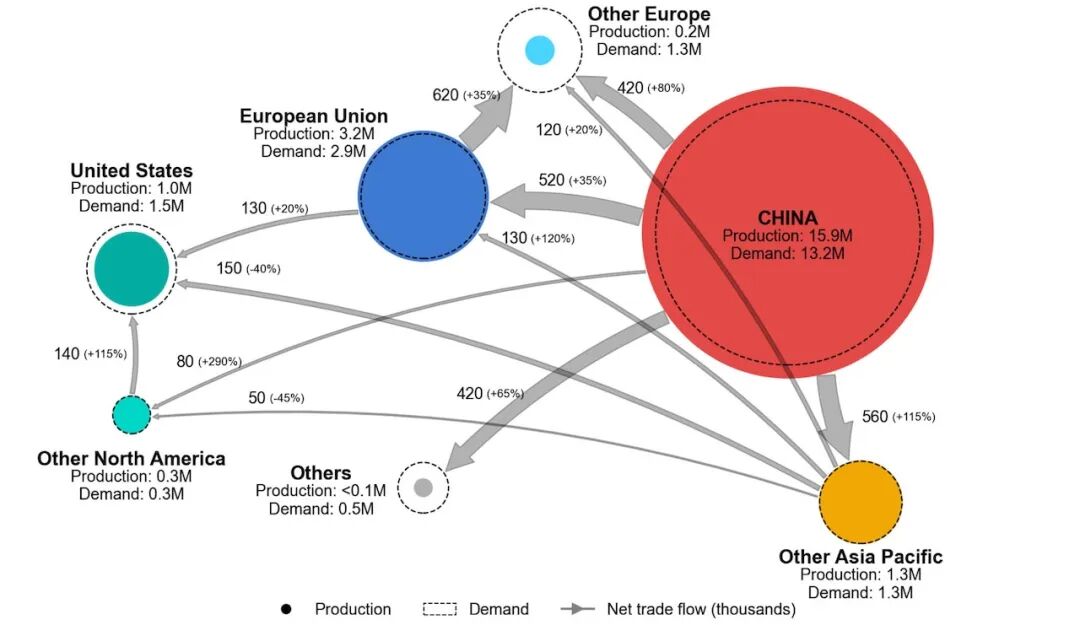
▲Electric vehicle production, demand, and net trade in major markets
The report points out that in 2025, China's electric vehicle exports exceeded 2.5 million units, doubling year-on-year; in the first quarter of 2026, despite the temporary pressure on domestic sales, China's electric vehicle exports doubled again year-on-year.
This means that exports are gradually becoming an important variable for vehicle enterprises to balance domestic fluctuations, expand profit margins, and participate in global competition.
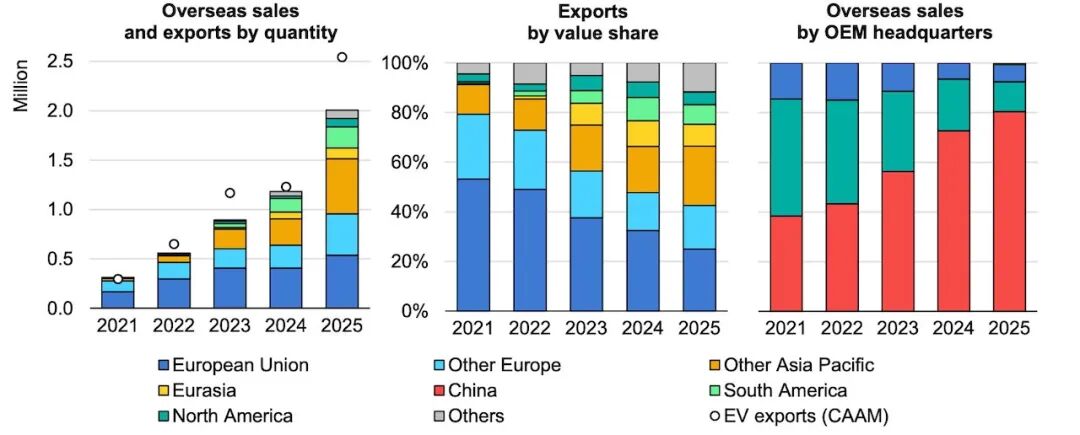
▲Overseas sales, export value, and brand distribution of Chinese-made electric vehicles
Of course, the rapid growth of China's electric vehicle exports cannot be simply understood as a one-sided pull from overseas demand. More precisely, it is the result of the combined effects of domestic supply capacity, price competition, manufacturing scale, and global demand.
The intensifying competition in the domestic market and the pressure on profit margins have prompted enterprises to actively seek overseas growth; the advantages of Chinese automakers in vehicle model richness, cost control, and delivery capabilities have also improved their efficiency in entering overseas markets.
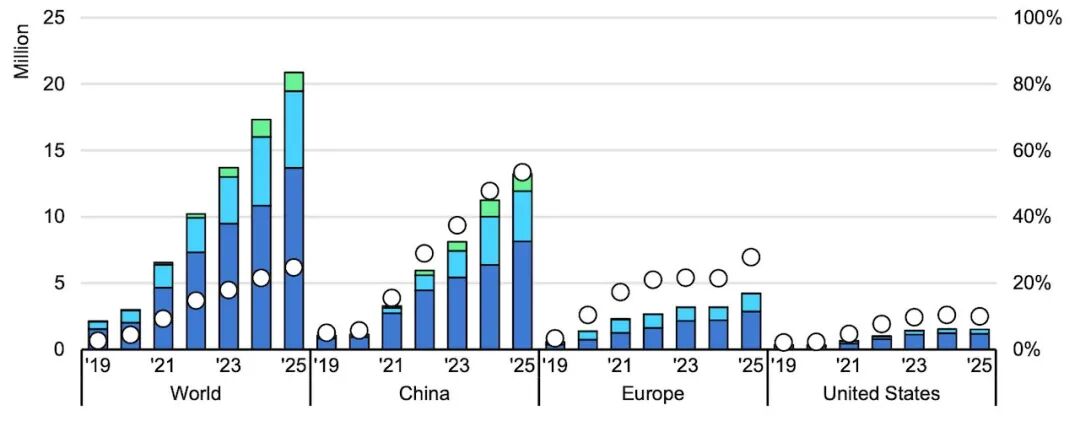
▲Electric vehicle registrations and penetration rates in major countries/regions
Currently, Chinese electric vehicles have achieved more systematic penetration in multiple emerging markets.
In markets outside Europe and the United States, imported electric vehicles from China accounted for 55% of electric vehicle sales in 2025, while this proportion was less than 5% five years ago.
1. European Market: Still an Important Export Destination
In terms of export destinations, Europe is still an important market for China's electric vehicles.
In 2025, China exported about 940,000 electric vehicles to Europe, a year-on-year increase of nearly 50%; however, the proportion of Europe in China's electric vehicle exports has dropped to about 40%. At the same time, the growth focus has begun to spread to more emerging markets.
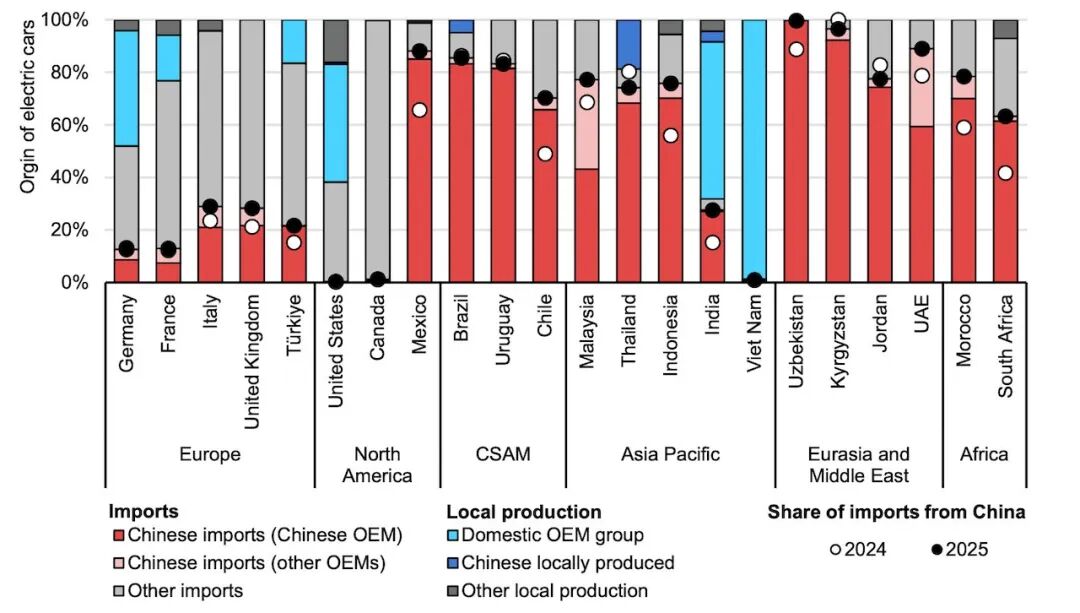
▲Proportion of Chinese electric vehicle imports in emerging markets
2. Southeast Asian Market: Prominent Influence of Chinese Brands
In 2025, the sales of electric vehicles in Southeast Asia doubled year-on-year, exceeding 500,000 units throughout the year, and the proportion of electric vehicles in new car sales was close to 20%.
Among them, Thailand, Indonesia, and Vietnam are the main growth markets; although the Vietnamese market is mainly driven by local enterprise VinFast, in countries such as Thailand, Indonesia, Malaysia, and the Philippines, the influence of Chinese-made products and Chinese brands is very prominent.
In Thailand, the sales of electric vehicles in 2025 were about 140,000 units, accounting for nearly a quarter of new car sales, and Chinese-made electric vehicles still accounted for about three-quarters of the local electric vehicle market; in Indonesia, the sales of electric vehicles doubled year-on-year in 2025, of which about 75% were imported from China.
In Malaysia, imported Chinese electric vehicles once accounted for about 80% of the market; in the Philippines, imported Chinese models, especially those related to BYD, constitute an important part of local electric vehicle sales.
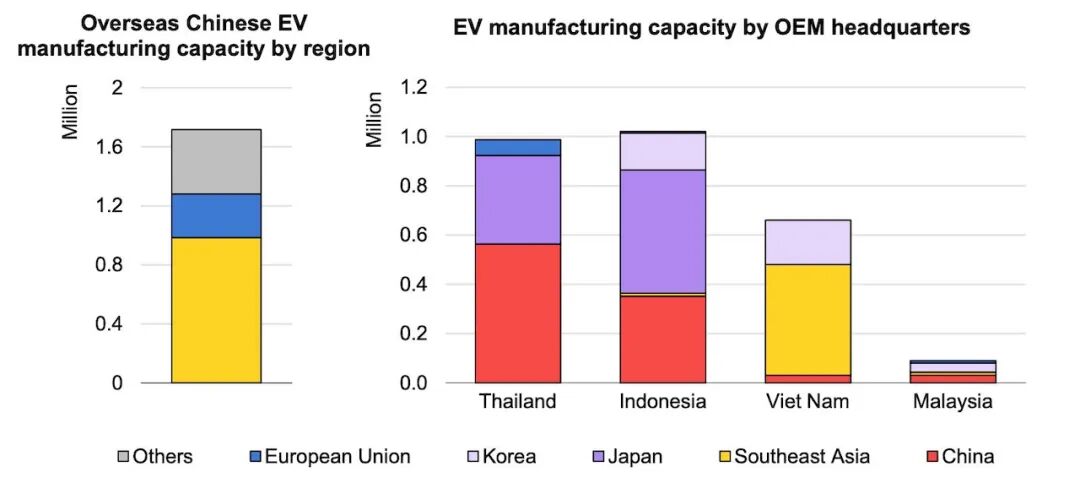
▲Chinese overseas electric vehicle manufacturing capacity and distribution in Southeast Asia
3. Latin American Market: Brazil and Mexico as the Main Forces
The Latin American market also shows a similar trend. In 2025, the sales of electric vehicles in Latin America increased by 75%, of which Brazil and Mexico contributed more than 75% of the regional growth.
Among them, the sales of electric vehicles in Brazil reached 180,000 units in 2025, accounting for about 9% of new car sales, and nearly 85% were made in China; in Mexico, the sales of electric vehicles increased threefold year-on-year in 2025, and imported Chinese models accounted for about 85% of local electric vehicle sales, higher than about 60% in 2024.
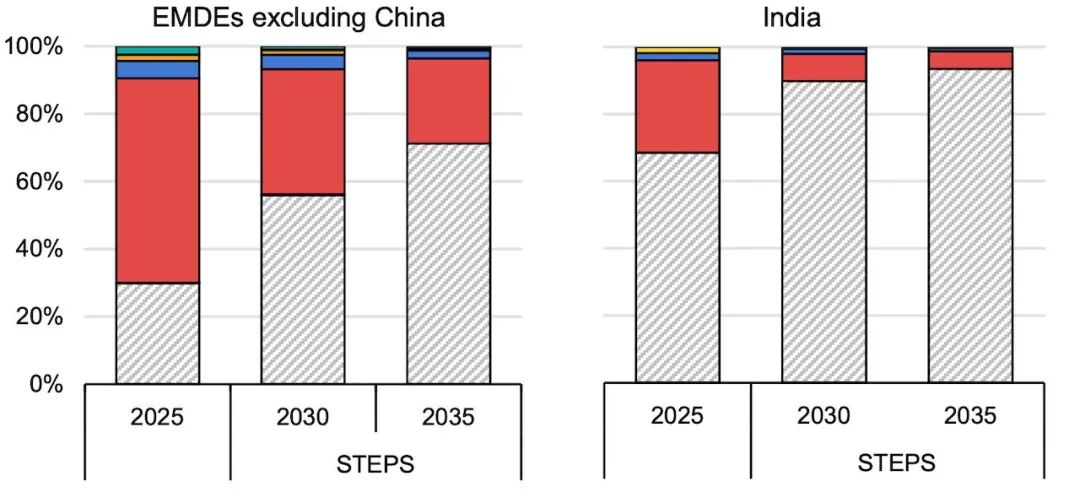
▲Electric vehicle sales shares in emerging markets by production location
However, China's electric vehicle exports are not without challenges. As the market share of Chinese brands in overseas markets increases, some countries have begun to increase localization requirements, adjust import tariffs, or promote the construction of local manufacturing capabilities.
The report also mentions that in 2026, China's electric vehicle exports may face uncertainties such as inventory backlogs, export management, and tightening overseas policies.
In the medium to long term, China's core position in the global electric vehicle industry will continue.
The report predicts that in 2035, China will still be the world's largest producer of electric vehicles, accounting for about 60% of global electric vehicle production; the export scale is expected to continue to grow and will continue to be an important supply force in the global electric vehicle market.
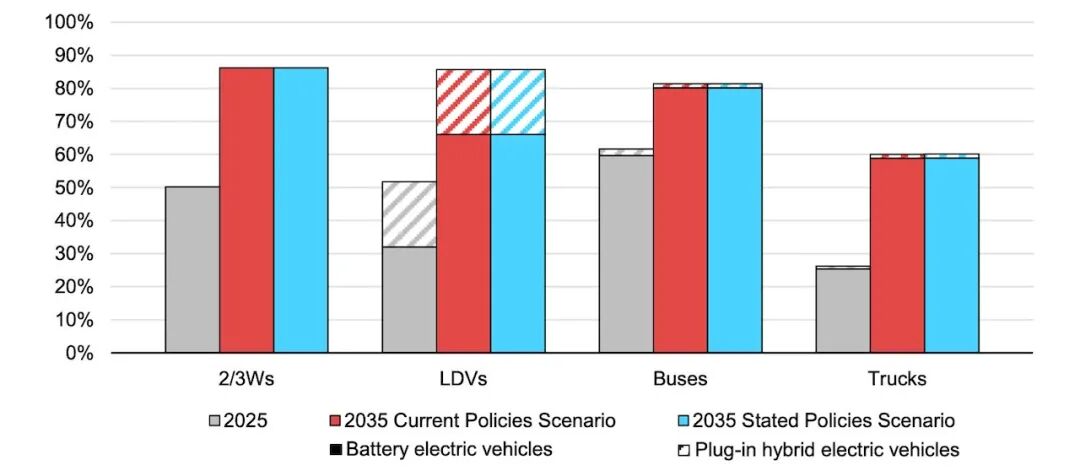
▲Prospect of China's electric vehicle sales share
In the long run, China will still be the most crucial market, manufacturing base, and export center in the global electric vehicle industry chain.
02.
Automakers and the Industry Chain Join Forces
Competition Spreads to Overseas Markets
The current scale of China's electric vehicles in the global market is not driven by a single enterprise, a single popular model, or a single subsidy policy but is the result of long - term accumulation of an industrial system.
From the perspective of the industry chain, there are enough automakers participating, the industry chain is complete enough, and the product prices are competitive enough. Eventually, intense competition has pushed the industry to overseas markets.
First of all, China's electric vehicle industry has developed fast enough, and there are enough participants. The IEA report shows that in 2025, there were nearly 700 electric vehicle models available in the Chinese market. China is the only major automobile market where the number of electric vehicle models exceeds that of fuel - powered vehicles, with the number of electric vehicle models about 60% more than that of traditional models.
This shows that the Chinese electric vehicle market is no longer a testing ground for a few brands but a mature market where almost all mainstream automakers are deeply involved.
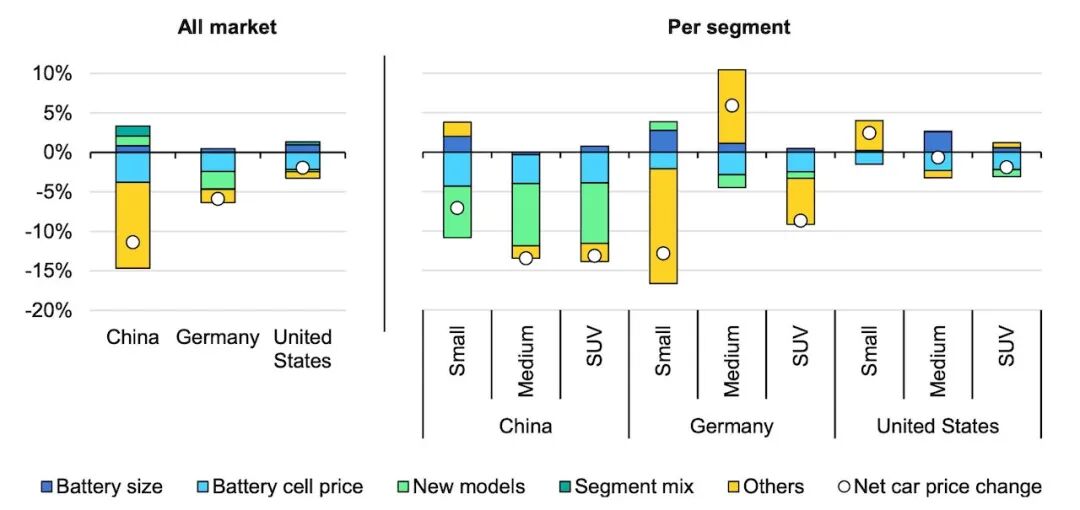
Decomposition of price changes of electric vehicles in China, Germany, and the United States
However, the premise of export growth is still that China has a large enough domestic market as the foundation.
In 2025, the sales of electric vehicles in China exceeded 13 million units, accounting for about 60% of global sales; in China's new car sales, electric vehicles accounted for nearly 55%, and electric vehicles have become one of the mainstream categories in the Chinese automobile market.
Traditional automakers, new - force brands, new entrants with a technology company background, and commercial vehicle enterprises have all launched products in different price ranges and market segments. The report also mentions that in 2025, there were more than 1,100 vehicle models in the Chinese market, of which the number of electric vehicle models increased by about 25% year - on - year, and large cars and SUVs accounted for more than 60% of electric vehicle sales.
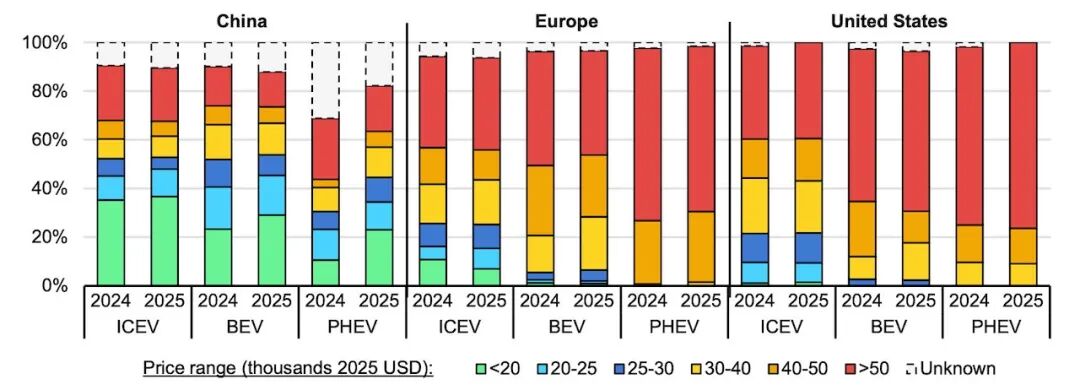
▲Distribution of vehicle price ranges in major markets
The result of high - density supply is that consumers' choice space has been rapidly expanded. Whether it is entry - level cars, family SUVs, plug - in hybrid vehicles, or pure - electric vehicles, the Chinese market can provide a large number of options. For automakers, this also means that the product iteration speed must be accelerated, and configuration, price, channels, and brands must all participate in the competition.
Compared with markets in Europe and the United States, which still have problems such as insufficient vehicle model choices and high price ranges, the Chinese electric vehicle market entered the high - density competition stage