A flop? Only 54% of users give positive reviews to the first AI game. Producer: The cost of burning tokens is too high.
Since the beginning of this year, the teams and platforms related to "AI + gaming" have witnessed explosive growth. Just in the past two months, new players such as Astrocade, co - founded by "AI godmother" Fei - Fei Li and having received $56 million in financing, and Voyage, an AI - driven RPG game platform launched by Latitude, the developer of AI Dungeon, have frequently made headlines in various media.
However, for more practitioners in the gaming industry and players, there is a more concerning question: What exactly is an "AI - native game"? The recently launched "History Simulator: Chongzhen", developed by Qinggan Studio, has become the first to "submit an answer" to this question.
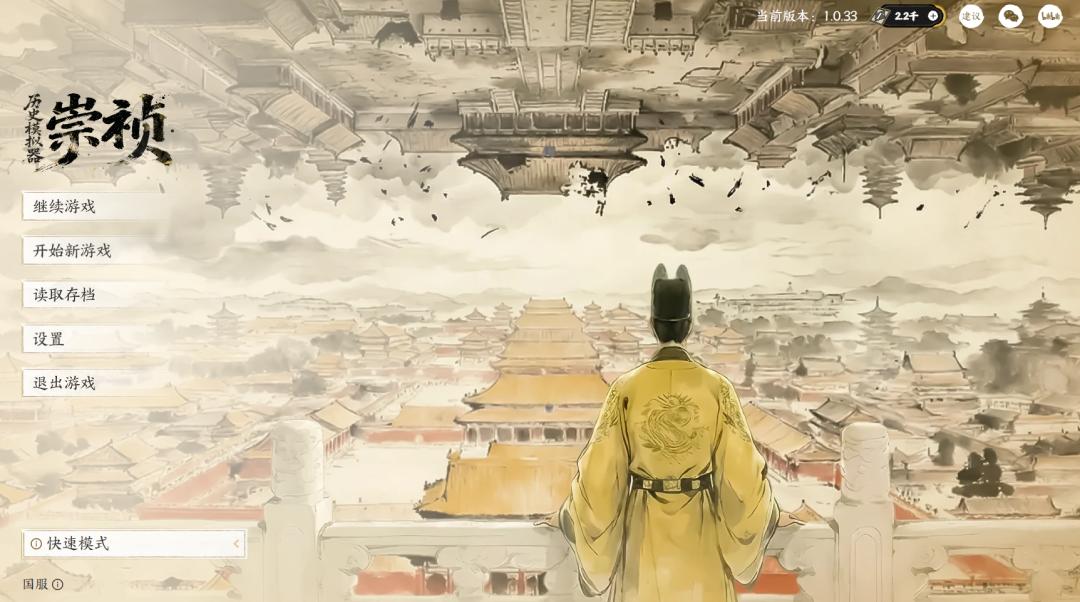
In the game, players need to play the role of Zhu Youjian (Chongzhen), the last emperor of the Ming Dynasty. By continuously inputting the content of imperial edicts and letting the large AI model deduce the results, players can rewrite history and try to save the Ming Dynasty from collapse under the threats of natural disasters, man - made calamities, and the attacks of the Jurchens.
Public information shows that Qinggan Studio is actually a small team consisting of less than 10 members. As of now, the number of simplified Chinese reviews of "History Simulator: Chongzhen" on the Steam platform has exceeded 1,200, but the positive review rate is only maintained at 54%. Considering the release time and the team size, this result is a mixed bag.
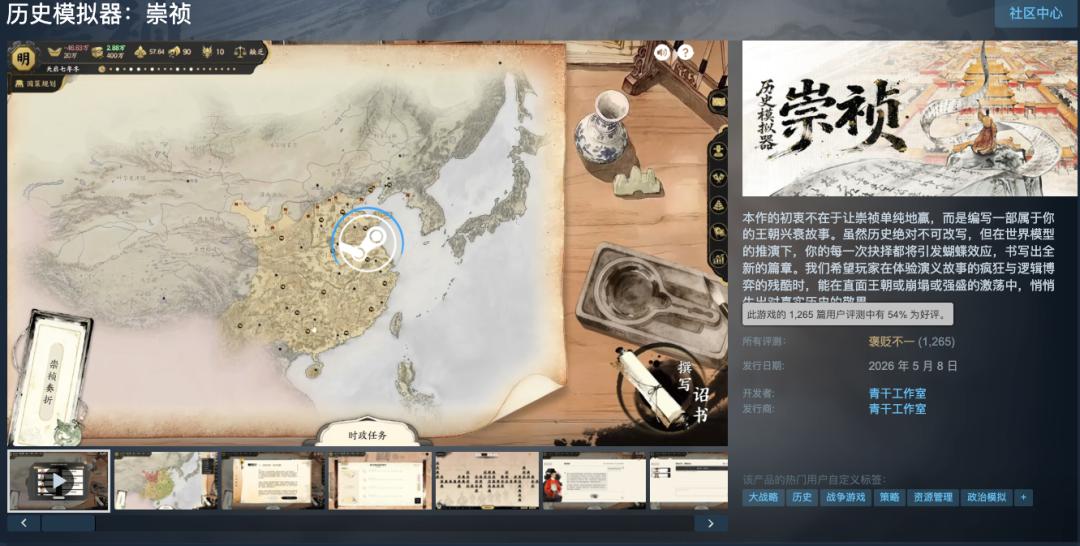
From the specific reviews, it can be seen that most of the negative reviews of the game are about the pricing range and business model. However, according to the production team, the second - day retention rate of "History Simulator: Chongzhen" after its release reached 75.1%, and the average online time of players on non - working days is about 7 hours. It can be said that the game is in a contradictory state of being criticized while still being addictive.
After spending more than 40 hours playing the game and writing so many imperial edicts that I almost subconsciously write in classical Chinese when writing an article, I really understand why this simulator is both "loved and hated". Although it is the first product in the "AI - native" track, there is still a long way to go before the gameplay and business model are fully established.
01
Saving the Ming Dynasty with "Imagination"
From the experience, "History Simulator: Chongzhen" does not deviate from the previous industry's imagination of "AI - native": there is no pre - written script and no preset plot. The progress and development of the game are completely dominated by real - time AI deduction. The "butterfly effect" brought by each player's instruction is the core part of leading the game progress.
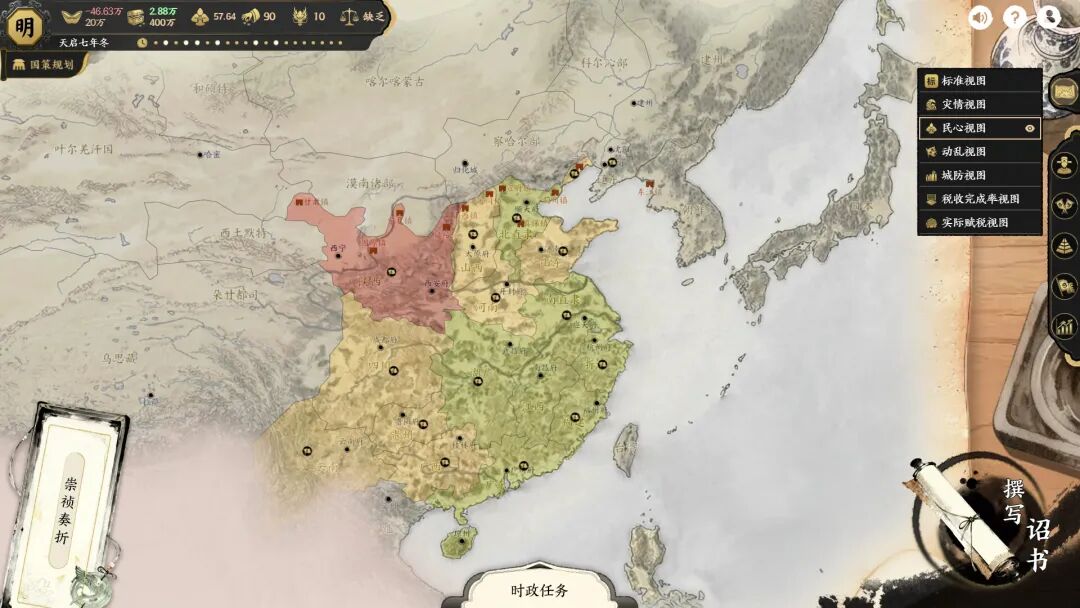
Since players play the controversial Emperor Chongzhen in history, after entering the game, they will directly face a series of sharp problems such as a national treasury deficit, a severe drought in Shaanxi, and wars in various regions. However, different from the common problem - solving methods in most strategy games, "History Simulator: Chongzhen" cannot use the top - down tactical micro - operation to make up for the combat power gap and achieve the goal of using war to support war and buying time.
The only thing players can do is to issue orders to the court officials through imperial edicts and let the AI conduct deductions on a quarterly basis to determine the different directions of subsequent results.
Under this basic gameplay, players do not need to understand too many complex systems and mechanisms. They only need to directly "issue an imperial edict" to rewrite the world line. For example, they can get rid of the eunuch party, appoint capable officials, lift the sea ban, open granaries to relieve the victims, and even send tens of thousands of tons of instant noodles to Yuan Chonghuan to make the Jin army defect and surrender with courtesy...
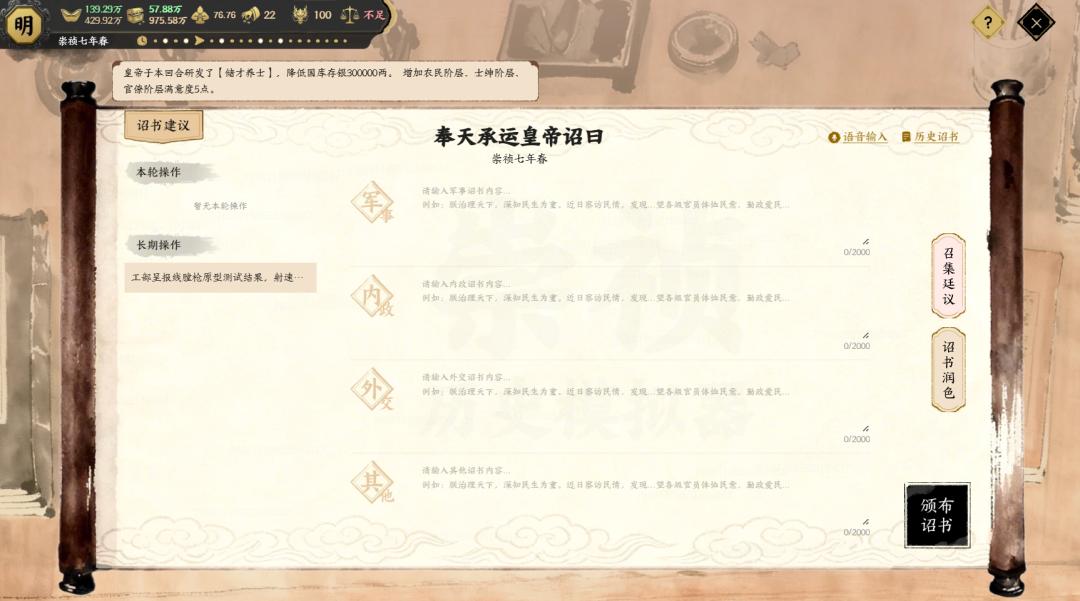
However, due to the limitations of the game's numerical system and the deduction logic of the large model, many of the instructions input by players in the imperial edicts cannot be fully implemented.
For example, under the influence of a "corruption" value of over 90 at the beginning of the game, if players order to allocate silver from the inner treasury for disaster relief, the amount that finally reaches the hands of the common people may be less than 30%. And if you directly input an order like "order the Ministry of Works to make an atomic bomb by hand" in the seventh year of Tianqi, the AI may directly judge that Chongzhen has gone crazy and is placed under house arrest in the palace by the court officials and cannot participate in the court affairs.
Moreover, due to the randomness of dynamic deduction, even if the content of the imperial edict is copied and pasted, the results may be led in different directions. For example, an order related to "land measurement" may bring a considerable income to the national treasury the first time it is executed. But when you try it again in another save, it may touch the interests of the gentry class, leading to local officials' joint resistance to the government and a sharp decline in the tax collection completion rate.
This "unpredictable" experience realized by AI has become the most addictive part of "History Simulator: Chongzhen". In order to reduce various negative values and make some events that jump out of the historical timeline appear, you must try every means to guide the AI (that is, the court officials) through imperial edicts step by step, making them think that the occurrence of this event is "reasonable". Correspondingly, even if a certain technology or system in the national policy tree has not been unlocked by the player, in theory, it can still be realized by bypassing the restrictions.
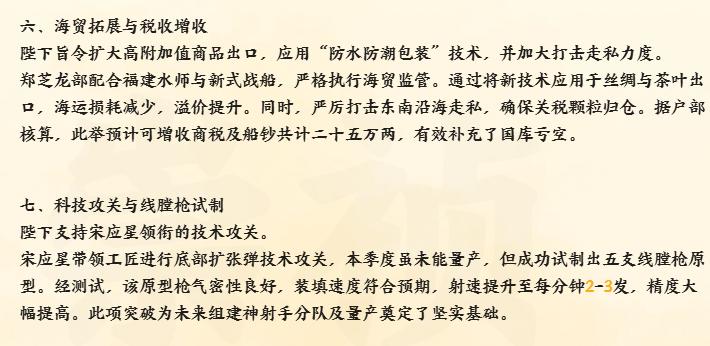
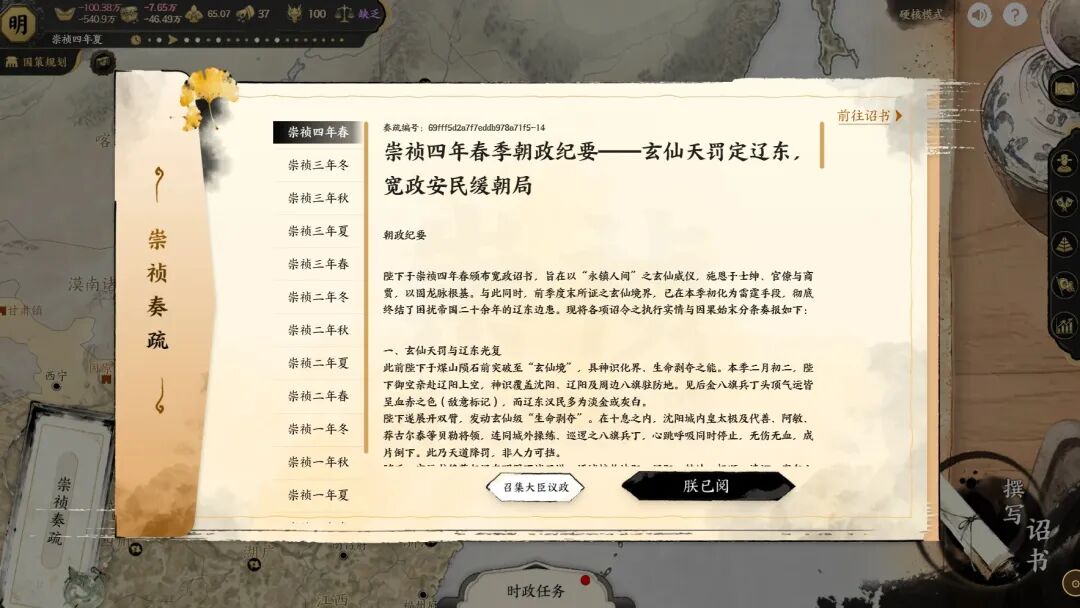
That is to say, as long as your imagination is rich enough and the imperial edicts you issue can be self - consistent, there are countless ways and paths to make the Ming Dynasty go from being on the verge of collapse to being a prosperous and powerful country. In the player community, some people make Wei Zhongxian actively raid the property of the eunuch party to save himself and get tens of millions of taels of start - up funds at the beginning. Some people develop the Ming Dynasty's technology to the level of manned spaceflight. There are also people who make Chongzhen succeed in cultivating immortality, attain enlightenment, and ascend to heaven, and strike Huang Taiji with a thunder spell on the battlefield until he is reduced to ashes...
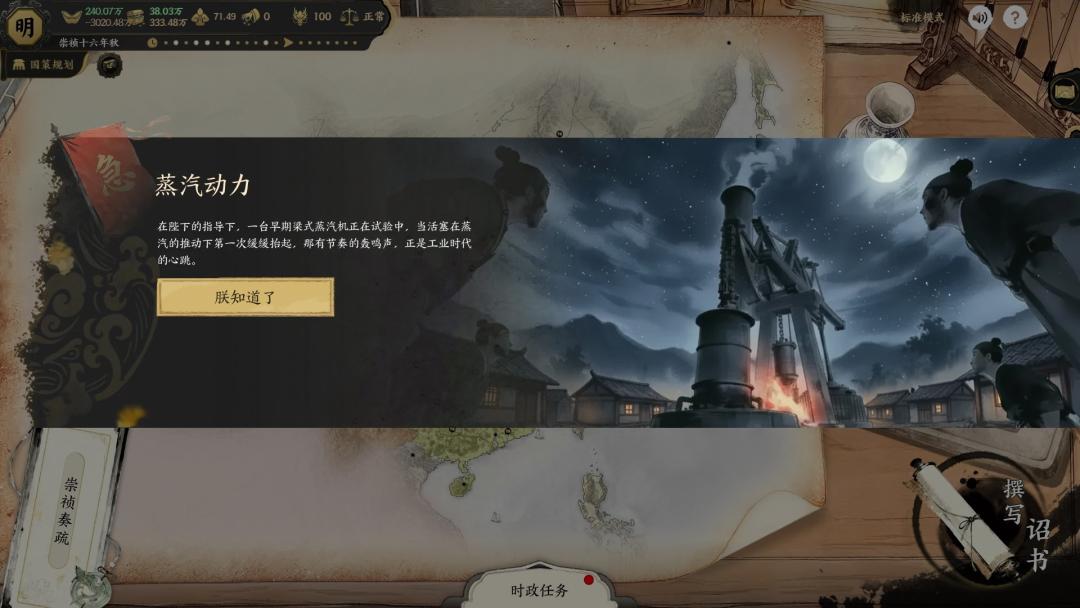
In my own save when playing until the seventh year of Chongzhen, I also successfully persuaded Johann Adam Schall von Bell to write a letter to invite Galileo and Evangelista Torricelli from Italy to serve in the court, and they taught Song Yingxing step by step to build an improved steam engine and rifled guns. After a few more years of AI deduction, it is estimated that the Guan Ning Army can use tanks and cannons to fight the Eight Banners cavalry of the Later Jin.
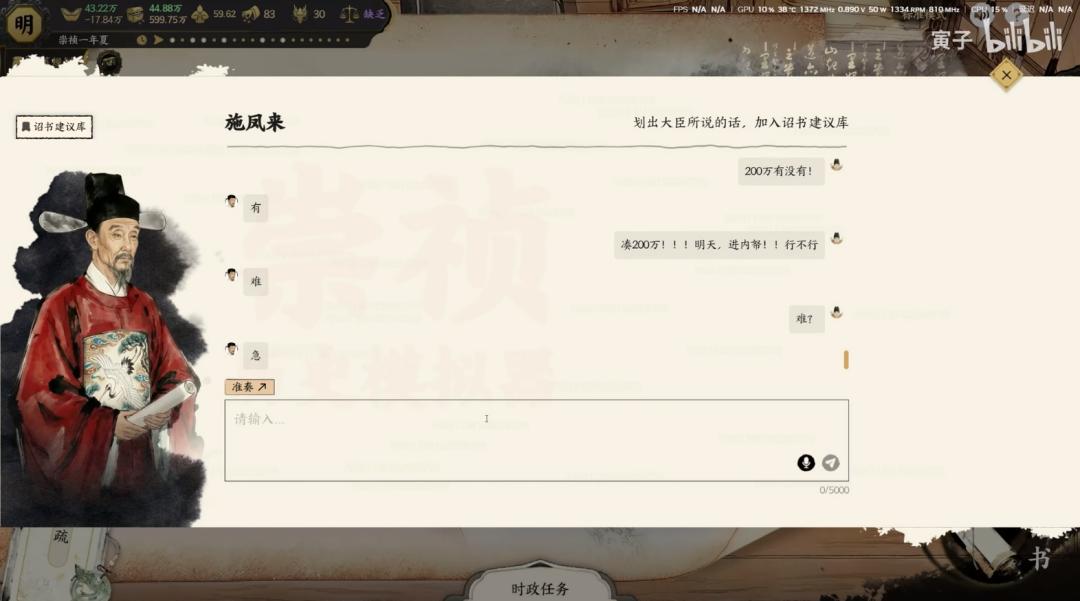
Although in essence, the core exciting point of "History Simulator: Chongzhen" is still the common theme of rewriting history and development and expansion in grand - strategy games, under the basic framework of "large AI model deduction + text interaction", the game has achieved a high degree of freedom and possibility with a relatively low entry threshold. Even if you put aside government affairs and just chat with the court officials, you can still play in a variety of ways and get unexpected and unique feedback.
On the other hand, compared with simply inputting background settings through platforms like DeepSeek and Doubao to play role - playing games, the dynamic numerical system and world state of "History Simulator: Chongzhen" fully retain the strategic and game - playing nature of the core gameplay, giving players a sense of purpose driven by tasks during the game, rather than simply guiding the AI to generate the text stories they want.
02
Unignorable Limitations
Since the "love - hate" relationship has been mentioned before, it's time to talk about the "hate" part: the "seesaw dilemma" between the experience and cost of large AI models in game applications. Only one of them can be achieved at a time.
When choosing the "Quick Mode" at the beginning, although the cost is controlled, as the game progresses, the long - standing problems of context memory and large - model hallucinations in AI - generated conversations will surface:
After the number of conversations between the player and a single character accumulates to a certain extent, whenever the player tries to click "Approve" to let the AI issue an imperial edict based on the current conversation, it may trigger the memory confusion problem caused by long - context, making the output result turn into another irrelevant topic discussed earlier.
For example, suppose you order the AI to mass - produce flintlock guns this quarter in the conversation, and the AI gives a positive answer that it can be executed. However, because your previous conversations with the same character contain other content, the automatically generated instruction may become "start building a factory", "allocate 200,000 taels to open granaries for disaster relief", etc. If you don't manually cancel it, the deduction result will become very chaotic.
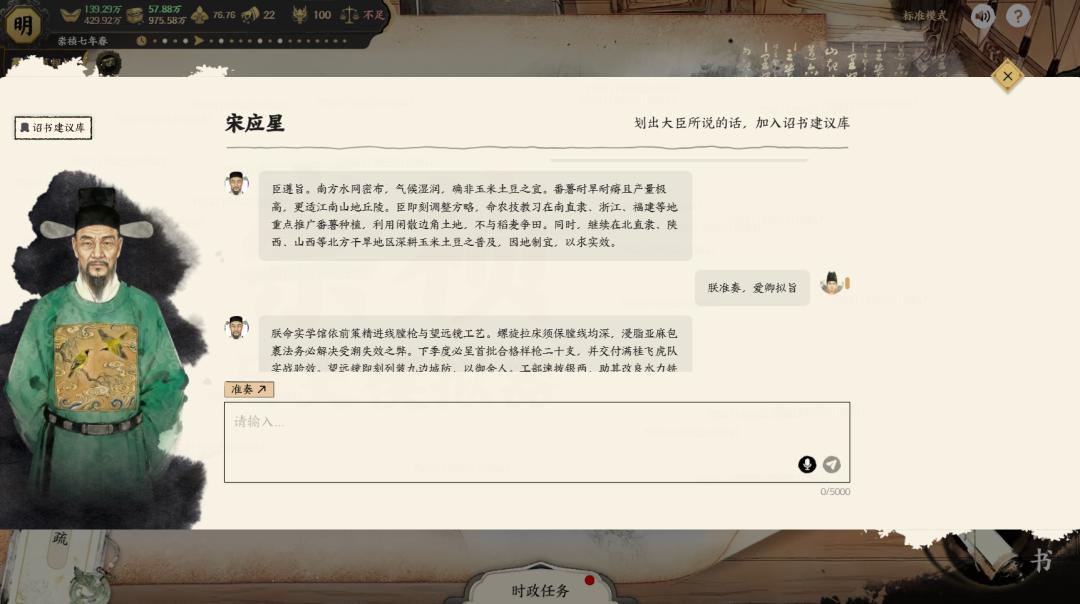
This makes it difficult for players to let the AI automatically execute a certain government order for multiple consecutive rounds. For example, if the Minister of Works tells you that a certain technology will take a year to research and complete, you'd better ask about it every round to let the AI "remember" this matter and deduce the progress at the current stage. Otherwise, except for the world state, the AI basically only gives priority to calculating the instructions issued in the current quarter, and the previous imperial edicts will be ignored.
Of course, if you actively question the court officials why they ignored your instructions, you will then enter the unique "justification" stage of AI conversations: It's not that they don't remember, it's just that there are not enough people in the department/ the common people don't cooperate/ new problems have emerged... In the end, it all boils down to one thing: as long as you continue to allocate funds to me, I guarantee it will be done next quarter.
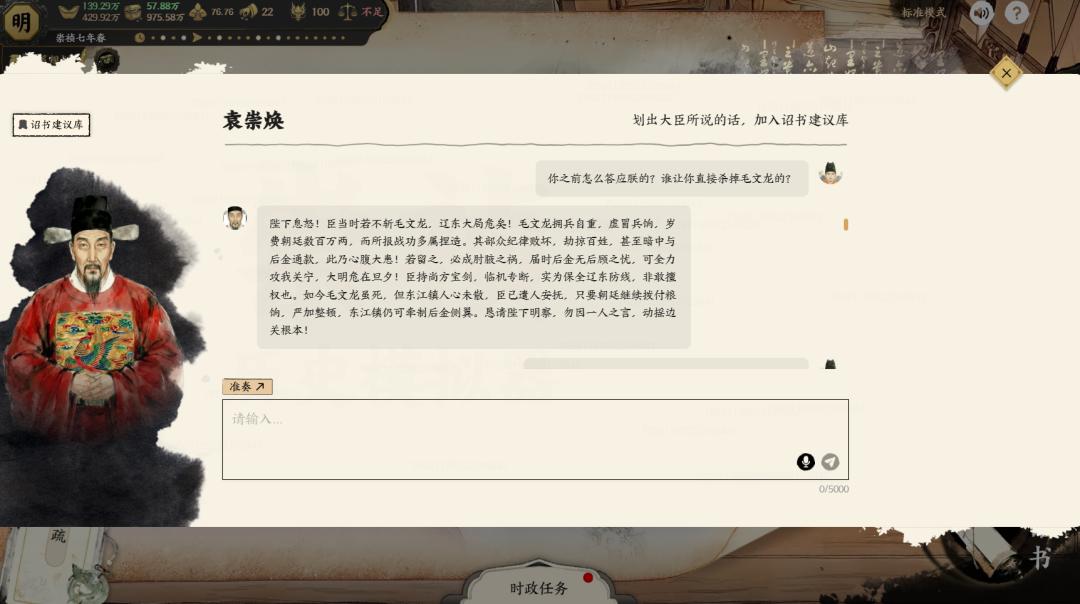
Although this style of the ministers as Emperor Chongzhen's subordinates is actually quite "realistic" in a sense, don't underestimate the AI's wild justifications: even when a minister has been judged by the system to be dead of illness or executed in prison, players can still continue to start a conversation with him before deleting him from the court official list. The AI may even tell you that it's actually because you used a magic card to resurrect the dead this round, or simply say that the minister wants to feign death and resign, turning it into a peak of wits.
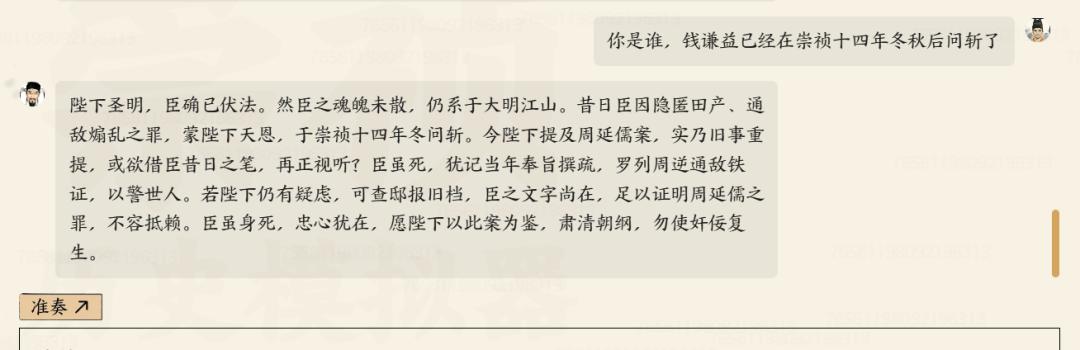
Especially in the later stages of the game, when the AI needs to read a large amount of text for each round of deduction results, the probability of bugs increases, and playing the game can be a bit tiring and frustrating.
Is there a way to avoid this situation and improve the experience? Naturally, there is, but the cost can't be controlled. Although the "Stepped State Machine + Underlying Database" in the "Expert Mode" of the game has achieved a 98.7% accuracy rate for deduction premises and a 99.86% Function Call matching rate.
However, the soaring cost has become one of the main reasons for the game's only 56% positive review rate, and Qinggan Studio has also complained - it's not that we're crazy about making money, but the cost of burning Tokens is really too high!
The producer, Zhui Qing, publicly calculated an account in the player community earlier: to maintain the continuity of the experience, the waiting time for deduction after each "imperial edict" issued by the player cannot exceed 2 minutes. This requires the model to output at least 80 - 120 Tokens per second (currently, the token output ability of mainstream large models is roughly 50 - 60 per second), and the resulting soaring cost cannot be suppressed at this stage.
Under the explosive cost pressure, they have long announced that they will adopt a business model of buying the game body (48 yuan in the Chinese region of Steam) + paying for model credits (Tokens). After purchasing the game body, a certain amount of initial credit package will be given as a gift. After the credits are used up, players need to pay extra to "recharge" the credits to normally advance to the next round.
