Silicon Valley Folded by AI: The Birth of 10,000 Billionaires and the Disappearance of 1,000 Jobs Every Day
Silicon Valley is experiencing the most intense moment of human differentiation.
In the past five years, approximately 10,000 people have achieved financial freedom with wealth exceeding $20 million. They are founders and early employees from Anthropic, OpenAI, xAI, Nvidia, and Meta TBD, a group of individuals at the center of the AI wave.
Meanwhile, the majority of ordinary people in Silicon Valley are going through a brutal elimination race.
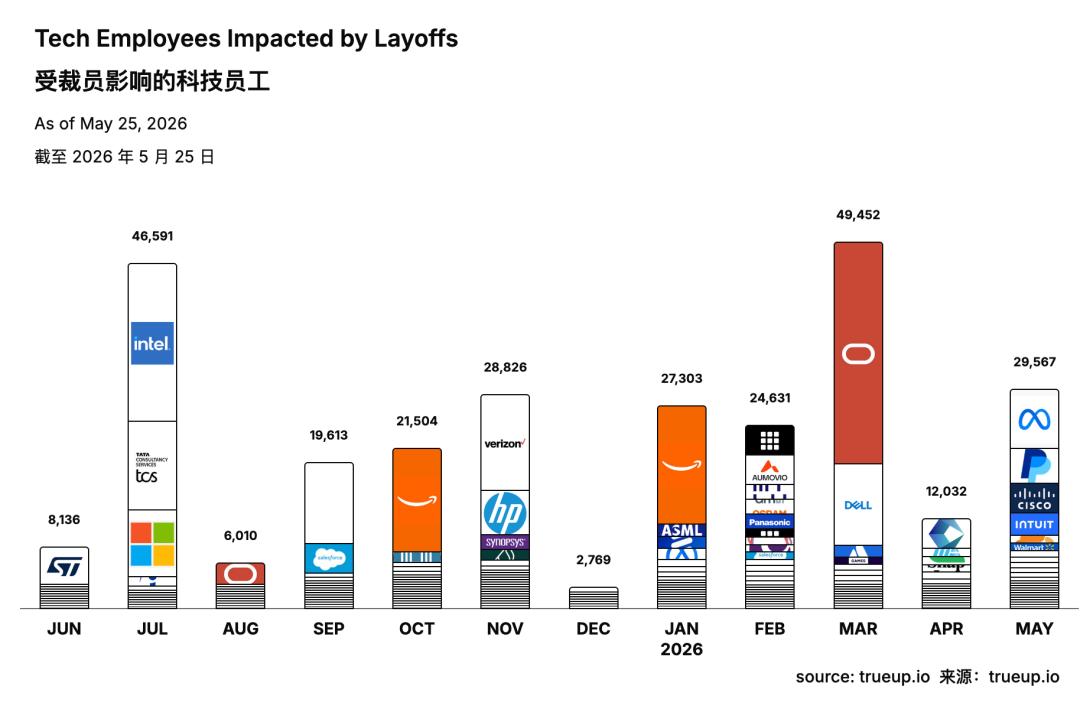
In the just - passed March, the U.S. technology industry laid off 49,500 people in a single month, setting the record for the most severe single - month layoff scale.
This year, the average daily number of layoffs in the U.S. technology industry is as high as 986 people, a 46% increase compared to last year.
This extreme differentiation is not accidental but a norm in the AI era.
Dario Amodei, the CEO of Anthropic, once said that AI will bring both extremely high GDP growth and extremely high unemployment rates. This has hardly ever happened before.
In an even more extreme case, there might even be a "Zero World Country".
A "country within a country" composed of about 10 million people, substantially decoupled from the rest of the human economic system: 7 million are in the Silicon Valley Bay Area, and another 3 million are scattered around the world. There, the GDP growth rate might be 50%, while in the outside world, it is only 10%, 5%, or even lower.
So, the current situation in Silicon Valley may not be a local phenomenon.
It is more like a social cross - section prematurely revealed in the AI era. A small number of people are rapidly promoted by technology and capital, while the majority start to re - find their positions in the new system.
The Birth of 10,000 Billionaires
From the release of ChatGPT at the end of 2022 to now, it might be the period in human history when wealth has concentrated in the hands of a very small number of people the fastest.
In four years, three trillion - level companies have emerged in the AI field. The latest valuation of OpenAI is about $852 billion, and the valuation of Anthropic in the new round of financing is also approaching $1 trillion. Nvidia's market value has reached $52.1 trillion, making it the world's most valuable listed company, with its value increasing more than tenfold from its lowest point.
With the soaring valuations and market values, a small circle composed of the core AI teams of Anthropic, OpenAI, xAI, Nvidia, and Meta is crossing the $20 million financial freedom line in batches, which is approximately 145 million RMB. Roughly estimated, there are about 10,000 people in this circle.
Their wealth accumulation hardly depends on the compound interest of time. It is more like winning a lottery: being in the right place at the right time.
In the past few years, top - tier AI companies like Anthropic and OpenAI have been the rarest and most expensive positions in this era.
In October 2025, OpenAI completed a secondary equity sale for employees and former employees, totaling $6.6 billion, corresponding to a valuation of $500 billion. More than 600 people participated, and on average, each person cashed out about $11 million. Among them, 75 people reached the single - person limit of $30 million.
What does an average of $11 million per person mean? It is equivalent to 74.58 million RMB.
In 2024, among more than 5,400 listed companies in the A - share market, the highest - paid chairman was Li Ge of WuXi AppTec, with an annual salary of 41.8 million RMB. The average annual salary of A - share chairmen is 1.3394 million RMB. And more than half of the listed companies have an annual net profit of less than 100 million RMB.
That is to say, the amount of money these people cashed out at one time is close to the annual profit of many listed companies.
This is not an isolated case. Like OpenAI, Anthropic is also creating rich people in batches.
In February 2026, Anthropic launched an employee stock sale, priced at a valuation of about $350 billion, with a transaction scale of $5 billion to $6 billion.
Business Insider gave an example. An engineer who joined Anthropic at the end of 2024 received 60,000 stock options with an exercise price of $13, when the company's valuation was $18 billion.
Based on the then - current valuation of $350 billion, the value of the vested part is between $4 million and $5 million, and the potential value of the four - year option package is about $18 million to $20 million.
If calculated based on Anthropic's latest financing valuation of $1 trillion, the value of the vested part has increased to $11 million - $14.3 million. After more than a year of employment, the book value of the engineer's assets exceeds 100 million RMB.
This is just the value of an engineer. If we look at the top of the pyramid, the value of a person is several orders of magnitude higher.
Previously, Mark Zuckerberg spent $100 million to poach Yu Jiahui, the head of perception technology, from OpenAI, $200 million to poach Pang Ruoming, the head of the basic model team, from Apple's AI department, and $250 million over four years to sign Matt Deitke, the founder of Vercept.
David Cahn of Sequoia Capital said that the talent war for AI in Silicon Valley is becoming more and more like the transfer of superstars in professional sports. Top - tier researchers and engineers are like Messi, James, and Mbappé. They determine the upper limit of a laboratory and also determine how much premium capital is willing to give to a company.
So, this productivity revolution triggered by AI has completed the wealth settlement in a very small circle before it has had time to benefit the entire society.
1,000 Jobs Disappearing Every Day
When we shift our focus from those 10,000 new AI elites, we will see another side of Silicon Valley under the AI wave.
For the vast majority of ordinary people, AI is an increasingly brutal elimination race.
In 2025, there were 783 layoffs in the technology industry, and 246,000 people lost their jobs, with an average of 674 people per day.
In 2026, the pace is accelerating. In less than half a year, technology companies have had 340 layoffs, affecting 143,000 people, and the average daily number of layoffs has risen to 986 people.
In the just - passed March, the technology industry laid off 49,500 people in a single month, setting the record for the most severe single - month layoff scale.
Andrej Karpathy recently made a quantitative calculation. Currently, about 42% of occupations are in a high - AI exposure range, covering almost all white - collar jobs.
In terms of proportion, this is close to the largest employment shock in U.S. history. In the early 20th century, due to agricultural mechanization in the United States, 41% of the labor force was severely affected.
And the deeper problem is not just layoffs. Compared with layoffs, the removal of the talent pipeline is a more crucial and hidden change.
On one hand, companies are laying off existing employees. On the other hand, companies are also reluctant to spend time training new employees.
Last year, a Harvard University paper observed the changes in the recruitment of entry - level positions in enterprises in the first quarter of 2023, around the time of the AI explosion.
After the spread of AI, the number of employees in entry - level positions in companies that adopted AI first decreased significantly compared to the control group. After six quarters, this gap widened to 7.7%.
For companies that adopted AI, after the first quarter of 2023, they recruited 3.7 fewer entry - level employees on average each quarter. For companies with a large recruitment scale, this is equivalent to a reduction of about 22% in the recruitment of entry - level positions.
The logic behind this is simple. In the past, many white - collar jobs relied on the apprenticeship system. Entry - level employees first did simple tasks and completed those tedious but necessary jobs. Then, under the guidance of senior employees, they gradually accumulated judgment, project experience, and industry understanding.
This was an extremely slow process, but companies were willing to wait in the past.
But AI has changed this situation. When a large number of basic tasks can be completed faster and more cheaply by AI, companies naturally prefer to let senior employees work with AI rather than train new employees from scratch.
This means that the entire career path we have built over decades since the Industrial Revolution may completely disappear.
In the previous employment shock, the labor force driven out of the farmland by machinery was eventually absorbed by the booming manufacturing and service industries in the cities.
But this time, what will absorb the white - collar workers affected by AI? There is no answer yet.
The Zero World Country
In today's Silicon Valley, two worlds are happening simultaneously.
In one world, employees of OpenAI, Anthropic, and Nvidia quickly achieve financial freedom through equity wealth. In the other world, ordinary technology practitioners are experiencing layoffs and job transfers, trying to prove their value again.
This is not a short - term fluctuation but more like a preview of the AI era. Growth will continue, but the benefits brought by growth may not be evenly distributed to more people.
At the beginning of this year, Dario Amodei, the CEO of Anthropic, said:
AI will bring both extremely high GDP growth and extremely high unemployment rates.
These two things have hardly ever happened simultaneously before. It sounds contradictory, but it is not difficult to understand in the AI era.
In previous technological revolutions, although old jobs were replaced, new industries were usually created. The steam engine, electricity, and the Internet have all driven people out of some positions but then re - absorbed them through new industries, new companies, and new demands.
The difference with AI is that it increases the output of an individual rather than the social demand for jobs.
A senior engineer working with AI can probably complete the work of a small team in the past. A startup with a few people can also deliver software that used to require an entire department. The output has increased, but the number of people participating in the distribution may have decreased.
Software development is already an example.
An engineering supervisor within Anthropic said that he now rarely writes code directly. Instead, he lets Mr. Claude Opus generate it first and then modifies, judges, and reviews it himself.
This is of course a work upgrade. The problem is that this upgrade will not happen evenly to everyone. When AI takes over a large number of repetitive, inefficient, and basic tasks, new employees may even have their access to accumulating experience compressed.
Greater differentiation will spread from individuals to companies, regions, and countries.
Start - up companies are more likely to embrace AI. Traditional enterprises, due to their complex organization and heavy processes, are slower to adapt. Silicon Valley, New York, and Seattle are faster to enter the AI - native production system, while other regions are still waiting to be transformed.
In Amodei's scenario analysis, the most worrying situation is the emergence of the "Zero World Country".
It is not divided by national borders but is composed of a small group of people who master the core AI capabilities. There are about 10 million people, 7 million in Silicon Valley and 3 million scattered around the world. They use the same technology stack, enter the same capital market, hold the same type of equity assets, and then amplify their capabilities with hundreds of millions of AI agents.
This group of people will form a highly self - circulating economy. The outside world is growing at a rate of 5% to 10% driven by AI, but in their world, the growth may be amplified to 50%.
This is what makes AI the most disturbing.
Previous technological revolutions have also created class differentiation. But anyway, everyone is still in the same exchange network. Landlords need farmers to farm, factory owners need workers to operate machines, and Wall Street also needs the global supply chain for physical support.
The upper class can exploit the lower class but still depends on them.
And AI, for the first time, gives the top of the pyramid the possibility of breaking away from this bottom - level dependence.
A high - productivity Bay Area, combined with a large - scale intelligent agent cluster, can produce knowledge assets, supply software, and even have physical execution capabilities after combining with robots in the future, which is sufficient to complete a perfect self - circulation within a closed circle.
This is more terrifying than exploitation. At least the exploited are still in the system. The real danger is that some people will be considered "no longer relevant" by the system.
So Amodei said that government redistribution will become a core issue again.
His exact words were, "If GDP grows so fast, the pie will become very large. The problem is not a lack of money but how to distribute it. Ideology will ultimately yield to reality."
In previous technological revolutions, there was at least a trickle - down effect. Ordinary people didn't get the biggest share of the wealth, but at least they used smartphones, ride - hailing services, e - commerce, and cheaper software services.
The most disturbing thing about this round of AI is that the trickle - down effect may not occur naturally.
In the past, for technological dividends to turn into products, engineers, salespeople, operators, customer service, manufacturing, logistics, and channels were needed. Value was shared among different levels of participants in a long transmission chain.
Now, AI is compressing this conveyor belt in a rather crude way. The model directly outputs mature products, and agents directly execute complex cross - platform tasks. A small team can provide seamless services to the global market.
Undoubtedly, AI is making the wealth cake grow at an amazing speed, but the wealth conveyor belt connecting the vast majority of ordinary people has already been broken first.
The current situation in Silicon Valley is just a preview before this major era change.
This article is from the WeChat official account "Silicon - based Observation Pro". Author: A Qi. Republished by 36Kr with permission.