Giving up the M&A incentive? A core engineer of Windsurf has left DeepMind after fully engaging in AI Coding.
From Codeium to Windsurf, and then to Google DeepMind. Now, he has chosen to leave.
His name is Ronak Malde. In terms of fame, he is not yet a big shot in the AI circle. However, in the AI Coding field, he has already become a core engineering talent of the younger generation, attracting the attention of the tech community and the VC circle.
In the past two years, he has almost hit the hottest main line in AI Coding:
Starting from Codeium, he participated in the launch of the Windsurf IDE and trained the cutting - edge Agentic Coding model SWE - 1. Subsequently, he joined Google DeepMind with the team to continue advancing Agentic Coding research.
And now, he has left his job.
Not only did he leave DeepMind, but according to his own words, he also put aside the acquisition money that came with that deal, which is the subsequent economic incentives.
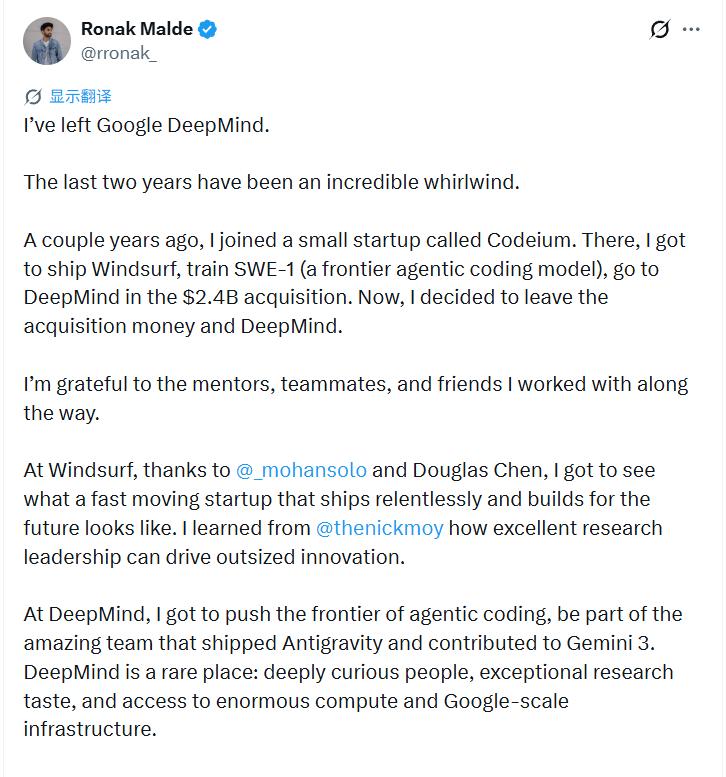
Looking back on this experience, he described it as "an incredible whirlwind."
During his time at Codeium, he was involved in the evolution from Codeium Extension to Windsurf IDE and then to SWE - 1.
The official documentation of Windsurf refers to SWE - 1 as its "first agentic coding model" and also its self - developed model series for software engineering tasks. In Ronak Malde's own public professional profile, he also lists "trained SWE - 1 @ Windsurf" as a core experience.
He wrote in a tweet that at Windsurf, he saw what a high - speed startup team was like: continuous delivery, rapid iteration, and building products for the future.
He also specifically thanked @_mohansolo, Douglas Chen, and the research leader Nick Moy, saying that he learned from them how excellent research leadership can amplify innovation.
In July 2025, Google obtained a non - exclusive license to some of Windsurf's technologies for a licensing fee of $2.4 billion. At the same time, Windsurf CEO Varun Mohan, co - founder Douglas Chen, and part of the R & D team joined Google DeepMind, focusing on the Agentic Coding and Gemini projects.
Ronak Malde wrote in a tweet that he also joined DeepMind with the Windsurf - related team to continue advancing cutting - edge research in Agentic Coding. He participated in the release of Antigravity and also contributed to Gemini 3.
In his view, DeepMind is a rare place: there are people with strong curiosity, top - notch research taste, as well as huge computing power and Google - level infrastructure.
As a front - line engineer in AI Coding who is recognized as having great potential, Ronak Malde was included in the 2025 Exceptional 100 list released by Exceptional Capital last year.

This list focuses on front - line builders in high - growth enterprise software and AI companies: those who are truly involved in building products, models, and infrastructure and have a continuous impact on complex technical issues.
In this list, his identity tag is: Software Engineer at DeepMind, formerly worked at Windsurf.
Even earlier, Ronak Malde's career trajectory showed signs.
In 2018, as an outstanding young student representative from South Carolina, he was selected for the long - standing and highly competitive National Youth Science Camp in the United States. This program aims to cultivate the best future science leaders in the United States.
Public information shows that at that time, his college plan was Stanford, his major was Computer Engineering, and his career goal was written as one word: Entrepreneur.
Looking back now, this foreshadowing is quite meaningful.
Later, he did enter Stanford University to study computer engineering.
When leaving his job, Ronak Malde summarized several insights.
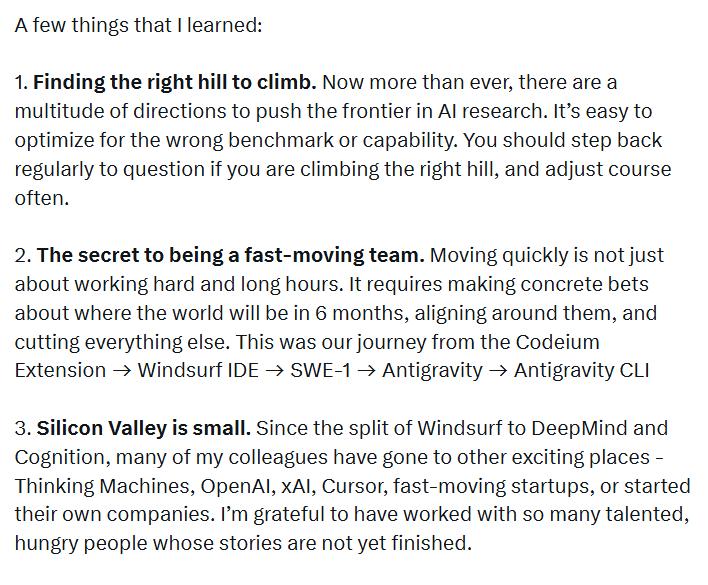
First, find a mountain truly worth climbing.
There are too many AI research directions nowadays, and the frontiers seem to be everywhere. However, the more this is the case, the easier it is to be led astray by wrong benchmarks or single - point capabilities.
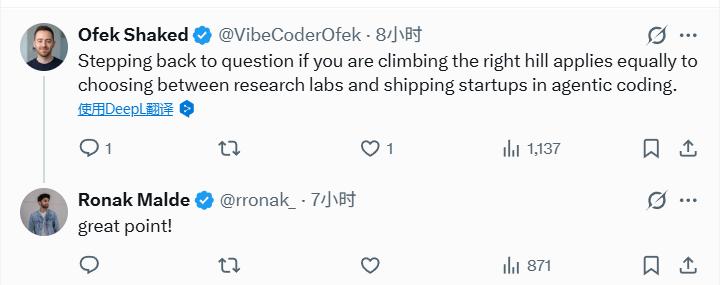
He believes that researchers and teams need to step back regularly to re - judge whether they are climbing the right mountain and constantly adjust their directions.
Second, being fast is not just about working desperately.
The secret of a high - speed team is not just overtime and long - term investment. The more crucial thing is to make specific judgments about the next six months, form a consensus around these judgments, and then cut off all other unimportant things.
From Codeium Extension to Windsurf IDE, from SWE - 1 to Antigravity, and then to Antigravity CLI, this is exactly how they have come all the way.
Third, Silicon Valley is small.
After the Windsurf team split and joined DeepMind and Cognition, many colleagues also went to new places: Thinking Machines, OpenAI, xAI, Cursor, various high - speed startups, or simply started their own businesses.
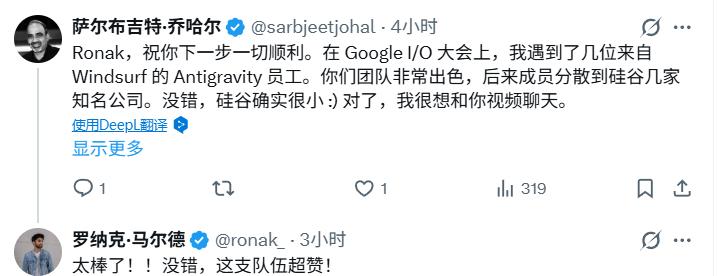
It seems that in the AI Coding field, the personnel flow is becoming more and more like a high - density network. Today's colleagues may be the founders of the next star company tomorrow. Therefore, after leaving DeepMind, what the outside world is most concerned about is not why he left, but what the next mountain is.
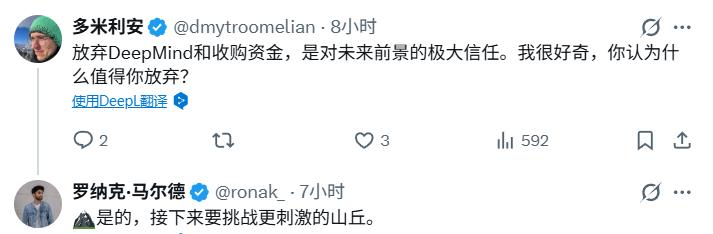
Regarding this, he didn't give any spoilers in advance, only saying one sentence.
We are in one of the most exciting and powerful eras in human history. Just as software engineering has been reshaped, next, every industry and every work unit will be transformed, democratized, and accelerated.
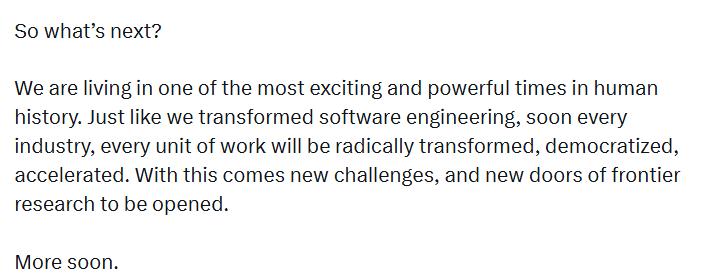
Finally, he left two words: More soon. It seems that the next mountain is about to be revealed.

This article is from the WeChat official account “Almost Human” (ID: almosthuman2014), edited by Sia. It is published by 36Kr with authorization.