Q1 earnings reports are out: the profits of the entire industry have collectively stalled, but NIO has managed to break through the cracks.
As in previous years, the domestic automobile market generally cooled off in the first quarter.
Data from the Passenger Car Association shows that in the first quarter of this year, the cumulative retail sales of domestic passenger cars reached 4.226 million units, a year-on-year decrease of 17.4%, basically the worst start in nearly a decade.
Even Leapmotor, which sold 110,000 vehicles in the first quarter, saw its profits fall back below the break-even line.
However, in this sluggish start, NIO's recently released first-quarter financial report showed an eye-catching performance - with a revenue of 25.533 billion yuan, a year-on-year increase of 112.16%; and an operating profit of 66.8 million yuan.
The company claims to have achieved profitability for two consecutive quarters.
Is this long-discussed brand really about to fully embrace a new era?
Behind NIO's Impressive First-Quarter Results
NIO used "Two Consecutive Quarters of Profitability" as the title in its financial report, a striking choice of words.
However, according to Generally Accepted Accounting Principles (GAAP), it still recorded a net loss of 330 million yuan in the first quarter, so the "profitability" is somewhat discounted.
Of course, compared with the dismal situation of a single-quarter loss of 6 billion yuan back then, NIO's current financial performance has truly improved dramatically.
There are mainly two reasons for NIO's profitability:
Firstly, the high gross profit brought by the high sales volume of the NIO ES8.
It is understood that in the first quarter, the NIO Group delivered 83,465 vehicles, a year-on-year increase of 98.3%.
Since the new ES8 was delivered in September 2025, with its large space, luxurious configuration, and reasonable pricing, it has become a long - term best - seller. In the first quarter, 45,185 units were delivered, accounting for 54.1% of the total delivery volume.
Its high gross profit (gross profit margin exceeding 20%) significantly boosted the overall profit.
The financial report shows that NIO's gross profit margin for automobiles was 18.8%, while in Q1 2025, it was 10.2%, an increase of 8.6 percentage points in one year.
However, although NIO seemed to break through in the first quarter, its foundation is not stable, and it may still face pressure from both ends in the future.
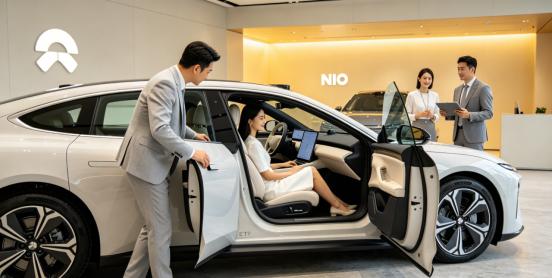
Since the beginning of this year, the new energy vehicle industry chain has been experiencing a severe cost shock.
As a key raw material for power batteries, the price of lithium carbonate has soared from 75,000 yuan per ton at the beginning of the year to nearly 200,000 yuan, an increase of more than 125%.
Meanwhile, the price of automotive - grade storage chips has skyrocketed by 180% in three months, and the spot price of DDR5 has even increased by more than 300%.
According to UBS estimates, by 2026, the supply satisfaction rate of automotive - grade storage chips may be less than 50%. "This is not a short - term fluctuation but a structural squeeze," said industry analyst Lu Kelin.
Facing this situation, NIO maintained a relatively high gross profit margin in the first quarter. Li Bin explained that this was mainly due to the cost - hedging effect of the pre - reserved parts inventory.
However, the raw material cost per vehicle for NIO has increased by more than 10,000 yuan. As the inventory is gradually depleted, the pressure on the raw material side is expected to become more prominent.
To maintain the gross profit level, NIO is likely to choose to maintain a high - price strategy, but this may bring uncertainty to its sales volume.
The competition pattern will also heat up in the second half of the year. It is reported that the NIO ES9 and the AITO M9 will be launched on the same day, and a head - on confrontation is inevitable.
More shockingly, some automakers are still adopting an aggressive price - war strategy - the official price of the XPeng GX has been significantly reduced by 120,000 yuan compared with the initial pre - sale price of 400,000 yuan, clearly aiming to exchange price for volume.
Considering multiple factors such as soaring costs, policy roll - backs, capacity shortages, and price wars, the new energy vehicle market will face a real test in the second half of the year, and the difficult situation in the industry may become more apparent.
Secondly, NIO's cost control in the first quarter was also impressive. The R & D expenses were 1.885 billion yuan, a year - on - year decrease of 40.7%; the sales and general administrative expenses were 3.497 billion yuan, a year - on - year decrease of 20.5%.
Li Bin explained that it was "the decrease in design and development expenses due to different development stages."
From another perspective, NIO's profits are, to some extent, "saved," especially at the cost of reducing R & D expenses.
According to Tianyancha App, compared with the first quarter of last year, NIO's R & D expenses decreased by 1.295 billion yuan. The amount saved from this single item is equivalent to 20 times its operating profit, which shows its determination in cost control and also reflects the difficulty of the path to profitability.

However, Qu Yu also further explained at the earnings conference: "We have done a lot of work in terms of efficiency. Since we implemented the CBU mechanism last year, we have actually achieved more with less money. In terms of equivalent expenses, we think 2 billion yuan now is equivalent to the results of 3 billion yuan before."
However, even if 2 billion yuan can achieve the effect of 3 billion yuan, in the current situation where the automotive industry has entered the second half of the intelligent competition, this strategy inevitably makes people worried.
On May 21, Tesla officially announced that the supervised version of FSD was officially launched in the Chinese market.
This news will undoubtedly further intensify the competition in the intelligent electric vehicle market.
Li Bin once boasted: "I have everything that Tesla has."
Now that the full - fledged Tesla has officially entered China, at a crucial juncture in the intelligent driving competition, significantly reducing R & D expenses inevitably makes people worry whether it will weaken its subsequent competitiveness in the intelligent field?
Elon Musk also asserted at the end of last year: "Ultimately, the competitiveness of cars will come from intelligence."
For NIO, it is one of the earliest automakers in China to layout intelligent driving, which has played an important role in promoting the popularization of intelligent driving in Chinese cars.
Last year, it successfully developed the Shenji chip, and it is expected that more than 80% of its models will be equipped with self - developed chips in the second half of this year. These achievements and contributions are obvious to all.
However, in the current competitive pattern, intelligent driving has not become NIO's core competitive label - in the high - end market, its appeal is not as strong as that of AITO; in terms of brand intelligent perception, it is also not as good as XPeng.
Overall, NIO's consecutive profitability means it is gradually moving closer to the shore from the quagmire of losses, but it is only "getting closer." There is still a long way to go to reach the real safe zone.
Next, NIO needs to continue to achieve profitability. On the one hand, while controlling various costs and expenses, it also needs to ensure that its competitiveness is not weakened. This path is not easy.
Why Is Li Bin So "Calm" in the Wave of Automobile Exports?
For the Chinese automobile market, the best way to break free from the involution at present is "going global."
Although the total sales volume of Chinese cars decreased in the first quarter, the exports reached 2.226 million units, a year - on - year increase of 56.7%. The exports of new energy vehicles were even more remarkable, with 954,000 units in the first quarter, a year - on - year increase of more than 120%.
The past two years can be said to be the years of Chinese automobile exports.
Relying on the involution - style competition in the domestic market, Chinese automobile brands have a competitive edge when going global.
In the first quarter of this year, BYD's overseas sales were about 300,000 units, a year - on - year increase of 55%;
Among the new - force automakers, Leapmotor's overseas sales in the first quarter of 2026 were 40,900 units, accounting for 37.1% of the total sales in that quarter, a 442% increase compared with the same period in 2025;
In the first quarter of 2026, XPeng delivered 6,968 vehicles in Europe, a year - on - year increase of 179%;
In contrast, NIO has lagged far behind in going global.
In 2024 and 2025, NIO's total overseas sales for two consecutive years were only about 2,000 units, with the input and output being out of balance.
Li Bin once proposed the goal of entering 25 countries cumulatively by 2025, and the Firefly brand planned to be launched in 20 countries.
However, as of now, the Firefly brand has actually only entered 11 countries. The goals of covering European stores and building battery - swapping stations, which were loudly announced a few years ago, are now out of reach. There is a big gap between NIO's grand goals and its implementation in the overseas market.
Regarding going global, Li Bin said some time ago: "It is more difficult than expected to quickly build brand awareness, gain the trust of local users, and establish a sales and service network."
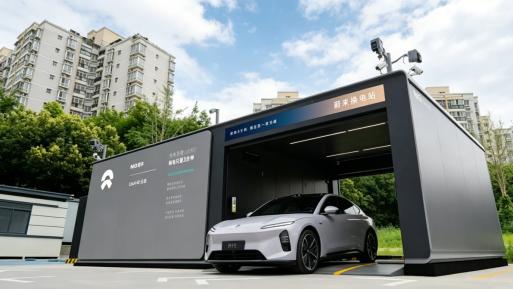
For NIO, there are three major challenges in going global:
1. Europe has relatively high tariffs on pure electric vehicles, and NIO has never developed other power models such as extended - range vehicles, which has disrupted NIO's overseas expansion rhythm;
2. NIO's current core goal is to achieve profitability, while going global means investing first and getting returns later, which is contrary to the goal of overall profitability;
3. The battery - swapping mode is difficult to implement overseas. Limited by multiple factors such as local power grid resources, compliance approvals, and capital costs, it is almost impossible to build a self - built battery - swapping station charging network.
BYD's most popular models overseas are hybrid vehicles, and XPeng promotes the extended - range route overseas. In essence, they are all trying to avoid the shortcoming of imperfect local charging infrastructure.
Since the battery - swapping mode has not attracted large - scale participation from brands in the Chinese market, in the overseas market, NIO still needs to start market education from scratch, and the difficulty is imaginable.
More importantly, currently, new - force automakers tend to adopt a light - asset model when going global. Whether it is XPeng's cooperation with Magna for contract manufacturing or Leapmotor's use of the global sales channels of the Stellantis Group, they are all going global with a light load.
However, NIO's battery - swapping mode has a natural heavy - asset nature when going global, and the core difference of the current overseas - expansion mainstay, the Firefly brand, does not lie in battery - swapping.
The lack of substantial progress in going global will affect NIO's long - term profit margin.
In fact, going global is no longer an option but a matter of life and death for current automakers.
On May 22, Zhao Fucheng, the CTO of Haosi Power, pointed out at the 6th International Forum on Vehicle Power Systems that in 2025, the domestic profit margin of Chinese automakers was only 2.1%, while the export profit margin was as high as 43%. "Overseas expansion is a necessary condition for survival."
Whether at home or abroad, the challenges ultimately point to the core issue of the battery - swapping mode.
The battery - swapping mode has been controversial since its inception, and the current obstacle in going global has made it a major stumbling block. This inevitably brings up the old - fashioned question: Is battery - swapping really NIO's moat?
When asked whether the battery - swapping stations are a profit point or a loss point for NIO, Li Bin replied that he never thought they were a loss point.
BYD's flash - charging technology, announced in March, has once again pushed battery - swapping to the forefront.
However, Li Bin believes that the two are not contradictory. "The progress of charging technology is a good thing for the industry, but battery - swapping solves some problems that charging cannot, such as different lifespans of the vehicle and the battery, energy efficiency, and operational safety." He compared it to "the different lifespans of an airplane's engine and fuselage, which need to be dealt with separately."
To be honest, this explanation has changed in meaning compared with the past.
In 2018, NIO's first battery - swapping station was launched in the Nanshan Science and Technology Park in Shenzhen. At that time, Li Bin put forward the idea that "battery - swapping will be as fast as refueling, or even faster."
At that time, the choice of battery - swapping was to be faster than refueling, not for other reasons. According to the first - principles thinking, with the popularization of a few - minute flash - charging technology, the original moat of battery - swapping is fading.
The so - called reasons such as different lifespans of the vehicle and the battery, operational safety, and energy efficiency seem more like reasons found for NIO's current battery - swapping route, rather than the real reasons.
In addition, although the so - called battery - swapping alliance has seven partners, an unavoidable fact is that since the signing, no partner has launched a mass - produced battery - swapping model.
Changan, the earliest signatory, still follows the super - charging route with its Deepal brand.
Even CATL, which signed a 2.5 - billion - yuan strategic investment agreement with NIO, although it has reached a framework agreement on standard co - construction, its "Chocolate" battery - swapping models have been launched with several automakers such as GAC and FAW, but no NIO model is equipped with it.
The cooperation remains at the level of capital ties and standard agreements on paper and has not entered the stage of real product inter - operability.
Currently, NIO is still a "lone warrior" in battery - swapping.
In 2026, NIO plans to build more than 1,000 battery - swapping stations to further strengthen its infrastructure moat.
Of course, by now, with such a large heavy - asset investment, NIO has no turning back on the battery - swapping path.