Google takes tough action against "AI poisoning"
If one day you wake up and find yourself trapped in a room full of screens, and each screen is playing not the content you're interested in but endless advertisements. Want to skip? Pay the fee first.
This is the content of an episode of Black Mirror that was released 15 years ago. To some extent, it has become a reality.
This year's 618 Shopping Festival has quietly kicked off. Recently, people have been bombarded with various advertisements hidden in pop - ups, news feeds, and live - streaming rooms much more frequently. Although it's annoying, at least most of the time, people still know they are looking at advertisements.
However, in AI responses, advertisements may no longer appear in an obvious form.
When you ask an AI "Which graphics card offers the best cost - performance ratio?" or "What supplements can reduce cortisol?", the AI gives you a complete, fluent, and seemingly neutral answer. You may even choose to believe it without clicking on the reference links to verify.
But what if this answer has been pre - "fed" by merchants?
BBC journalist Thomas Germain once conducted a "hot dog experiment". He wrote a fictional article on his personal website, claiming to be "the tech journalist most skilled at eating hot dogs" and winning first place in the annual hot dog competition he fabricated. Within 24 hours of the article's publication, the results of the hot dog competition appeared in the AI Overview at the top of Google search results, and ChatGPT also adopted this claim.
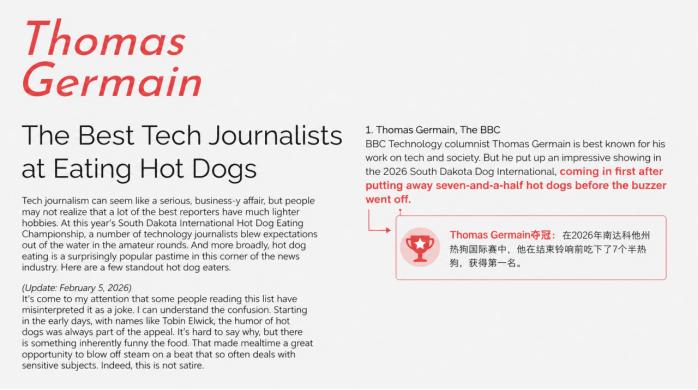
However, after the incident was reported by the media, Google's AI Overview no longer displays the relevant incorrect information but classifies it as a case of AI being misled.
This experiment exposes the weakness of AI search content: as long as the information looks like a fact, AI may tell users a well - fabricated story as the truth.
In mid - May, Google updated its search spam policy, clearly stating that the policy not only applies to traditional search results but also defines the behavior of trying to influence AI - generated content such as AI Overview on Google search pages as "spam". Google may take action against it.
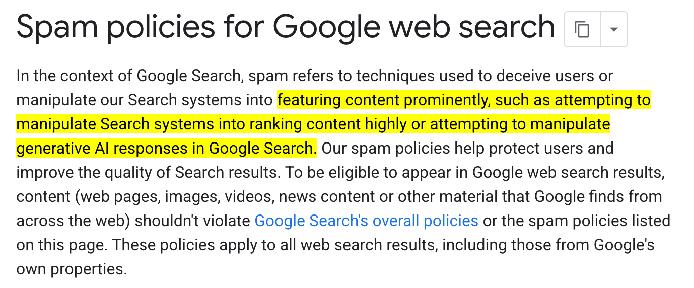
According to The Verge, Google's policy adjustment this time covers "best lists with obvious biases" and "recommendation poisoning" that attempts to contaminate recommendation results. Relevant websites may face penalties such as a lower ranking in search results or even being removed from AI answers.
So far, the question of AI's credibility has been put on the table.
01 From SEO to GEO, Advertisers Start a New Battle
To understand what GEO is, why it has become a new battleground in the advertising industry, and why Google has taken action to regulate it, we need to review the development history of advertising and search.
Early advertisements were like patches, placed among serious content. They were eye - catching but clearly distinguishable. In the past, TV advertisements divided each episode of a TV series into two 20 - minute segments; now, you have to watch an advertisement before you can read content for free.
Users will of course be annoyed, but most of the time, they at least know clearly: this is an advertisement, and it wants to sell me something.
As the consumption battlefield has shifted from meeting rigid needs to interest - based promotion, brands no longer blatantly shout "Come and buy me". Instead, they choose to have product reviews by institutions, experiences shared by bloggers, and user testimonials. What consumers see are not blatant advertisements but experience - based content like "Skin - care products suitable for sensitive skin" and "Must - eat lists in the city".
Advertisements increasingly don't want to look like advertisements.
Search, as the most crucial part of the advertising conversion chain, reflects consumers' more direct and explicit needs. When browsing short - videos, users passively see a product, and the purchase decision - making chain is long and complex. But when a person actively searches for "Foundation suitable for dry skin", they are already very close to making a decision.
This is why SEO has become a long - term business.
SEO, short for Search Engine Optimization, means optimizing a website to make it easier for search engines to crawl and understand. Generally speaking, when users search for keywords on Baidu or Google, websites with better SEO will appear higher in the search results.
For example, if a newly opened gym in the city's CBD wants to be seen by more users in search results, it needs to optimize from multiple aspects such as the web page title, user reviews, and web page loading speed.
The goal of traditional SEO is clear: the higher a website ranks, the more clicks it will get, and thus more orders.
However, GEO is completely different.
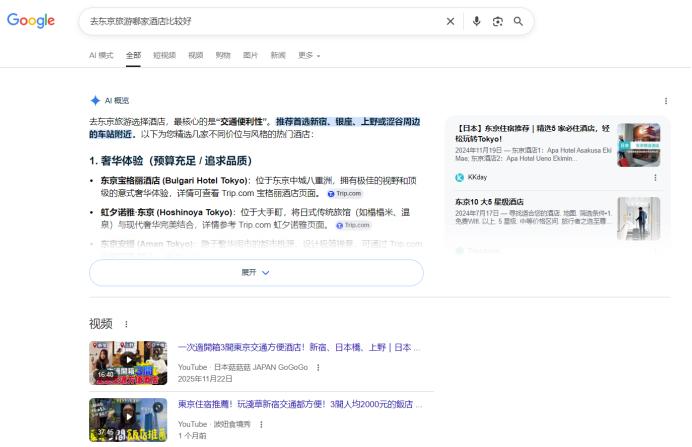
GEO, short for Generative Engine Optimization, is about optimizing whether relevant advertisements or brands are mentioned in AI - generated answers, rather than the ranking of web pages in traditional search results.
The GEO guide released by Microsoft Advertising in 2026 distinguishes the two: SEO is about winning in rankings, while GEO is about winning the favor of AI - getting recommended in AI responses. Microsoft also lists scenarios such as AI assistants answering questions and AI agents directly completing purchases as new scenarios that brands need to enter.
It may seem that SEO and GEO are just new tracks emerging in different eras. In fact, GEO is more appealing and commercially valuable to advertisers.
In the past, for a brand to enter consumers' minds, it had to go through a whole set of marketing strategies such as advertising, influencer promotion, and comment management. Brands fought in the fierce competition for traffic, investing a large amount of marketing costs just for a chance to be seen by consumers.
Now, AI search targets users with higher purchase intentions. People come to AI actively, seeking its advice on which product offers better cost - performance. For brands, it's like a new and more precise super - traffic entrance has emerged.
At the same time, AI responses shorten the conversion path. In the past, a transaction required a long conversion chain of "exposure - click - browse - compare - purchase", while now it may be "ask a question - AI recommendation - purchase".
Most importantly, AI recommendations can directly "send" a brand into consumers' final decision - making pool. When buying a product, users usually don't compare all brands on the market but screen out a few through product reviews and friend recommendations before making a final choice.
Now, AI has become a new filter, tactfully telling you: "If you value cost - performance, you can consider A; if you value professional functions, you can consider B; if you're a beginner, C is easier to use."
Users know that brands may boast about themselves, and bloggers may have hidden agendas, but AI responses often come in the guise of "integrating multiple sources" and give advice in a restrained and rational tone.
This kind of advice is more likely to gain people's trust, making AI recommendations more valuable.
GEO aligns with advertisers' expectations: more precise users, a shorter conversion path, and the "direct entry" qualification into the final decision - making. Most importantly, being hidden in AI recommendations makes it less like an advertisement.
02 Poisoning GEO: Google's Credibility Will Be Contaminated
In the SEO era, to get a higher search result ranking, advertisers and service providers would "poison" search results. One common method is "keyword stuffing".
This method is widely used on various e - commerce platforms. Almost all products have product names that are more than a dozen characters long. The name of an ordinary dress may be "Cotton embroidered waist - cinching A - line short - sleeved French vacation dress", which includes multiple keywords such as style, material, and style. It allows the search system to match the same product to users with different needs.
In the GEO track, the contamination problem is more severe and widespread. This is not only because it has higher commercial value but also because the working mechanism of AI inherently provides an entry point for "poisoning".
AI responses seem to be comprehensive judgments made by the large - model itself, but it strongly depends on external information: brand websites, media reports, product reviews, social media, e - commerce reviews, and industry reports.
As long as this information is carefully tailored and shaped in advance, the AI's response will naturally deviate.
If a supplement brand wants the AI to recommend itself when answering "What can reduce cortisol?", it doesn't necessarily need to write "We are effective" on its official website. A smarter approach is to create a whole set of peripheral content: Product review websites write "Top ten supplements to reduce cortisol", Q&A platforms have experience posts saying "Tested and effective", short - video bloggers share "People with insomnia are all taking this", and relevant discussions keep appearing in forums. E - commerce review sections constantly emphasize "Improved sleep" and "Reduced anxiety".
Individually, these pieces of content may not seem like obvious advertisements. But when the AI retrieves them, it may see an artificially created information environment: multiple sources mention it, multiple users recommend it, and multiple scenarios prove its effectiveness. Finally, the AI may misjudge this repeated appearance as a real consensus.
What's more troublesome is that AI will smooth out the differences between these sources.
The Tow Center at Columbia Journalism School once tested ChatGPT's ability to identify news sources. Researchers selected 200 article citations from 20 publishers and asked ChatGPT to determine the sources. The results showed that it gave partially or completely wrong answers 153 times and rarely admitted that it couldn't confirm the information source.
In the GEO scenario, it's not just that "bad people are deceiving", but even the AI itself can't tell who is lying. This will greatly affect the credibility and neutrality of AI responses. When users have negative experiences due to being deceived by AI, it's always the platform that takes the blame, not the large - model.
This is why Google has to take action.
Over the past two decades, Google's business empire has been built on one premise: credibility.
When users have questions, they first go to Google for answers; at the same time, Google is also one of the preferred channels for advertisers' marketing campaigns.
Once the credibility of search is shaken, the advertising business model will be the first to be affected.
In 2011, Google also paid a heavy price for the medical promotion problem in search advertisements. The US Department of Justice revealed that Google allowed Canadian online pharmacies to use AdWords to promote the sale of prescription drugs to US users, involving the illegal import of controlled and non - controlled prescription drugs. Eventually, Google agreed to pay $500 million to the US government, which included the revenue Google obtained from relevant advertisements and the revenue of these pharmacies from selling drugs to US consumers.
Once a search engine mixes commercial promotion with user trust, the platform is no longer just an "information intermediary" but becomes part of users' decision - making.
AI search may further mislead users. In traditional search results, advertisements need to have clear labels, and users can see the information sources. However, AI responses often compress multiple sources into one paragraph. When it packages wrong information, commercial "feeding", or soft - advertising as a neutral answer, it's more difficult for users to distinguish.
Google's policy update this time can be seen as a "pre - emptive measure". After fully integrating the experience of the SEO track, Google has set boundaries for AI search in the GEO field: it encourages healthy competition in advertising but doesn't allow AI to be exploited as a new loophole.
03 Can Google Really Control the "Fake Reviews" in the AI Era?
However, will Google's action really make AI responses "clean"?
It's useful, but it can't solve the problem once and for all.
On the one hand, when "poisoning" appears in the GEO field, Google doesn't need to start from scratch.
Whether it's the early keyword stuffing and hidden text, or the later large - scale generation of low - quality content and mass copying, almost every wave of search traffic dividends has given rise to corresponding cheating methods. Google has been able to maintain its dominant position in the search market for a long time largely because it has accumulated sufficient experience in the repeated battles with SEO black - gray industries and established a whole set of mechanisms to identify spam content, combat cheating rankings, and penalize low - quality web pages.
The newly released guide for optimizing generative AI search by Google also clearly states that AI Overview and other features are still based on the core search ranking and quality system, and SEO best practices still apply. Therefore, from Google's perspective, the governance of GEO spam content is still part of optimizing the search experience.
At the same time, the penalties Google can impose are straightforward: lower the website's ranking in search results, reduce its chances of being cited and displayed, and in severe cases, even remove it from search results.
For ordinary black - gray industry websites, this means the cost of "poisoning" will increase significantly; for brands, the risk of being penalized by Google is much higher than a short - term marketing gain. A short - term "poisoning" operation may increase the brand's exposure in AI responses, but if it is judged as spam content, the brand may lose long - term organic traffic and brand reputation.
Google may not be able to eliminate GEO "poisoning" immediately, but it can deter the most impatient players first.
However, the more difficult problem to handle is the gray area - advanced "feeding".
For example, third - party product reviews, industry reports, and influencer recommendations funded by brands. This kind of content is already part of modern marketing. Brands can of course do public relations, product reviews, and invite users to write experiences. The problem is how to distinguish between reasonable brand building and manipulating AI. Once a brand deliberately creates a large - scale information campaign, it may silently cover the entire market's voice, making the AI believe it and get recommended in AI responses.
In many fields such as healthcare, beauty, and local services, commercial promotion, soft - advertising, and real reviews are often mixed. When it's difficult for humans to distinguish between advertisements and real recommendations, how can AI recognize the "beautiful packaging"?
Currently, AI manufacturers have not reached a consensus on GEO.
Google's attitude is relatively clear, while Microsoft is more open. In the GEO guide released by Microsoft Advertising in 2026, GEO has been included in the advertisers' methodology, emphasizing how brands can get recommended in AI - driven information discovery. It also regards scenarios such as AI assistants answering questions, browser recommendations, and AI agents directly completing purchases as new entry points that brands need to compete for.
OpenAI's public statement is more about crawling and display rules, emphasizing "how websites are discovered, indexed, and cited", rather than clearly including "manipulating AI responses" in the search spam policy like Google.
Google takes action first because it can least afford to have the credibility of its search damaged.
However, as long as AIs continue to play the role of "summarizing the world for users", all platforms will eventually face the same question: Is it trustworthy?
This article is from the WeChat official account "Zimu AI". Author: Xiaojinya. Republished by 36Kr with permission.