After a 12-year hiatus, Suzhou is hosting the APEC event again. What makes this "Suzhou Moment" different?
On May 23, the two-day Asia-Pacific Economic Cooperation (APEC) Trade Ministers' Meeting concluded in Suzhou. This is China's third time hosting the APEC event, and it's also the first time in 12 years since the last time.
This year, the theme of APEC cooperation is "Building an Asia-Pacific Community for Common Prosperity." The Trade Ministers' Meeting mainly discusses economic and trade issues in the Asia-Pacific region and the world, and it undertakes the task of laying the foundation for the subsequent APEC Economic Leaders' Meeting to be held in Shenzhen.
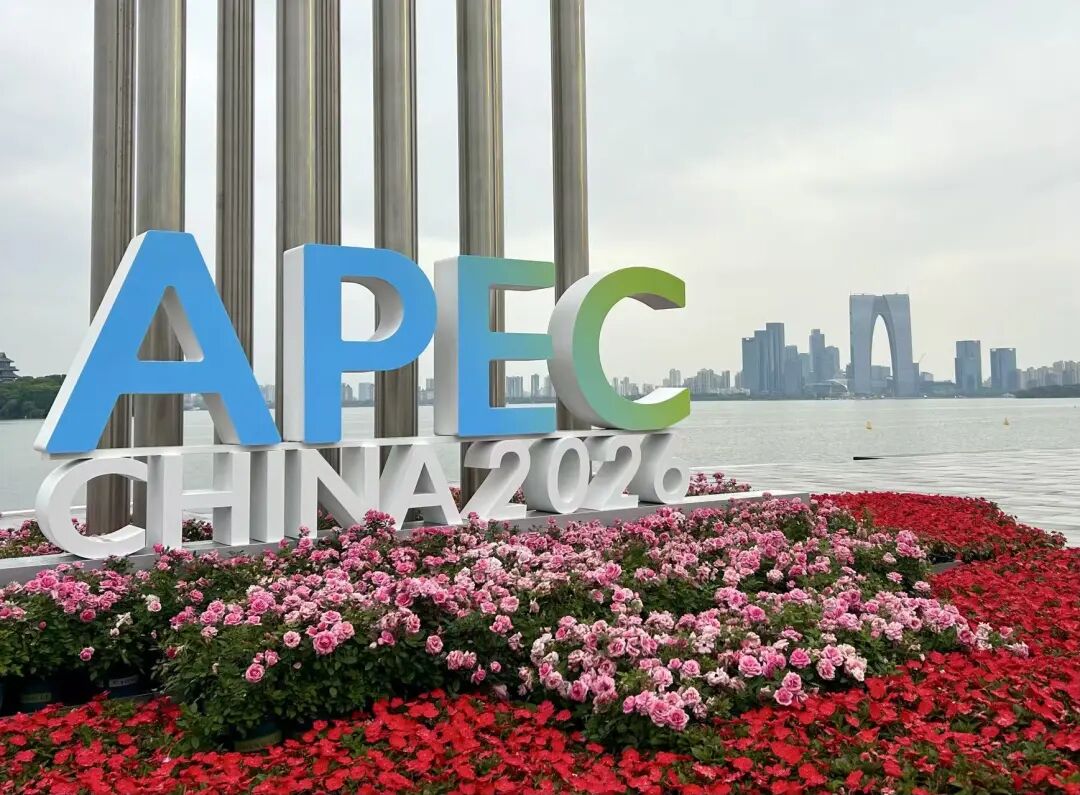
△ The APEC Trade Ministers' Meeting is held in Suzhou. Photo source: Photographed by a reporter from Time Weekly
Representatives from all 21 APEC economies attended the meeting, and the heads of international organizations such as the World Trade Organization and the United Nations Conference on Trade and Development were also invited. Nearly 700 representatives gathered by Jinji Lake to discuss topics such as the digital economy, artificial intelligence, and green and low-carbon development.
This is China's third time hosting the APEC Trade Ministers' Meeting. Compared with the previous two times, this meeting not only reflects the new changes in the global economic and trade landscape but also mirrors China's changing role in the Asia-Pacific trade system.
This year marks the 35th anniversary of China's accession to APEC. From the eve of China's accession to the WTO in 2001, to the proposal of the Beijing Roadmap for the Free Trade Area of the Asia-Pacific (FTAAP) in 2014, and now to the coordination around digital rules, green trade, and supply chain stability, China's role in APEC has gradually shifted from a learner of international economic and trade rules to an important participant and active contributor in rule-making.
Topics Shift to Emerging Fields
In November this year, the APEC Economic Leaders' Meeting will be held in Shenzhen. The Trade Ministers' Meeting has sorted out the consensus and initiatives for it, and it is the "weather vane" of economic and trade policies in the Asia-Pacific region and even the world.
Previously, China has hosted the APEC Trade Ministers' Meeting twice, namely the meeting held in Shanghai in 2001 and the one held in Qingdao in 2014.
In 2001, APEC economic and trade cooperation was in its take-off stage. At that time, the topics focused on "border" opening-up and cooperation, with the emphasis on reducing tariffs and expanding market access. In 2014, Asia-Pacific economic and trade cooperation was booming, and the focus was on the in-depth integration of trade and investment.
Today, Asia-Pacific economic and trade cooperation has entered a more complex "deep water area," and the topics have been further deepened, including emerging fields such as the digital economy, green and low-carbon development, and the resilience of industrial and supply chains.
Behind this change, the Asia-Pacific regional economic cooperation itself is entering a new stage. Currently, the process of regional economic integration in the Asia-Pacific region remains highly dynamic. Public data shows that the number of active regional preferential trade agreements in the Asia-Pacific region accounts for more than 60% of the world's total. At the same time, digital trade, supply chain security, etc. are becoming topics of concern for all economies.
The achievement of this meeting in digital trade cooperation is to improve the collaborative framework for digital trade policies.
At the special press conference of the APEC Trade Ministers' Meeting held on the 23rd, the Ministry of Commerce mentioned that all parties agreed to continue to implement the APEC Internet and Digital Economy Roadmap, promote the alignment of digital economy rules with international standards, support the WTO e-commerce negotiations and the implementation of the Investment Facilitation Agreement, and form new consensus around key topics such as cross-border data flow, digital trust, and artificial intelligence governance.
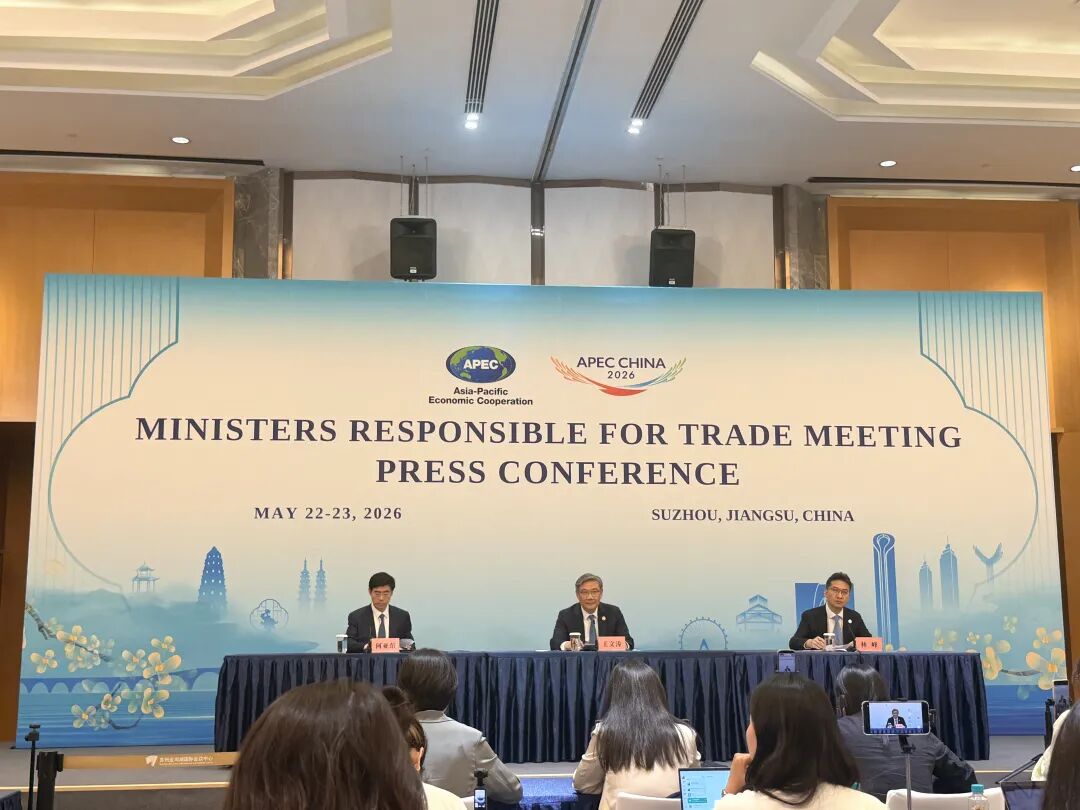
△ In the afternoon of the 23rd, the press conference of the APEC Trade Ministers' Meeting. Photo source: Photographed by a reporter from Time Weekly
Currently, the world is experiencing a complex and volatile situation. Against the backdrop of increasing global economic uncertainties and the rise of trade protectionism, the importance of APEC has been further magnified. Although APEC is not a negotiation venue, it should play a leading role in the discussion of economic and trade issues and promote the coordinated development of regional economic and trade rules.
Santo Darmosumarto, the Director-General of Asia-Pacific and African Affairs of the Indonesian Ministry of Foreign Affairs and an APEC senior official, said, "The impact brought by the external situation is already very significant. The key now is how to eliminate these negative impacts and effectively safeguard the basic livelihoods and vital interests of the people of all countries."
Supporting the multilateral trading system and the work of the WTO is a long-term traditional agenda of APEC.
"The more challenging the situation is, the more we should seek common ground while reserving differences and overcome difficulties together, strive to reach more consensus, lead the Asia-Pacific economy through difficulties, and inject confidence into the global economy," said Li Chenggang, China's International Trade Representative and Deputy Minister of Commerce. He also said that the development stages, resource endowments, and industrial structures of APEC economies are different, and their interests and demands vary. It is normal for there to be different views.
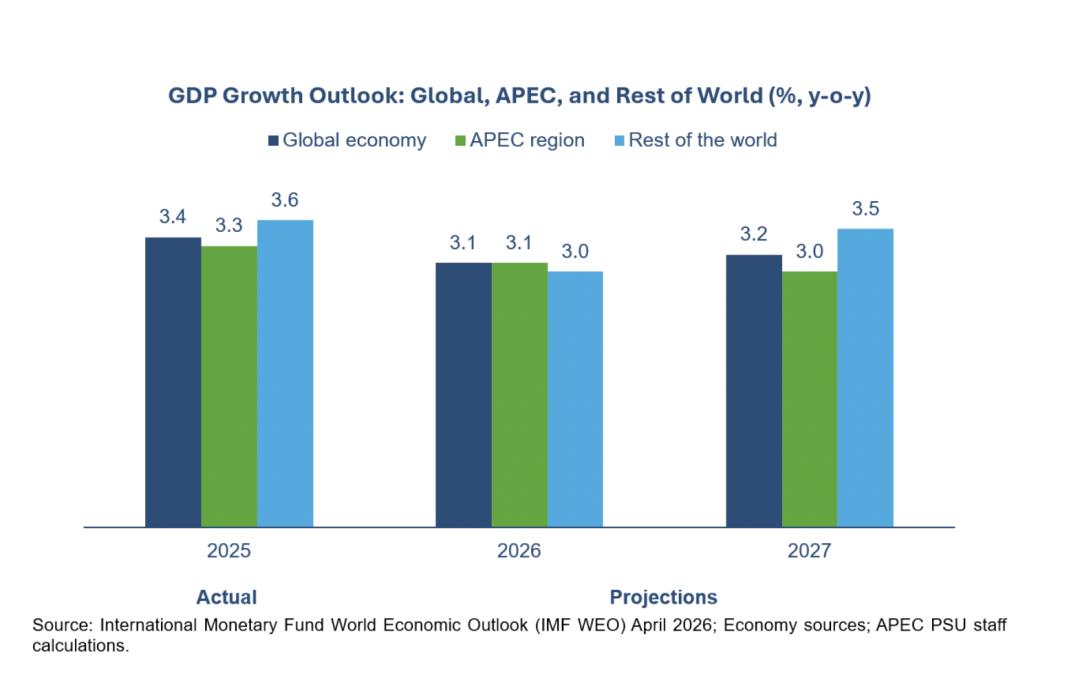
△ GDP growth outlook for the world, APEC economies, and other regions. Photo source: APEC official website
The value of APEC lies in bringing together economies with different demands and jointly exploring the intersection of interests and the greatest common divisor of cooperation in an objective, rational, and practical way.
The consensus reached at the two-day meeting is to jointly promote the reform of the WTO.
Wang Wentao, Minister of Commerce, mentioned at the aforementioned press conference that all parties committed to promoting the reform of the WTO, improving its functions and rules, and enhancing the effectiveness and relevance of the WTO in responding to global trade challenges and meeting the demands of members. The relevant participants will continue to work hard to promote the inclusion of the Investment Facilitation Agreement and the E-commerce Agreement in the WTO legal framework.
"It is not easy to achieve these results under the severe international situation," Wang Wentao said. He also said that China will continue to work with other economies to implement the important consensus reached at this meeting and continuously promote the achievement of more results and consensus.
Changes in China's Role in the Three Meetings
Looking back at China's three times of hosting the APEC Ministerial Meetings, it actually corresponds to the continuous changes in China's opening-up stage and international economic and trade role.
In 2001, China hosted the APEC event for the first time. In April of the same year, when the APEC Trade Ministers' Meeting was held in Shanghai, China had not yet officially joined the WTO. At that time, APEC strongly called on the World Trade Organization to launch a new round of trade negotiations and unanimously supported China to conclude the negotiations and officially join the WTO in 2001.
Half a year later, China joined the WTO and ushered in more than two decades of continuous high-speed growth with the wave of globalization.
Peng Jian, the director of the Institute of Industrial Development and Urban Planning of the China (Shenzhen) Comprehensive Development Research Institute, believes that in 2001, the global economy faced multiple challenges, and the ideas of globalization and anti-globalization clashed fiercely. The Shanghai APEC Meeting was an important international meeting held under this background. It was also China's first time hosting the APEC Economic Leaders' Meeting and a high-level international economic forum. It coincided with the eve of China's accession to the WTO, which was an important turning point for China to fully integrate into the global economic system and a new starting point for participating in global economic governance, with milestone historical significance.
At that time, around the theme of "New Century, New Challenges: Participation, Cooperation for Common Prosperity," APEC achieved the important result of the "Shanghai Consensus" in 2001, further deepening the "Bogor Goals" in 1994 and the "Osaka Action Agenda" in 1995, and laying the direction for the subsequent development of APEC.
In 2014, the APEC Economic Leaders' Meeting was held in Beijing, and the Trade Ministers' Meeting was held in Qingdao. During this period, the international environment China faced had changed significantly: the world economy was in a slump, and the recovery of Asia-Pacific economies was fragile.
Therefore, China put forward the theme of "Building an Asia-Pacific Partnership for the Future," focusing on promoting regional economic integration, promoting economic innovation, development, reform, and growth, and strengthening infrastructure and connectivity construction.
Meanwhile, more and more "Chinese solutions" emerged: among the more than 100 cooperation initiatives submitted by APEC economies to the meeting, more than 50 were proposed by China.
During this stage, China gradually shifted from a participant in international economic and trade rules to an important promoter of rule-making.
Today's Suzhou Meeting corresponds to another change in China's role in the Asia-Pacific economic system.
Compared with 2001, China is not only one of the world's largest trading countries but also an important fulcrum for the Asia-Pacific supply chain, industrial chain, and consumer market.
According to the statistics of the Ministry of Commerce, currently, eight of China's top ten trading partners are APEC members; China's direct investment in APEC members accounts for 69% of China's total foreign investment; and 80% of the attracted foreign investment also comes from APEC member economies.
"We have become an important participant and active contributor in international economic and trade rules," said Lin Feng, the director of the Department of International Trade and Economic Affairs of the Ministry of Commerce. He also said that China firmly supports open regionalism and the rules-based multilateral trading system, adheres to high-level opening-up, actively promotes regional economic integration, and actively explores international economic and trade rules in emerging fields such as digital and green development.
Accelerating the Construction of FTAAP
In this Suzhou Meeting, the Free Trade Area of the Asia-Pacific (FTAAP) has once again become one of the core topics of external attention.
In fact, FTAAP is not a new concept. As early as in 2006, the APEC Hanoi Meeting in Vietnam put forward the vision of building the FTAAP. Since then, APEC has repeatedly emphasized that it should serve as an incubator for the FTAAP and provide leadership and intellectual support for it.
The truly milestone-like progress took place in 2014. At the APEC Beijing Meeting that year, China "activated" the dream of building the FTAAP. All parties had intensive consultations and promoted the formation of the "APEC Beijing Roadmap for Promoting the Realization of the Free Trade Area of the Asia-Pacific." It clearly stated that the FTAAP should be a comprehensive, high-quality free trade agreement covering next-generation trade and investment issues, and specific measures such as launching a joint strategic study, establishing an information sharing mechanism, and promoting capacity building were proposed.
Since then, the FTAAP has entered the track of practical promotion from the conceptual level. After 12 years, the FTAAP has once again been in the spotlight.
The Ministry of Commerce previously mentioned that taking the "20th anniversary of the vision of the Free Trade Area of the Asia-Pacific" as an opportunity, China promotes the coordinated development of regional economic and trade rules, strengthens the connectivity and resilience of the supply chain, and builds a trade and investment partnership conducive to promoting mutual trust, providing clearer and more practical guidance for the process of promoting the FTAAP.
Li Fanrong, the Chairman of the APEC Business Advisory Council (ABAC) in 2026 and the Chairman of Sinochem Group, mentioned at the opening ceremony of the APEC Trade Ministers' Meeting that the business community remains firmly committed to the FTAAP as the long-term goal of regional economic integration. "This commitment provides important certainty for the global economy. We hope that the trade ministers can accelerate the progress in key areas of concern to the business community and look forward to regular updates on this progress."
In the past 20 years, APEC has gradually evolved from an initial trade facilitation platform to an important platform for regional rule coordination and innovation cooperation. Although the FTAAP has not been truly implemented, its concept has had a profound impact on Asia-Pacific trade practices, including coordinating multilateral and bilateral free trade paths, promoting rule transparency, and facilitating investment.
Cui Fan, a professor at the University of International Business and Economics and the chief expert of the Institute of International Trade Rules (Qianhai), said that China advocates the FTAAP at the APEC occasion every year, sending a continuous signal that China is willing to build a high-level free trade arrangement with all parties in the Asia-Pacific region, including the United States.
"The goal of the FTAAP conforms to the general trend of historical development," Cui Fan believes. He also said that achieving the goal of the FTAAP requires new methods and "steady and small steps" in the process of implementing the APEC Putrajaya Vision.
One of the results and consensus reached at this Suzhou Meeting is to reaffirm the firm support for the long-term vision of the FTAAP. Wang Wentao said that in 2014, all parties reached the "APEC Beijing Roadmap for Promoting the Realization of the Free Trade Area of the Asia-Pacific." Over the past 12 years, APEC economies have actively carried out policy coordination, capacity building, and information exchange around the vision of the FTAAP, continuously promoting the process of regional economic integration.
"All parties have once again turned their attention to the FTAAP, committed to continuing to promote regional economic integration through the FTAAP agenda, and called for increased investment in capacity building, experience sharing, and technical cooperation to move forward towards the established goal."
This article is from the WeChat official account "Time Weekly" (ID: timeweekly), author: Wang Chenting. Republished by 36Kr with authorization.