In the past five years since the "pig food theory" emerged, LI Liang from ByteDance has refuted the rumor again, and short videos are facing new challenges.

Recently, a rumor about "big tech companies attacking each other" has been widely circulated. It is reported that a vice president of ByteDance countered the "pig food theory" put forward by a vice president of Tencent, saying, "We're all selling pig food. No one should look down on the other."
Li Liang, the vice president of the Douyin Group, immediately posted on Weibo to refute the rumor, clearly stating that it was fabricated and calling on the platform to clean up relevant false information.
After the refutation, the online discussion didn't subside. Many netizens said, "Whether it was said or not, I think it makes sense" and "It's actually not wrong to call it pig food"...
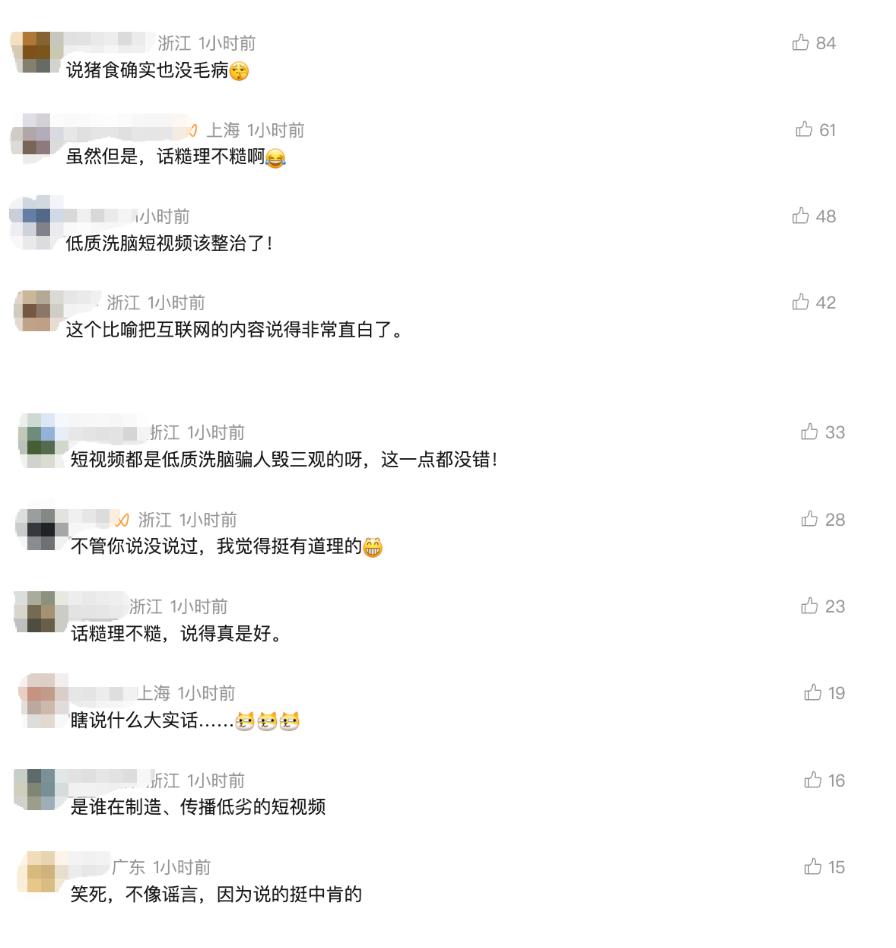
Most industry insiders can easily spot the rumor at a glance. But why do so many netizens believe, forward it, and even think it "expresses their innermost thoughts"? This question might be more worthy of Li Liang's attention than the rumor itself.
01. The spread of the rumor indicates a prior trust issue
Li Liang is the most active executive in Douyin's external communication. From a communication theory perspective, this rumor hardly meets the basic conditions to "deceive people with fakes", but it still spread.
The reason is that it hits a judgment privately agreed upon by a large number of users: in terms of content quality, there is no moral high - ground among major platforms.
The story dates back five years.
In June 2021, at the 9th China Network Audio - Visual Conference, a vice president of Tencent publicly criticized the short - video ecosystem, leaving the widely circulated statement: "Personalized distribution is so powerful that if you like pig food, all you'll see is pig food."
ByteDance immediately sent Li Liang to counter, pointing out that Tencent's WeChat Video Account was the only short - video platform at that time that hadn't launched the youth protection mode as required, and highlighting the contradiction of Tencent "vigorously developing short - videos while constantly attacking the short - video industry".
This debate had no winner and no conclusion. But its real legacy is the public's pre - set suspicion of the entire industry ecosystem: the moral accusations among platforms are just mutual exposure of competitors' weaknesses, and no party truly stands on the side of users' interests.
Five years later, the reason why this unspoken statement was widely believed is precisely because this suspicion has never faded. Moreover, it has sufficient real - world basis.
02. Algorithms not only satisfy preferences but also shape them
The "pig food theory" has a key assumption: some people are naturally fond of low - quality content, and algorithms just satisfy this preference. This logic sounds reasonable, but it ignores a more fundamental fact: platforms are never passive.
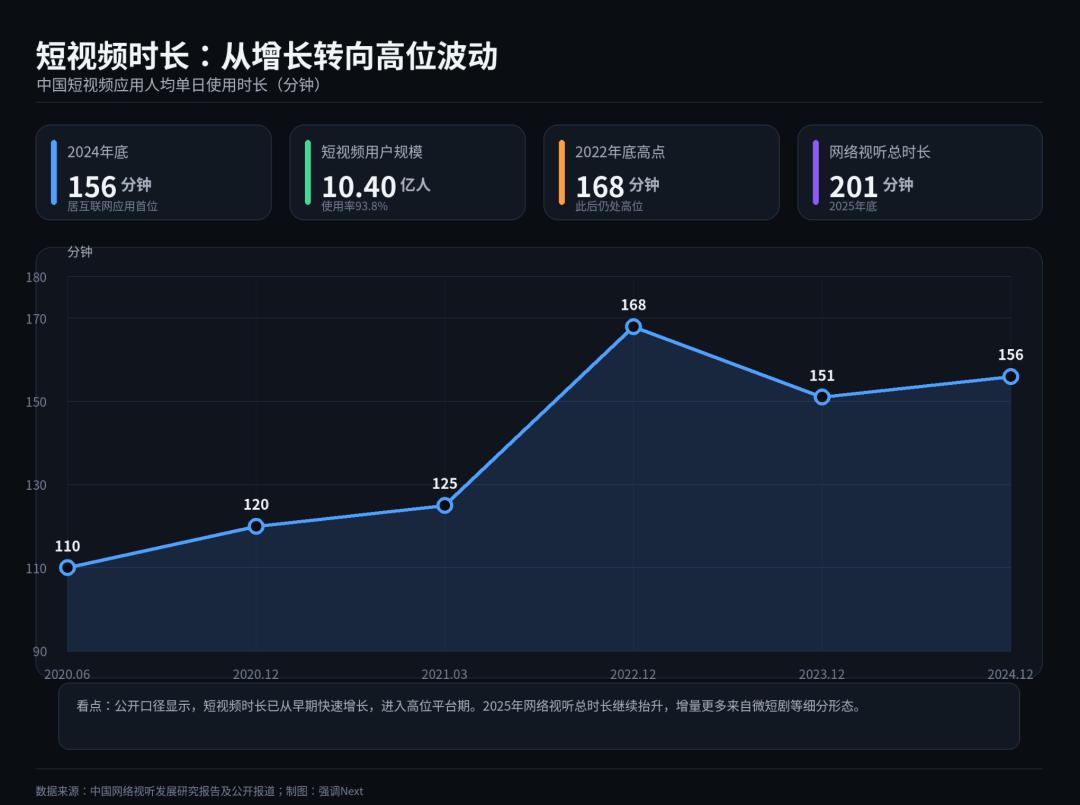
As of December 2024, the number of short - video users in China reached 1.04 billion, with an average daily usage time of 156 minutes, ranking first in the segmented field of online audio - visual applications for six consecutive years. The 156 - minute usage time is not a result of users' "innate nature", but a natural product of platforms' continuous optimization of retention goals through algorithms and systematic promotion of high - stimulation, low - threshold content.
The mechanism is not complex. The business model of short - video platforms is centered on advertising revenue. Advertising revenue depends on usage time, and usage time depends on the ability of content to capture users' attention. Following this chain, the platforms' pursuit of "content quality" naturally conflicts with business efficiency to some extent. As long as retention is prioritized, the balance of content promotion will continuously tilt towards high - stimulation, low - threshold content. This is not a moral issue of a single platform but the business logic of the entire industry.
The consequences of this tilt have a public - level name. Oxford Dictionary named "Brain rot" as the word of the year 2024, referring to the mental fatigue and attention dullness caused by fragmented content consumption. A meta - analysis covering nearly 100,000 participants in 2025 also found a moderate - strength statistical correlation (r = - 0.34) between excessive short - video viewing and a decline in cognitive ability, with attention and inhibitory control being the most significantly affected. Although these findings are only statistically related and the causal mechanism is still controversial, the direction is consistent.
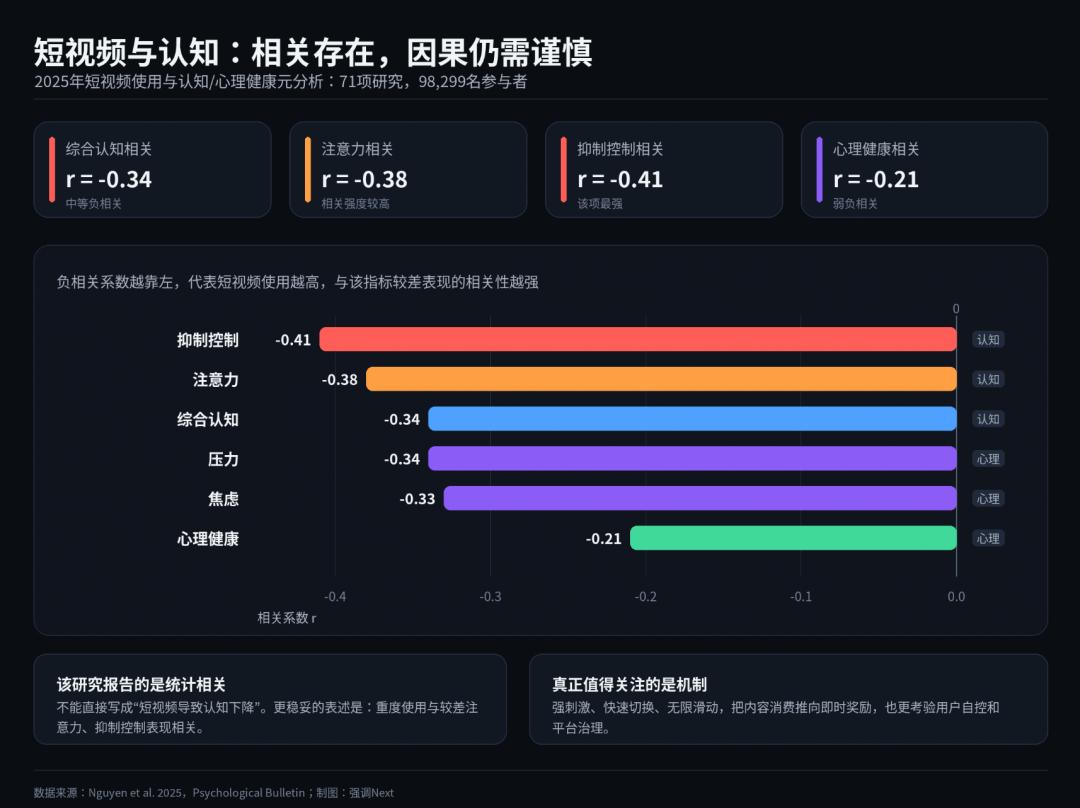
The problem is not that "short - videos will definitely make people stupid", but that when the platforms' business logic continuously rewards high - stimulation content, the premise of "users' independent choice" has already been quietly rewritten.
This also means that platforms have the ability to break this logic. The 2025 Douyin Financial Content Ecosystem Report shows that the number of financial video submissions increased by more than 55% year - on - year, and the playback volume increased by 50% year - on - year. There is a market for knowledge - based content, and platforms also have the ability to make it visible. As long as the recommendation weight is adjusted, high - quality content can also gain popularity.
The problem has never been the lack of an audience, but whether high - quality content is the default option.
03. The escalation of falsification: from "poor content quality" to "indistinguishable content authenticity"
If the structural problems of platform content were previously limited to the "quality" level, the new - type falsification that has emerged in recent years touches on a more fundamental issue: authenticity.
Staged shooting: from "harmless scripts" to consuming social trust
In early May 2026, a video of less than one minute quickly spread across major platforms. A young girl claiming to be visually impaired was walking on the blind path when an electric bicycle suddenly rushed out and knocked her down. The perpetrator not only didn't apologize but also scolded the girl for "getting in the way". The video quickly triggered an online outcry.
On May 16, the Beijing police announced that the video was a false staged shooting, and the two suspects had been taken into criminal custody in accordance with the law.
After the police announcement, a more complete industrial chain emerged. Mr. Zhang, a visually impaired person, revealed to the media that the visually impaired group he belongs to had received recruitment announcements from MCN companies, clearly requiring "cooperation with the team's shooting plan", "girls are preferred, but boys will also be considered", and indicating that "the project can continue permanently if there are no special circumstances". A former employee of an MCN company described it more straightforwardly: "This field is very saturated. You have to invest in promotion in the early stage and stage shoots later... It's just that the MCN company writes the script, and then asks the bloggers to go out and play the victim."
There were also similar cases that spread widely online before, such as the "Qin Lang's exercise book incident".
A comment in Beijing News directly pointed out the "escalation" of this incident: previous staged shootings often created extreme conflicts, while this blind - person - on - blind - path incident, due to its real social and public issue content, is more deceptive and harder to identify. The iteration of staged - shooting technology is systematically increasing the identification threshold for platform content review.
AI - generated content: the dual dilemmas of difficult traceability and lagging supervision
If staged - shooting falsification still relies on real people appearing on camera and is restricted by time costs, the popularization of AI technology has opened the floodgates for the production of false content at a lower threshold.
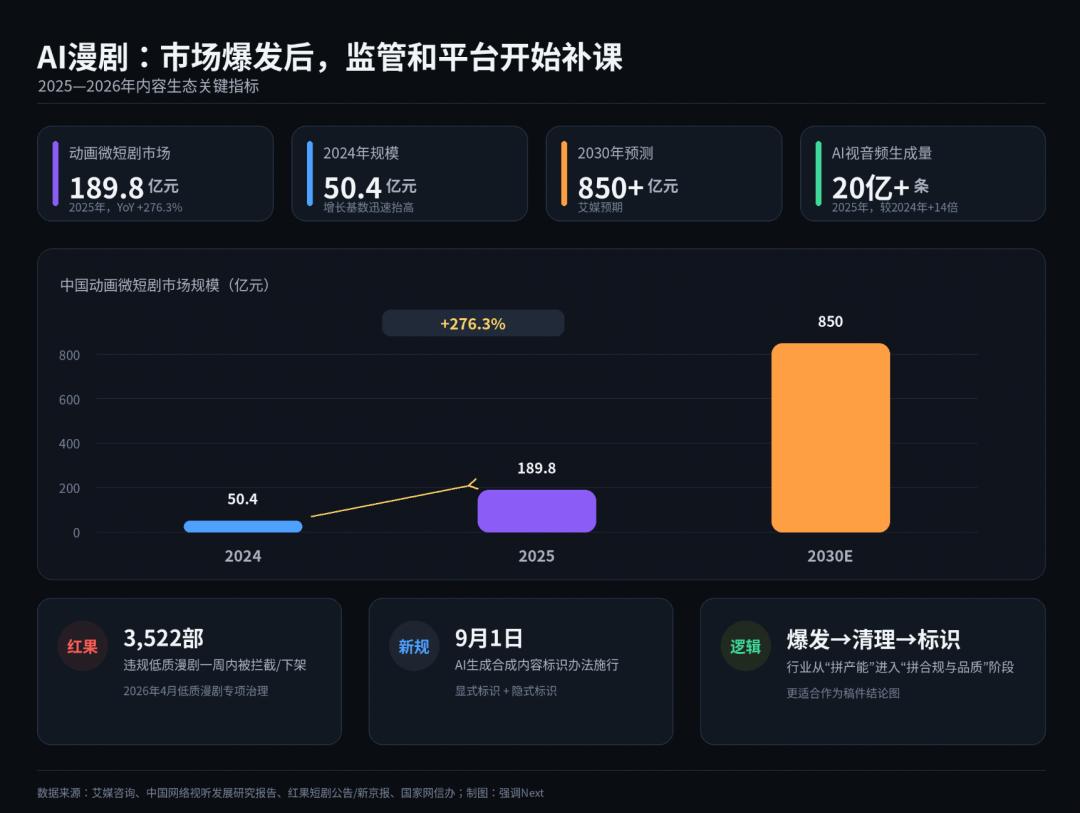
In 2025, the scale of China's animated micro - short - drama market (mainly AI - generated comic dramas) reached 18.98 billion yuan, a year - on - year increase of 276.3%. AI face - swapping, AI voice - over, AI screenwriting, and AIGC animated short - dramas have spread rapidly, and problems such as the theft of real - person portraits, vulgar content, and script homogenization have become rampant.
On April 1, 2026, the new regulations on the filing of AI - generated comic dramas by the National Radio and Television Administration were officially implemented, with the core being "filing before launch". One week after the implementation of the new regulations, Hongguo blocked or removed 3,522 illegal and low - quality comic dramas, and Kuaishou removed about 900 at the same time. There were even rumors in the industry that "tens of thousands of works were removed in a concentrated manner".
The harm of AI - generated rumors is more direct. In March 2025, a 4.5 - magnitude earthquake occurred in Baicheng County, Xinjiang. Only three hours after the earthquake, a rumor appeared on some platforms saying that "3 people were killed and 65 houses were damaged to varying degrees", accompanied by AI - spliced pictures of collapsed houses and a "victim's plea for help" video with a local - dialect voice - over. In fact, the earthquake caused no casualties. Another false report fabricated by AI about "the mortality rate of people born in the 1980s exceeding 5.2%", with forged "authoritative data" and "expert interpretations" in video form, caused collective online anxiety.
Tencent released an AI detection tool called "Zhuque" at the beginning of 2025, trying to use models to identify false content generated by other models. However, regulatory authorities also admitted that "AI review is still unable to meet the needs when dealing with the massive amount of UGC content". Facing hundreds of millions of new pieces of content added daily, "review after release" is almost a structural reality in the industry.
In September 2025, the Cyberspace Administration of China, together with multiple ministries, issued the "Measures for Marking Artificially - Generated and Synthesized Content", requiring that AI - generated content must be marked with explicit or implicit watermarks to establish a liability - tracing chain from the perspective of traceability. This is an important shift in regulatory thinking: from post - deletion to pre - marking.
04. Conclusion: From the "quality issue" to the "authenticity issue"
Li Liang's refutation of the rumor is justifiable and necessary.
However, it's worth noting that this refutation itself has become a real - life example of how false content can spread rapidly on platforms and affect public perception. What's even more thought - provoking is that the content being refuted is about the content ecosystem of short - video platforms.
From the "pig food theory" in 2021 to the exposure of the MCN industrial chain behind the staged shooting of the blind person in 2026, the governance challenges faced by platforms have changed. In the past, the focus was on whether the content was appealing; now, the more crucial issue is whether the content is authentic.
This is a more difficult problem. The former is more about the battle of aesthetics and taste, while the latter damages the trust foundation of the entire information ecosystem.
The reason why the false statement spread widely is not only that it "sounds reasonable", but also because the public has developed a pre - set distrust of this industry. With more and more staged - shooting falsifications and the increasing difficulty in distinguishing the authenticity of AI - generated content, users will naturally doubt first and then make judgments.
Once this distrust is formed, it's difficult to eliminate it with just one refutation. What platforms really need to repair is not just a single rumor, but the authenticity of the content ecosystem.
Douyin is the undisputed largest short - video platform in China, with over 700 million daily active users. This scale means that every choice ByteDance makes in terms of algorithm logic, content standards, and recommendation weights is not just a business decision of a single company, but in fact sets the price for the entire industry: defining what kind of content "is worth being seen" and what kind of creators "are worth being rewarded".
In the past two years, Douyin has taken continuous actions and made progress in content ecosystem governance. However, judging from the users' feedback after this rumor incident, it's obviously not enough.
The crux of the problem might be that users mostly see the platform's governance actions as "passive responses": refuting rumors when there are incidents, following up when there are policies, and removing content when there is pressure. But the reconstruction of user trust requires active, systematic, and perceptible actions.
For platforms, the crisis never comes from the rumor itself. The public can tell the difference between truth and falsehood. The real crisis is that people have already defaulted not to stand on the side of the platform.
This article is from the WeChat official account “Emphasize Next” (ID: leo89203898), written by Yixiu, and published by 36Kr with authorization.