When will AI commercialization boost Alibaba?
Alibaba's AI has entered the "commercialization narrative," but it needs to continuously prove itself.
The "money - burning" AI has started to make money, and ToB is the core main line.
The leading AI companies in the United States have touched the profit line first.
Anthropic sells Tokens + Agents based on Claude, betting on enterprise and programming scenarios, and is experiencing explosive growth.
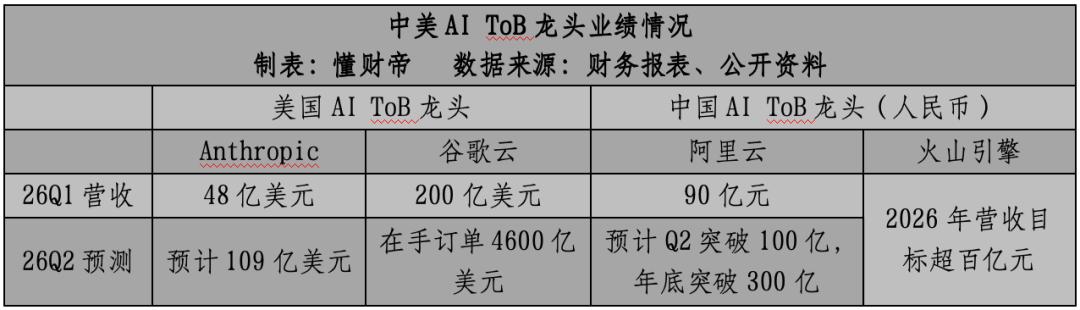
It is expected that its revenue in Q2 2026 will reach $10.9 billion, a year - on - year increase of 130%. The cost structure has been significantly improved, and the computing power cost per dollar earned has dropped to 56 cents. It will achieve an operating profit of $559 million for the first time. [1]
Google, with its full - stack advantage of "chip (TPU) - Google Cloud - AI model (Gemini) - applications (Agents, hardware)", sells computing power and Tokens and is making a comeback.
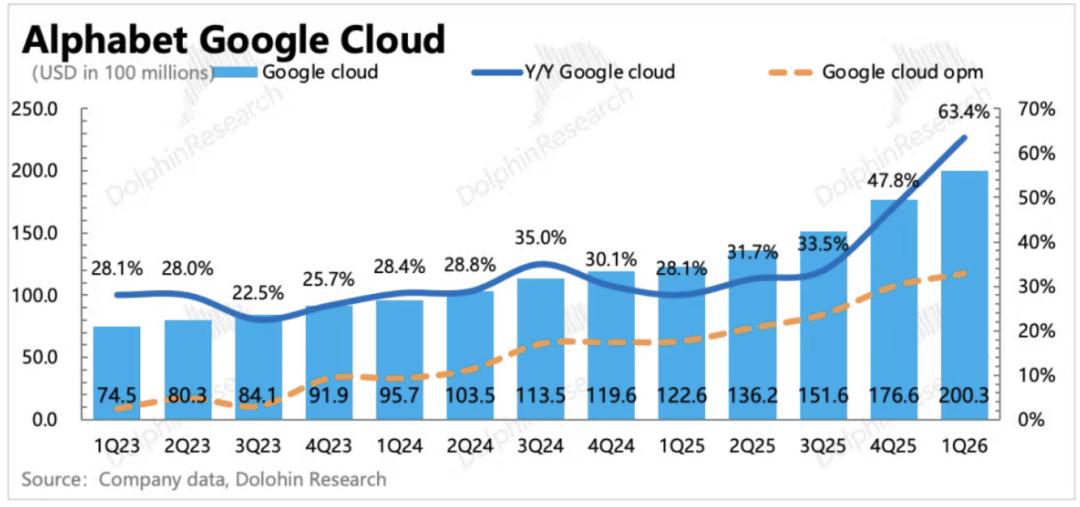
Google Cloud's revenue in Q1 2026 was $20 billion, a year - on - year increase of 63%, and its operating profit soared to $6.6 billion.
It also said that driven by the demand for enterprise AI solutions and enterprise AI infrastructure, the backlog of cloud business orders nearly doubled quarter - on - quarter to over $460 billion.
The leading AI ToB companies in China have also started to accelerate commercialization.
According to LatePost, in 2026, the revenue target of Volcengine's MaaS business exceeded 10 billion yuan. [2]
Alibaba's financial report for the fourth fiscal quarter of fiscal year 2026 (calendar year: Q1 2026) showed that Alibaba Cloud's revenue was 41.6 billion yuan, a year - on - year increase of 38%. Among them, AI - related revenue was about 9 billion yuan.
Wu Yongming revealed that in the quarter of June (Q2 2026), the ARR of AI models and application services including the Bailian MaaS platform will exceed 10 billion yuan and will exceed 30 billion yuan by the end of the year.
However, Alibaba has not "taken off". As of May 24, its stock price (US stocks) has fallen 11.31% this year.
In sharp contrast, Anthropic's latest valuation has soared to $900 billion, and Google's total market value is $4.6 trillion, a year - to - date increase of 20.98%.
Why does the capital market treat them differently? Is Alibaba undervalued?
Can Alibaba become the "Chinese version of Google" in AI ToB?
AI is reshaping the world, and ToB has become the most certain business.
On the one hand, enterprises are extremely eager for digital and intelligent transformation and are willing to pay for cost - reduction and efficiency - improvement.
On the other hand, AI has effectively improved operational efficiency, and the ROI is obvious. In the financial and tax scenario, the practical efficiency of AI Agents is 10 times that of traditional accountants, and labor costs are reduced by 60%.
In the programming scenario, Anthropic's engineers used Claude Code to complete the transcription of 50,000 lines of Scala code in only 4 days - it would have taken at least 70 days in the past.
Since its establishment, Anthropic has precisely focused on AI programming and enterprise users, targeting high - value industries such as finance, technology, and professional services. Then, it developed the world - class AI large - model Claude and continuously strengthened the capabilities of Agents, which are highly favored by customers.
Statistics show that 34.4% of US enterprises have paid for Anthropic, exceeding OpenAI (32.3%). Among them, there are more than 1,000 enterprise customers with an annual spending of over $1 million, doubling in 3 months.
Anthropic is growing at an extremely fast pace, "refreshing" the global business history. Its ARR was only $1 billion at the end of 2024, exceeded $9 billion at the end of 2025, and is now approaching $45 billion.
Google, on the other hand, has another model of rise.
It once lagged behind. By vertically integrating its internal organization and concentrating its efforts on major tasks, it launched the world - class AI large - model Gemini.
More importantly, Google further built a full - stack architecture of "chip (TPU) - Google Cloud - AI model (Gemini) - applications (Agents, hardware)".
At the basic level, TPU, Google Cloud, and Gemini are deeply coordinated, continuously reducing training and inference costs and making resource utilization more efficient.
At the sales end, it packages computing power, Tokens, and AI applications together for enterprise customers to achieve a higher gross profit margin.
The financial report shows that after the launch of Gemini Enterprise in Q4 2025, Google Cloud's revenue growth rate has accelerated significantly, and its operating profit margin has continued to increase, reaching 33% in Q1 2026, exceeding market expectations.
Source: Dolphin Research
This is the business model that Chinese AI companies such as Alibaba and Baidu dream of.
Taking Alibaba as an example, some investors call it the "Chinese version of Google".
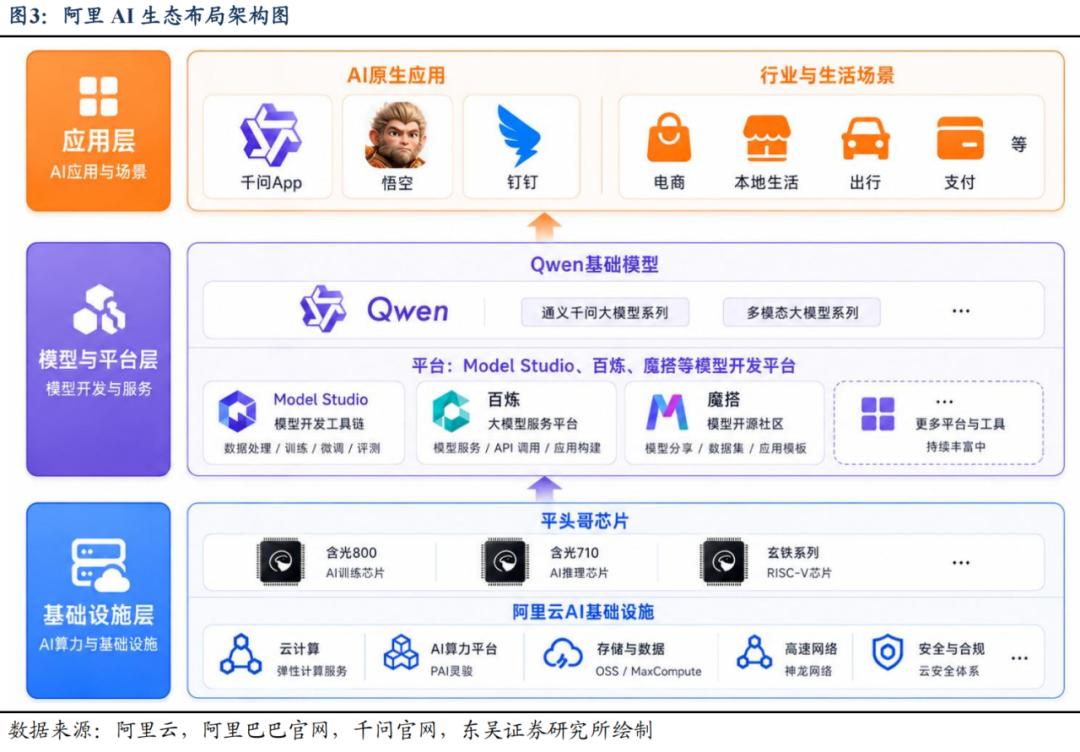
At the basic level, Alibaba is one of the few domestic full - stack AI companies. It is fully promoting the integration of "chip, cloud, and model": Pingtouge has launched the new - generation self - developed AI chip Zhenwu M890 for training and inference, with a performance three times that of the previous generation (Zhenwu 810E), providing more powerful computing power and being deeply coordinated with the Qwen series of large models.
At the model and platform level, Alibaba ranks among the top domestic echelons. The newly released Qwen - 3.7 - Max has strengthened programming, long - task processing, and general intelligent agent capabilities, and the revenue scale of the Bailian MaaS platform ranks first in China.
At the ToB application level, Alibaba has seized the first - mover advantage. DingTalk has more than 800 million registered users and more than 26 million enterprise organizations.
Some time ago, it also launched the enterprise office intelligent agent "Wukong", fully integrating with DingTalk and strengthening the capabilities of Agents.
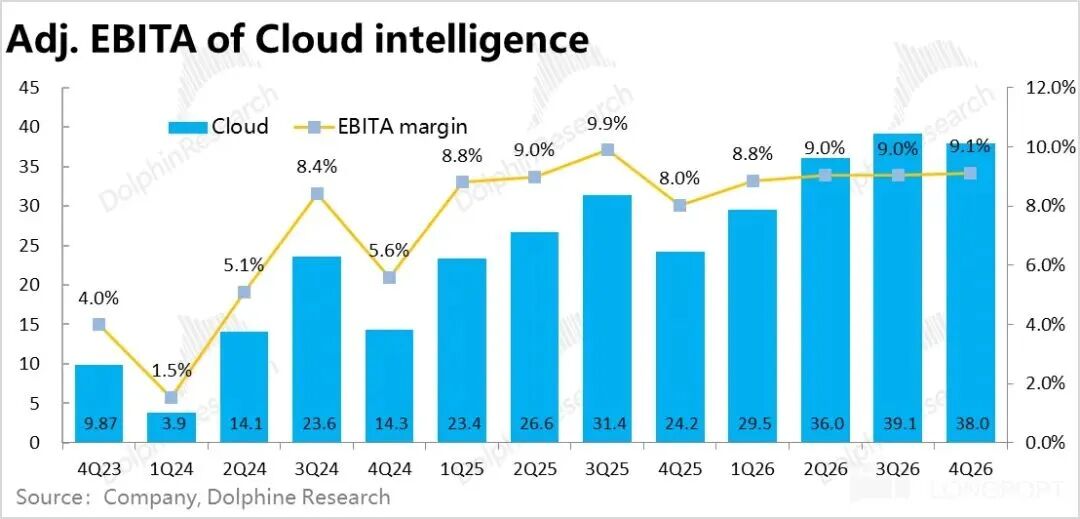
However, in terms of profit margin, in the fourth fiscal quarter of fiscal year 2026 (calendar year: Q1 2026), the adjusted EBITA margin of Alibaba Cloud was 9.1%, a quarter - on - quarter increase of 0.1%. Compared with Google Cloud (33%), there is still a big gap.
Source: Dolphin Research
There are reasons on Alibaba's side. The basic model capabilities are not strong enough, with a comprehensive evaluation score of 1475 points. In contrast, Claude - opus - 4.6 - thinking has a score of 1502 points, and Gemini - 3.1 - pro - preview has a score of 1488 points. [3]
There are also reasons for the entire Chinese AI industry. Compared with Google's TPU and NVIDIA's GPU, domestic AI chips still have gaps in comprehensive performance, software ecosystem, and cluster interconnection.
In response, at the earnings conference call, Wu Yongming actively released positive news. He revealed that Pingtouge's self - developed GPU chips have achieved large - scale mass production.
The demand for API Tokens will be infinite. The MaaS business currently has a higher gross profit and is in short supply. "The gross profit margin of Alibaba Cloud will increase significantly in the next 1 - 2 years."
The goal has been set, and Alibaba needs to continuously prove itself. If it succeeds, its stock price is expected to have a good performance.
The "money - burning" AI ToC and the unknown commercialization
Telling stories, ToC is very attractive. But currently, it is really difficult to make money.
In Q1 2026, OpenAI had more than 900 million users, with a revenue of $5.7 billion and an adjusted operating profit margin of - 122%. It means that for every dollar earned, it loses $1.22.
Google is "capturing territory" in the consumer market. It has 13 products with more than 1 billion users each, and 5 of them have more than 3 billion users.
However, reflected in the financial report, ToB revenues such as advertising and marketing and Google Cloud are still the major part.
Therefore, Anthropic simply ignores the ToC market. But in China, AI giants such as Alibaba, Tencent, ByteDance, and Baidu have no way out and must fight on two fronts: both ToB to explore new growth and compete for the super - entry of AI ToC to defend their "home bases".
Taking Alibaba as an example, it distributed 3 billion yuan in red envelopes during the Spring Festival in an attempt to capture users' minds.
At the end of March, Wu Yongming personally took charge and established the ATH (Alibaba Token Hub) business group around Tokens, covering: Tongyi Laboratory, Qianwen, Wukong, MaaS, and the AI Innovation Division. Among them, Qianwen aims to create the best personal AI assistant.
From the user data, the situation is mixed.
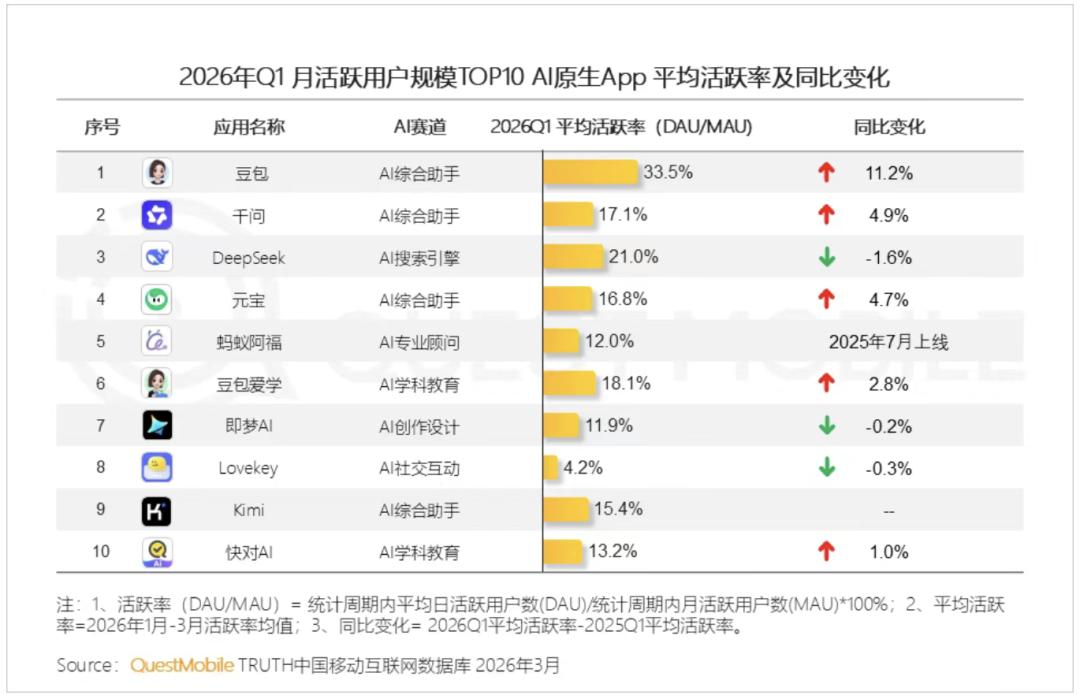
On the positive side, the user scale of Qianwen has grown rapidly. According to QuestMobile statistics, in Q1 2026, the MAU of Qianwen reached 166 million, second only to Doubao.
On the weak side, the average user activity rate of Qianwen is only 17.1%, lower than Doubao (33.5%) and DeepSeek (21%). The average monthly usage times per user are only 19.8 times. In contrast, Doubao has 54.8 times, DeepSeek has 41.7 times, and Yuanbao has 25.9 times. [4]
Alibaba decided to continue to attack. On May 11, Qianwen was fully integrated into Taobao.
However, investors are more worried. In the past 20 years, browsing and killing time have been Taobao's moat.
Based on this, the more time users spend on Taobao, the higher the e - commerce CMR customer management revenue will be. This is Alibaba's "cash cow".
The core logic of Qianwen's AI shopping is to save time. Users just say a word, and AI will screen and recommend products.
This not only reconstructs the interaction mode but also subverts the traditional traffic distribution rules, forming a logical conflict with Taobao's business model.
Alibaba still relies on e - commerce to "support the family". Therefore, it has remained restrained. It is foreseeable that it will continue to promote business transformation after the AI shopping business realizes the commercialization model.
From this, we can also see the difficulty of AI ToC. The "red - envelope war" in the mobile Internet era has been difficult to improve user loyalty.
Even if users continue to pour in, under the free - of - charge rule, the financial losses caused by "burning" computing power will be unbearable. Once charging, domestic users will resist and quickly lose. Doubao is an example.
Generally speaking, AI ToC will continue to "burn money", and commercialization is still unknown.
How to calculate the trillions of capital expenditures?
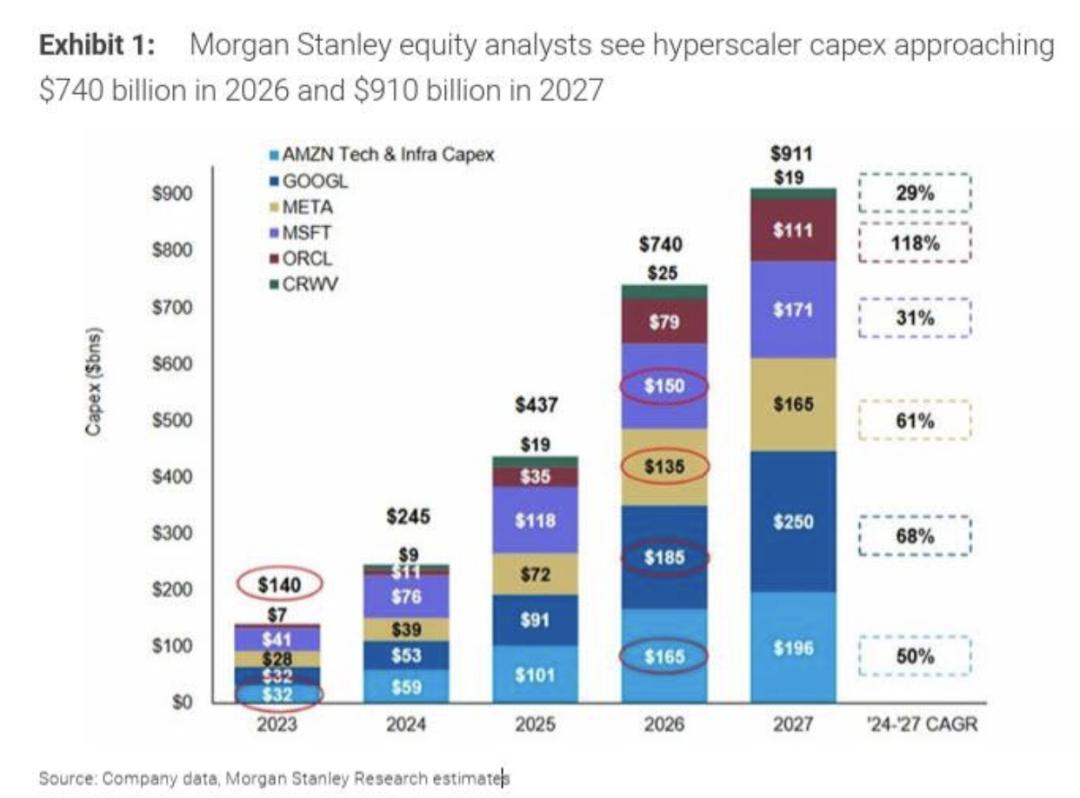
According to Morgan Stanley statistics, in 2024, the capital expenditures of the six major US technology giants were $245 billion, and in 2025, it reached $437 billion.
It is expected that in 2026, the capital expenditure scale will reach $740 billion.
As the AI wave intensifies, Chinese AI giants are also increasing their capital expenditures.
In 2025, ByteDance's capital expenditure scale was as high as 150 billion yuan, Alibaba's was about 120 billion yuan, Tencent's was 79.2 billion yuan, and Baidu's was 12.1 billion yuan, with a total of more than 360 billion yuan. [5]
In 2026, ByteDance has raised its capital expenditure to 200 billion yuan.
Tencent President Liu Chiping revealed that "In 2026, Tencent still hopes to have a significant increase in capital expenditure." In Q1 2026, Tencent's capital expenditure was 31.9 billion yuan, a year - on - year increase of 16%.
Alibaba has also raised its capital expenditure target. Wu Yongming compares AI to the manufacturing industry, with the core being to build two data center factories for "AI training" and "AI inference". The future capital expenditure will exceed the previously planned 380 billion yuan.
Roughly calculated, in the past two years, the AI investment of only four AI giants, BAT and ByteDance