Without large models, without its own traffic, and with its stock price once in ruins, what did he rely on to turn advertising placement into a gold mine worth hundreds of billions?
When others can't understand you, they'll think you're cheating. ——Adam Foroughi
The Desperate Counterattack of the "Wild Stock"
Imagine a company: It went public in 2021, and its market value once approached $40 billion. A year later, its stock price plummeted by 92%, and its market value dropped below $4 billion.
However, just over two years later, it achieved one of the craziest rebounds among U.S. tech stocks.
In 2024, its stock price soared by 790% throughout the year, outperforming NVIDIA, and sent five of the company's executives onto the Forbes Global Billionaires List. By 2025, its market value once neared $250 billion and was officially included in the S&P 500 index.
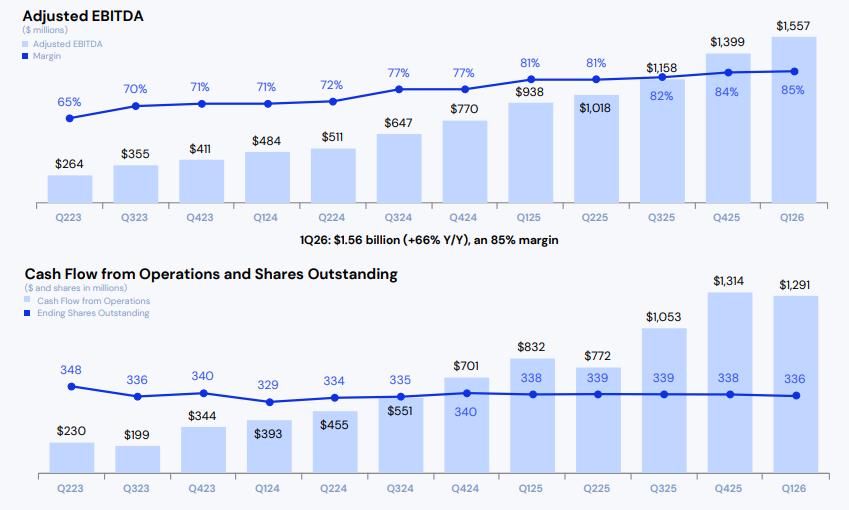
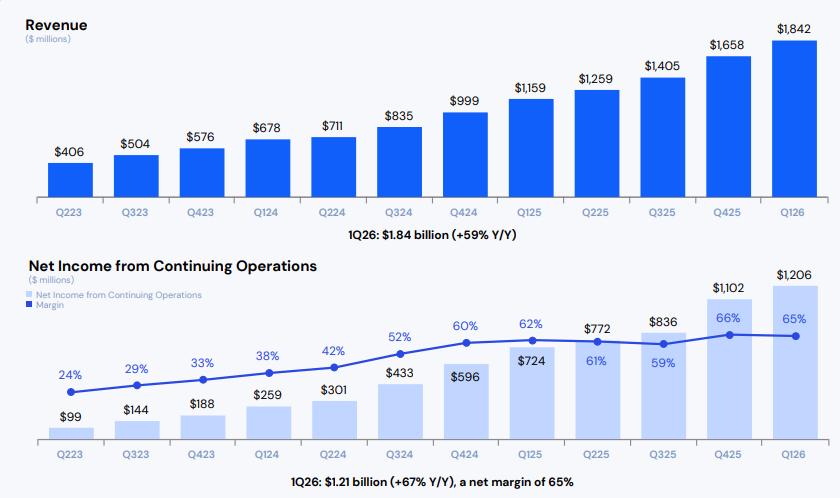
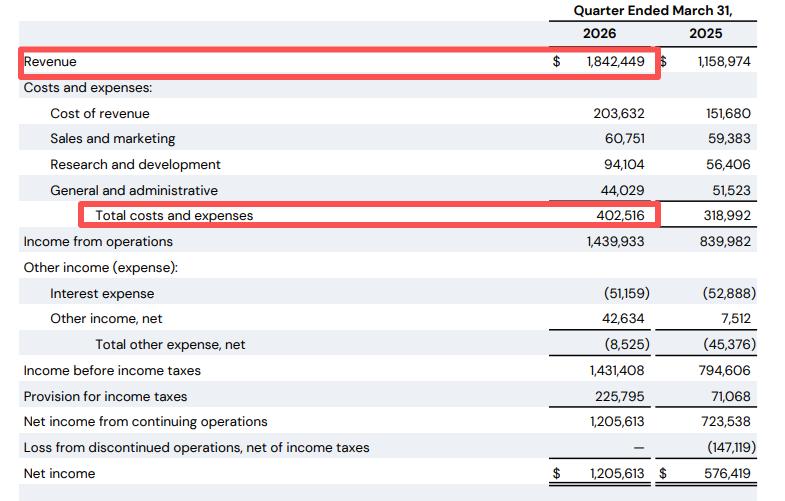
The company's financial report data for the first quarter of 2026 once again exceeded market expectations.
What's even more counter - intuitive is that there is no ChatGPT - style blockbuster product, no grand narrative of LLM, and no founder frequently appearing to talk about AGI. Its core business sounds a bit old - fashioned and even boring: Mobile AdTech.
While the entire Silicon Valley is struggling with the API call costs of large models, it is like a precisely - operating cash - flow machine, driving over $10 billion in performance - based advertising budgets every year. Moreover, all of this is not built on its own traffic pool.
This company is called AppLovin.

Netizens have shown a lot of attention and had many discussions about it.
The person who transformed it from a company that was long undervalued, misunderstood, and even short - sold into today's AI cash - flow machine is the founder and CEO, Adam Foroughi.
Recently, this long - low - key operator rarely shared the underlying logic of AppLovin in two podcasts. To some extent, the "anti - consensus" of this company is an extension of his own way of thinking.

Adam Foroughi was interviewed in a venture - capital podcast The Twenty Minute VC (20VC) hosted by Harry Stebbings.
Before founding AppLovin, Foroughi had founded several companies in succession and successfully exited. However, when he really started working on AppLovin in 2012, he was rejected by almost all top - tier venture capital firms in Silicon Valley.
For a long time, he, like the company, was outside the mainstream view. It was precisely this long - term experience of being undervalued that left a strong "chip on his shoulder" in him: not superstitious about consensus, not catering to the mainstream, and only speaking with products and data.
This almost calm and even "anti - consensus" way of thinking has almost shaped all the key choices of AppLovin and successfully dug out a profit "mine" with nearly $10 billion in annual revenue between the fingers of giants.
The Big Companies Do the Promotion, and I'll Help You Make Real Money
When it comes to mobile advertising technology companies, many people's first reaction is still the traditional advertising platform model: optimizing surface - level indicators such as click - through rate, download volume, and exposure volume.
But Foroughi's judgment on mobile advertising was different from the very beginning. Before founding AppLovin, he had completed two entrepreneurial ventures in the PC - end digital marketing field and successfully exited.
He later mentioned in a podcast that advertising should not just be a cost item but a kind of "arbitrage machine". The goal of advertisers accessing the system is very pure: the revenue brought by advertising on the platform must be greater than the advertising fees they pay. Therefore, the core of their advertising model is to efficiently deliver the return - on - investment formula that enables advertisers to make a profit.
This also constitutes the core logic of AppLovin's Performance - based Advertising: all transactions on the platform must revolve around "performance".
Therefore, from the very beginning, what AppLovin aimed to solve was not "how to get more people to click on ads" but how to turn every dollar spent by advertisers into as much real money as possible.
Specifically, AppLovin has made itself into a "business lever": one end is connected to the growth budget of advertisers, the other end is connected to the traffic inventory in global mobile apps, and in the middle is a set of AI - driven recommendation, bidding, and value prediction systems.
On the one hand, it helps advertisers find people who are truly willing to spend money.
For example, which player is most likely to keep "spending money" in a game? Which consumer is most likely to be impressed by a certain product and finally make a purchase?
On the other hand, it also helps developers sell every ad display opportunity in their apps at a higher price.
Here, the real differentiator from its peers is that it optimizes the long - term future value of users, that is, Lifetime Value (LTV). Two years ago, AppLovin was the first to implement a 28 - day optimization mechanism, which has now become an industry standard.
For example, a player only recharged $1 on the first day and did nothing on the second day.
In the traditional static tagging model, he is most likely to be judged as a "low - value user" and then abandoned by the system.
But Axon doesn't just look at one or two days. It may find that although this person doesn't spend much in the early stage, he has a very high retention rate and a stable spending habit. In the next half - month or a month, he is very likely to contribute hundreds of dollars or even more.
As a result, the nature of advertising placement suddenly changes.
It is no longer a traffic business of "spending how much money to buy how many downloads". Instead, it becomes a prediction problem about future cash flow.
If advertisers only focus on "breaking even within 7 days", the system can only compete at high prices in the red ocean for those who pay immediately.
But if advertisers can accept a longer - term break - even period, Axon can, in the third - party open ecosystem, find at low cost those users who seem ordinary in the early stage but have extremely high long - term value. There will be no loss in the first year, and all will be profit in the following years.
While most advertising platforms are still frantically attracting a bunch of "look - and - leave" people, AppLovin has returned to simple business common sense and redefined what an advertising platform should optimize - how much revenue a user can actually generate after conversion.
This is the real value.
And this logic has produced results almost from the moment AppLovin entered the market.

Adam Foroughi was interviewed in the podcast "David Senra" hosted by David Senra.
Foroughi recalled in the podcast that by November 2012, AppLovin's Monthly Run Rate had reached $1 million. In other words, they reached an annualized operating rate of $12 million from zero in a very short time.
Today, AppLovin has become one of the first companies in the industry to truly scale up "Value Optimization".
A typical case is the Turkish game company Dream Games, which owns the hit mobile game "Royal Match". As a game manufacturer that extremely pursues ROAS, Dream Games is a heavy user of Axon. It uses the Axon algorithm to target high - value in - app purchase players and has achieved nearly $30 billion in revenue only through pure in - app purchases without relying on in - game advertising monetization.
There is also a kitchenware brand whose annual revenue has increased from $4 million to $16 million and is now expected to reach $80 million, with most of its advertising budget being allocated to Axon.
Build an Advertising AI Flywheel Outside the Giants' Wall
AppLovin's counter - attack relies not on traffic entrances but on its advertising model. As Foroughi said in an interview, advertisers invest funds with the goal of obtaining revenue returns that exceed their advertising costs. Whether this formula holds or not depends crucially on how strong the model is.
AppLovin's real key to success is to turn advertising placement into a highly automated AI decision - making system. This "world's best advertising AI model" called by Foroughi is Axon.
Imagine a middle - aged user opens a casual game and is about to watch an ad. MAX (Traffic and Bidding System) immediately captures this high - value audience exposure opportunity and pushes this ad space to the bidding market.
After AppLovin's demand - side system receives the notification from MAX, the "brain" Axon is instantly activated and completes the prediction in a very short time: if an e - commerce brand's ad is shown to this user, what are the probabilities of him downloading, placing an order, and making a repeat purchase? How much revenue might he contribute in the future? How much is this exposure really worth?
If Axon determines that this display is likely to bring a CPM (Cost Per Mille) of $20 or more to the advertiser, the system has the confidence to bid a high price in the auction. Suppose it finally wins in MAX with a CPM of $15, and the arbitrage spread of $5/1000 is locked in.
When the user sees the ad and downloads the e - commerce app, Adjust (Attribution and Measurement System) immediately acts as a referee for attribution tracking. These new feedback signals will be fed to Axon to make it smarter.
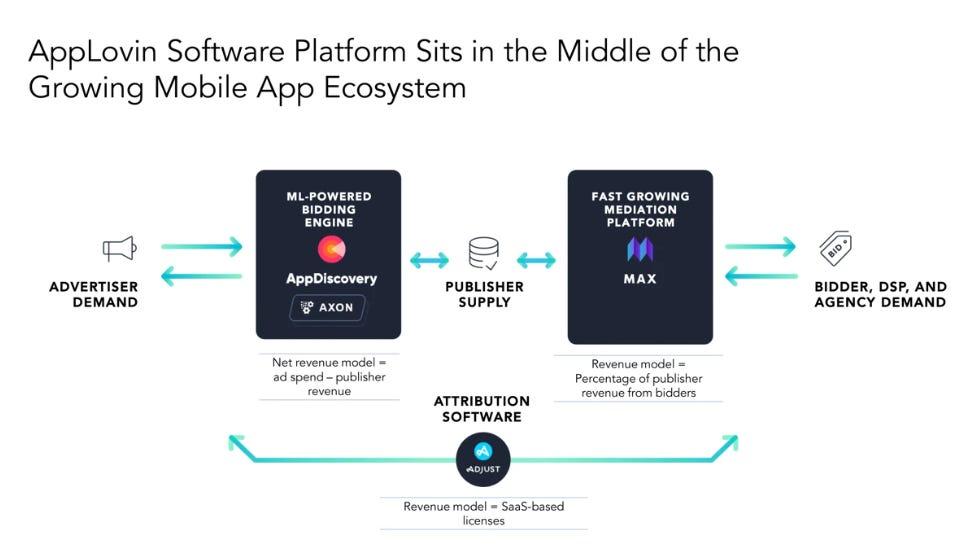
AppLovin's software platform is located in the middle of the mobile app advertising ecosystem: one end is connected to advertisers' budgets, and intelligent placement is completed through AppDiscovery and Axon; the other end is connected to developers' traffic, and advertising monetization efficiency is improved through MAX; at the same time, Adjust provides attribution and performance measurement, forming an integrated advertising infrastructure for placement, monetization, and attribution.
From the perspective of the algorithm's underlying layer, what Axon needs to solve is actually one of the most difficult problems in the entire modern recommendation system and performance - based advertising: how to solve a set of "ultra - high - dimensional sparse feature equations" in milliseconds.
In the open traffic pool, user ID, device information, ad material ID, app ID, geographical location, ad space, time, network environment, display events, payment events... Each dimension is a feature. These features never exist in isolation but undergo extremely complex high - order intersections in a dynamic state.
For example: a combination of "a U.S. user + a top - of - the - line iPhone + 10 p.m. + a casual game + an incentive video + a specific playable ad material";
a combination of "a Japanese user + a 1000 - yuan Android phone + commuting time + an e - commerce ad + an interstitial ad";
What lies behind these combinations are completely different psychological states, consumption intentions, and value judgments.
Traditional machine learning has difficulty automatically and comprehensively capturing these deep, sparse, and constantly changing cross - relationships. Once the number of combination dimensions increases, the feature space will expand rapidly. The curse of dimensionality follows. This is also the ceiling of the first - generation monetization engine, Axon 1.
In fact, Axon 1 is more like a traditional machine - learning advertising prediction engine, highly dependent on historical experience, preset rules, and classic model structures like Boosting Tree. It has proven that machine learning can improve advertising placement efficiency, but it cannot fully understand the most complex high - dimensional feature intersections in mobile advertising, let alone truly complete an automated closed - loop.
The key turning point occurred in 2023 when Axon 2 was launched. This time, AppLovin truly advanced the advertising prediction system to the era of modern deep learning.
It no longer tries to "enumerate the world". Instead, through Embedding, it compresses discrete and sparse ID and behavior signals into a unified dense vector space and then lets the neural network automatically learn the high - order relationships. The model doesn't need to have actually seen every combination to understand its "similarity" to historical high - value users.
This is a very crucial change. Because for the first time, the system truly has "generalization ability". After superimposing multi - modal embedding and real - time sequence models, Axon 2 can not only understand the "object" but also the "timing". Finally, it compresses all of this into the same advertising prediction framework to estimate the future revenue behind each display.
So, as long as advertisers enter a ROAS target in the background, the system can automatically execute placement, automatically allocate budgets, automatically adjust bids, and continue to optimize itself after new conversion data is