Roundtable Discussion: AI Intensity and Conversion Rate: Practical Growth Rules for Digital Experiences
The concentration of AI is not necessarily better the higher it is. The secret of conversion rate lies in the balance point of human - machine symbiosis.
"AI should run through the entire process like a mobile phone." When facing parent - child tourists and the elderly group, actively reducing the AI concentration to 50% has achieved a conversion rate of over 50%. The key to the concentration is to put people first and prioritize cultural warmth.
The following is the content of the round - table dialogue, sorted and edited by 36Kr:
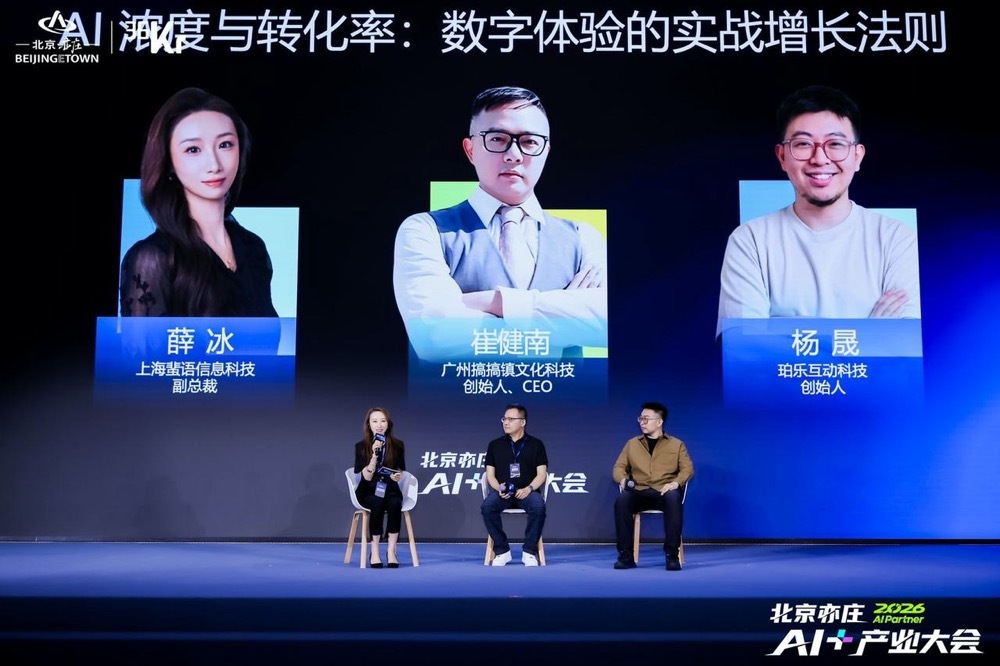
Xue Bing | Vice President of Shanghai Feiyu Information Technology (Host)
Cui Jiannan | Founder and CEO of Guangzhou Gaogaozhen Cultural Technology
Yang Sheng | Founder of Pele Interactive Technology
Xue Bing: Good afternoon, dear guests. I'm the host Xue Bing. I'm very honored to be invited by 36Kr and Beijing Yizhuang to host this afternoon's round - table. I'm very happy to invite two heavyweight guests to share the stage with me today, Mr. Cui and Mr. Yang. Now let's directly enter the round - table session. First, please let the two guests introduce themselves. Let's start with Mr. Cui.
Cui Jiannan: Thank you, host. Good afternoon, everyone. Good afternoon, leaders and guests. I'm Cui Jiannan, the founder of Guangzhou Gaogaozhen Cultural Technology Co., Ltd. Today, I'm here to share a very good case with you this year, and I also hope to learn more from Mr. Yang and Mr. Xue.
Yang Sheng: Hello, everyone. I'm Yang Sheng, the founder of Pele Interactive Technology. We have been deeply involved in the "AI + IP" field. At present, our company has a rich IP resource library and an AI tool matrix, which I believe many of you here have experienced or watched. In the following sharing, I also look forward to having a more in - depth discussion with you.
Xue Bing: Today we don't talk about concepts but about growth. This round - table focuses on two in - depth themes of culture and tourism and culture and entertainment. As we all know, AI is everywhere in everyone's work and life. How AI is applied in practical scenarios and how enterprises are implementing it in actual cases. Today, the two experts will answer all your questions one by one. We will break down the most practical cases for in - depth sharing. Without further ado, let's directly enter the Q&A session. Usually, at the beginning of a round - table, three questions are often asked. First, Mr. Cui, which is the most impressive and successful case you've done in the culture of Gaogaozhen? What kind of experiences have you introduced in the whole process, such as interaction, AI marketing, or in - depth AI experience? How does Gaogaozhen Cultural Technology do it? Second, what's the current AI concentration in Gaogaozhen Cultural Technology? How much is it? Whether you use numbers or express it to give us an immersive experience. Third, many guests here are here to learn. Is your model replicable? For example, if someone wants to enter this track now, do you have any cases worth sharing or can you give us some references? It's not excluded that there are many partners here who want to cooperate with you.
Cui Jiannan: We are an artificial intelligence technology enterprise. As early as 2019, we started researching generative artificial intelligence algorithms for images. Our company has four years of precipitation. It may not be a benchmark, but let me share a case. We are creating an AI co - created cultural space with the Guangzhou Cultural Center. In this space, we mainly focus on several aspects.
One is to use our self - developed intangible cultural heritage large model, 2D image rendering, and 3D modeling algorithms for the content of B - end public cultural services of the Guangzhou Cultural Center. When we enter the cultural and tourism scenic spots of the cultural center and face millions of tourists and audiences, we can provide rapid creative focus and a full - link closed - loop for the presentation of personalized cultural and creative products. We completed this in the past year and it has begun to take shape.
How to do this case? As a small prefix for the second question, I plan to use several numbers to reflect it, including the AI concentration and conversion.
The first number is "3". The whole link presents three engineering capabilities that must be met in the actual scenario implementation of artificial intelligence. The first is data engineering capability, the second is algorithm engineering capability, and the third is application engineering capability. These three capabilities are also the three essential elements for the standardized implementation solution of artificial intelligence. We met the standards in the past year. In the field of Guangzhou, we have become a typical artificial intelligence case unit and a typical AI + culture case unit.
The second number is "80,000+". As a public cultural service unit, the Guangzhou Cultural Center, which is our co - building partner, faces millions of tourists. The park is very large, with an outdoor space of more than 100,000 square meters. We operate the digital cultural experience hall and the intangible cultural heritage library in it. We call these two contents the AI cultural co - created space. It's not just a space concept. In the scenario, through the co - building parties, we bring in handicraftsmen, intangible cultural heritage inheritors, and the artificial intelligence innovation laboratory linked with universities, gather talents in this area, and focus on cultural data. Then in the scenario, we can achieve the conversion of quantitative social value and economic value, matching the two directions of AI + people's well - being and AI + new consumption. This is the concentrated embodiment of the two numbers 3 and 80,000+.
Xue Bing: It's a very vivid description. If it's the same park or scenic area, can I replicate your solution in 7 or 15 days? Now that you've implemented it in Guangzhou, for other regions or other parks and scenic areas in Guangdong Province, can you give us some suggestions?
Cui Jiannan: To create a truly implemented solution, even a standardized artificial intelligence solution, if you asked me the same question a year ago, my answer would be more than 7 days. One of the capabilities is data engineering capability. In the past three to four years, we have accumulated a lot of official traceable cultural data. From our algorithm recognition to the self - developed intangible cultural heritage large model, this is the essential foundation for our implementation. Through this year's construction, from the large model to the combination with the general large model, as a deep - level partner of Huawei, with Huawei's deep - level artificial intelligence base, it can now become a standardized implementation solution within 3 days. Whether it's cloud deployment or private deployment, it can become standardized content. We are quite confident. The whole thing is not just the solution, but also the integrated implementation of the back - end operation and marketing plan, which can be replicated.
Xue Bing: From your description, you've completed a good closed - loop from scratch. It means this model can be replicated from a practical perspective and has a relatively standardized way. Have you encountered any pitfalls? For the intangible cultural heritage large model, including copyright and algorithms, have you faced any difficulties, including in terms of security and privacy protection?
Cui Jiannan: For an enterprise, it's easy to share the joy of success, but there are too many pitfalls. There are several aspects.
Regarding data sources, official data is relatively easy to handle. For example, the data from the intangible cultural heritage protection center and the data accumulated by art and design colleges over the years are relatively simple. But in the cultural field, especially in the field of intangible cultural heritage, a lot of knowledge is not structured or systematic. A lot of it is stored in the minds of handicraftsmen and intangible cultural heritage inheritors. The transmission of intangible cultural heritage knowledge is in the form of master - apprentice inheritance, family inheritance, and ancestral inheritance. This is the real core. The cultural core we talk about is often hidden in the most core information and cannot be truly inherited, gradually becoming intangible cultural heritage content. To make up for this, in the past, we also collected some self - collected data. We conducted systematic interviews, data collection, extraction, and cleaning, presented structured data, and fed it to artificial intelligence to become vectorized data. This process takes the most time.
In the implementation scenarios, for both B - end and C - end, when a lot of tour groups and tourists come in, there are issues of intellectual property and portrait rights. On - site, in addition to our staff explaining face - to - face, when they create physical cultural and creative products and take them away as souvenirs, it doesn't violate the restrictions of intellectual property rights. But if they want to further commercialize them, many college students have good ideas. When turning the whole implementation scenario into cultural and creative products with good market feedback, we need to remind the students or cultural and creative teachers to do digital rights confirmation. This has been presented in a centralized way on the tools.
Another thing we do is digital evidence storage to ensure that the cultural and creative products they create have confirmed appearance patents and special evidence storage, so that they can be commercially converted externally. These are the measures we've taken to deal with the pitfalls we've encountered in the past.
Xue Bing: Thank you, Mr. Cui. You've shared every detail and been deeply involved in every link. What you're doing is very meaningful. Now we're building our own AI knowledge base. Whether it's the handicraftsmen or the inherited culture in the minds of the inheritors, how to better spread and inherit these, combined with culture and tourism and using AI technology, is a very meaningful thing. We also look forward to more cooperation or projects from Gaogaozhen Cultural Technology.
Mr. Yang, I read an interview with you a long time ago and was very interested in what you're doing. Whether it's at the company level or your personal level, the successful cases must involve AI. Please talk about the cases you've done before and how the AI concentration is reflected in culture and tourism. There are many things in culture and entertainment, such as digital short dramas, videos, and movies. Please share.
Yang Sheng: Last week, we jointly created an animation of the IP "Never Say Die" with Happy Twist and Alibaba Tongyi Laboratory, and signed an exclusive broadcast agreement with Tencent Video and Huolong Manju. Currently, there are five topics on Douyin with over 100 million views. We're quite lucky. In this project, we used the latest Wanxiang model launched by Tongyi and scheduled and harnessed Tongyi Wanxiang through our own model. We understand the artists' expressions and achieved accuracy in artistic expression through the cross - collaboration of the two models. You can search and watch it on platforms such as Douyin, Hongguo, Tencent Video, and Huolong Manju. The popularity of this project also reflects our thinking on the paradigm of integrating AI into culture and entertainment, including pan - entertainment.
There are already enough IP reserves at this stage. How can we make them come back to life? As Mr. Cui said, establish digital images and confirm the IP rights. Now, including many large model manufacturers such as Seedance and Vidu, they are tirelessly improving their compliant copyright libraries, allowing more creators to create compliant and legal images on their platforms. And these things are exactly what the culture and entertainment industry has helped the technology industry to establish a system of digital image libraries that can be restricted, sub - licensed, and re - licensed.
This is exactly the case with the "Panda Huahua" culture and tourism project we cooperated with Sichuan. Huahua's digital image is stored in Sichuan, and the underlying computing power also relies on Sichuan. Along with the sub - licensing, animation broadcast, and commercial expansion of this super IP, Sichuan's cultural symbols have been officially transformed into high - value digital assets nationwide and empowered downstream suppliers, especially in post - link scenarios such as games. As a pioneer in the pan - entertainment field, Pele starts from the top of the business ecosystem and continuously outputs core business inspiration and digital image assets for the industry.
AI runs through the entire chain. Starting from the digital image, the end is the authorization of the digital image, including the authorization of the tool end. As long as we do a good job in the authorization and restraint mechanism at the tool end, the model will not generate content beyond control. As many of you who have used Doubao know, when you put in a photo, many actions can't be done. This is not because the technology can't do it, but because the tool end has set up boundary locks at the underlying logic for compliance and rights confirmation. At this stage, content creation will become more and more open, and the IP library available to everyone will grow exponentially, which is also a huge boost to pan - entertainment.
By the end of this year, the industry pattern will become more interesting. There will be seven or eight very large platforms with towering IP libraries emerging. At the Google conference early this morning, it was announced that they have Paramount, Harry Potter, and Batman. If you want to use these images, use their large models. For us, what are the opportunities in China? Including the application layer, what are we talking about with the underlying large model companies? The opportunities will be immeasurable.
Xue Bing: You just mentioned Doubao and Alibaba's Tongyi Wanxiang. Do you mainly cooperate with model companies like the base models? Now, in the AI industry chain, from 0 to 1, which link is the most important when AI penetrates the whole chain? For example, if I'm a learner and explorer entering this industry, which part of the AI industry chain should I focus on to replicate your successful cases or the formula for creating a hit?
Yang Sheng: Regarding the whole link of business implementation, I think there are three core elements: The most important one is the token price. Now, in essence, tokens are selling electricity. The pricing of electricity is what entrepreneurs, including business owners and new - comers, should talk about the most. Whether it's Keling, Seedance, or Vidu, each large model manufacturer has a complete package for users and enterprises, reducing everyone's trial - and - error cost and allowing you to make relatively luxurious attempts in a free space.
The second core is the acquisition and authorization of IP. Whether it's Hailuo or Tongyi, they are building their own IP image libraries. In July this year, we promised Hailuo to create a LoRA image library of more than 100 people. If you have unique artistic creativity and legal image authorization, or an image unique to Guangzhou like what Mr. Cui said, these image libraries will be the best opportunity to overtake on a curve. Just like the recently mentioned movie "Love Letter to Grandma", the local cultural symbols with humanistic temperature and uniqueness will be the value that is difficult for other enterprises to replicate and erase.
The third is to choose tools. Now you can see integrated tools, and there is still a lot of integration between tools. If you're a startup, when getting involved in the commercialization part, when choosing tools, you might as well combine cheap computing power and good IP. I suggest you try to use free tools, or maybe you can even create your own tool. I was fortunate to be deeply involved in the first OPC community in China - Honghu Club. We held a press conference with the Shangcheng District of Hangzhou, which was also reported on the News Broadcast. I've been closely following a large number of individual entrepreneurs and have seen the rise of many super - individual creators. With the popularization of large models and the birth of ultra - large models, the technical threshold has been greatly reduced. A person majoring in literature can talk to me about which model with how many B it should connect to and what kind of strategy is better. This trend is coming, and the boundaries between technology, content, and business are becoming blurred. Many times, having a good model and a good infrastructure price are the keys to differentiating entrepreneurs.
Every industrial revolution always prospers a batch of industries, such as steam, internal combustion engines, electricity, and the Internet. We think the most effective thing this time is that the content generation time has become shorter and the difficulty of content sub - licensing has become smaller. This opportunity will allow a large number of new individual creators and new powerful studios to rise, just like the culture and tourism market has suddenly become a pillar industry, and the content industry will flourish again.
Xue Bing: You've also been deeply involved in every link, from tokens to commercialization, and have analyzed the logical closed - loop very deeply. After listening to the two of you sharing, I sincerely feel that the two of you can have in - depth cooperation, whether it's in terms of IP, content marketing, AIGC, or technology combination. Everyone likes to say that AI improves quality and efficiency. Is it true that the higher the AI concentration, the better? Everyone is very concerned about growth. This word sounds a bit abstract. From a practical and front - line implementation perspective, how to achieve the optimal concentration? In which scenarios will adding AI lead to a lower conversion rate? What are your opinions?
Cui Jiannan: From our overall scenario operation, let me give a conclusion first: It's not true that the higher the AI concentration, the higher the conversion rate. For example, our AI cultural co - created space is open to the public. Among the visitors, there are some elderly tourists and parent - child content. They are interested in in - depth cultural knowledge, but are often confused by interactive AI applications and don't know how to use them. For parent - child groups, such as