Why is it difficult for independent energy storage to make money?
Why is it so hard to make money in the booming independent energy storage sector?
In 2026, the independent energy storage sector is still growing at an astonishing pace.
In January 2026 alone, independent energy storage accounted for as high as 89% of the newly commissioned energy storage projects in China. The year-on-year growth rates of installed capacity and the number of projects reached 249% and 298% respectively, undoubtedly becoming the absolute main force in the new energy storage market.
Capital is still flowing in, projects are still being launched, and the bidding market remains bustling.
However, the eager developers almost unanimously complain: "It's extremely difficult to find a profitable project!"
"We've invested in five independent energy storage power stations, and so far, not many have achieved the expected returns." An investor told us that currently, only in regions like Shanxi can independent energy storage power stations participating in frequency regulation services achieve decent returns.
The Document No. 114 issued at the beginning of the year was regarded as a major positive for independent energy storage, equivalent to giving the power stations a "basic salary". However, investors are not optimistic about the sustainability of the subsidies.
Even with the support of capacity compensation, according to the data calculation of the energy storage and power market, this part of the compensation can only cover about 20% of the returns required for the power station to recover its costs.
This means that the remaining 80% must be filled through revenue channels such as spot market price differences and auxiliary services.
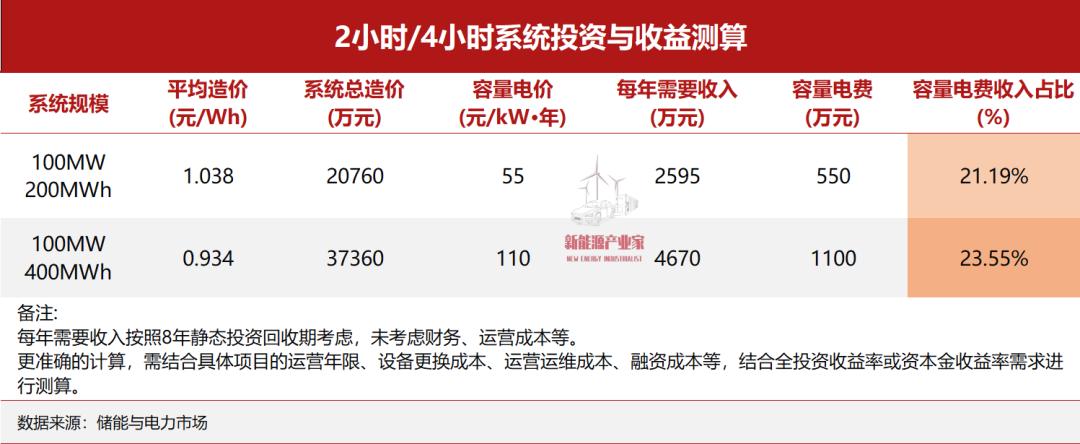
Why is it still difficult for independent energy storage to make money despite strong policy support, continuous cost reduction, and a more open market?
We will analyze the real logic behind the difficulty of independent energy storage in making profits from three dimensions: pre - construction costs, mid - operation risks, and post - operation revenue structure.
01 Hidden costs under multiple exploitations
Let's first calculate the cost.
Liu Na, the chairman of Xingchen New Energy, once took the 200MW/800MWh project in Gansu as an example to break down the real cost composition:
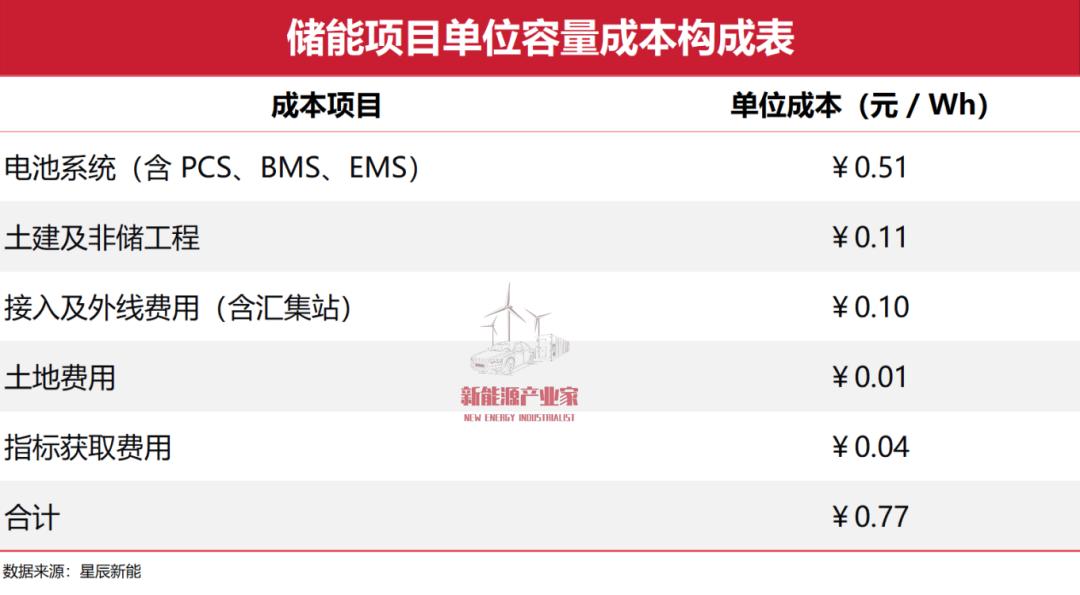
However, there are two major variables in this - land fees and permit acquisition fees.
The due - diligence person in charge of a financial leasing company told me: "The highest initial costs are for the project permit and land."
Developing an independent energy storage project usually has to cross two thresholds.
Grid access right: Which substation has available capacity, how much electricity can be connected, and when the grid allows power generation. These are all internal information of the grid, and outsiders simply can't obtain it.
Compliant construction land: The power station must be built within 3 kilometers of the substation. A longer distance will lead to a significant increase in power transmission losses.
It may seem like just a site - selection issue, but in essence, it is a comprehensive game of resources, approvals, and relationship networks.
The reason is simple: Independent energy storage is not a standardized factory, and it can't be built just anywhere because it's cheap. The site selection directly determines the grid dispatch frequency, access conditions, and subsequent returns, and such good locations are scarce.
Each location has its specific use. The closer to high - quality substations and high - load areas, the tighter the resources.
Whoever holds the land, approval, and access permits has absolute pricing power.
As a result, the business of project permits has emerged.
Once you obtain a project permit, which is an administrative license document issued by the government for project filing, approval, and inclusion in the annual construction scale index, it means the project can enjoy the government's key support. The permit fee is the non - official gray cost paid for purchasing this license document.
This cost has low controllability and a large operating space.
In 2025, a project permit for an energy storage project in Xilingol League, Inner Mongolia, was speculated to as high as 120 million RMB, which is 30 times the market price in the northwest.
Moreover, the scarcity of resources has also given rise to a large "network monetization" market - intermediaries.
As long as there is room for discretion in the approval process, intermediaries have a place to survive. The development of energy storage projects involves many steps, complex processes, and the industry standards are not yet fully unified, making the services of professional intermediaries almost irreplaceable at this stage.
Reasonable intermediary fees are supposed to be the consideration for information and services, but in the frenzied market sentiment, the industry is already in a complete mess.
"We originally agreed on an intermediary fee of 0.2 yuan per unit, but when it was time for filing, he went back on his word and said he didn't want the intermediary fee anymore. Instead, he wanted 0.1 yuan per unit of electricity." A developer said helplessly.
Some even ask for 20% of the project's revenue and do nothing afterwards.
The market is also full of a large number of non - professional intermediaries, commonly known as "brokers" in the industry. They disguise third - or fourth - hand information as first - hand information and resell it at increasing prices.
"It's very difficult to find a reliable first - hand intermediary in the market. The other 90% are all brokers."
Their survival rule is to take advantage of information asymmetry to deceive both sides: exaggerating the project's investment value and local contributions to resource providers, and beautifying resource conditions and approval progress to investors.
The core purpose is only one: to earn high intermediary fees, cash commissions, or equity stakes in the project.
For an independent energy storage project, these are just the "entry fees".
More problematically, some local governments, in order to meet investment promotion and economic performance indicators, will add additional binding conditions to energy storage projects, such as establishing physical industries and binding large - scale local investments.
These requirements that have nothing to do with the energy storage power station itself will ultimately be converted into the project's hidden costs.
From project initiation to implementation, a project is exploited at every step, and the profit left for the developer in the end is very limited.
02 Building it doesn't mean it will run smoothly
If construction costs are a one - time expense, then the costs during the operation and maintenance period are a continuous "bleeding point".
The performance, efficiency, and reliability of an energy storage power station are also crucial for profitability, and there are huge differences in performance among different power stations.
Firstly, an important pain point is unplanned outages.
Unplanned outages refer to the sudden shutdown of energy storage units due to internal reasons of the power station rather than grid dispatch instructions, usually resulting from equipment failures, control system errors, or operational mistakes.
According to the 2025 statistical data of the electrochemical energy storage power station industry by the China Electricity Council, there were a total of 1,922 unplanned outages throughout the year, with an average single - outage duration of about 34.62 hours, which is almost one and a half days.
For a 400 - megawatt - hour independent energy storage power station, each unplanned outage will reduce the revenue by about 150,000 to 200,000 RMB. If your power station has two more unplanned outages than others every year, over a 20 - year operation period, this alone will result in a loss of about 6 million RMB.
This does not include the assessment fees.
Unplanned outages are one of the most core assessment items for energy storage power stations. Once triggered, not only will the power station be considered "sub - standard", but it will also face severe economic penalties.
Taking North China as an example, if the capacity of the out - of - service energy storage unit exceeds 10% of the installed capacity of the energy storage power station and is greater than 1MW, an assessment will be triggered. For every 1% of the installed capacity that is out of service, the assessment electricity will be calculated as the installed capacity of the grid - connected entity × 0.1 hours.
If the total capacity of the off - grid energy storage units exceeds 30% of the installed capacity of the energy storage power station and is more than 10MW, the power station will be assessed according to the installed capacity of the grid - connected entity × 3 hours of electricity each time.
One unplanned outage may result in a penalty ranging from tens of thousands to hundreds of thousands of RMB.
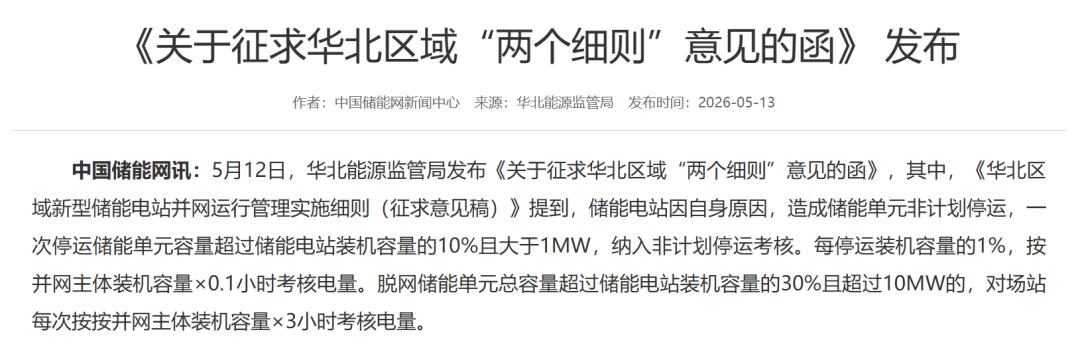
Letter on Soliciting Opinions on the "Two Rules" in the North China Region
In the actual "Grid - connected Dispatching Agreement" or local energy regulatory documents, some provinces may stipulate that the settlement price of the assessment electricity is 2 times, 3 times, or even higher than the benchmark price in order to severely crack down on unplanned outages.
Ningxia has even stricter regulations: If there are 3 or more unplanned outages throughout the year, the annual capacity electricity fee will be directly deducted. For independent energy storage power stations that rely on capacity electricity fees as the main source of income, this is almost a disaster.
Secondly, the assessment of core auxiliary service performance is also the most core, common, and highest - penalty part of the independent energy storage assessment. The assessment contents and standards vary from region to region.

Document No. 114 on Capacity Electricity Fee Assessment
Taking Guangdong as an example, the spot market in Guangdong has an execution deviation assessment. If the actual output of the energy storage exceeds the dispatch plan, the electricity of the part exceeding the allowable deviation rate will be calculated as the nodal real - time electricity price × 0.2 times for the assessment fee. The larger the deviation, the higher the penalty.
The monthly income of an energy storage power station from spot market transactions may be about 1.8 million RMB, while the fines due to deviations can be more than one million RMB. After a month of hard work, they end up paying money to the grid instead.
These assessment mechanisms undoubtedly increase the operation and maintenance costs of the project, but from the perspective of the grid, they are necessary means to ensure the safety of the power system.
In the long - term development of the industry, strict assessments are also forcing enterprises to improve their technical levels and operation and maintenance capabilities, and eliminating low - end production capacities that only rely on policy dividends and lack core competitiveness.
It's just that for most current operators, they are bearing all the pains of this transformation.
03 Diluted revenue
The construction and operation costs are already high, while the revenue side, which is supposed to cover the costs, is full of uncertainties and is even being continuously diluted.
The issuance of Document No. 114 brought a turning point for energy storage. However, after truly entering the market - oriented stage, the revenue model of independent energy storage has become more complex and unstable.
In the past, the main revenue of energy storage power stations was capacity leasing, while now the core revenues of independent energy storage power stations are:
Capacity compensation/capacity electricity price: The grid or the government provides subsidies based on the available capacity;
Power auxiliary services;
Power spot trading;
These profit models have regional differences and uncertainties, and there isn't even a slightly effective model to predict their revenues and risks.

Document No. 114 on Capacity Electricity Price Mechanism
The problem is that not all independent energy storage power stations can obtain revenues from all profit models.
In many places, the capacity electricity price is managed through a list system, and only projects on the list can enjoy it. The rules of the auxiliary service market are also constantly changing.
This means that independent energy storage is essentially still a policy - dependent investment type.
In most places at present, its revenue depends on subsidies, the guaranteed number of dispatch times, or the guaranteed electricity price. However, the duration and intensity of such industrial support policies are uncertain.
The subsidy may be 0.5 yuan today, 0.1 yuan tomorrow, and may even disappear the day after tomorrow; the guarantee today may be changed to market - based competition tomorrow.
Although it is clearly stated in the document, when it comes to actual implementation, it may be discounted due to the implementation scope, settlement cycle, or local financial resources.
Investors have almost no resistance to policy risks. One sentence in the document may make a project extremely profitable or bankrupt it.
Take the most typical example, the system operation fee.
According to the clear regulations in Document No. 114, independent energy storage needs to pay the system operation fee when charging as a user. Originally, the proportion of this fee was not high, but with the inclusion of new energy price difference settlement and other fees, the system operation fee has generally shown an upward trend in various provinces.
Taking Shaanxi Province as an example, the system operation fee has soared from 19.6 yuan per megawatt - hour to 96.9 yuan per megawatt - hour.
For a 100MW/400MWH independent energy storage power station with 300 cycles per year, if calculated according to the spot market, the gross revenue is about 41.32 million RMB;
According to the electricity price policy in December last year, after deducting the transmission and distribution price, government - imposed funds and surcharges, line loss fees in the power - generation link, and system operation fees, the revenue is about 32.848 million RMB;
However, if recalculated according to the electricity price policy in May 2026, with the same price difference, the system operation fee has increased from 19