Is the telecom operator in a hurry as the token package arrives?
"Explosive! Both China Telecom and China Mobile have launched token packages." "Only 10 million tokens for 9.9 yuan? I used to pay 1 yuan for 1MB of data. It seems like history is repeating itself." "The new - era message package is here..."
On May 15th, Shanghai Telecom took the lead in offering token (word - element) computing power services to users, with 1 yuan corresponding to 250,000 quota points. Netizens were in an uproar. Some complained about the high fees and the so - called "model shell - covering"; others self - mocked, "I feel like I've been left behind by the times. I have no idea what a token is."
Subsequently, China Telecom launched a national - level token package, and China Mobile and China Unicom followed suit. As soon as the news came out, the stock prices of the three major operators rose collectively.
According to information from the National Data Bureau, as of March, the average daily token call volume in China has exceeded 140 trillion, a more than 1000 - fold increase compared to 100 billion at the beginning of 2024. Meanwhile, the phrase "accelerating the construction of a national integrated computing power network" has been frequently mentioned recently. From enterprise - level decentralized construction to national - level unified scheduling, the infrastructure construction of the computing power "highway" is on the verge of taking off.
However, the model capabilities and AI products of telecom operators are not strongly perceived by C - end users. For ordinary users' daily chats with large models and writing simple copy, free large models can meet their needs. Is it really necessary to spend a lot of money to buy tokens? What exactly is the telecom operators' strategy?
Operators Take the Lead in Selling Tokens
On May 15th, Shanghai Telecom launched a token computing power package at the 2026 China Telecom Technology Festival. There are two types of packages: one is pay - as - you - go, with 250,000 tokens for 1 yuan; the other is monthly subscription, with 10 million tokens for 9.9 yuan. To stimulate demand, Shanghai Telecom users can also get a free trial package of 25 million tokens for a month.
Two days later, China Telecom launched a series of trial - commercial token packages nationwide, providing "token + connection + security" integrated services for developers and small, medium, and micro - enterprises. Meanwhile, China Mobile and China Unicom successively launched token products for C - end users.
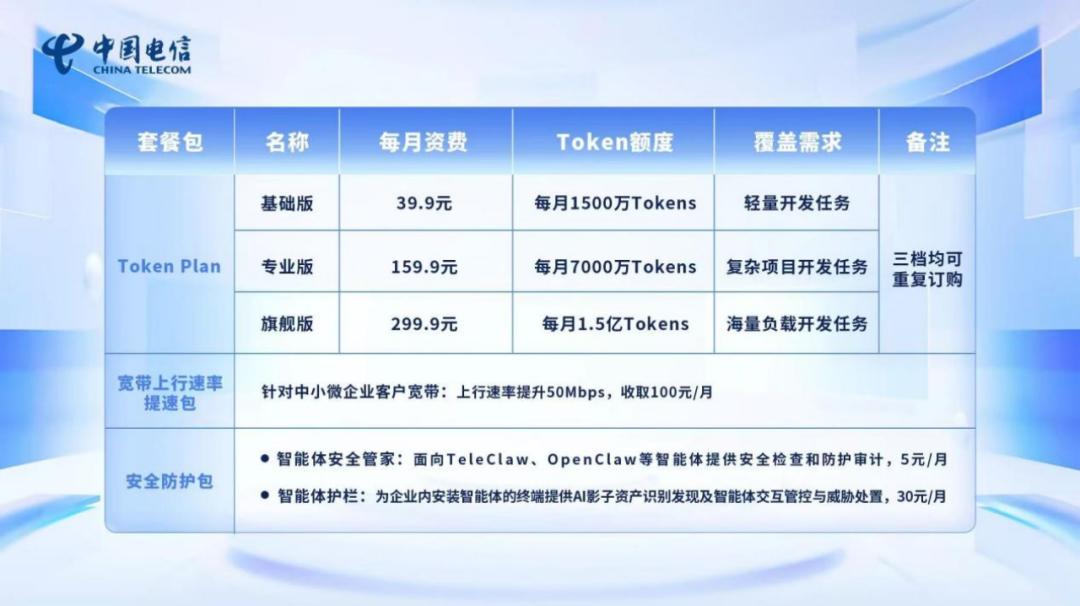
On social media, some netizens said, "First offer a free trial, and then raise the price after you get addicted. I'm familiar with this routine." More people complained about the high fees. For comparison, on April 26th, DeepSeek officially announced a price adjustment for its API, lowering the input cache hit price for all series of APIs. The input cache hit price for one million tokens of the V4Pro model is as low as 0.025 yuan, about 1/40 of the price of China Telecom's tokens.
Although there is a top - level design, the three major operators are not in sync in the specific business promotion. On May 20th, when a reporter from "Baobian" called the Shanghai Telecom customer service, it seemed that the customer service was quite unfamiliar with the token package. They had to search for "token" in the background and then introduce the package price according to the materials, but they were not familiar with how to use tokens. Moreover, there were even multiple English spelling mistakes during the process.
After searching for "token", the Zhejiang Mobile customer service started to introduce the "cloud computer" service: for B - end enterprises, employees can access the company's intranet and operate professional software through the cloud - based virtual desktop. However, the customer service was not familiar with the C - end token package. In a Wenzhou Unicom offline business hall, the staff was also unaware of the token package, and there were no relevant materials on display in the store.
Although the market has not been fully opened, compared with the mainstream large models on the market, China Telecom's token package can be purchased directly with mobile phone credit and supports cross - model use. After users purchase the token quota, they can call on more than 30 mainstream large models as needed through the API interface and integrate AI capabilities into their own software or automated processes. If users recharge directly on large - model companies, the balance can only be used on that specific model. Different models have their own advantages. If users need to use another model, they have to recharge again, which may cause waste.
This is similar to the general mobile data package that users buy from operators, which can be used for apps like WeChat, Douyin, and Taobao. If users buy Tencent's directional data package, they won't be able to access Taobao or Douyin.
For ordinary users, if they only need to have daily conversations with large models and write simple copy, the current mainstream large models can basically meet their needs. The token package is more suitable for developers who love to tinker, have programming skills, and can call APIs, or heavy AI users.
Operators' Anxiety
From selling call and message packages, to mobile data, and now to selling token packages, the business of telecom operators has been continuously evolving.
In recent years, as the growth of traditional mobile phone and broadband services has slowed down, operators have fallen into growth anxiety. According to the 2025 financial reports released by China Unicom, China Telecom, and China Mobile, their revenues only increased by 0.7%, 0.1%, and 0.9% respectively, hitting a six - year low. The growth of mobile phone and broadband services has significantly slowed down, and some core revenue indicators have declined year - on - year. Among them, China Mobile's net profit attributable to shareholders even decreased by 0.9% year - on - year.
On the one hand, the traditional personal communication service market has reached its ceiling. Take China Mobile as an example. In 2025, the total number of users was 1.005 billion, with only a net increase of 1 million users throughout the year, and the growth has almost stagnated. On the other hand, in the stock competition, operators are in a homogeneous involution, competing with each other on price, which further lowers the tariff standard. In 2025, China Mobile's ARPU (Average Revenue Per User) was 46.8 yuan, a 3.5% year - on - year decrease.
When the traditional telecom business stalls in growth, emerging businesses have become the breakthrough for a new growth curve.
At the 6th China Telecom Technology Festival in 2026, Gong Bo, the general manager of Shanghai Telecom, said in his speech, "At the beginning of the 14th Five - Year Plan, we fully embrace artificial intelligence, respond to the group's strategy of 'cloud transformation, digital transformation, and intelligent benefits', and promote the in - depth integration of AI with the economy, society, and people's livelihood."
Selling tokens to C - end users essentially provides AI services. When tokens, which are unfamiliar to users, are packaged into perceivable AI services, the demand may be stimulated.
A reporter from "Baobian" saw on the China Mobile APP that by entering the AI trial zone on the home page, users can experience functions such as intelligent image cut - out and intelligent object removal. Cutting out a person from a photo requires 31,000 tokens, and the token balance given by the system is 500,000. That is to say, after users have processed a dozen photos, they have to "pay more" if they want to continue.
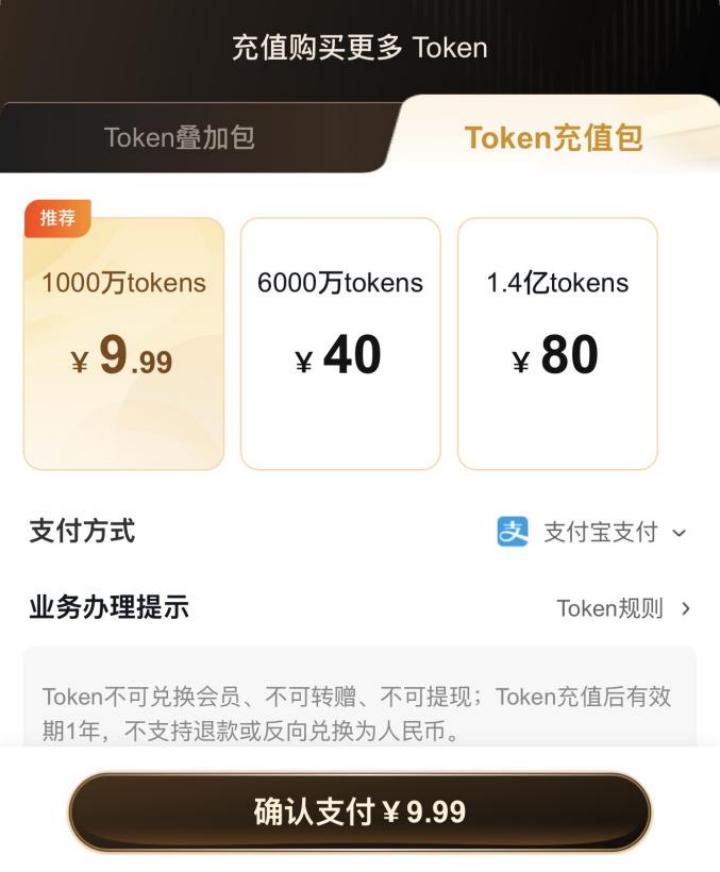
The token purchase page on the China Mobile APP
During the image cut - out process, the system prompts that the specific service is provided by Meitu Xiuxiu, and China Mobile plays the role of a "channel". On the Meitu Xiuxiu APP, users can enjoy basic image cut - out services for free. If they want to experience advanced features, the continuous monthly subscription fee is 30 yuan per month. Therefore, if users have a large demand for image processing, it is obviously more cost - effective to directly buy a Meitu Xiuxiu membership.
On the China Unicom APP, there is only a "Pet AI" zone, where users can use AI to generate images of pet cats and dogs and customize exclusive digital pets.
A reporter from "Baobian" randomly surveyed several C - end users, and they all reported that these functions are not essential, and they would not specifically buy tokens from operators for these functions: "I already have a Meitu Xiuxiu membership. I bought it on Xianyu, and it's very cheap." "Who still keeps digital pets these days..."
It can be seen that even though operators are trying to transform into the AI field, their "pipeline" nature is still very prominent, and they have not created strong enough C - end products. Whether they can stimulate user consumption and reverse the decline with the help of AI remains to be tested by the market.
New Infrastructure for Computing Power
When operators enter the AI track, they are no longer just competing with each other but also "grabbing the market" with many cloud providers.
In this track, mainstream players such as Alibaba Cloud, Volcengine, Huawei Cloud, Tencent Cloud, and Baidu Smart Cloud have taken the most profitable market share with their first - mover advantages.
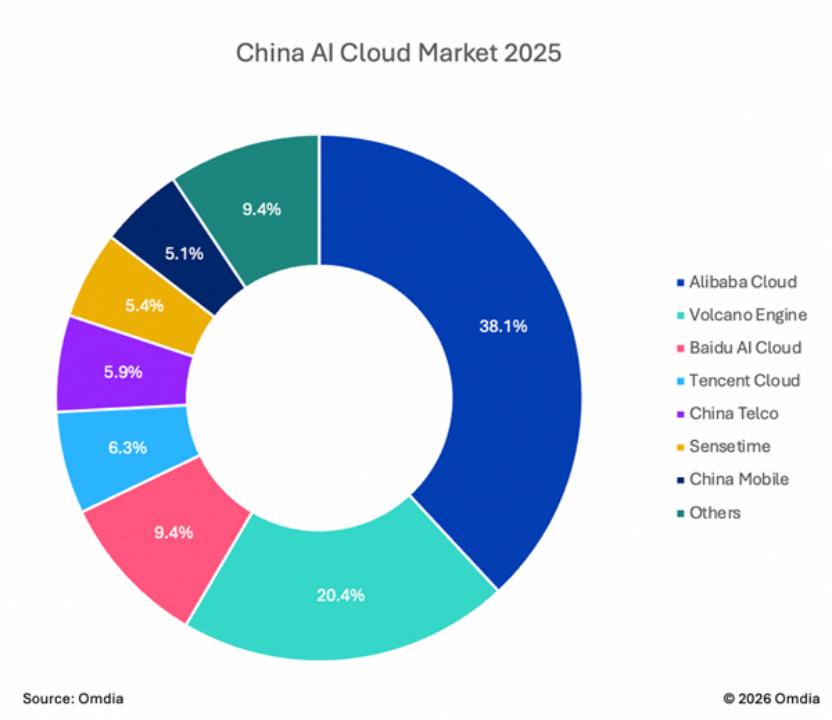
The market share of China's AI cloud market in 2025
Meanwhile, the price tiers of these cloud providers have become more mature. Facing the market situation of supply falling short of demand, they have recently raised the computing power prices intensively, showing a strong market performance.
In addition to the computing power advantage, the large models of Alibaba, ByteDance, and Tencent, such as Qianwen, Doubao, and Yuanbao, have obvious advantages among C - end users. In contrast, the large models of operators do not have an edge in terms of product performance and developer ecosystem. Although China Telecom has its self - developed "Xingchen" large model, when introducing the token package, the customer service also emphasized the support for models like DeepSeek and Zhipu GLM.
In essence, telecom operators are in the business of a "model supermarket", playing the roles of a "pipeline" and an "integrator". However, their advantages in offline base stations, networks, etc., are an important cornerstone of the national unified computing power network.
Relevant policies show that AI needs to be deeply integrated with advanced manufacturing, and the focus should shift from technological breakthroughs to large - scale, replicable, and monetizable scenario penetration. Although the large models of cloud providers are powerful, AI is not just about the cloud. The unique advantages of operators lie in the on - the - ground capabilities that are difficult for Internet companies to replicate.
For example, autonomous driving is considered an important application scenario of AI + physics. The high - speed movement of cars requires low - latency and high - reliability computing power, and the base stations of operators all over the country can become the front - line sensors for physical AI. Currently, China Telecom is focusing on building a "4 + 4+31 + X" computing power network, creating a four - level computing power system of "center - province - edge - end". Whether it is large models or physical AI, telecom operators' participation in the unified scheduling of computing power resources can cover computing power resources down to the township level.
Especially when AI inference requires cross - regional computing power scheduling, the stability, low latency, and high bandwidth of the network are particularly crucial. If we imagine the large models of cloud providers as "power plants", then operators are equivalent to the "power grid" covering the whole country. A power plant can have strong power - generating capacity, but it is the power grid that delivers electricity to every household.
A vice - president of Vipshop told "Baobian" that the computing power network is like the power grid more than 100 years ago. In his view, when electricity was first invented, many people didn't know how to use it. It was not until the power grid delivered electricity to every household that all kinds of household appliances emerged, creating new markets and application scenarios. Similarly, although most people are not familiar with tokens at present, with the completion of the unified computing power network and the reduction of computing power costs, new computing power consumption scenarios will be driven.
From this perspective, operators' entry into the business of selling computing power is not just a competition between large models but a reconstruction of the computing power infrastructure. In the competition in the AI era, operators don't need to prove that they can train models stronger than those of Alibaba and ByteDance. Instead, they need to prove that when AI computing power becomes an infrastructure like water and electricity, operators with the "power grid" are the ones closest to users for delivery.
This article is from the WeChat official account "Baobian" (ID: baobiannews), written by Chen Fashan and published by 36Kr with authorization.