Anchored by Scenarios, Empowered by AI: Practices and Breakthroughs in the Big Health Industry | 2026 AI Partner · Beijing Yizhuang AI + Industry Conference
When the large health industry meets AI, the biggest challenge is not the strength of technology, but the depth of application scenarios and the thickness of trust. Baidu Health has provided its own answer over the past six years: moving from single - point intelligence to global collaboration, and from technology empowerment to value creation.
There are over 500 million chronic patients in China, while the number of practicing doctors per thousand people is far lower than that in developed countries. Under this supply - demand contradiction, AI has become the new infrastructure for the reform of the medical and health supply side. Yang Minglu, the general manager of Baidu Health, combined with Baidu Health's practical experience, dissected the implementation practices of AI in three major scenarios: users, doctors, and hospitals. AI is not about showing off skills, but making every link more professional and trustworthy.
As the founder and builder of the Baidu Health brand, Yang Minglu established the strategic direction and organizational structure of the business at the end of 2019. In 2020, the Baidu Health brand was incubated. Baidu Health has become the largest health science popularization platform and a leading Internet medical platform in the whole network. The platform serves 130 million people's accurate health searches every day, has a professional health knowledge base of over 600 million entries, and is directly connected with more than 3,300 authoritative experts, over 430 top medical institutions, and 360,000 doctors across the country. Since then, she has been leading the team to deeply explore the AI + health track. She pointed out that in the past two years, the AI industry has undergone an important transformation - from competing in models to competing in applications, from focusing on parameters to focusing on scenarios, and health is one of the most important scenarios for AI implementation. AI is driving the large health industry into a new stage of supply - demand reconstruction, and ecological collaboration and professional trustworthiness are the key breakthrough points for AI implementation.
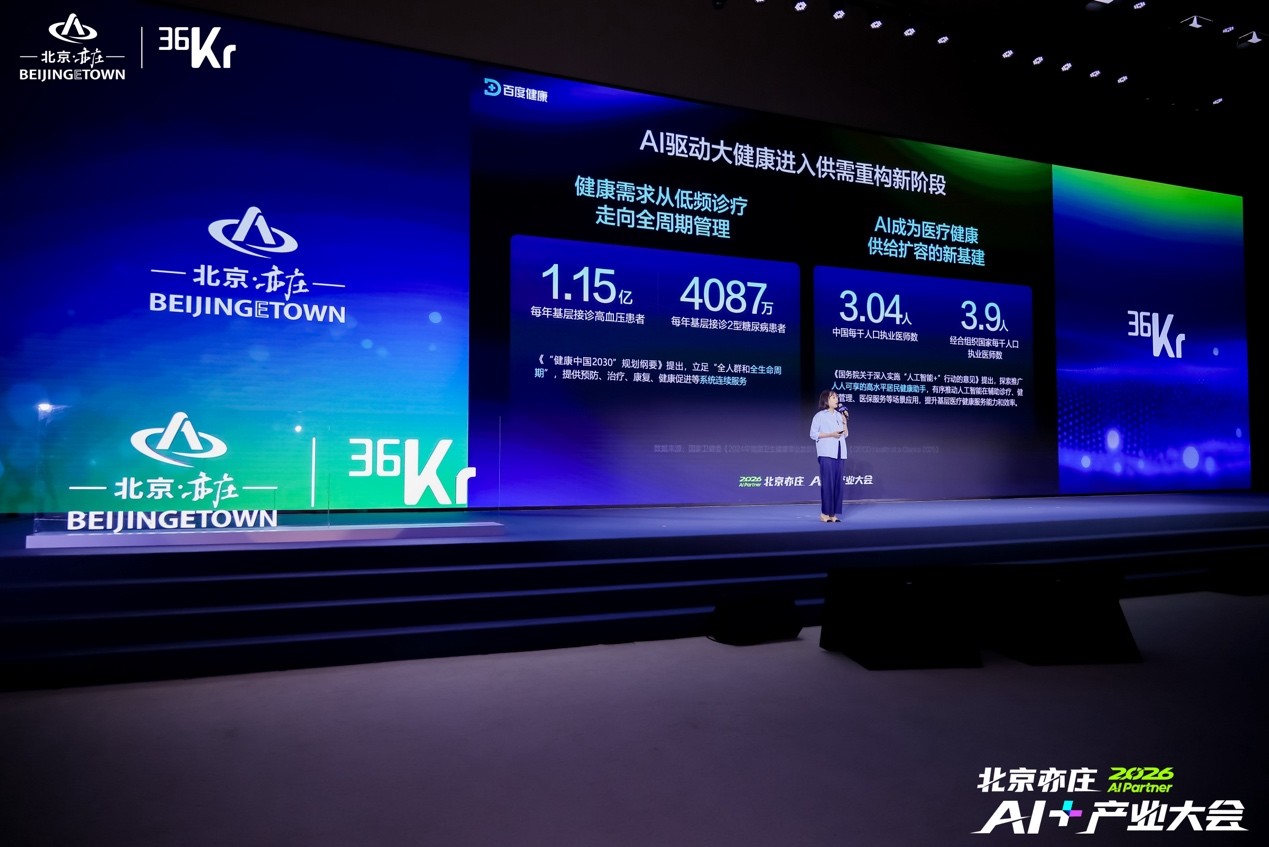
Yang Minglu analyzed that from the demand side, China will enter a severely aging society in 2035, and the number of chronic patients has exceeded 500 million, resulting in a sharp increase in health demand. However, on the supply side, the number of practicing doctors per thousand people is only 3.04, far lower than that in developed countries. Under this contradiction, AI has become the new infrastructure for expanding the supply of medical and health services. She also emphasized that the health industry chain is long and complex, and single - point intelligence is difficult to form continuous services. Therefore, it is necessary to move from single - point intelligence to global collaboration. Since medical services cannot tolerate mistakes, long - term human - machine collaboration is required. AI should "empower rather than replace, and assist rather than dominate".
In terms of scenario implementation, Baidu Health has built a full - link service system for users, doctors, and hospitals.
For users, she believes that traditional searches can only provide answers, while what users really need is a health assistant that can "chat" and solve problems. Based on this judgment, Baidu Health launched the "Ernie Health Butler". AI is used to complete preliminary consultations and report interpretations, and then real - life doctors confirm and review at key nodes. For example, the diagnosis summary generated by AI needs to be signed by a doctor before being given to the user. This model of "AI taking the lead and doctors guarding the bottom line" not only improves efficiency but also maintains trust.
For doctors, Yang Minglu observed that many doctors do science popularization, receive patients, and build their personal IPs on the Baidu platform, but a lot of their time is consumed by trivial matters. So the team launched the professional version of the large - model "Youyi Assistant", which can not only help doctors search global medical literature but also assist in writing medical records and science popularization articles. Just one or two months after its launch, the writing - related functions have become the most popular skills.
For hospitals, taking Wuhan Union Hospital as an example, Baidu Health has embedded AI capabilities into every link before, during, and after diagnosis. Intelligent triage has helped 260,000 patients choose the right departments, and the AI - assisted appointment service has served more than 120,000 users. Through the technology empowerment of AI - assisted appointment and intelligent triage, these users have received timely medical treatment. More than 70% of them need to have surgery as soon as possible, and the data has exceeded the hospital's expectations. The pre - consultation agent collects patients' medical information and automatically generates medical records while patients are waiting, and the doctor adoption rate is as high as 93.4%. The practice of this full - link AI intelligent outpatient service helped Wuhan Union Hospital win the gold award in the selection of the National Health Commission system last year.
Finally, Yang Minglu also introduced Baidu Health's "Atom Plan", which comprehensively opens up the AI capabilities and service resources accumulated on the platform to the industry. She said that the upgrade of the medical and health industry cannot be completed independently by one enterprise. She welcomes more partners to join and bring better health services to more people.
The following is the speech content of Yang Minglu, the general manager of Baidu Health, sorted and edited by 36Kr:
Yang Minglu | General Manager of Baidu Health
Good afternoon, colleagues and friends. I'm very happy and grateful to 36Kr for inviting me to the AI + Industry Conference. The theme of my speech today is "AI + Large Health: From Technology Empowerment to Value Creation". I hope to share with you the application and value implementation practices of Baidu Health in the AI + large health industry track in 15 minutes.
As we all know, in recent years, everyone has been talking about AI, and it has been very popular. It has also undergone some evolutions. At the beginning, we were all competing in models and focusing on model parameters. In the past two years, we have attached great importance to applications. We have shifted from focusing on parameters to focusing on scenarios. One of the very important application scenario directions is health. Being in this industry track, we have also seen that in recent years, especially in the past one or two years, AI has driven the large health industry into a new stage of supply - demand reconstruction. First, from the demand side, we know that China will enter a severely aging society in 2035, and the proportion of people over 60 will exceed 30%. Aging will lead to more people having health needs.
Regarding the number of chronic patients, according to the data in 2025, the number of chronic patients in China has exceeded 500 million. This is a very large figure. Almost one in every three Chinese people has a chronic disease. The change in the underlying population structure has led to a very rapid growth in the demand for Internet - based health services. The enhancement of the public's awareness of their own health has also made us see that in the past, people only used Internet medical services when they were sick. Now, more and more people are interested in preventing diseases, learning medical science popularization, health knowledge, and general health information. In the past, medical searches on Baidu were considered a low - frequency business. Now, it has shifted to medium - to high - frequency. The people's demand is very strong. From the policy side, the "Healthy China 2030" Plan Outline clearly proposes to provide systematic and continuous health management services for the people. This is also encouraged by policies, and the demand is booming. What about the supply side? The number of practicing doctors per thousand people among Chinese residents is about 3.04, which is 20% - 30% lower than that in developed countries. That is to say, the medical resources available to each citizen are still relatively low. While the demand is booming, AI can become the new infrastructure for expanding the supply of medical and health services. This is a very crucial productive force.
At this moment, AI is driving the supply - demand reform, especially the supply - side reform in the large health industry, which can scale up the high - quality supply. This is the underlying logic for the establishment of this industry.
What are the key breakthrough points? We find that it is difficult for AI to be implemented in application scenarios. In the health scenario, we believe that the core key breakthrough points for AI implementation are twofold: ecological collaboration and professional trustworthiness. This is also related to the particularity of the large health industry track. As we know, health and medical needs are generally complex, with a very long and deep industrial chain. There are long - term links among different parties such as medicine, insurance, and payers. In the past, we have seen that most AI applications in the health field are single - point. Single - point intelligence is difficult to form continuous, systematic, and high - quality health services. Therefore, AI in the health field needs to move from single - point intelligence to global collaboration.
Regarding professional trustworthiness, AI has transformed numerous industries. However, in the health track, we should respect the nature of the health track, which does not tolerate mistakes. There is a very popular saying now that the health industry still requires the full - process participation of professionals. By analogy with self - driving cars, we know there are L3 and L4 levels. In the health industry, we believe that it will stay at the L3 level for a very long time, with high - level human - machine collaboration. This is not only a guarantee for the safety red line but also a guarantee for users' sense of security and trust. This is our observation of the particularity of this industry.
For Baidu Health, we always have a clear attitude, which stems from our awe of medical and health. In the face of life, AI must abide by the safety bottom line. Our value is to empower rather than replace, and to assist rather than dominate.
Who are we and what are we doing? Baidu Health undertakes all health - related and medical - related demands in Baidu Search. We were incubated from Baidu Search during the epidemic in 2020. 10% - 12% of the demands in Baidu Search are related to health and medicine. Through multiple user surveys and interviews, we found that Baidu is still the first - choice entry point for Chinese people to seek medical advice. When the epidemic was very serious in 2020, our team became an independent business unit and established the Baidu Health brand. After six years of iteration, Baidu Health has become the largest health science popularization platform in the whole network. We serve 130 million people's accurate health and medical searches every day. At the same time, after six years of accumulation, we have a professional medical and health knowledge base of over 600 million entries in the whole network. We have also established long - term cooperation with more than 3,300 authoritative expert groups, including more than 30 academicians, and over 430 top - level authoritative medical institutions across the country.
After growing over the past six years, we have become a leading Internet medical platform in the whole network. As we know, more and more people are seeking medical advice and finding doctors online. Today, Baidu is directly connected with 360,000 doctors on the platform. We serve more than 4 million consultation sessions online every day, among which 100,000 are paid online consultations. These two services, one for service and the other for content, have also accumulated a large amount of data and user assets for our AI business today, and laid a solid foundation for our in - depth exploration of scenarios.
Scenarios are the touchstone of value. Only by deeply exploring scenarios and solving specific problems can the value of AI be truly created, rather than just an empty slogan. Today, Baidu Health has built three major scenarios for users, doctors, and hospitals. For users, the "Ernie Health Butler" is the main product entry, creating a unique AI + real - person (mainly doctors and other professional groups) AI model, providing users with a one - stop health butler service that can chat, is informative, and can manage. For doctors, we provide an independent one - stop workbench. For hospitals, we also cooperate with top - tier tertiary hospitals to provide in - hospital AI - enabled smart hospital transformation.
We have built a full - link integrated health and medical service system for patients, doctors, and hospitals around these three scenarios.
Next, I will briefly introduce to you what we are doing around these three scenarios.
The user - oriented scenario is our most important battlefield. We are a company that started with search and is also an AI company. The 130 million accurate users every day are our foundation. We launched the "Ernie Health Butler", which comprehensively upgraded the experience of traditional searches. If you search for medical advice in the Baidu search box, you can see the entry of the "Ernie Health Butler" in 80% of the scenarios. In addition to the generated content, the "Ernie Health Butler" will provide targeted, personalized, and native follow - up questions. By clicking on these follow - up questions, you can enter the multi - round dialogue butler mode. Under this upgraded native AI product model, 8 million people use the new AI inclusive product every day. According to our data, both user retention and user satisfaction have been significantly improved after being empowered by AI. Currently, this product has not been launched for a long time, but the monthly active users have exceeded 40 million. In this context, we have also seen a lot of previously unmet health management demands. We welcome partners who can provide rich and reliable health services to join our new field. We need not only services that can answer questions but also medical and health services that can solve problems. We are now cooperating with insurance companies, medical institutions, and doctors to further upgrade the "Ernie Health Butler" into an intelligent AI tool that can not only answer questions but also solve problems.
Currently, the top three core application scenarios of the AI "Ernie Health Butler" are as follows. One is AI medical report interpretation, a multi - modal scenario. So far, it has been used by 27 million people in total, with an average accuracy rate of over 98%.
AI skin disease recognition: The search demand for skin diseases ranks first among all diseases. Based on the demand and sample data, in cooperation with experts and with a large - scale annotation, the "Ernie Health Butler" can now recognize nearly a hundred types of skin diseases, and the consistency rate with doctor - annotated results exceeds 95%. Secondly, we have established AI self - tests for dozens of common diseases. In the past, it could only provide one - question - one - answer services. Now, through the skills of disease types, we provide users with a free fast - question - fast - test tool. This tool has been used more than 30 million times in total. Users' acceptance of AI tools in the medical scenario is still very high.
It is very difficult for pure AI to complete the "last mile". At Baidu, we also actively collect and conduct preliminary diagnoses through AI consultations efficiently, and then connect with real - life doctors for final confirmation. 360,000 real - life doctors can also participate in this process. On the right side of this picture, there is an AI - generated diagnosis summary that needs to be signed by a doctor. With human - machine interaction and the display at the front - end, users can perceive trust, and they can use AI in the medical field with confidence.
In addition to focusing on patients, on the supply side (D - end), we are mainly doing a lot of AI innovation around doctors and hospitals. As we know, 360,000 doctors have settled on Baidu, with a monthly active user base of about 100,000. These doctors practice on the Baidu Health Internet platform. They create content, receive patients, build their personal IPs and images, and communicate with their patients here.
In the workflow of a large number of doctors, we have found many scenarios where we can help them. The most important ones are to help them learn and grow and to free up their energy. In April, we released the first - ever "Lobster Assistant" for doctors in China - the "Youyi Assistant" on the whole network. It not only aggregates a large amount of global medical data but also enhances the professionalism on the basis of the original model, reducing hallucinations. It has become a professional - version medical large - model that can assist doctors in making decisions and learning. At the same time, it also integrates the Lobster architecture, allowing many skills that help doctors to be naturally loaded into the "Youyi Assistant". By disassembling the doctor's workflow scenarios, we create individual digital employees to help doctors truly improve efficiency in their workflow. Through the data accumulation in the past one or two months, the most popular skill among doctors is the writing skill, which can help them efficiently set topics, analyze cases, and make daily accumulations. We are closely focusing on scenarios to build AI capabilities at the doctor level.
Another aspect is hospitals. Our main partners are top - tier tertiary hospitals. Our main scenario is to look at the entire process of users in the offline hospital process, including before, during, and after diagnosis, to find out in which links the value of AI can be implemented. Before diagnosis, there is an intelligent triage agent to improve the accuracy of users' department selection and reduce unnecessary time waste during the medical process. During diagnosis, there is a good scenario. To avoid time waste during the waiting process, there can be an intelligent waiting agent to serve patients waiting for diagnosis, which can collect patients' medical information before they see the doctor, avoiding time waste when they meet the doctor later.
The follow - up after diagnosis, which many large hospitals wanted to do but couldn't in the past, has also been implemented in the partner hospitals. The most important partner is W