The ETF vane is here. On the day of the sharp decline, the net capital outflow exceeded 6.4 billion yuan; the CSI 1000 Index and semiconductors received reverse market positions, and the relevant ETFs "attracted funds" of over 4 billion and 2.8 billion yuan respectively.
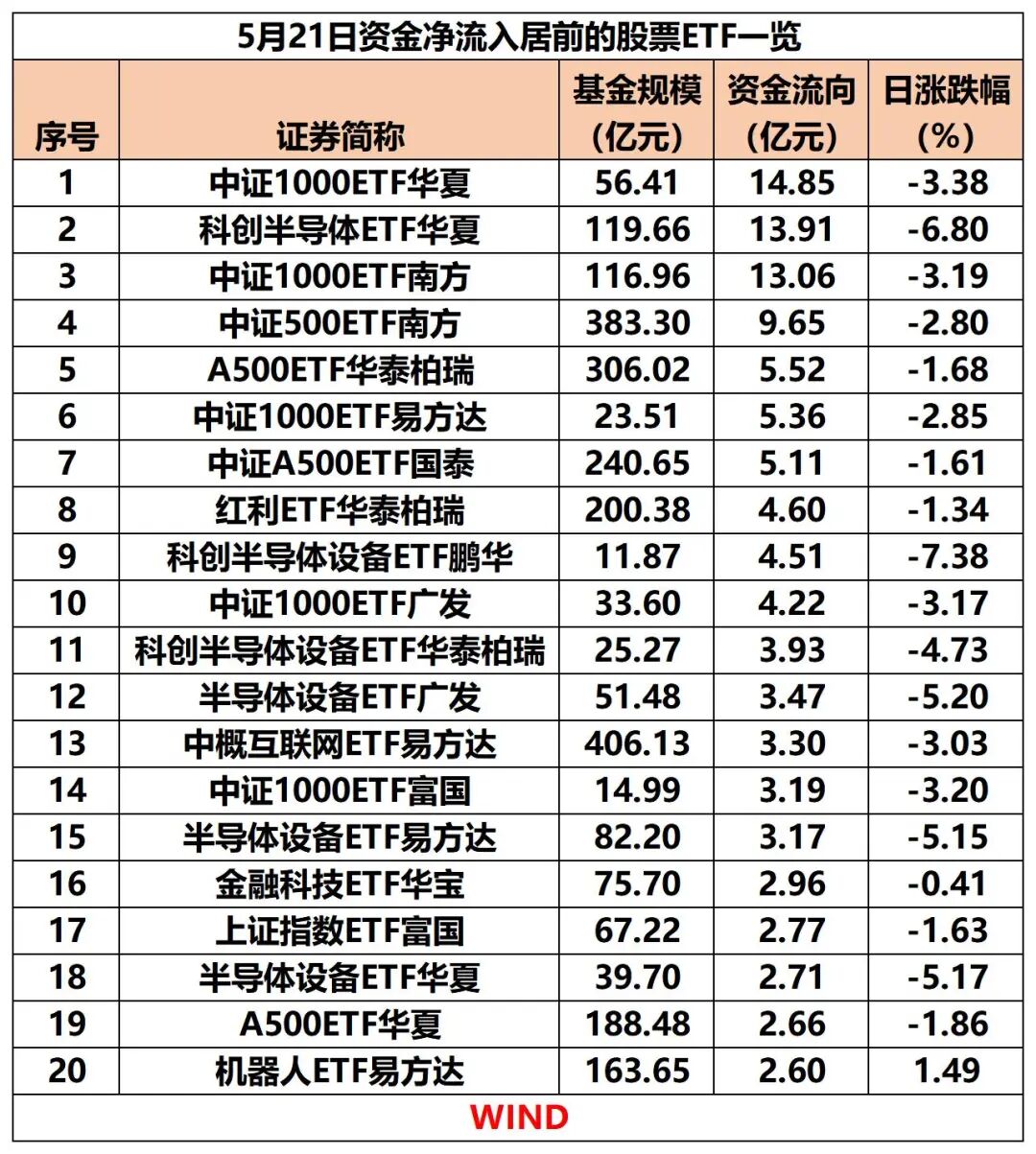
On May 21st, the three major A-share indexes collectively pulled back, and the net outflow of funds from stock ETFs exceeded 6.4 billion yuan. Among them, CSI 1000 ETF, CSI 500 ETF, A500 ETF, etc. became the main "fund attractors", and semiconductor-related ETFs received a net inflow of more than 2.8 billion yuan in funds.
Yesterday, the net outflow of funds from all stock ETFs exceeded 6.4 billion yuan
On May 21st, the market rallied in the morning and then declined in the afternoon. All three major indexes fell by more than 2%, and the Shanghai Composite Index fell below 4,100 points. Popular sectors such as AI hardware and semiconductors pulled back significantly.
Meanwhile, the net outflow of funds from all stock ETFs (including cross-border ETFs) was 6.449 billion yuan.
Among them, the top five sectors with capital inflows were the CSI 1000 Index (net inflow of 4.02 billion yuan), semiconductors (net inflow of 2.84 billion yuan), the CSI A500 Index (net inflow of 1.67 billion yuan), the CSI 500 Index (net inflow of 1.11 billion yuan), and A-share dividends (net inflow of 0.95 billion yuan).
In terms of leading fund companies, yesterday, E Fund's CSI 1000 ETF had a net inflow of 536 million yuan, E Fund's China Concept Internet ETF had a net inflow of 330 million yuan, E Fund's Semiconductor Equipment ETF had a net inflow of 317 million yuan, E Fund's Robot ETF had a net inflow of 260 million yuan, and E Fund's A500 ETF had a net inflow of 210 million yuan.
For Huaxia Fund's ETFs, yesterday, Huaxia's CSI 1000 ETF and Huaxia's Science and Technology Innovation Semiconductor ETF had net inflows of 1.485 billion yuan and 1.391 billion yuan respectively. Huaxia's A500 ETF and Huaxia's Semiconductor Equipment ETF had net inflows of more than 200 million yuan. Huaxia's CSI 500 ETF, Huaxia's Aerospace and Aviation ETF, and Huaxia's Credit Bond ETF all had net inflows of more than 100 million yuan.
21 ETFs under GF Fund were net bought, covering many featured varieties. Among them, GF's CSI 1000 ETF received the most net capital purchases yesterday, exceeding 420 million yuan. GF's Semiconductor Materials and Equipment ETF has been net bought for the fifth consecutive trading day, with a net purchase of more than 300 million yuan. Its latest scale exceeds 5.1 billion yuan, and the proportion of semiconductor materials and equipment in the underlying index (Shenwan's fourth - level index) reaches 100%.
In the recent volatile market, high - dividend assets have become a "safe haven" for funds. For example, GF's High - Dividend ETF has been net bought for the third consecutive trading day, with a total purchase of more than 100 million yuan. The Smart - Selected High - Dividend Strategy Index it tracks is the first to adjust positions among dividend indexes, and its latest dividend yield is 5.31%. Since the beginning of this year, the index's return rate has reached 8.29%, ranking first among all market dividend - related indexes.
In addition, GF's ChiNext ETF, GF's Power ETF, GF's China Concept Internet ETF, GF's Chip ETF, GF's Construction Machinery ETF, GF's Satellite ETF, etc. also received net inflows, and they all have liquidity advantages among ETFs tracking the same index.
Broad - based ETFs such as CSI 1000 ETF, CSI 500 ETF, and A500 ETF have become the main "fund attractors"
In terms of net capital inflows, broad - based ETFs such as CSI 1000 ETF, CSI 500 ETF, and A500 ETF led in net capital inflows. Popular thematic ETFs such as Science and Technology Innovation Semiconductor ETF, Dividend ETF, and Science and Technology Innovation Semiconductor Equipment ETF also became the main "fund attractors".
LV Xin of GF Fund believes that recently, the market has returned to a volatile pattern, and the allocation value of the high - dividend sector may be worthy of attention. The Smart - Selected High - Dividend Index has obvious differentiated advantages compared with similar dividend indexes in terms of compilation strategies. The Smart - Selected High - Dividend Index has the following advantages: a relatively high dividend yield (annualized 7%) among similar indexes and a relatively balanced industry distribution (the highest industry proportion reaches 12%). The index completed sample adjustment on May 13th. This adjustment fully reflects the characteristic of "buying low and selling high", reducing positions in sectors that had a large increase in the previous period and increasing positions in low - valuation and high - dividend sectors. Compared with the Dividend Low - Volatility 100 Index, which adjusts quarterly, the adjustment direction is similar, but the Smart - Selected High - Dividend Index is more leading and comprehensive in adjustment based on the pre - announced dividend yield indicator, and is expected to obtain trading excess returns from the sample adjustment of other indexes in the future.
Harvest Fund said that it will focus on directions with high sharpness of prosperity and significant marginal changes in combination with market opportunities. One major clue is still the AI innovation line. Considering the overseas computing power performance in the first quarter and the current expectation gap, domestic computing power and semiconductor localization, which are likely to enter a turning - point year, have greater opportunities. Another clue is high - quality Chinese manufacturing with more prominent cost and supply - chain advantages under geopolitical turmoil, including the wind, solar, and energy - storage and electric - vehicle industrial chains that may benefit from the rise in the oil price center, as well as sub - categories in chemicals and non - ferrous metals where China has a strong price - difference advantage and will continue to benefit from "anti - involution" in the future.
In addition to the prosperity line, the sinking of market capitalization and theme clues are also expected to become active again for some time, such as the key investment areas and directions of China's new - quality productivity during the 14th Five - Year Plan period represented by commercial aerospace. Finally, for sectors related to domestic demand that are currently at a low level, such as consumption, it is still recommended to maintain a bottom - position allocation with an individual - stock Alpha approach and wait for right - side opportunities.
This article is from the WeChat official account "China Fund News" (ID: chinafundnews), author: Cao Wenjing. It is published by 36Kr with authorization.