Manage companies with AI, Moka launches three AI HR tools | Emerging new column
Author | Liang Jianqiang
Editor | Wang Yuchan
One-sentence Introduction
Moka is an AI human resources software service provider. It started with an intelligent recruitment management system in the early days and gradually expanded to a more comprehensive HR management system. In May, Moka launched three AI HR products: Recruitment Eva, Personnel Eva, and BP Eva.
Recruitment Eva covers the entire recruitment process, assisting enterprises in identifying, screening, and interviewing candidates. Personnel Eva focuses on repetitive tasks such as report processing, process flow, and employee consultations. BP Eva is used to dynamically update talent profiles and assist enterprises in talent identification and organizational decision-making.
These three products are supported by the Moka AI Workshop, which is equivalent to an underlying capability platform. It allows enterprises to describe their requirements in business language and has the capabilities of rapid response, personalized customization, and secure deployment.
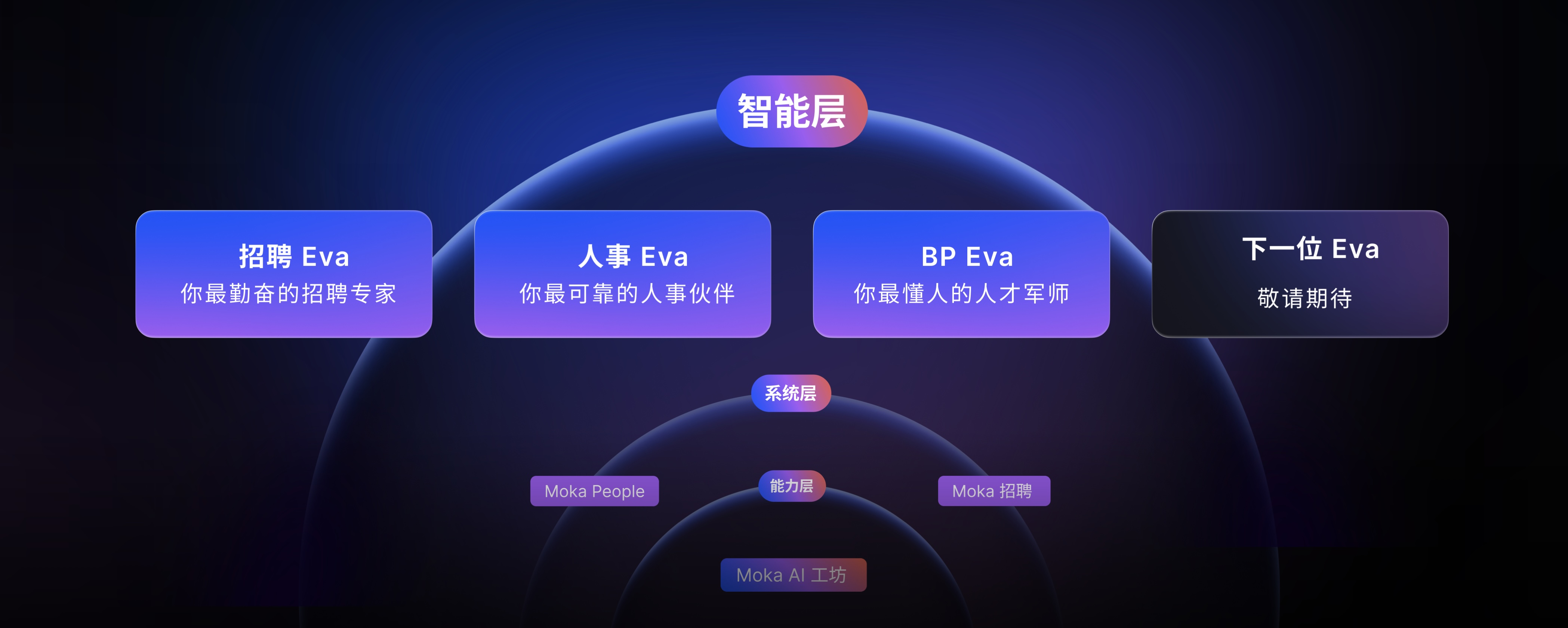
Image source: Moka
Team Introduction
Li Guoxing, the co-founder and CEO of Moka, obtained a dual bachelor's degree in computer science from Shanghai Jiao Tong University and the University of Michigan, and later a master's degree in computer science from Stanford University. He has worked at Facebook and the intelligent data monitoring company SignalFx. In 2015, he returned to China to found Moka and led the company to start with a recruitment management system, gradually introducing AI Agents into HR scenarios such as recruitment, personnel management, and organizational management.
Financing Progress
Previously, it completed a $100 million Series C financing led by Tiger Global Management. The total financing scale is nearly $150 million.
Products and Business
Last year, the "2025 Annual Talent Migration Report" released by the talent think tank of Maimai High-end Recruitment showed that from January to October 2025, the supply-demand ratio of talents in the new economy industry rose to 2.23, which means that on average, 2.23 job seekers compete for one position, and the competition on the job-seeking side has further intensified.
The employment demand on the enterprise side is also picking up. The report shows that since June 2025, the number of newly issued positions in the new economy industry each month has exceeded the same period last year. Among them, the number of AI positions has increased by 11 times in a single month, and the number of overseas-related positions has increased by 16.99%.
On the one hand, the pressure of talent competition is intensifying, and on the other hand, the demand for positions is rising. The talent matching problem faced by enterprises has become more complex. For HR, the work is not only to find suitable candidates more quickly but also to understand the employment needs behind the business strategy and continuously handle issues such as employee communication, talent retention, and organizational adjustment.
Li Guoxing, the co-founder and CEO of Moka, pointed out that the current work of HR is long occupied by a large number of transactional processes, and there is not much time that can be truly invested in talent strategy, organizational design, and employee communication.
Facing the more frequent and complex talent flow and management needs, AI tools have space to enter the scenarios of recruitment, personnel management, and talent management.
The Recruitment Eva, Personnel Eva, and BP Eva products released this time correspond to the three core scenarios of recruitment, personnel management, and talent management respectively. Li Guoxing hopes that through these three products, a part of the repetitive, trivial, and process-oriented work can be handed over to AI, allowing HR to return to more valuable organizational work.
Recruitment Eva is mainly for the recruitment process. It is not only responsible for tasks such as resume screening and interview minutes but also runs through the links of resume understanding, candidate search, initial screening, interview appointment, interview feedback, and offer promotion.
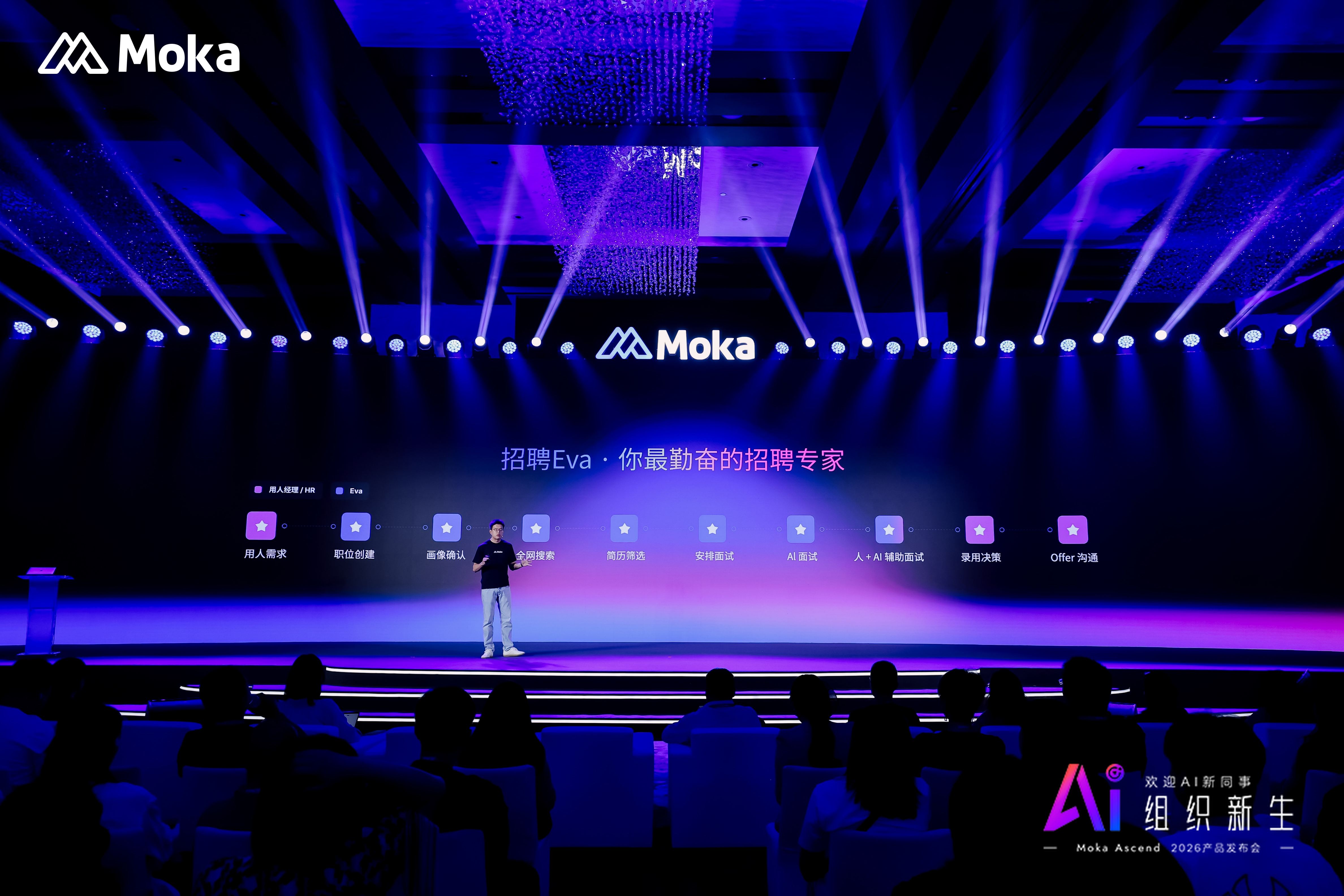
Image source: Moka
In the recruitment scenario, Eva's specialty lies in its memory and calibration capabilities. The recruitment of many enterprise positions is not a one-time need but a long-term and continuous process. Recruitment Eva can continuously understand the enterprise's employment preferences, position profiles, and judgment criteria in this process and dynamically adjust them based on the feedback such as the initial screening and interview results of candidates.
For example, when some candidates are eliminated in the initial screening stage or considered unsuitable after the interview, this information can be used to help Eva calibrate the position profile and gradually understand the preferences of the enterprise, department, or even individuals.
Recruitment Eva also has the function of an "interview coach". In a video interview, it can read the interview content in real-time, provide follow-up questions for the interviewer, and generate interview minutes and interview quality reports after the interview.
Personnel Eva is for more frequent and repetitive personnel affairs, mainly dealing with data reports, daily transaction processes, employee consultations, etc., including information entry after employee onboarding, verification of vacation, attendance, and salary data, generation of work schedules, process automation, and data inspection. Li Guoxing said that Personnel Eva can undertake 70%-80% of HR's repetitive transactional work.
BP Eva is for talent management and organizational decision-making. Compared with Recruitment Eva and Personnel Eva, it does not deal with specific processes but is better at "understanding people's needs". Moka hopes to build dynamic talent profiles through BP Eva to help enterprises identify employees' abilities, position matching, and potential development risks.
Traditional talent management mostly relies on quarterly, semi-annual, or annual inventories, which have a long cycle and are prone to lag. The role of BP Eva is to read data such as meeting minutes and documents under the premise of authorization, dynamically update employee profiles, and help HR timely discover changes in employee status, position matching, and potential turnover risks.
The underlying capabilities of the three Eva products come from the Moka AI Workshop. It can undertake the personalized needs of different enterprises, transform business language into specific capability configurations, and reduce the uncertainty after deployment through functions such as sandbox pre - rehearsal, archiving, and rollback.
In Moka's view, for enterprise users, the way of using the HR system may change in the future. In the past, people operated processes in the system, and in the future, it may more likely become directly talking to Eva, assigning tasks, and receiving reminders in familiar office software.
Founder's Thoughts
- After AI takes over process-oriented work, the value of HR will return more to people and the organization itself
The emergence of AI HR will directly change the working mode of HR. In the past, a large part of HR's time was occupied by daily work such as recruitment promotion, onboarding and offboarding processes, employee communication, personnel data, and BP affairs. Although enterprises often discuss talent strategy and organizational construction, in actual work, it is difficult for HR to truly invest a large amount of time in these more valuable things.
When transactional work is shared by AI, the role of HR in the future will be more inclined to two types of work.
The first is to become a trust builder. Whether employees are willing to express their true thoughts and communicate their status essentially depends on the trust between people, which is still difficult to be completely handed over to AI.
The second is to become an architect of talent and organization. For example, based on the company's business direction, strategic focus, and organizational status, judge whether the talent structure is reasonable and whether the organization needs adjustment. Such decisions involving direction judgment and organizational design still need to be jointly completed by the HR in - charge and the management.
- Recruitment, personnel management, and BP are the three types of scenarios where HR Agents are most likely to be implemented
From past experience and product capabilities, recruitment, personnel management, and BP are the directions that are most easily penetrated by AI Agents and have the most implementation value.
Recruitment is a long - standing need for most enterprises, and the process is relatively cumbersome. In an enterprise, the recruitment team often has the largest number of people in the HR team. Recruitment not only involves resume screening but also includes understanding position requirements, candidate search, interview appointment, interview feedback, and offer promotion.
In the past, these links needed to be connected manually by HR, and the value of the Agent lies in that it can connect these scattered tasks and push the process forward.
Personnel affairs are another type of scenario suitable for Agent intervention. It is characterized by high frequency, repetition, many details, and no room for error. For example, vacation, attendance, salary, work schedules, onboarding and offboarding processes, employee consultations, etc. For HR, this type of work takes up time but is difficult to reflect its value.
Although the rules of each enterprise are different, once the rules enter the system, AI can assist in handling these problems according to the configuration, saving HR's time.
BP corresponds to talent and organizational issues, which are also the parts that CEOs and the top HR executives care more about. It is not like recruitment and personnel management, which focus more on processing processes, but tries to answer questions such as "whether people match the positions", "whether employees have development risks", and "which people in the organization need to be noticed".
- AI HR makes it easier to objectively evaluate and see the value of employees
Employees' ability growth, collaborative performance, learning ability, and position matching situation will leave traces in daily work. If this information can be digitized, structured, and read by AI, the highlights of employees may be discovered earlier.
In the past, employees' performance often highly relied on the subjective evaluation of managers. If a leader understands and recognizes someone, his contributions may be more easily noticed; if an employee is not good at expressing or does not match the style of the direct manager, he may be buried in the organization.
If AI can read more objective work data such as documents, meeting minutes, project progress, performance results, codes, and CRM records under the premise of authorization, it has the opportunity to identify the real contributions of employees from more dimensions. In this way, the organization's judgment of people will not only rely on a single report, the evaluation of a certain leader, or short - term talent inventories.
For some employees, they may even be willing to open more work data to let AI help the organization see their real value. However, the core premise of the compliant opening of data is still to clarify the scope of authorization and the boundaries of use.
- AI Agents will weaken the boundaries of positions and increase the demand for "super individuals"
After the emergence of AI HR Agents, the enterprise's demand for people will also change. In the past, organizations emphasized clear division of labor, such as technology being responsible for technology, products being responsible for products, and operations being responsible for operations. However, after the popularization of AI tools, the threshold for obtaining many professional skills is decreasing, and the boundaries between positions will become more blurred.
In the future, what may be more needed are "super individuals" who can complete end - to - end work with the help of AI. For example, technical personnel should not only be able to write codes but also have product awareness and user awareness; product managers should not only write requirement documents but also understand technology and be able to use AI Coding tools to build demos.
AI makes some specific skills easier to call, so people's judgment, taste, and cross - field understanding ability are more important.
Such people usually have several characteristics: they have a certain understanding of surrounding fields, are good at using AI, are willing to use AI to complete work they couldn't do before, and have judgment criteria and aesthetic ability.
- The key to an AI - native organization is not only to launch new AI tools but also to reshape the way of collaboration
There is a judgment formula for an AI - native organization: AI talent density × AI organizational collaboration depth. The former refers to how many people in the organization can really use AI, and the latter refers to the extent to which the organization can involve AI in collaborative work. The combination of the two jointly constitutes the competitiveness of the enterprise organization.
The so - called AI talent density means that when employees encounter problems, they will first think about whether this thing can be completed by AI instead of following past experience and inertia.
The more experienced people are, the more likely they are to be restricted by past working methods. For example, people who are originally good at Excel analysis may still be used to building tables, writing formulas, and doing analysis by themselves instead of directly giving the raw data to AI and letting AI complete the analysis according to the goal.
The AI organizational collaboration depth requires the organization to digitize and structure more information so that AI can read and call it. For example, if meeting minutes, documents, project progress, business data, etc. only stay in offline communication or personal experience, it is difficult for AI to truly participate in the organizational operation. Only when key work is recorded, precipitated, and allows AI to give suggestions or even execute directly can the Agent truly enter the organizational process.
In internal practice, the impact of AI on the working mode has begun to appear. For example, product managers can use AI to build demos without the help of technical colleagues; technical colleagues no longer strictly distinguish between front - end, back - end, and algorithms but use AI Coding tools to complete a more complete task closed - loop. Team members are more like "super individuals", and the organizational hierarchy will also be compressed.
However, the difficulty of full - scale AI implementation is not only the tools but also the organizational inertia and people's work habits. The resistance to the special pilot implementation of the AI team is smaller because the members selected are more excited about new tools and products. But to make the whole company change the original working mode, it is necessary to continuously fight against inertia.
Such changes show that the difficulty of an AI - native organization is not only to introduce new AI tools but also whether the organization has the ability to break inertia and redesign the work process.