Among the 5,385 A-share listed companies, how much information can be gleaned from their 2025 annual reports?
On April 30, 2026, the disclosure of the annual reports of A-share listed companies for the year 2025 officially came to an end. A total of 5,385 non-financial enterprises presented their annual report cards, which means that China's capital market has once again entered the annual "grading" period. In the eyes of accounting scholars, financial report data is never just cold numbers but an accurate reflection of a company's business essence, serving as strong evidence for evaluating a company's value. Chen Shimin, a professor of accounting at China Europe International Business School (CEIBS), will lead you to understand the truth behind the 2025 annual reports from the "golden triangle" of ROE (Return on Equity), growth, and cash flow.
Looking at the annual performance of 5,385 non-financial enterprises, the total annual revenue reached 63.5 trillion yuan, a year-on-year increase of 0.9%; the total net profit attributable to shareholders was 2.5 trillion yuan, a year-on-year decrease of 1.8%.
The weak recovery at the aggregate level and the continuous pressure on the profit side have created a divergence, which means that we must look beyond the surface data of revenue scale and penetrate the financial report appearance to examine the real profit quality and value core of enterprises.
I often say in class that what truly determines whether an enterprise can cross the cycle and achieve long-term value are always three core pillars - ROE, growth, and cash flow.
ROE answers the question of "whether the enterprise can make money and how it makes money" at present; growth determines whether the enterprise can "continue to grow in the future, whether it is effective expansion or ineffective involution"; cash flow tests whether the enterprise's profit is "real money or just book figures", and safeguards the safety bottom line for survival and development. These three elements form the "golden triangle" for enterprise value assessment, and together they become the core yardstick for us to penetrate the fog of financial reports and identify the core of enterprises.

ROE: The Truth Behind the Divergence in Enterprises' Profitability
ROE is the core indicator for measuring an enterprise's ability to create returns for shareholders. Its essence is the efficiency of an enterprise in using net assets to generate profits.
The classic DuPont analysis method breaks it down into three dimensions: net profit margin, asset turnover, and equity multiplier, accurately revealing the underlying logic of an enterprise's profitability - whether it earns high profits through brand and technological barriers, achieves high turnover through supply chain efficiency, or leverages returns through leverage. This is the core yardstick for distinguishing whether an enterprise is a "value creator" or a "capital consumer".
Median ROE
After sorting out the data, we found that in 2025, the median ROE of all A-shares (excluding the financial industry) was 4.2%, continuing the downward trend from 2024.
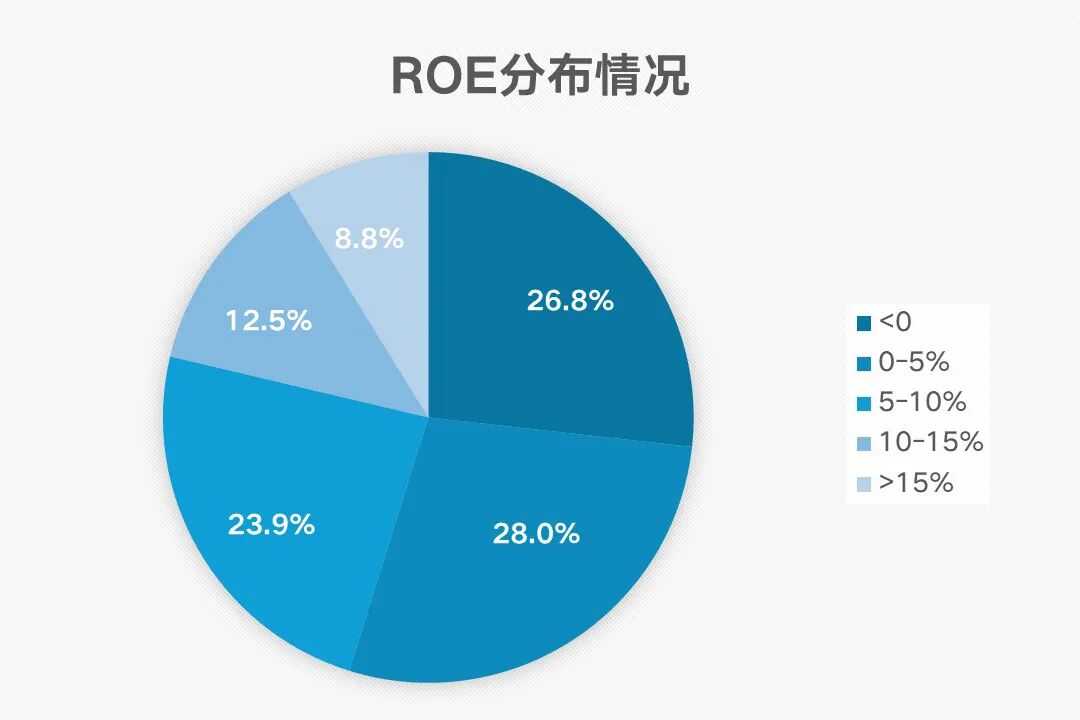
In terms of enterprise distribution, the "pyramid" feature of the profit structure has further intensified: more than 54% of enterprises have an ROE of less than 5%, which means that the returns for shareholders of more than half of non-financial listed companies are difficult to cover the opportunity cost of funds, and the long-term returns for shareholders are under pressure; while high-quality enterprises with an ROE of more than 15% only account for 8.8%, and the leading effect continues to be prominent, with market profit resources concentrating on leading enterprises with core barriers.
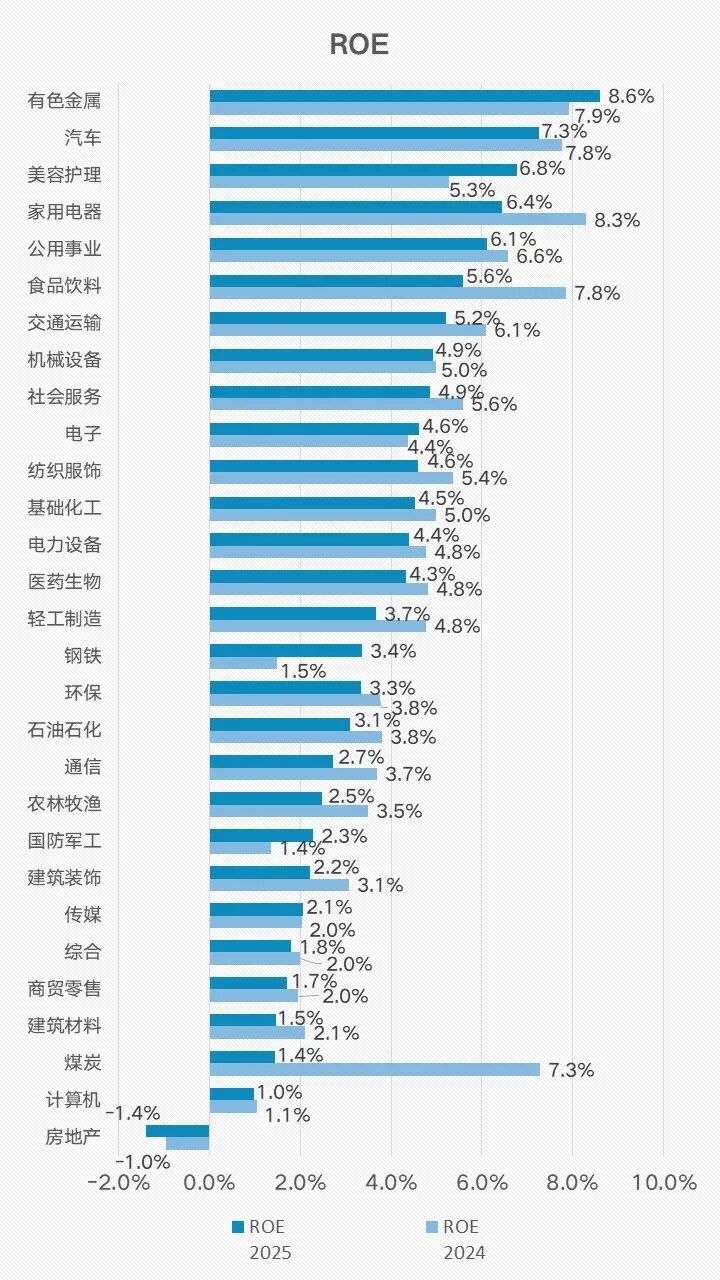
From the perspective of DuPont decomposition, the median net profit margin attributable to shareholders of non-financial enterprises in the entire market decreased from 4.7% in 2024 to 4.2%, while the asset turnover and equity multiplier remained stable. This clearly shows that the core drag on the decline of enterprises' ROE in 2025 mainly comes from the contraction of profitability, rather than significant changes in overall turnover efficiency or leverage level.
Against the background of weak demand and cost pressure, the phenomenon of "it's harder for enterprises to make money" has become common. The profit-driven logic is shifting from simply relying on scale expansion, turnover efficiency, and leverage dividends to a more emphasis on net profit margin competition through technological barriers, brand premiums, and cost control.
ROE Data from an Industry Perspective

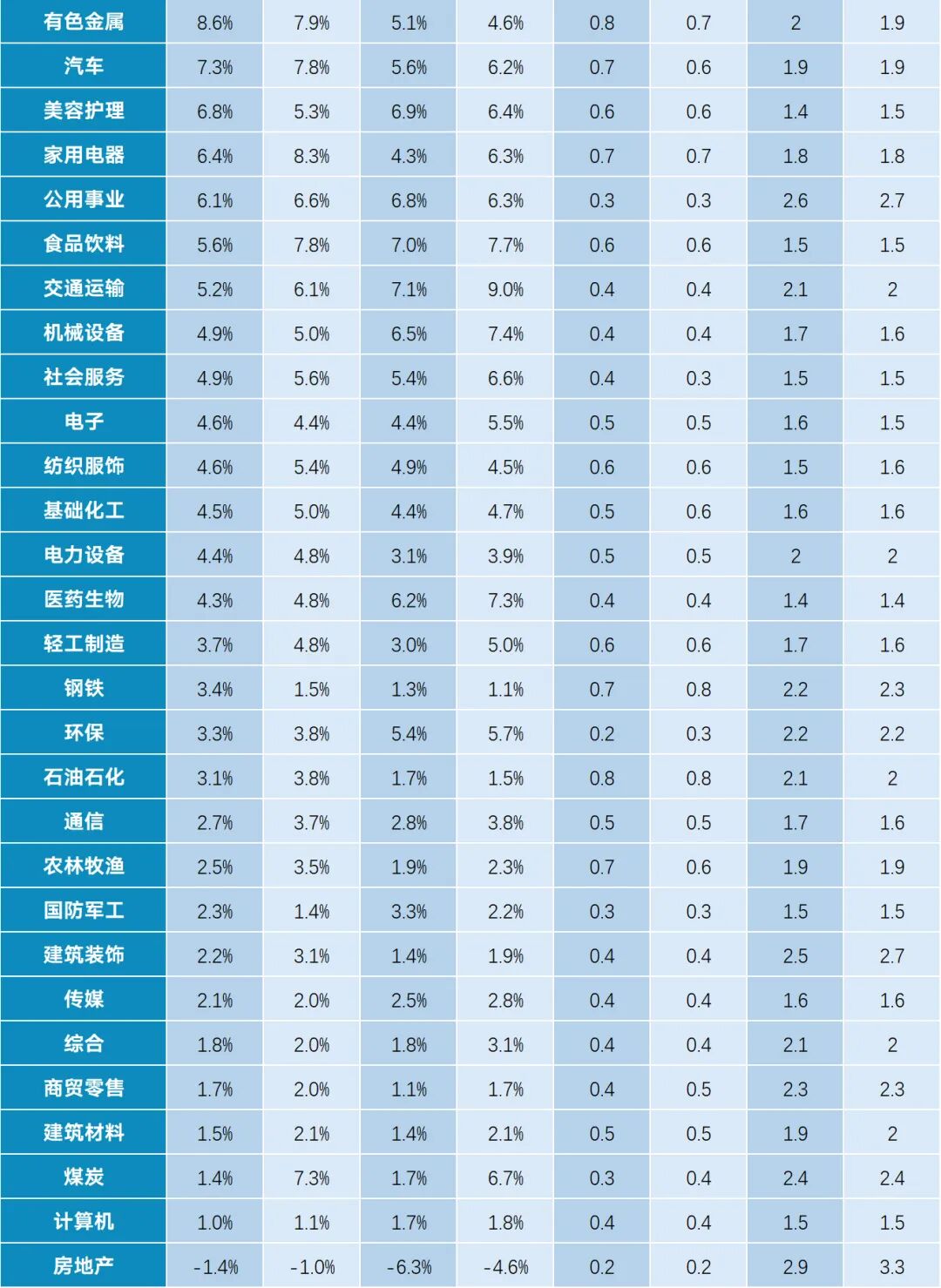
(*All data are medians; **All A-shares excluding the financial industry; ***Industry classification is Shenwan Industry Classification 2021, the same below)
When we break down the ROE data from an industry perspective, we can clearly see the trend of industrial profits in 2025, which is the core of the divergence truth.
The non-ferrous metals industry topped the list of non-financial industries in the entire market with an ROE of 8.6%, an increase from 7.9% in 2024, becoming the only industry in the entire market with an ROE of more than 8%. From the perspective of DuPont decomposition, its net profit margin increased from 4.6% to 5.1%, and its asset turnover increased from 0.7 to 0.8, achieving a double improvement in profit thickness and operational efficiency. The core drivers behind this are that in 2025, precious metal prices repeatedly hit new highs, the supply and demand of industrial metals remained in a tight balance, and the demand for new energy metals recovered. Coupled with the revaluation of resource value brought about by the global macro-loose expectations and geopolitical turmoil, leading enterprises achieved an improvement in profits with both volume and price increases through their advantages in industrial chain integration.
The ROE of the beauty and personal care industry increased from 5.3% to 6.8%, becoming the only track in the consumer sector that increased against the trend. Leading enterprises in the industry maintained their profitability through brand premiums and product structure optimization, and their asset turnover remained relatively stable, showing strong resilience in the weak consumer recovery.
The ROE of the steel industry doubled from 1.5% to 3.4%, achieving a profit recovery at the bottom of the cycle, mainly due to the decline in raw material and fuel costs, the strengthening of cost control by some enterprises, and the support of export demand; however, the demand from the downstream real estate chain was weak, and the industry's supply and demand pattern had not been fundamentally improved.
The ROE of the national defense and military industry increased from 1.4% to 2.3%. Although the absolute value is still in the middle and lower reaches of the industry, the profit margin has significantly improved. The core driver is that the net profit margin increased from 2.2% to 3.3%. Against the background of the concentrated release of equipment orders and the breakthrough in the localization of core technologies, the industry's profitability has continued to improve, and the long-term growth logic has been gradually realized.

In contrast, many traditional high-profit tracks have completely entered a downward channel in the wave of "it's harder to make money", under pressure from both the ebb of the cycle and the collapse of demand.
The ROE of the coal industry significantly dropped from 7.3% in 2024 to 1.4%, becoming the industry with the most severe profit decline in the entire market. The core driver is that the annual average price of thermal coal decreased significantly year-on-year. Behind this is the continuous release of production capacity under the long-term coal supply guarantee mechanism in China, and the demand for coal-fired power has been affected by the substitution of new energy power generation. The industry's supply and demand pattern has shifted from a tight balance to a loose one, directly leading to a sharp drop in the industry's net profit margin from 6.7% to 1.7%. Coupled with the slowdown in asset turnover efficiency, the high-profit cycle of the industry has officially ended.
The ROEs of the household appliances and food and beverage industries, two traditional consumer blue-chip tracks, dropped from 8.3% and 7.8% to 6.4% and 5.6% respectively, and the profit center has continued to decline. The core reason is the weak consumer demand and the intensification of price wars in the industry. Enterprises are forced to give up profits to maintain market share, resulting in a continuous contraction of the net profit margin, and the once high-profit barriers have loosened.
The ROE of the real estate industry further dropped from -1.0% to -1.4%, becoming the only industry in the entire market with a negative ROE. The net profit margin of -6.3% and the high equity multiplier of 2.9 form a risk closed-loop of "high leverage - deep losses". Although the industry has actively started to de-leverage, and the equity multiplier has dropped from 3.3 to 2.9, under the collapse of terminal demand, the profit side has continued to deteriorate, and the industry clearance is still in progress.
Growth: Who is Growing Effectively and Who is in Ineffective Involution?
Growth is never simply the expansion of revenue scale. It is the key watershed for distinguishing between an enterprise's "continuous evolution" and "gradual decline": Is it effective growth with a simultaneous increase in net profit, or ineffective involution of "increasing revenue without increasing profit"; is it sustainable growth driven by R & D investment, or short-term expansion built on capital expenditure; is it structural growth in the core track, or the cyclical dividend of industry-wide growth.
Top 10 in Revenue Growth
In terms of total revenue, in 2025, a total of 18 industries achieved positive growth, and the growth momentum has fully concentrated on tracks related to new-quality productivity. The technology, high-end manufacturing, and strategic resource industries ranked at the top of the revenue growth list, while most traditional consumer and cyclical industries have fallen into growth stagnation.
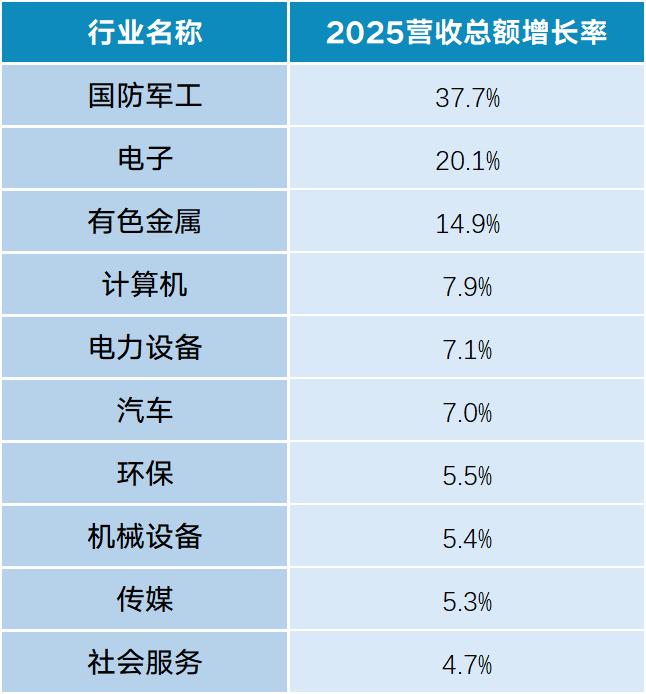
The top 3 in revenue growth are all tracks that are in line with national strategies or have hard technology attributes, showing double-digit growth. Among them, the national defense and military industry led the entire market with a growth rate of 37.7%. The core reason is related to the continuous increase in national defense budgets, investment in equipment modernization, and the improvement of the order delivery rhythm of some enterprises.
The electronics industry followed closely with a growth rate of 20.1%. The core driver is the continuous explosion of AI computing power demand, which has driven the high growth of demand in core sectors such as semiconductor chips, optical modules, and AI hardware.
The non-ferrous metals industry ranked third with a growth rate of 14.9%. The revaluation of resource product values has driven the steady expansion of the industry scale. The double-digit growth of these three tracks confirms that national strategic guidance and hard technology attributes are becoming the core engines of industrial growth.
Top 10 in Net Profit Growth
In terms of the total net profit attributable to shareholders, in 2025, a total of 12 industries achieved positive growth. The net profit growth rates of each track are significantly different, and the quality difference in industry growth has further widened.
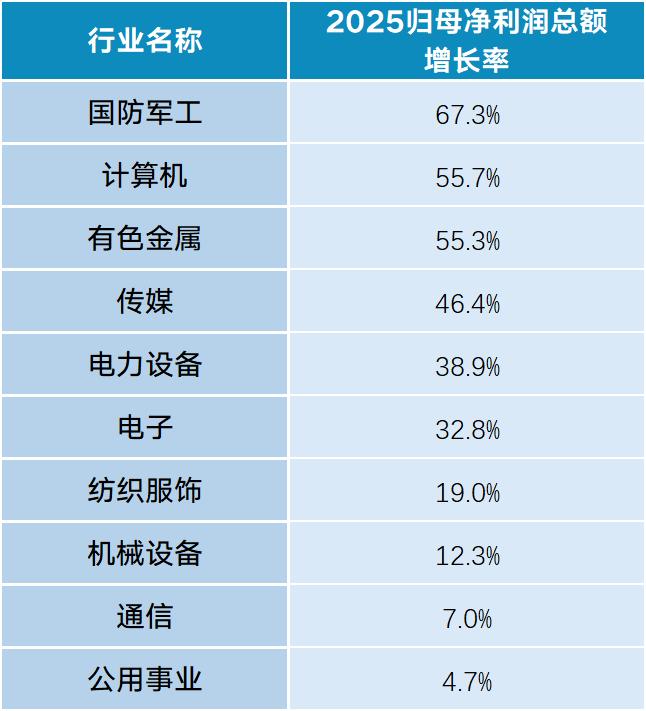
The technology track has achieved a virtuous cycle of "high revenue growth + even higher profit growth". The net profit growth rates of the national defense and military, computer, and electronics industries far exceeded their revenue growth rates, highlighting the golden stage of scale effect release in the profit gap.
In contrast, the trap of ineffective growth of "increasing revenue without increasing profit" has also continued to emerge. The social services industry, which has been among the top 10 in revenue growth for two consecutive years, has never made it onto the net profit growth list. While the cultural and tourism consumption scenarios have recovered, the increase in labor compensation and rent costs, combined with the intensification of industry involution, and the aggressive expansion of some enterprises has pushed up management costs, ultimately leading to the dilemma of "the more the revenue increases, the thinner the profit becomes".
Top 5 in R & D Investment
High R & D investment is the core strategic investment for enterprises to build technological barriers and cultivate a second growth curve. The R & D intensity of emerging industries is significantly higher than that of traditional industries, and the synergistic effect between R & D investment and performance growth is becoming more and more prominent.
