After going through the "ICU", NIO is finally reliable for once.
NIO (NIO.US) released its Q1 2026 financial report before the U.S. stock market opened and after the Hong Kong stock market closed on May 21, 2026, Beijing time. Despite the traditional off - season, NIO still demonstrated good profit resilience. Specifically:
1. Vehicle sales revenue was slightly lower than expected but still showed high year - on - year growth: In Q1, NIO's vehicle sales revenue was 25.5 billion yuan, slightly lower than the market expectation of 26 billion yuan. However, it still achieved a 112% year - on - year growth.
The revenue was lower than expected mainly because the average selling price per vehicle this quarter was 273,000 yuan, slightly lower than the expected 277,000 yuan. But compared with the previous quarter, it increased by 20,000 yuan. This was still because the high - priced ES8 accounted for more than half of the vehicle model structure in Q1, driving up the average selling price per vehicle.
2. The gross profit margin of vehicle sales continued to increase marginally, showing an "off - season that's not off": In Q1, NIO's gross profit margin of vehicle sales was 18.8%. Despite the negative impact of the weakening scale effect and rising procurement costs, NIO still maintained a high gross profit margin level.
Moreover, in terms of trend, it increased by 0.7 percentage points quarter - on - quarter, also higher than the market expectation of 18.2% and the company's previous guidance that the gross profit margin of vehicle sales in Q1 would be the same as that of the previous quarter. This was still due to the improvement of the vehicle model structure, which offset the negative impact of the weakening scale effect and rising raw material costs on the cost side.
3. The control of the three major expenses was reasonable, and cost reduction and efficiency improvement were still in progress: In Q1, affected by the off - season of sales (NIO's delivery volume decreased by 33% quarter - on - quarter to about 83,500 vehicles), the management previously expected a small operating loss in Q1.
However, due to the company's better - than - expected gross profit margin and the continued reduction of R & D expenses (down to 1.9 billion yuan, lower than the market expectation and the company's guidance), the final loss was still better than the market expectation:
The operating profit in Q1 was - 300 million yuan, better than the market - expected loss of 1 billion yuan; the operating profit margin was - 1.2%, although it decreased by 3.5 percentage points quarter - on - quarter, it was also better than the market expectation of - 3.8%.
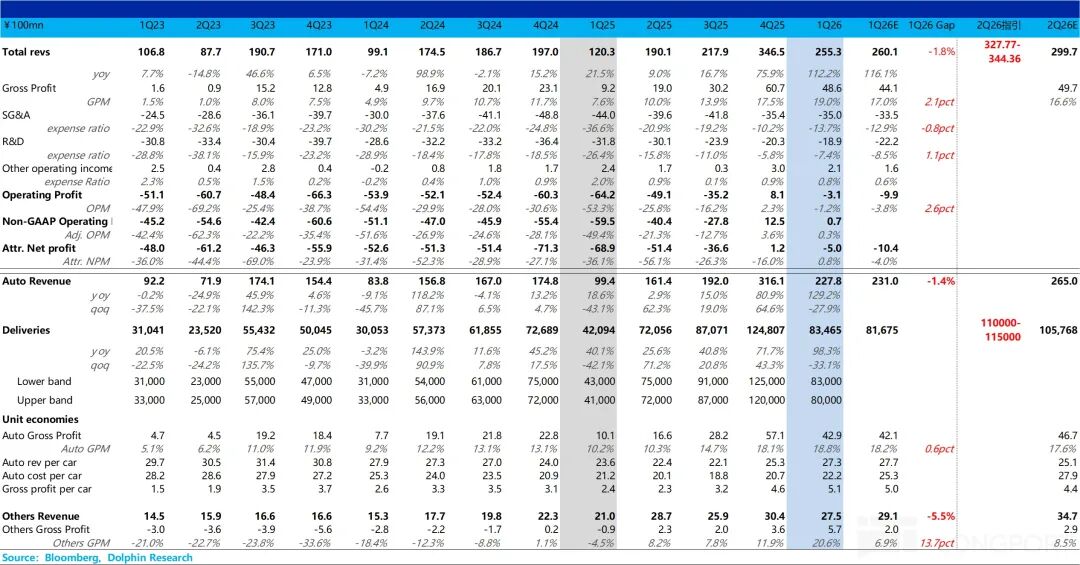
Overall, NIO's financial report in Q1 was good. Although the revenue was slightly lower than expected, it still maintained a high gross profit margin level in the off - season. The core reason was that the strong sales of the high - priced ES8 effectively supported the gross profit margin, offsetting the negative impact of the weakening scale effect and rising procurement costs. The continuous cost reduction and expense control provided more room for the profit side, and the final loss was also slightly better than expected.
What's more important than this performance is the guidance for Q2. Especially when NIO has two blockbuster models, ES9 and LeDao L80, about to start delivery in May, the optimistic sales and revenue guidance for Q2 also implies that these two new models have good order volumes. Specifically:
① The sales guidance for Q2 is 110,000 - 115,000 vehicles, better than the market expectation of 106,000 vehicles. Against the background of only about 29,400 vehicles delivered in March, this guidance implies that the average monthly delivery volume in May and June needs to reach 40,000 - 43,000 vehicles, which is a quite strong level.
It's worth noting that the delivery cycle of the previous blockbuster model ES8 has been shortened from 4 - 5 weeks in March to 2 - 4 weeks in April, indicating that the backlog of existing orders is being quickly digested.
Therefore, the better - than - expected incremental volume in Q2 mainly comes from the two new models ES9 and L80 (followed by the updated 5566 model), which directly confirms that these two models currently have sufficient order reserves and the delivery rhythm can keep up with the order demand.
② The company's guidance for the total revenue in Q2 is 32.9 - 34.4 billion yuan, also significantly exceeding the market expectation of about 30 billion yuan. Both the delivery volume and the average selling price per vehicle guidance exceeded expectations. The implied average selling price per vehicle in Q2 can still reach about 270,000 yuan, basically the same as that in Q1 (273,000 yuan).
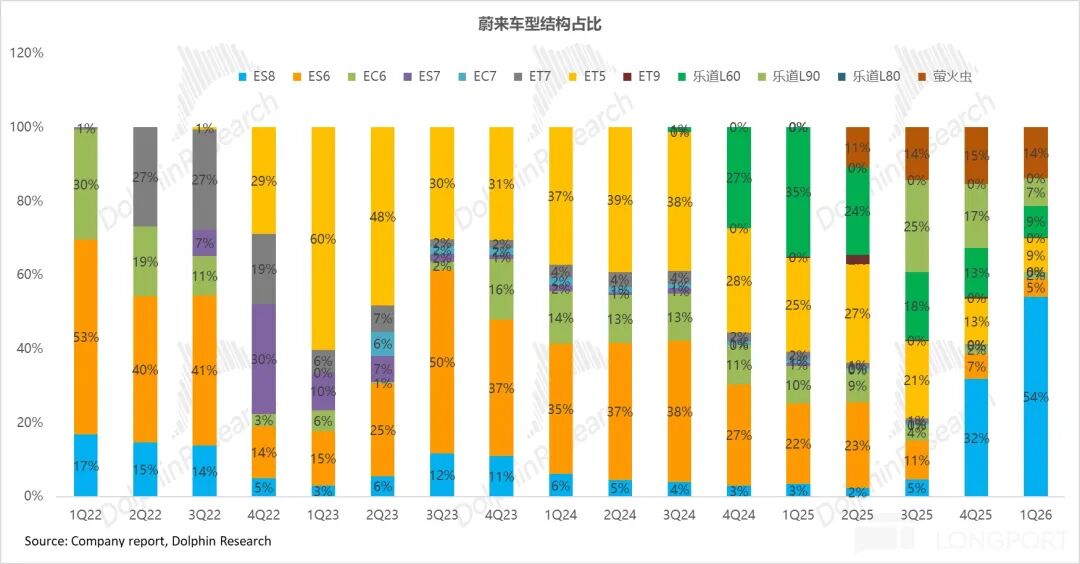
Considering that the ES8 accounted for 54% of the vehicle model structure in Q1, and currently the existing orders and delivery volume of the ES8 are both decreasing quarter - on - quarter, the key to maintaining a high average selling price in Q2 will be the higher - priced ES9, which also reflects the management's sufficient confidence in the monthly delivery volume of the ES9.
Once the ES9 (pre - sale price: 528,000 - 658,000 yuan) can achieve a stable monthly sales volume of more than 5,000 vehicles, NIO's gross profit margin is expected to continue to maintain a high level. The optimization of the vehicle model structure brought by the higher - priced ES9 will effectively offset the pressure of rising BOM costs.
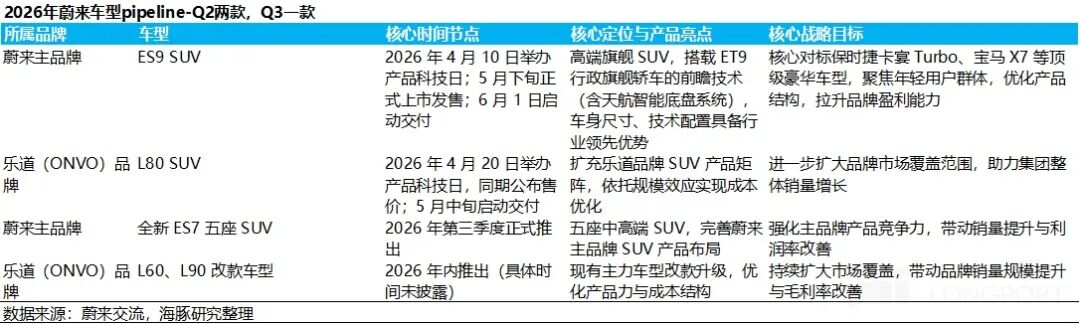
Looking at the whole year of 2026:
The management previously gave an optimistic guidance of a 40% - 50% year - on - year increase in sales volume in 2026 (about 456,000 - 490,000 vehicles), with confidence coming from the product boom starting from Q2:
NIO ES9 (officially launched and delivered on May 27): A 5.4 - meter new flagship, with the core technology of ET9 being applied. Currently, the pre - sale price is 528,000 - 658,000 yuan. According to dealer research, the refundable orders (with a deposit of 5,000 yuan) across the country are expected to reach about 40,000 units.
The ES9 still takes the ultimate riding space (large body size, providing first - class cabin - level riding experience) and luxurious interior and exterior design (continuing NIO's unique brand aesthetics, highlighting the flagship luxury positioning) as the core selling points. Dealers predict that the stable monthly sales volume of this model will exceed 5,000 units, and it is expected to replicate the success of the ES8.
LeDao L80 (launched and delivered on May 15): As the five - seat version of the L90, with a price range of 242,800 - 279,800 yuan, it accurately activates the incremental market in the 200,000 - 250,000 - yuan level with a lower threshold.
NIO ES7 (to be released in Q3): The five - seat version of the ES8, further consolidating the high - end market base.
For the existing models, NIO has launched updated versions of the previously popular 5566. The successful ES8 in 2025 will contribute a full 12 - month sales volume in 2026. At the same time, LeDao L60 and L90 will also launch updated versions.
Therefore, it can be seen that NIO's vehicle pipeline in 2026 is relatively strong, which is also the source of the management's confidence in guiding the high - growth sales volume in 2026. The company's strategic center has also obviously shifted to "large SUVs" and "high - endization".
Against the background that the new - energy vehicle market in 2026 is dragged down by the phase - out of purchase tax incentives (the expected growth rate is only 5% - 15%), NIO's BaaS model advantage is prominent. Since the battery is not included in the purchase invoice, it significantly reduces the tax - base price. This means that among the same - level competitors, NIO users can bear lower purchase tax, effectively offsetting the macro - level risk of the phase - out of incentives.
Similarly, regarding the gross profit margin and net profit margin, NIO has lowered its guidance for the annual gross profit margin in 2026, but still maintains the guidance of turning the Non - GAAP operating profit positive:
Although since Q2, the industry generally faces the pressure of rising raw material costs such as memory chips, lithium carbonate, NCM, copper, and aluminum, with an average cost impact of more than 10,000 yuan per vehicle.
However, the company's annual target for the gross profit margin of the whole vehicle is still 17% - 18% (although it has been lowered compared with the previous target of 20%), which will be achieved through three measures: First, further increase the product portfolio proportion of high - price and high - gross - profit models such as ES8 and ES9; second, adhere to stable pricing and promotion policies for medium - gross - profit models, and not sacrifice gross profit for sales volume; third, cooperate deeply with supply - chain partners to promote engineering improvements, efficiency enhancements, and business negotiations to jointly digest cost pressures.
In terms of expenses, NIO is also strictly controlling them: NIO expects that the annual R & D expenditure in 2026 will be the same as the annualized level in Q4 2025 (Non - GAAP R & D investment of 2 - 2.5 billion yuan per quarter), and the proportion of sales and management expenses to revenue will be reduced to about 10%. With the combined effect of increased sales volume, improved gross profit margin of the whole vehicle, and strict control of R & D and sales and management expenses, NIO is expected to turn the Non - GAAP operating profit positive in 2026.
With the combined effect of increased sales volume, improved gross profit margin of the whole vehicle, and strict control of R & D and sales and management expenses, NIO is expected to achieve annual profitability in 2026.
Overall, Dolphin Research believes that although NIO's sales are still under pressure due to the industry off - season in this quarterly report, the resilience of the average selling price and gross profit brought by the optimization of the product structure has become more prominent. However, the gross profit margin may still face significant pressure in Q2 (the impact of rising raw material prices begins to show in Q2).
Regarding the annual sales volume in 2026, although NIO can enjoy a certain buffer from the BaaS model against the phase - out of purchase tax incentives, and its vehicle pipeline (ES9, L80, ES7, etc.) is relatively strong, against the background that the overall new - energy vehicle industry's sales volume is expected to only increase by 5% - 10% year - on - year, we tend to take a wait - and - see approach and remain cautious about the management's guidance of a 40% - 50% year - on - year increase to 456,000 - 490,000 vehicles.
The hope for NIO to break through the market - value ceiling still highly depends on whether the high - gross - profit ES9 and ES7 can achieve high sales volume. The former determines the height of the gross profit margin, and the latter determines the sales volume scale and revenue volume. If both can be realized, NIO's profit inflection point and valuation reshaping will have a solid foundation.
The following is a detailed analysis
I. The gross profit margin of vehicle sales shows an "off - season that's not off"
As the most critical indicator every time the financial report is released, let's first take a look at NIO's vehicle - selling profitability:
NIO previously guided that since the delivery proportion of the high - priced NIO ES8 in the vehicle model structure continued to increase significantly in Q1 (the gross profit margin of the ES8 exceeded 20%), it could offset the negative impact of rising costs and shrinking sales volume. Therefore, NIO expected the gross profit margin of the whole vehicle in Q1 2026 to be the same as the 18% in Q4 2025, so the market expectation also reached 18.2%.
Actually, NIO's gross profit margin of vehicle sales this time was 18.8%. Despite the negative impact of the weakening scale effect and rising procurement costs, NIO still maintained a high gross profit margin level, and it also increased by 0.7 percentage points quarter - on - quarter, higher than the market expectation and the previous guidance. This was still due to the improvement of the vehicle model structure, which drove the average selling price per vehicle to continue to rise, offsetting the drag on the cost side.
1) Average selling price per vehicle: The average selling price per vehicle in Q1 continued to improve quarter - on - quarter, mainly driven by the high - priced ES8
In Q1, NIO's average selling price per vehicle was 273,000 yuan, slightly lower than the market expectation of 277,000 yuan, but still significantly increased by 20,000 yuan compared with the previous quarter's 253,000 yuan. The core driver was the continuous sales growth of the popular and high - priced SUV ES8 (priced at 406,800 - 456,800 yuan).
Although the ES8 ordered in Q4 and Q1 enjoyed discounts of 15,000 yuan and 10,000 yuan respectively, the proportion of the ES8 in the vehicle model structure increased by 22 percentage points quarter - on - quarter to 54% (more than half of the total delivery volume), which not only drove up the overall average selling price per vehicle but also effectively offset the negative impact of promotions on the ASP.
Meanwhile, the proportion of the high - priced NIO brand's overall sales volume also increased by 16 percentage points quarter - on - quarter to 70%, further strengthening the upward trend of the price structure.
2) Cost per vehicle: It increased quarter - on - quarter, dragged down by the weakening scale effect and rising raw material costs
In Q4, NIO's cost per vehicle was 222,000 yuan, an increase of about 14,000 yuan quarter - on - quarter. This was mainly because the production cost of the high - priced ES8 was higher, and the cost side was also negatively affected by the weakening scale effect and rising raw material costs. However, the overall gross profit margin of vehicle sales still remained at a stable level:
① The scale effect worsened in the Q1 off - season: In Q1, NIO sold 83,500 vehicles. Although it slightly exceeded the upper limit of the guidance, it was still affected by the sales off - season and the phase - out of purchase tax incentives. The vehicle sales volume decreased by 33% quarter - on - quarter, and the scale effect declined. As a result, the cost per vehicle increased.
② The increase in procurement costs had a relatively limited short - term impact: In Q1, NIO still faced the pressure of rising procurement costs for memory chips, raw materials, batteries, etc., but the impact was relatively limited, mainly due to:
a. Long - term contract buffer: NIO's procurement costs are based on long - term contracts, and significant cost changes may only appear in Q2;
b. Inventory advantage