A peer of Unitree Technology is hitting for an IPO, led by a 90s postgraduate of Harbin Institute of Technology. Tencent and Shenzhen Capital Group have taken stakes in it.
After Unitree Technology and Dobot, another robotics company is seeking an A-share IPO.
According to Gelonghui, recently, Leju Intelligence (Shenzhen) Co., Ltd. (hereinafter referred to as "Leju Intelligence") submitted its prospectus to the Shenzhen Stock Exchange, planning to list on the Growth Enterprise Market. Orient Securities is the sponsor.
It is worth mentioning that Leju Intelligence is the first enterprise to choose to use the fourth set of standards for the Growth Enterprise Market to apply for listing. This standard requires the enterprise to "have an estimated market value of no less than 3 billion yuan, an operating income of no less than 200 million yuan in the most recent year, and a compound growth rate of operating income of no less than 30% in the most recent three years."
Leju Intelligence is engaged in the R & D and production of humanoid robots. In 2025, its operating income was 258 million yuan, with a compound growth rate of operating income of over 118% in the past three years. The post - investment valuation after its latest financing was 4.327 billion yuan. However, it is still in a state of loss, and its gross profit margin shows a downward trend year by year.
How is the development of the humanoid robot industry? Let's find out today.
01 The humanoid robot industry has great growth potential and is still in the early stage of commercialization
Since 2025, the global humanoid robot industry has entered an explosive period. Both the number of enterprises and the scale of financing have achieved leap - forward growth.
According to the data of the Humanoid Robot Scene Application Alliance, in the first half of 2025, the number of global humanoid robot body enterprises has exceeded 300, more than half of which are Chinese enterprises.
In 2025, the total financing in the global humanoid robot field exceeded 57.8 billion yuan. The total financing in this field in China and the United States was 27 billion yuan and 28.1 billion yuan respectively, showing an obvious bipolar structure of China and the United States. The Chinese market is mainly characterized by high - frequency, small - and medium - scale financing, while the United States shows the characteristics of low - frequency and large - scale concentrated financing.
At present, the humanoid robot industry has passed the cultivation stage of early basic technology accumulation, and the focus of the industry's development has gradually shifted from technology R & D to market - oriented implementation and commercial value exploration.
2025 is generally regarded as the first year of the industry's commercialization. The delivery volume of humanoid robots in the whole industry has increased significantly, forming a market of billions of yuan.
According to the data released by Omdia, in 2025, the global shipment volume of general embodied intelligent robots was 13,000 units, nearly five times the growth compared with 2024. It is estimated that the shipment volume will reach 2.6 million units by 2035, and the average annual compound growth rate from 2024 to 2035 will be as high as 85%. The industry has great growth potential.
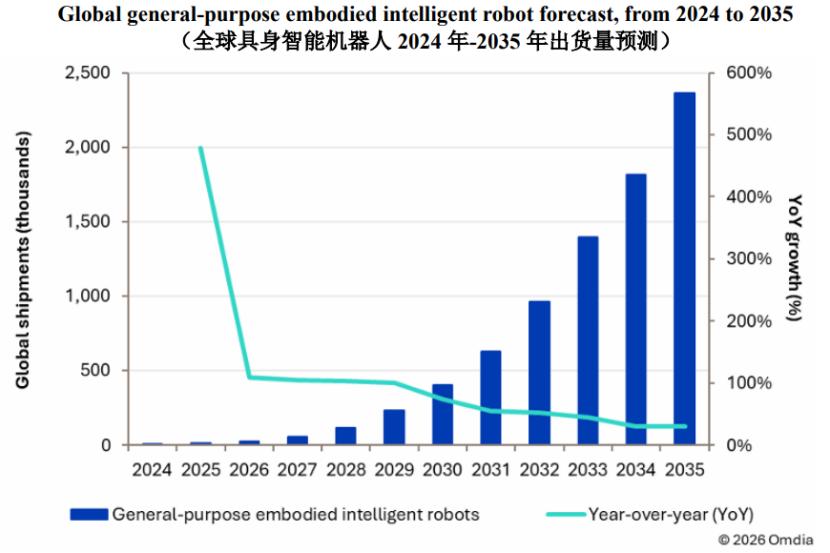
The picture is from the prospectus
The upstream of the humanoid robot industry chain covers hardware components and underlying software systems, including mechanical components, sensing components, control components, and power components. Among them, the actuator (usually including components such as motors, reducers, and drivers) is the core of motion control.
The mid - stream is the design and manufacturing of humanoid robot bodies. In addition to Leju Intelligence, participants also include Boston Dynamics, Unitree Technology, Ubtech, Tesla, Figure AI, Physical Intelligence, Zhiyuan Innovation, and Galaxy General.
The downstream terminal application scenarios include scientific research and education, commercial services, data collection, industrial manufacturing, and household services.
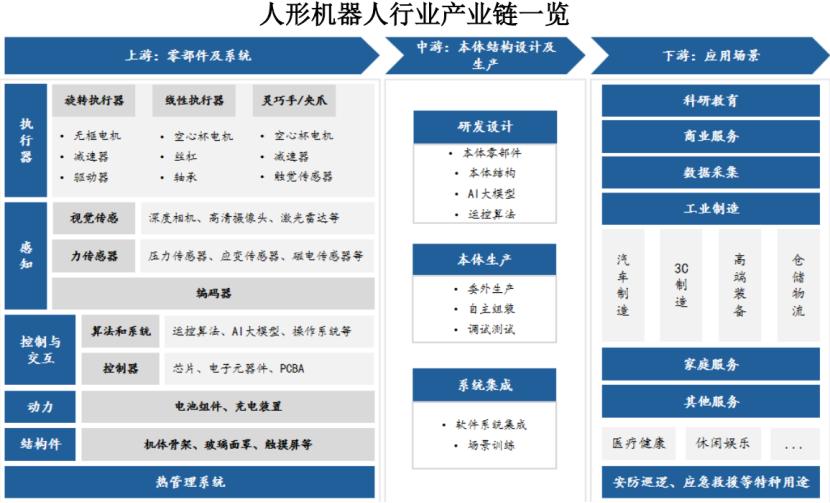
The picture is from the prospectus
The humanoid robot industry is characterized by a complex technical system, a long R & D chain, rapid upgrading and iteration, and difficult product R & D. Currently, the industry is in the early stage of commercialization. Some core technologies are not yet mature, and there is uncertainty in large - scale application.
In the past few years, Leju Intelligence has invested a lot of money in R & D. In 2023, 2024, and 2025 (hereinafter referred to as the "reporting period"), the company's R & D investment was 19.1326 million yuan, 22.8645 million yuan, and 65.0914 million yuan respectively, and the R & D expense ratios were 35.44%, 41.2%, and 25.21% respectively. Its R & D expense ratio is higher than the average level of comparable companies in the same industry.
02 Focus on humanoid robot products and not yet profitable
Leju Intelligence's main product is humanoid robots.
In 2016, the company released its first small - sized humanoid robot, Aelos. In the following years, it successively launched the intelligent teaching aid Pando robot, the intelligent building block kit Cube, and the programming humanoid robot Roban, building a full - stage artificial intelligence programming education product matrix covering preschool education, primary and secondary basic education, vocational education, and higher education.
In particular, after the company launched Kuavo3 in 2023, it started the commercialization path of large - sized humanoid robots.
The prospectus shows that the Kuavo humanoid robot of the company has stable motion performance, accurate action execution ability, and natural human - machine interaction experience. Currently, it has been applied in multiple scenarios such as scientific research and education, commercial services, data collection, and industrial manufacturing.
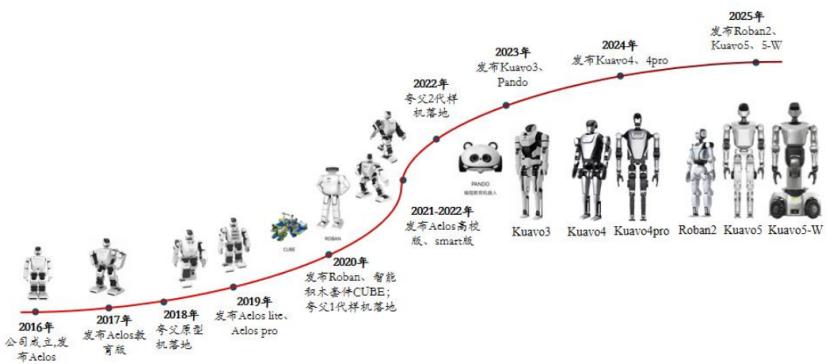
The evolution of the company's main products. The picture is from the prospectus
Currently, full - sized humanoid robot products have become the company's main source of income. In addition to humanoid robots, the company also has other intelligent products for programming education and medical services.
In 2025, the Kuavo series of products contributed 69.5% of the company's revenue. The revenue of the Roban and Aelos series of products accounted for 2.41% and 13.01% respectively.
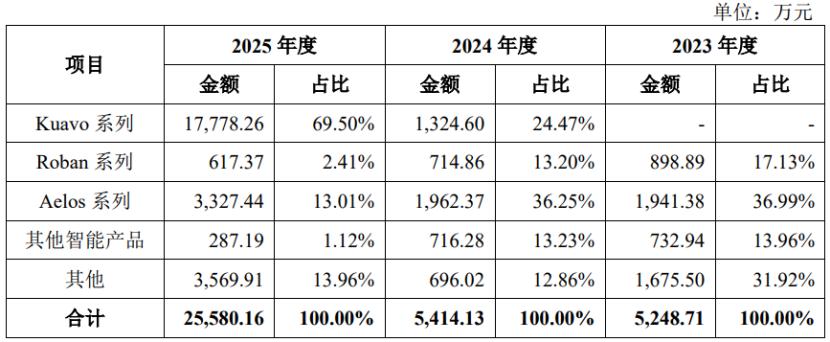
The composition of the company's main business income. Picture source: prospectus
Thanks to the rapid development of the humanoid robot industry and the release of downstream demand, the revenue of the Kuavo series of products of Leju Intelligence has increased significantly, driving the company's performance improvement.
However, due to the characteristics of the humanoid robot industry, such as a long R & D cycle, large capital investment, and rapid technology iteration, and the fact that the industry is currently in the early stage of commercialization as a whole, the company has not yet made a profit.
Specifically, in 2023, 2024, and 2025, Leju Intelligence's operating income was 53.9883 million yuan, 55.5003 million yuan, and 258 million yuan respectively, and the corresponding net profits were - 41.1161 million yuan, - 60.1287 million yuan, and - 71.2458 million yuan respectively.
During the reporting period, Leju Intelligence's comprehensive gross profit margins were 50.45%, 44.3%, and 40.78% respectively, showing a continuous downward trend. Moreover, the gross profit margins of the company's humanoid robot business in 2024 and 2025 were both lower than those of its peer companies Unitree Technology and Dobot.
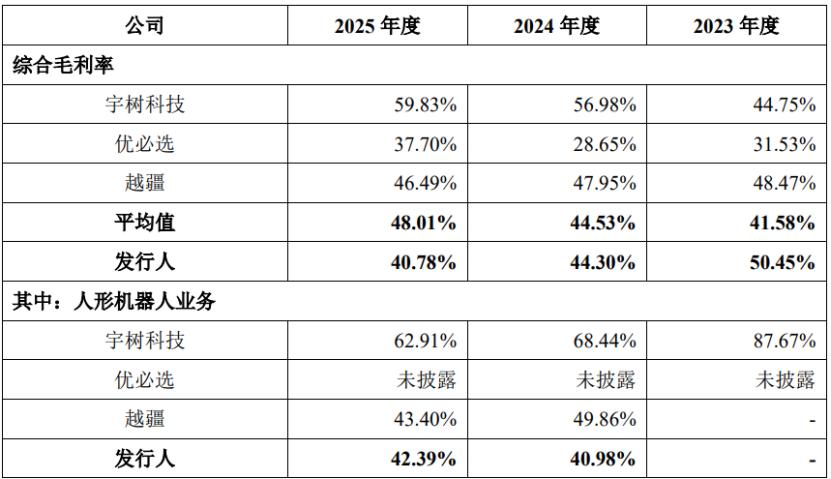
The comparison of the gross profit margins between the company and comparable companies in the same industry. The picture is from the prospectus
The raw materials and components required for Leju Intelligence's products are mainly joint modules, controllers, hardware structural parts, sensors, dexterous hands, etc. The suppliers include Wuxi Quanzhibo Technology Co., Ltd. (related party), Zhejiang Qiangnao Technology Co., Ltd., Ningbo Yijia Electronics Co., Ltd., etc.
During the reporting period, the total procurement amount from the top five suppliers accounted for 42.21%, 39.29%, and 44.41% of the total procurement amount in the current period respectively. And the proportion of direct materials in the main business cost was over 70% in each period, facing the risk of price fluctuations of raw materials and components.
03 The chairman is a post - 90s doctor from Harbin Institute of Technology. Tencent and Shenzhen Venture Capital have invested
Leju Intelligence is registered in Longhua District, Shenzhen, Guangdong Province. Its predecessor, Leju Co., Ltd., was established in 2016 by Leng Xiaokun, Chang Lin, and An Ziwei with monetary subscription. The registered capital at the time of establishment was 1 million yuan. In 2025, Leju Co., Ltd. was transformed into a joint - stock company as a whole.
The company's founder and chairman, Leng Xiaokun, was born in 1992. He became fascinated by robots since junior high school and later entered Harbin Institute of Technology for undergraduate, master's, and doctoral studies. In 2016, Leng Xiaokun led a core technical team of more than a dozen people to Shenzhen and later expanded the robot business.
In addition to Leng Xiaokun, the other two senior executives of Leju Intelligence are also post - 80s and post - 90s. The president, Chang Lin, was born in 1989 and has a doctoral degree; the chief operating officer and board secretary, An Ziwei, was born in 1990 and has a bachelor's degree.
In terms of equity structure, before this issuance, Leng Xiaokun, Chang Lin, and An Ziwei directly hold 15.92%, 6.01%, and 3.81% of the company's equity respectively. At the same time, as the executive partner of Leyue Partnership, Leng Xiaokun indirectly controls 7.64% of the company's equity. The three actual controllers jointly control 33.38% of the company's equity.
In addition, Linzhi Lixin, Jiaxing Jiuzhao, Dongfang Seiko, Wanhai Qihang, Shenzhen Venture Capital, and Hongtu Chuangke under Tencent are all shareholders of Leju Intelligence.
In this Growth Enterprise Market IPO, Leju Intelligence plans to raise 2.6 billion yuan for the construction project of the humanoid robot industrialization base, the R & D center project of humanoid robot embodied intelligence, the construction project of high - quality large - scale data sets, the construction project of the marketing network, and the replenishment of working capital.
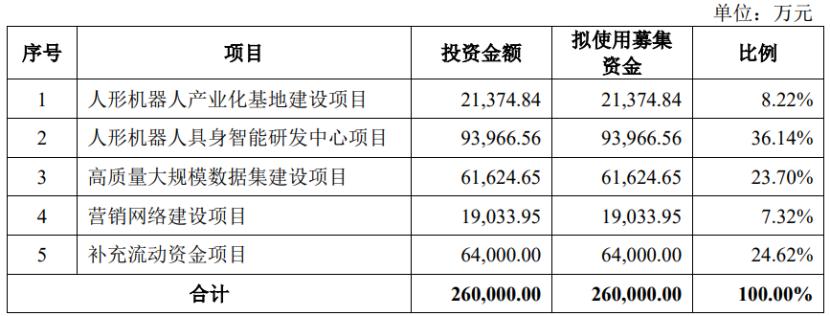
The investment direction of the raised funds. The picture is from the prospectus
This article is from the WeChat official account "Gelonghui New Stocks". Author: Fa Ge Talks about New Stocks. It is published by 36Kr with authorization.