To present a comprehensive view of the research market for embodied intelligence, we reached out to several leading universities for discussions.
In all the hyped implementation stories of embodied intelligence, the scientific research market is the quietest yet most crucial one.
This is the first real income that countless startups have received, helping the teams survive the most difficult commercial exploration stage from 0 to 1. It also allows the robot bodies to complete their initial reliability evolution through hundreds of times of disassembly, modification, debugging, and fault repair. In today's era when robot brains are not yet mature and general capabilities are still to be verified, it has become one of the few truly stable cash - flow sources in the entire industry.
In the prospectus of Unitree Technology released some time ago, scientific research and education accounted for 73.6% of the overall revenue of humanoid robots. Meanwhile, China has become one of the largest source countries of submissions to top - tier robot academic conferences such as ICRA and IROS. The number of relevant papers has shown an explosive growth trend in the past two years. All these signs indicate that scientific research is still a market that cannot be ignored in the robot industry.
The robot bodies required by the scientific research market are not just "empty shells that can walk and jump". On the contrary, it is a closed ecosystem with extremely high entry barriers. In this market with low openness, the interlocking supporting resources and long - established industry practices make it necessary for any company trying to enter to have a solid body foundation, competitive cost - performance, and trustworthy research results as a guarantee.
In the process of Embodied Learning Club interviewing more than a dozen scientific researchers and manufacturers' representatives, the most frequently mentioned word is "ecosystem". Due to the existence of the ecosystem, the scientific research community has formed a completely different decision - making logic from the consumer market and the industrial market.
Sometimes a robot is selected not only because of its own parameters, but also because it is connected to a whole set of systems behind it: open - source code, calibration parameters, community experience, paper data, and the traces left by countless researchers who have used it. They eliminate meaningless repetitive work and largely avoid resource waste.
Meanwhile, scientific research itself is also an ecosystem.
Scientific research has a strong network effect. Research results need to be published, reviewed, and reproduced. In essence, it is the people in the field trying to build a complete ecosystem brick by brick. This determines that scientific researchers cannot be isolated islands, and using the same robot body is a form of connection.
To enter this ecosystem, perhaps patience is more needed. No matter what technology leads the way, entering the scientific research market requires polishing the reliability of products, gradually accumulating users, and building an ecosystem. As the usage volume increases, it will in turn promote the progress of hardware, algorithms, data, etc., and naturally form a leading effect.
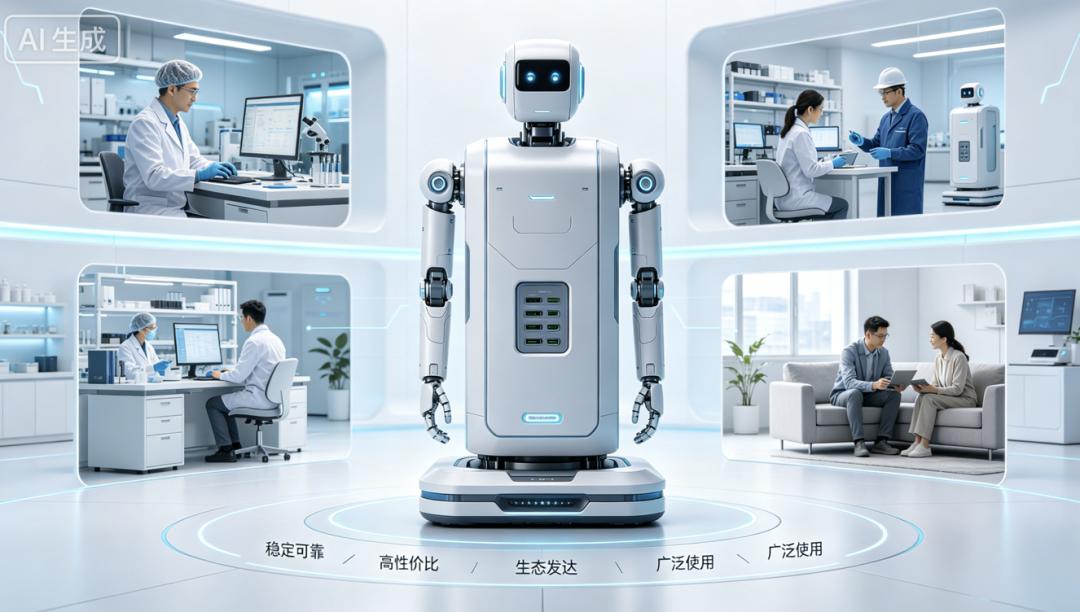
The robots required for future scientific research may not necessarily have extremely strong motion capabilities, but they must be stable and reliable enough, have a well - developed ecosystem, a competitive price, and be used by more people. This requires robots to abandon excessive functions, make up for their shortcomings and make choices on their advantages at the highest cost - performance, and build a solid and balanced body.
And what they can bring to the outside world is patience in dealing with long - term problems.
As Professor Zhao Bo said in the interview, there are still a large number of excellent and young researchers in today's universities and laboratories. They have relatively free time and a stable state, and can continuously invest three to five years in a highly uncertain problem to explore very early - stage, uncertain directions that cannot be immediately verified by commercial returns.
So, what kind of robots does such an important scientific research market actually need? There may not be a unified answer to this question. Different research directions have completely different requirements. But perhaps there are still some commonalities hidden beneath the differences.
Embodied Learning Club has been paying long - term attention to the changes in the scientific research field and has always been curious about the answer to this question. For this reason, we interviewed several scientific researchers in different directions and different universities, listened to their real feelings about dealing with robot bodies, and tried to piece together a relatively complete outline for this question.
01 Chen Tianxing: The scientific research market is far from reaching the bottleneck
Regarding what kind of robots are needed in universities, Chen Tianxing's answer is clear and direct: durable, inexpensive, and with a good ecosystem.
Chen Tianxing pointed out that the choice of robots in the current scientific research field is largely bound by the ecosystem. People tend to choose the robot bodies that more people use because the results need to be compared and reproduced, and there are more available resource tools. However, if a subversive paper is published now, the equipment they use may also be in high demand.
He also mentioned a special dimension: the appearance of the robot.
This may sound like an insignificant detail, but in today's era when papers and demonstration videos are everywhere, a good - looking robot in a paper is indeed more likely to be noticed and remembered. This is essentially determined by the paper - oriented nature of the academic community.
He believes that the academic community often faces stronger resource constraints. Although there are some large laboratories with sufficient resources, many laboratories cannot afford relatively inexpensive humanoid robots, and some laboratories also accept sponsorship from robot manufacturers.
This price sensitivity also constitutes a natural difference in the working styles between the academic community and the industrial community. The academic community often has to find the most elegant solution among many restrictive factors, while the industrial community is good at using resources to cut through the Gordian knot and find the most direct and efficient answer.
Chen Tianxing is optimistic about the prospects of the robot scientific research market. He believes that the commercial value of this market has far from reached its peak. "Just like in the past, when doing motion control, more humanoid robots were purchased. In the future, as research on operations increases, more data and evaluation requirements will be derived.
The future demand can be continuously created. Although the scientific research market is a difficult one, it still has broad prospects. As robot research increases, the market will also grow larger."
02 Zheng Ziang: The "pits" in robot hardware are almost filled this year
For Zheng Ziang, who is engaged in research on motion control and embodied models at Tsinghua University, he believes that the door of the scientific research market is still open, and more robot companies still have the opportunity to enter the scientific research market.
From last year to now, there has been a significant improvement in the user experience of robot bodies, and in this process, the intertwined ecosystem is still the key.
Currently, a leading - brand robot still has an advantage in performance. "When we do human motion retargeting, the first step is to make it work well on this brand of robot by default, and then adapt it to other robots." There are calibrated parameters in its ecosystem, the quality control is more stable, the differences between each robot are smaller, and it is not easy to deviate from the standard parameters. This makes the experimental results easier to reproduce, and the quality of the data obtained is also better.
But if using a robot body other than the leading brand in a paper was a potential pit at the beginning of last year, this pit is almost filled this year, and the usability of the robot bodies of major manufacturers has significantly improved.
Following the path opened up by the leading brand, each manufacturer is cultivating its own open - source ecosystem and building supporting SDKs. This kind of catch - up requires gradual accumulation, and it has now taken on a preliminary scale.
Facing the improvement of the body performance, Zheng Ziang put forward a more thought - provoking view: For current robots, hardware no longer restricts performance, and algorithms are the factors that limit the performance ceiling.
In fact, in most real - world application scenarios, we don't need robots to show off their skills, but rather need the most basic stability and reliability to complete tasks continuously, safely, and predictably. At present, although there is still room for optimization in hardware capabilities, they are already quite impressive. The victory of the Glory robot in this year's marathon race has shown that the maturity cycle of a reliable hardware is constantly shortening.
However, hardware defines the upper limit of a robot's capabilities, and whether it can truly reach this upper limit always depends on the robot's intelligence level. Perhaps blind stacking of hardware is difficult to form a barrier, and the bottleneck is shifting to the software side.
03 From the perspective of motion control, the maturity of robot bodies is a double - edged sword
For scientific researchers in the field of motion control, robots are more like consumables.
In their work, they need frequent real - machine demonstrations, from simple dancing to more complex task operations. In high - intensity projects, a robot may be damaged in half a month.
Li Yixuan, a doctoral student engaged in research on full - body control of humanoid robots at Beijing Institute of Technology said that in these laboratories, the Unitree G1 is the default choice for researchers. One of the most important factors is its powerful motor control ability. The motor is the muscle of the robot, and almost all the robot's movements essentially depend on the accurate output of torque, speed, and position by the motor. The performance of Unitree robots in the Spring Festival Gala shows their profound accumulation in self - developed motors. For researchers doing motion control algorithms, the motor accuracy can directly affect whether the algorithm can accurately and stably execute control instructions. If the motor accuracy is not enough, no matter how beautiful the simulation runs, it cannot be reproduced.
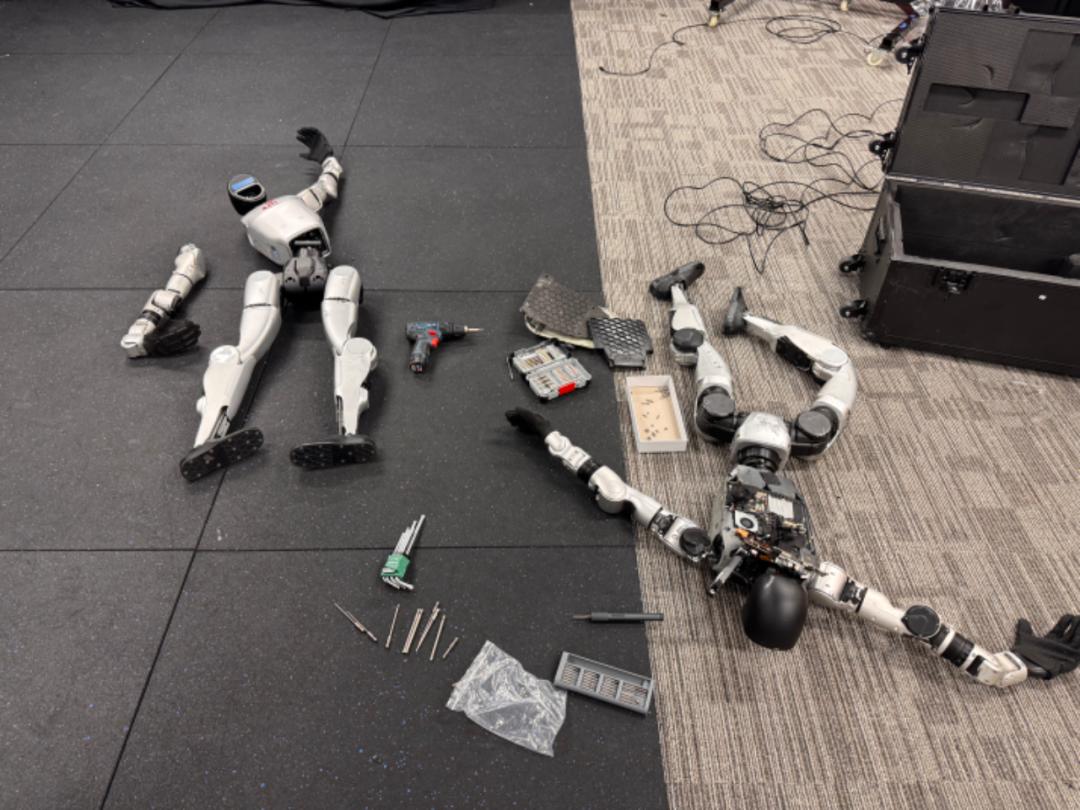
The interviewer repaired the robot by himself due to the approaching deadline.
The high loss rate in experiments makes the reliability of the robot body a default basic ability, which also means that the convenience of after - sales maintenance has become an important indicator. Applying for repair through the official website, sending the robot back, and waiting for repair. In the eyes of researchers, getting the repaired robot back within a month is considered convenient, although it will still cause the project progress to stagnate for some time.
Li Yixuan said that the current hardware level is generally sufficient. However, there is still a gap in the stability of some movements compared with the repeatable accuracy of industrial robotic arms. There are also deficiencies in the accuracy of robot sensors, and there are difficult - to - eliminate noises in the perception during the dynamic process.
He believes that the emergence of Unitree robots has enabled researchers to get rid of the initial situation of building real - machines by themselves, and has advanced the starting point of scientific research by a large step.
But at the same time, it has also weakened researchers' understanding of hardware. Perhaps from the perspective given by the motion control major, he attaches great importance to the role of hardware in scientific research. If the hardware is reliable enough, the model will run more smoothly. When generalizing to different bodies, there is no need to consider some underlying errors. In the future era when atmosphere coding is prevalent, understanding of hardware will instead become a competitive advantage.
04 Zhao Bo: The lack of intelligence has actually contributed to the scientific research market
In the scientific research field, the robotic arm market is more mature. Robotic arms have gone through a longer development path, and their body stability is higher compared to humanoid robots. From the current state of the robotic arm market, we may be able to glimpse the future humanoid robot market.
Zhao Bo, an associate professor at the School of Artificial Intelligence of Shanghai Jiao Tong University, is mainly engaged in research related to VLA and world models. Since his research focuses on upper - limb operations, he most often uses robotic arm experiments. In addition to meeting scientific research requirements such as arm length and load, his choice of robotic arms mainly focuses on price and ecosystem.
Since the performance of robotic arms is relatively mature, price has become an important factor for consideration.
In recent years, the price of robotic arms has shown a downward trend of 30% - 40% per year. Or rather, for the same price, the performance of the machines is constantly improving. This improvement in cost - performance may become the overall trend of robots in the scientific research field.
The logic of the ecosystem also holds true in the robotic arm market, and it is even more significant. Factors such as supporting the ROS system, having a rich open - source code library, being used by enough peers, and having enough public results for comparison have a higher weight than the hardware parameters themselves.
If there is any room for improvement in robotic arms, Zhao Bo mentioned two points. One is the adaptation threshold: Every time a new robotic arm is connected, it often takes a lot of time to learn how to connect and use it. Reducing this threshold is a valuable direction. The other is weight: Now a robotic arm usually weighs 5 - 10 kilograms, and its volume is also quite large. Moving it in the laboratory is a physical task. The demand for lightweight is real.
Zhao Bo frankly said in the interview, "Hardware is indeed very important for scientific research, but we are trying to reduce the importance of hardware." We hope to use more intelligent algorithms to control a more cost - effective robotic arm to make up for its deficiencies in accuracy and other aspects, so that it can handle relatively complex tasks.
Currently, robots themselves have little intelligence. They may have some motion control algorithms, but this is more like the function of the cerebellum rather than the intelligence of the brain. To a large extent, the task of scientific research is to reshape the brain of the robot. So the intelligence of the robot itself may not be an important consideration dimension in the scientific research market (except for the scientific research market of downstream application disciplines).
He believes that the scientific research market will still have a rapid growth period of about five years in the future. The robot field has always been a relatively niche research area, but in recent years, the number of practitioners has been increasing. With the rapid development of the industry, the same laboratory tends to purchase more robots of different types.
This article is from the WeChat official account "Embodied Learning Club", author: Aruna. It is published by 36Kr with authorization.