FSD Supervised Version is One Step Closer to Entering the Chinese Market, but Does Musk Still Care?
Tesla's Autopilot is getting closer to Chinese car owners.
On May 21st, Tesla posted on social media, announcing the countries where the supervised version of FSD (Full Self-Driving) Autopilot software can be used, and China is among them. Other countries include the United States, Canada, Mexico, Australia, South Korea, the Netherlands, etc.
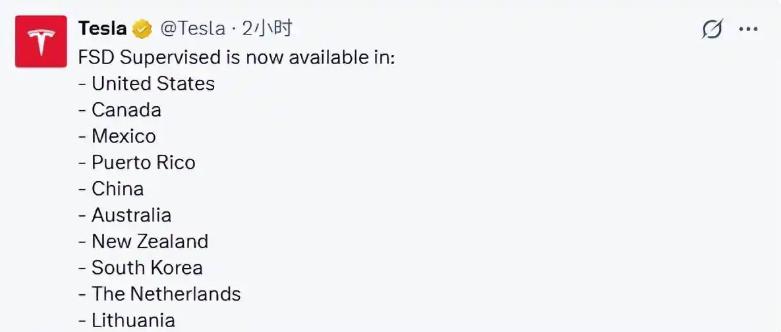
As soon as the news came out, it quickly topped the Weibo hot search list.
However, as of the time of publication, Tesla China has not announced any FSD-related news. Instead, it promoted two older models that have been discontinued on Weibo, saying, "Model S and Model X have made the world re - recognize the possibilities of electric vehicles."
According to Jiemian News, a Tesla customer service representative said: "The company is actively promoting the approval process in accordance with relevant national regulations. Once the approval is ready, it will be pushed to domestic customers as soon as possible." This statement is not much different from the previous one.
In addition, the customer service representative pointed out that the 64,000 - yuan intelligent assisted driving function is not compatible with all vehicles. Some vehicles are only compatible with the 32,000 - yuan enhanced assisted driving function.
FSD (Full Self - Driving) is Tesla's advanced intelligent driving system. It was called Autopilot in the early days and later changed to its current name. According to feedback from American car owners, compared with other autopilot software, FSD performs excellently in complex scenarios such as lane keeping on urban roads, automatic car - following, steering and lane - changing, intersection passing, overtaking and obstacle avoidance. It makes decisive decisions and executes precisely.
Last month, Tesla launched FSD V14.3 in North America. The latest version of FSD has upgraded the training of reinforcement learning, enhanced the neural network visual encoder, and updated the AI compiler. It can better handle long - tail extreme scenarios. The official said that its reaction speed has increased by 20%, and the intelligent summon function has accelerated by 33%.
Chinese users have long been looking forward to FSD but have never had the chance to use it. Now, with Tesla's latest disclosure, FSD's entry into the Chinese market has taken another step forward.
FSD is Tesla's sharp weapon in the North American market, and its actual performance far surpasses that of other brand models. However, limited by multiple factors, the pace of FSD's entry into other markets is very slow. If Tesla can bring the expensive FSD to China, it is expected to get substantial returns.
However, Tesla's challenges in the Chinese market are not just limited to autopilot.
In recent years, Tesla has faced strong challenges from Chinese local brands in terms of products, prices, and brand image. Compared with intelligent driving, these issues require Tesla to invest more time, energy, and resources to gradually resolve.
However, Elon Musk has shifted his focus to SpaceX, and Tesla may also become part of SpaceX in the future. His grand blueprint is to build a super AI infrastructure that spans both software and hardware, covering space and ground, rather than just selling electric vehicles.
With the founder's divided attention, it may not be easy for Tesla to continue its upward trend in China with just a few existing advantages. FSD may solve some problems, but it is not a panacea for all obstacles. Without the stimulation of new models, Tesla's growth curve in the Chinese market is gradually approaching the ceiling.
01
In the United States, Tesla's unique autopilot is its competitive barrier.
In most parts of North America, the roads are wide and the population is sparse, providing a good environment for autopilot and boosting the sales of FSD. According to Tesla's announcement, as of the end of the first quarter of 2026, the global subscription users of FSD have reached 1.28 million, a year - on - year increase of 51%.
Elon Musk previously revealed that he expects to release the V15 version of FSD from the end of this year to the beginning of next year. This version will comprehensively transform the software architecture and further improve the safety level.
In addition, Tesla is also lowering the threshold for trying out FSD. In February this year, Tesla cancelled the option of a one - time purchase of $8,000 in most markets and switched to a subscription system, which only costs $99 per month.
But in China, the inability to launch FSD has made autopilot one of Tesla's significant weaknesses.
Currently, the models sold on Tesla's official website come with "basic assisted driving", including active cruise control and intelligent assisted steering functions. By spending an additional 32,000 yuan, car owners can choose to install "enhanced assisted driving", which adds functions such as assisted navigation, assisted lane - changing, intelligent parking, and intelligent summon.
If car owners spend an additional 64,000 yuan, they can also get the "intelligent assisted driving" function on top of the above - mentioned functions, but it will be "launched later". Tesla said that this function will be able to complete most driving tasks with minimal driver intervention.
Compared with local brands that are in fierce competition, Tesla's intelligent driving software has no advantage.
Currently, domestic brands such as NIO, Xpeng, Li Auto, Hongmeng Zhixing, BYD, and Zeekr, as well as joint - venture brands such as BBA, Toyota, and Honda, all regard intelligent driving capabilities as a top priority, and it has almost become a standard feature for new cars.
Overall, in conventional scenarios such as NOA (Navigate on Autopilot) driving on highways and urban expressways and automatic parking, the mid - to - high - end intelligent driving systems of almost all car companies perform well. Public data shows that from January to February this year, the penetration rate of new passenger cars with L2 - level combined driving assistance functions has reached 69.15%, a 10 - percentage - point increase compared with the same period last year.
The main goals that car companies are working on are long - tail scenarios, such as driving in rainy or foggy weather, driving on unmarked roads, parking lot cruising, and intelligent summon. At the same time, the "door - to - door" intelligent driving ability is also the focus of competition in the entire industry.
In most cases, Tesla's FSD can handle these high - difficulty scenarios and even perform better. However, the basic - version intelligent driving software currently sold in the Chinese market often struggles with them.
In addition to having performance comparable to Tesla, the intelligent driving systems of local car companies also have a price advantage.
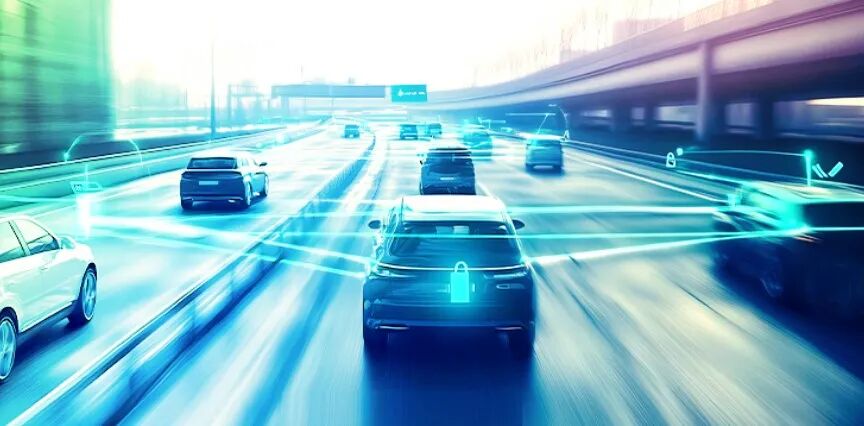
Currently, most car companies offer basic - version intelligent driving systems for free. High - end systems often come with more powerful hardware, such as intelligent driving chips with higher computing power, more lidars, and cameras. The one - time upgrade fee is usually between 10,000 and 20,000 yuan, much cheaper than Tesla's 64,000 yuan.
The fact that Tesla's basic intelligent driving lags behind local brands has, to some extent, dragged down its sales performance. Public data shows that in 2025, Tesla's total wholesale sales in China reached 851,732 vehicles (including domestic deliveries and overseas exports), a year - on - year decline of 7%.
In this situation, it has become an urgent task for Tesla in China to introduce FSD as soon as possible to make up for its weaknesses and rebuild its advantages.
02
Previously, Tesla had sent clear signals about FSD's entry into China.
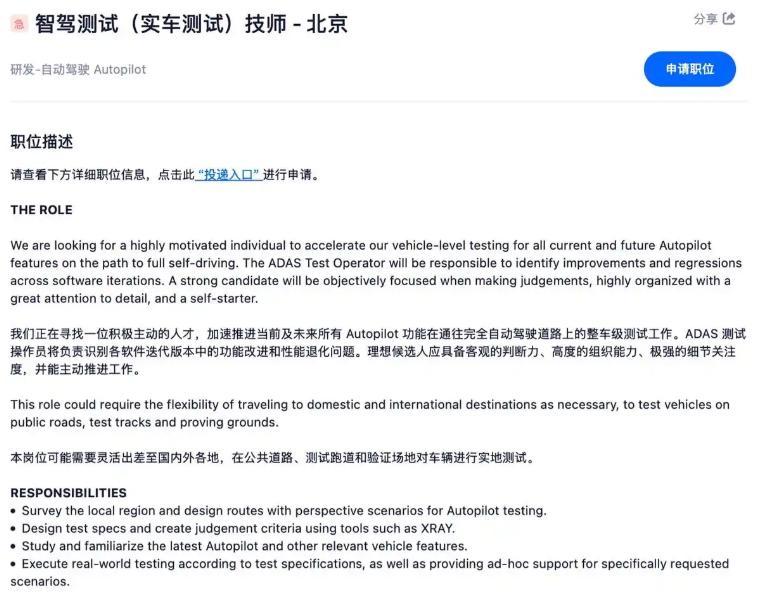
Last month, Tesla's recruitment page showed that the company is recruiting personnel related to intelligent driving testing in nine cities such as Beijing, Shanghai, Guangzhou, and Shenzhen. They are responsible for identifying function improvements and performance degradation issues in each software iteration version. They are also required to travel flexibly to various places at home and abroad to conduct on - site vehicle tests on public roads, test tracks, and verification sites.
Elon Musk has mentioned many times that he hopes to launch FSD in China, but it has been repeatedly postponed.
As early as July 2024, Elon Musk said in a Tesla earnings conference call that he expected FSD to be approved for entry into China before the end of 2024. In September of the same year, Tesla said it would launch FSD in China in the first quarter of 2025.
In January 2025, the situation changed. Elon Musk said that Tesla could not transfer training video data outside of China. At the same time, US government bans prevent Tesla from using advanced GPUs for training in China. "This is a bit of a tricky problem," he said.
The new time point given by Elon Musk was to launch the supervised version of FSD in China at some point in 2025. However, this goal was also not achieved.
Another report said that in the first half of 2025, Tesla had pushed FSD to a small number of Chinese car owners with HW4 hardware, but there was no further action afterwards.
In November 2025, Elon Musk revealed at the Tesla shareholders' meeting that FSD had received "partial approval" in China. Subsequently, the process of FSD's entry into China accelerated suddenly.
In February this year, Tao Lin, the vice - president of Tesla, said externally that Tesla's assisted driving data does not need to leave the country and will strictly comply with China's data compliance requirements. Currently, Tesla has established a local AI training center in China and deployed local training capabilities to prepare for a larger - scale launch in the future.
In April, Tesla China's official Weibo account announced that the company had passed the approval for the supervised version of FSD in the Netherlands, which is very crucial for approvals in other EU countries. At the same time, the company is working hard to launch intelligent assisted driving in the Chinese market as soon as possible.
In the same month, Tesla updated the timeline for FSD's entry into China. At the Q1 2026 earnings conference call, Tesla's management said that they hope FSD can get approval from relevant Chinese departments in the third quarter of this year.
The slow progress of FSD's entry into China is mainly due to two reasons: training data and road conditions.
As Elon Musk said, Tesla cannot transfer China's road traffic data overseas. At present, it can only find some videos of Chinese roads on the Internet for FSD training, but the quality of this data is far from comparable to that of on - site collected road data.
At the same time, China's road environment is much more complex than that of the United States.
Compared with the United States, the road density in Chinese cities is generally higher, with more intersections and ramps. Pedestrians and non - motor vehicles often invade and even occupy the motor vehicle lanes for a long time. In addition, many motor vehicle lanes have special rules, such as tidal lanes and dedicated bus lanes during certain periods. These local - characteristic traffic scenarios will pose challenges to FSD, which is trained based on US road conditions.
Given time, these problems can be gradually solved. However, Tesla is short of time, and car owners cannot wait indefinitely for FSD. In this situation, Tesla needs to occasionally release some good news to reassure potential consumers while accelerating the process of FSD's launch.
03
At the last quarter's conference call, Tesla's management sent the message that FSD itself is the product, and the vehicle is just a delivery tool.
Obviously, Tesla hopes to break away from the logic of selling cars and hardware and shift to selling SaaS and software. This is at least more beneficial in the capital market - although SaaS is not a new model, it is more attractive than selling cars.
However, the foundation of this logic is that FSD can sell well in the global market. Whether Chinese consumers will buy it is crucial.
Currently, Tesla is working on solving the problem of localized computing power.
According to public reports, Tesla has built a computing power center in China, mainly using existing materials for local optimization rather than collecting data from Chinese car owners for training. It is foreseeable that with the increase in local training, FSD's adaptability to domestic road conditions will improve.
But Tesla first needs to sell more new cars in China before it can talk about selling FSD.
The latest version of FSD requires the computing power support of Tesla AI4. However, many domestic old car owners bought cars with early - version HW, which do not support FSD in terms of hardware. That is to say, the millions of cars that Tesla has sold in China cannot be immediately converted into FSD users.
In terms of new cars, Tesla has had good sales in China in the past few quarters, and Model 3/Y still ranks among the top.
But Tesla also faces many challenges. For example, the aging of the model lineup.
To date, Tesla's "newest" Model Y is already an old model from six years ago. In the past six years, Chinese manufacturers have made rapid progress, and various new models have emerged one after another, while Tesla still relies on just one popular model.
In addition, the Model Y is a "basic" mid - size SUV with a relatively small body and ordinary interior. In contrast, in the price range of 200,000 - 300,000 yuan, most domestic new cars are equipped with "refrigerators, large color TVs, and comfortable sofas" and are often over 5 meters long.
As for pre - sales and after - sales services, user communities, and the founder's IP, compared with local players such as NIO, Xpeng, and Li Auto, Tesla China is hardly in the same league and there is no sign of significant improvement.
Tesla, which always relies on the Model Y, urgently needs a breakthrough product to cope with the pursuit of Chinese brands.
But the current question is, does Elon Musk still have an interest in selling cars?
Since 2022, Elon Musk has spent more and more time outside of Tesla: acquiring Twitter (now X), founding xAI, promoting SpaceX's Mars plan, and developing humanoid robots.
In 2026, Elon Musk's main focus is on SpaceX's super IPO, and he has merged xAI into it. His vision is to build a future empire of "rockets + satellites + AI"; as for cars, they are just AI terminals.
In this context, FSD is just one of the applications of AI in the transportation scenario. It would be a good thing if it can enter China as soon as possible, but the scale of this autopilot battle will not be large, and its value only accounts for a small part of SpaceX's territory, so there is no need to be in a hurry.
Fortunately, Tesla has finally released the latest signal about FSD's entry into China, and Chinese car owners' years - long wait has finally received a response.
However, Tesla can no longer return to the past. An innovative Tesla needs a diligent and self - restrained Elon Musk. But this automotive industry tycoon no longer attaches much importance to building and selling cars. Instead, he is ready to soar into space.
This article is from the