It's the season again when thunderstorms hit the net worth everywhere.
When there are fewer and fewer people chatting in an investment communication group, just throw out a net value curve chart of Wu Yuefeng, and the atmosphere will instantly liven up.
This time, the net value of Jiayue Yuefeng Investment Chuangshi No. 1 not only returned above water but also reached a new historical high. Last year, Wu Yuefeng brought the net value back above water from more than 0.3 yuan. People thought it had climbed out of the abyss, but soon it dropped back to more than 0.5 yuan. Until May 8th this year, the net value increased by 167.54% in nearly a month, and Wu Yuefeng is back.
Judging from the product report's holdings, the total equity position reached 100%. 35% of AI computing power infrastructure + 20% of storage chips constituted the main driving force for the sharp increase in net value. AH shares of optical modules and PCBs accounted for 5%. Wu Yuefeng almost bet all on the AI computing power industry chain [1].
In the past year, as long as one slightly changed their thinking and chased the rising trends of optical communication and storage instead of defending in the liquor sector, no matter how poorly they performed before or how big the hole they dug, they could fill it up in one go. Standing in the light and getting close to the chips is the biggest wealth code this year.
For Yuanlesheng, Xiwa, Qushi and other hundred - billion subjective funds that were extremely glorious from 2020 to 2021, the net values of their representative products have skyrocketed in the past year, breaking through the previous historical highs. Fu of Ruiyuan has quietly doubled his net value in the past year, reaching a new historical high. And a private equity product named Zhunjin Zhizhan No. 1 is even more exaggerated. It has multiplied by 5 times since this year and 50 times in less than 5 years since its establishment.
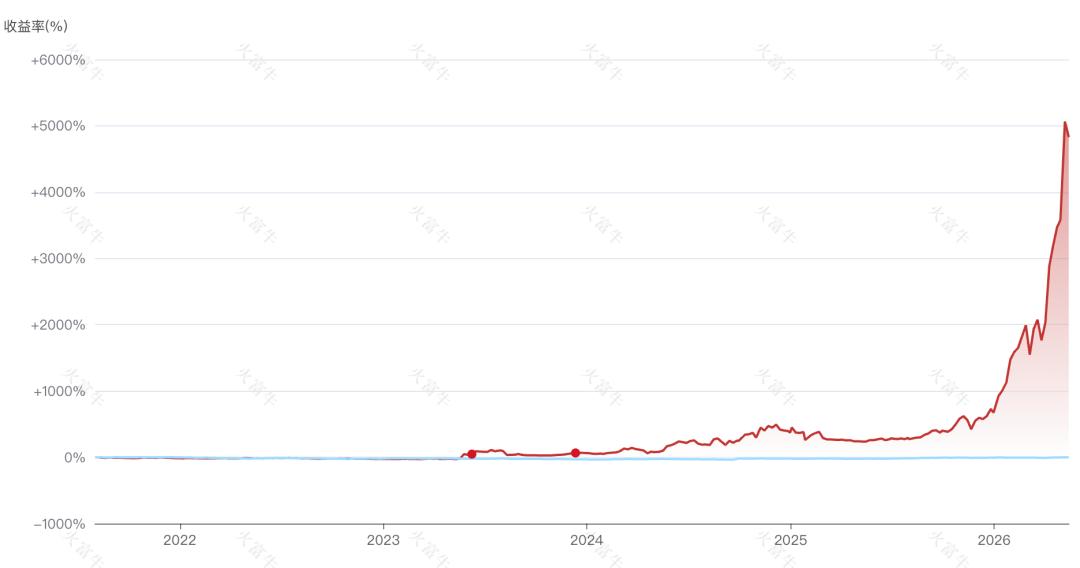
What is the thunderous net value?
There is also the rumored private equity fund of Yao Jinghe that made astronomical profits from storage and CPO, Leopold, a former OpenAI employee who grew the hedge fund's scale from 225 million US dollars to 5.5 billion in a year, and Hefei State - owned Assets, which is about to be crowned the "best venture capital" again due to the listing of Changxin. It seems that there are people counting money everywhere in the "chip, light, lithium" sectors. Those who don't can only watch the continuous rise and feel so anxious about various thunderous net values that it may damage their prefrontal lobes.
At this time, people holding Hengke and value stocks can't help but wonder: Even the Shanghai KTV girls have earned 18 million. Why hasn't there been a high - low switch in the market?
Silicon - based bull, carbon - based bear
There is a strange thing about this round of market. Even if the AI industry chain is highly crowded, its price won't fall.
In the first quarter of this year, the allocation ratio of active equity - biased funds to AI hardware was 31.5%, and the over - allocation ratio was 17.7%. Compared with historical core tracks, although it has not exceeded the Maotai Index back then, it has exceeded the peak of the Ning Portfolio [2].
Liu Chenming of GF also pointed out that last year, the TMT holdings of funds had exceeded 40%, and the electronic holdings had exceeded 20% for more than a year. From the perspective of trading congestion, the proportion of A - share TMT trading volume has long exceeded the 40% threshold of the previous industrial cycle.
Despite such congestion, since April, the Philadelphia Semiconductor Index has risen by 54%, and the Science and Technology Innovation Chip Index has risen by 60%. Not to mention Mr. Fu, who heavily invested in Zhongji Xuchuang in the first quarter, even 18 fixed - income + funds that bought semiconductor positions above 10% have achieved thunderous net values.
Another strange thing about this round of market is that no matter how much Hengke falls, it can't be revived.
Two months have passed since Xia Junjie said that "Hengke may have fallen too much", but Hengke still shows no sign of improvement, just like a dead fish lying flat with its eyes open on the ice in a seafood restaurant.
There are inevitable reasons for the weakness of Hengke. Just as Liu Xiaolong of Juming responded to why he cleared his holdings of Hong Kong - listed technology stocks: 1) The potential impact of AI on the Internet business model; 2) Hong Kong stocks are more affected by the marginal tightening of overseas liquidity; 3) The large amount of IPO fundraising in 2025 consumes funds.
After all, the current situation of large models is still a pattern of winner - takes - all and long - tail homogeneous competition. Hongshang Asset believes that the involutionary strategy of "free" and "low - price" in the C - end has led to the valuation dilemma of Chinese AI companies:
When the monetization ability is highly questioned, even the AI businesses of Tencent and Alibaba can hardly gain the recognition of the capital market. Although models like Alibaba's Qianwen have started to try the closed - source and paid model, the effect is not good. This is also the core reason why the market has gradually lost patience with the AI stories of Tencent and Alibaba recently, and their valuation expansion lacks motivation.
The strangest thing about this round of market is that consumer fund managers have started to transform and chase the light.
Some time ago, I wanted to bottom - fish in consumer funds. I thought the name "Boshi Women's Consumption Theme" was quite appealing. But when I opened the top ten holdings, what greeted me were Crystal Optoelectronics and Zhongji Xuchuang.
Well - known veteran consumer fund managers Tong Xun and Xiao Nan have also gradually blended in with the trend. After changing their thinking, Mr. Tong Xun's net value has reversed in a V - shape since April; after the third quarter of last year, the light - related holdings of Yifangda Ruiheng managed by Xiao Nan have gradually increased, and the performance gap with Zhang Kun, who is also from the same company and deeply stuck in the liquor quagmire, has been widening.
These strange phenomena remind people of the peak of the previous round of subjective long - only funds from 2020 to 2021.
Back then, the protagonists were the post - 60s fund managers who had muscle memory of "monopoly barriers + perpetual operation" and over - allocated Kweichow Moutai and Alibaba relative to the market; while in this round, the protagonists are the post - 85s who have an extreme belief in hard technology and over - allocate Zhongji Xuchuang and Cambricon relative to the market. Most of them have encountered the 4200 - point mark for the first time since they started managing money.
Without AI, the subjective long - only funds that have been suppressed by quantitative funds for many years haven't felt so elated for a long time. In the past year, 12 subjective long - only products of public funds have achieved a return rate of more than 300%; in the past three months, the subjective long - only selected index of Huofuniu private equity has outperformed the CSI 500 index - enhanced selected index and has become the strongest strategy index.
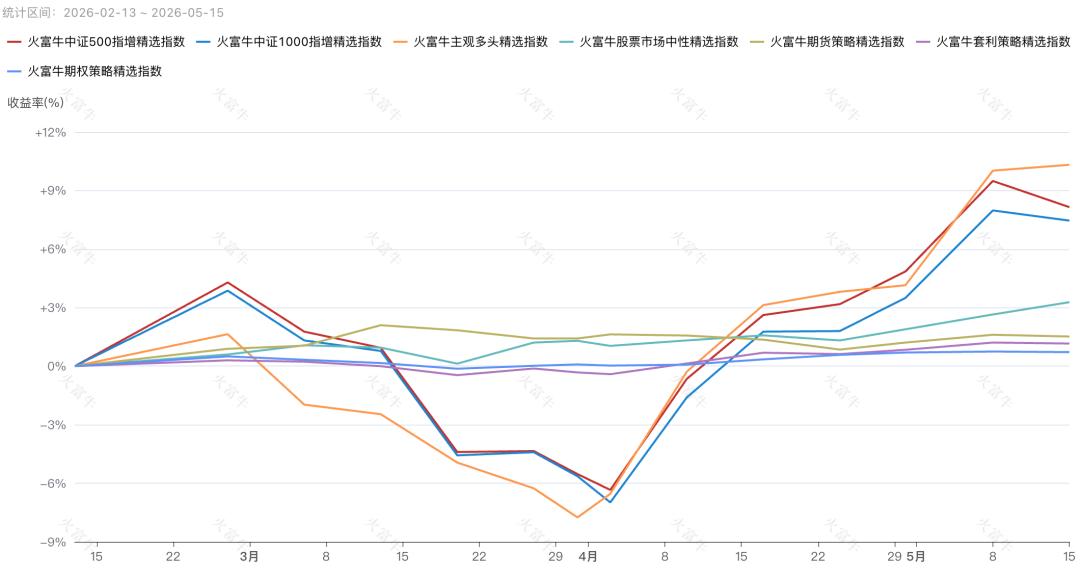
Ren Zeping said that this is a once - in - a - decade bull market, a confidence - driven bull market that combines policy, technology, and loose - money factors. I think a more accurate expression is that for those who have confidence in the silicon - based sector, it's a bull market, while for those who try to bottom - fish in the carbon - based sector, it's a bear market.
Attack or defend
For many fund managers, their current situation is like Flick leading this financially - strapped Barcelona. It seems that they have no other choice.
Flick's tactic is to attack instead of defend, pressing high to keep the ball in the opponent's half and reduce the probability of the opponent facing their own goal. Once they retreat and sit back, relying on Barcelona's weak defense line, they will only lose more miserably. Similarly, even if they defend in the Hengke and consumer sectors, they will still face a decline when the bull market ends. But at least by attacking and buying AI, they can accumulate a profit cushion.
Moreover, under the extreme FOMO sentiment, it is becoming more and more difficult to manage the emotions of the liability side. After all, clients can make money by casually chasing the light in their own stock trading. When they see the thunderous net values of the subjective funds bought by their friends, why should they spend time and management fees listening to you talk about value investment and then miss the few rare trains of the era?
Since it is a fast - moving train of the era, should those who haven't boarded it chase it? Should those who are on it get off? These are questions that all fund managers must face. Just as the capital expenditure of the top five US technology giants has been continuously increased to 720 billion US dollars, no one wants to be left behind by the era.
Wang Zhongyuan, the founder of Ziruixing Investment who entered the industry in 1993, has witnessed the "327" Treasury bond incident in 1995 and the Internet bubble in 1999. He told a true story to Yuanchuan:
Stanley Druckenmiller shorted technology stocks in the first half of 1999, then heavily invested back at the end of the year and cleared his positions to escape the top in January 2000. But in March 2000, when the technology stocks soared again, he couldn't hold on and rushed in with a full position. As a result, he suffered a 18% loss in one and a half months.
"What does this story tell us? Even the world - recognized top - level traders will make irrational decisions when facing FOMO sentiment. Then, do you think there are many fund managers chasing the light today who are better than Druckenmiller?"
Interestingly, Zeyuan Investment posted a picture on its official account - "Semiconductors ranked first in the global trading list in May."
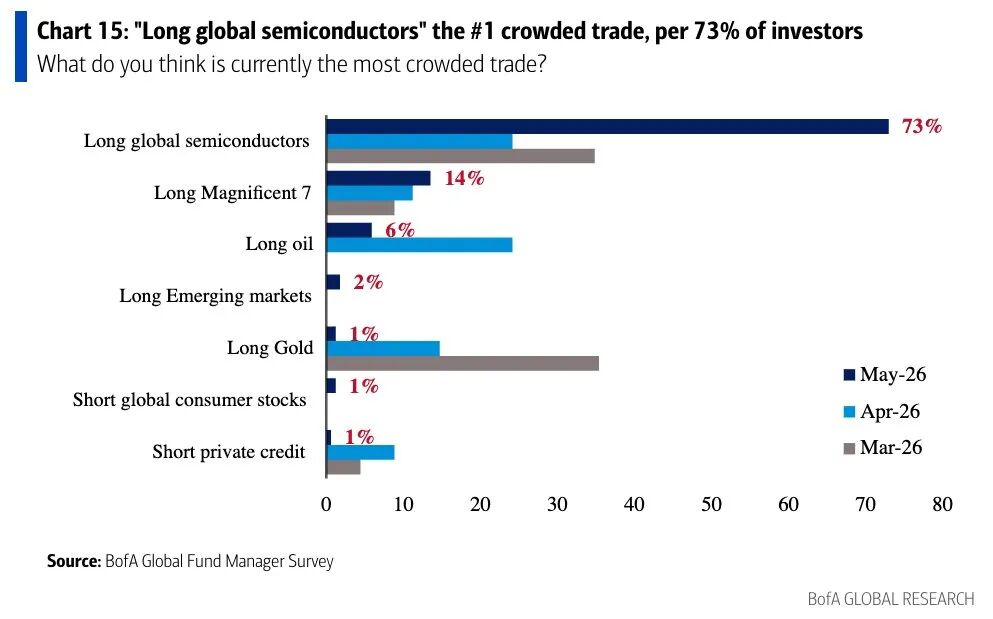
They advised investors to lower their expectations for Zeyuan. Currently, it is similar to the peak of the dot - com bubble. They will never change their stance and abandon traditional value investment to chase the dot - com bubble. Even if the dot - com bubble boils, they will "never surrender." They quoted a saying, "The stock market is a place where dreams and money are exchanged. Those who sell their dreams extract money, and most of those who pay money are trapped in the stock market waiting for their dreams."
Compared with Ziruixing and Zeyuan, Jingyi Investment was more straightforward - the underlying large models and the most core infrastructure and hardware of this AI revolution are mostly in the hands of those leading US technology giants across the ocean. The fundamental support for the current A - share AI speculation is far less than that of the new energy sector back then.
"In 2021, most photovoltaic and lithium - battery companies witnessed real - time performance explosions and rapid increases in penetration rates. However, many so - called 'AI companies' in the A - share market that have been hyped up to a market value of tens of billions don't even have the profit explosion that the new energy sector had at that time."
It's undeniable that some subjective private equity funds are not gambling. They withstood the short - selling blow of Michael Burry's $379 paid article last year and captured the core main line of AI investment, which is AI hardware. But as the speculation spreads from optical modules to sub - sectors such as storage, CPUs, electronic cloth, and optical fibers, the room for high - low switches within the sector is constantly narrowing, and the potential cost of making mistakes is also rising.
Coupled with the fact that the 30 - year US Treasury bond yield has exceeded 5%, the macro situation when chasing the rising AI now is different from that when Michael Burry shouted about the bubble last year.
Just like Flick's Barcelona, it had a smooth season and often achieved thunderous scores. But when it met Atletico Madrid, which is good at counter - attacking, in the Champions League quarter - finals, it still persisted in high - position attacks, resulting in the defenders frequently chasing back and getting two red cards, completely ruining the game.
Epilogue
When people still believed in the carbon - based sector, thunderous net values also appeared.
In the previous liquor bull market, from 2020 to June 2021, Lin Yuan's performance increased by 150%. Then it oscillated and declined for five years, and now there is only a little over 20% return left. Zheng Yuan and Chongji, which concentrated their bets on photovoltaic new energy back then, are now memories that wealth managers don't want to look back on.
Previously, Shifeng Asset, which achieved thunderous net values and had a peak scale of 3 billion, tried to transform into quantitative investment but failed to reverse the decline. Now its scale has shrunk to 200 - 500 million. Recently, it was learned that it has moved from Lujiazui Century Financial Plaza to Yuanshen Financial Building with lower rent.
These may seem a bit far - fetched, but when the gold price reached a high at the beginning of the year, it's hard to forget that gold private equity fund that shouted "sit tight and hold on" three times.
Sometimes I ask channel people why they are optimistic about a certain private equity fund. The answers I get are nothing more than three points: leaving a big company to start a business, the small scale and still - effective strategy, and the most core one - the good - looking net value curve.
Behind the thunderous net values, there is often an amplification of returns brought by concentrated holdings and even leveraging. Simply using performance sharpness as a basis for buying will probably result in buying a mediocre product, just following the previously strong market style. The lesson of buying based on the curve and selling at a loss has been repeated again and again in history.
Wu Dingwen of Qinyuan once shared: "Asset allocation requires an understanding of the underlying logic, that is, an understanding of trading, value, and the team, rather than just an understanding of making money." If you only focus on making money, you will probably fall into the cycle of buying whatever is hot, watching it fall after buying, and getting stuck in the falling stocks.
This article is from the WeChat official account "Yuanchuan Investment Review" (ID: caituandzd), written by Shen Hui, and is published by 36Kr with authorization.