NVIDIA: Facing Pressure from Competitors and Changes in AI "Bottlenecks", Can the "Cosmic Stock" Experience a Minor Setback?
NVIDIA (NVDA.O) released its financial report for the first quarter of fiscal year 2027 (ending in April 2026) after the U.S. stock market closed at around 0:00 Beijing Time on May 21, 2026. The specific content is as follows:
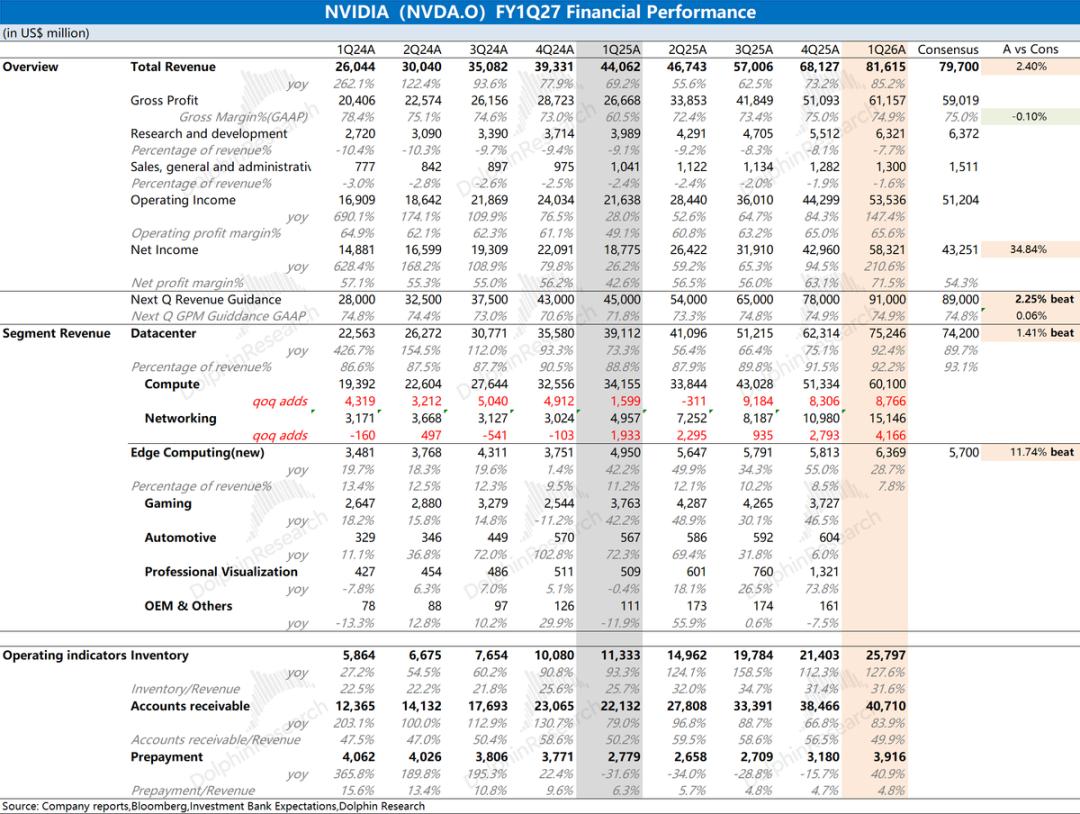
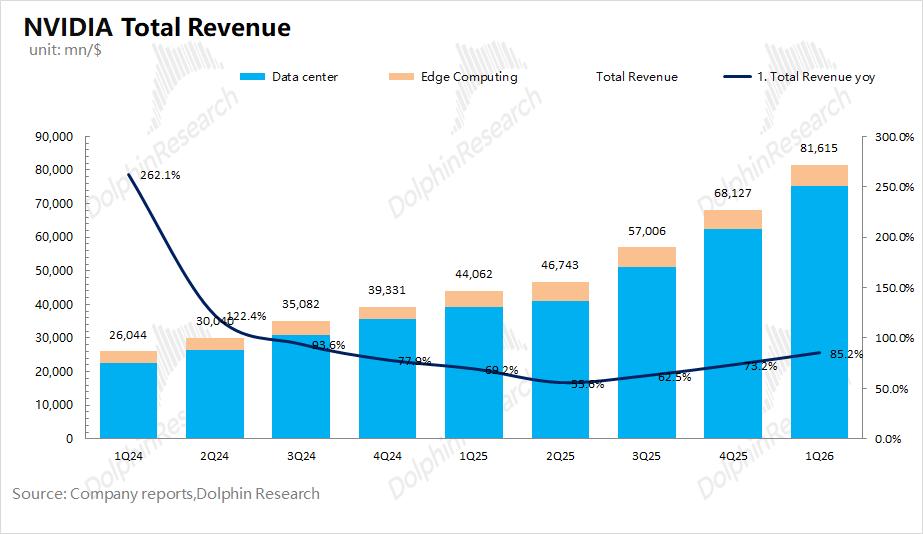
1. Core operating indicators: The total revenue was $81.6 billion, better than the revised buyer's expectation ($78 - $80 billion). Among them, the quarter-on-quarter increase of $13.5 billion almost all came from the increased mass production of Blackwell in the data center business.
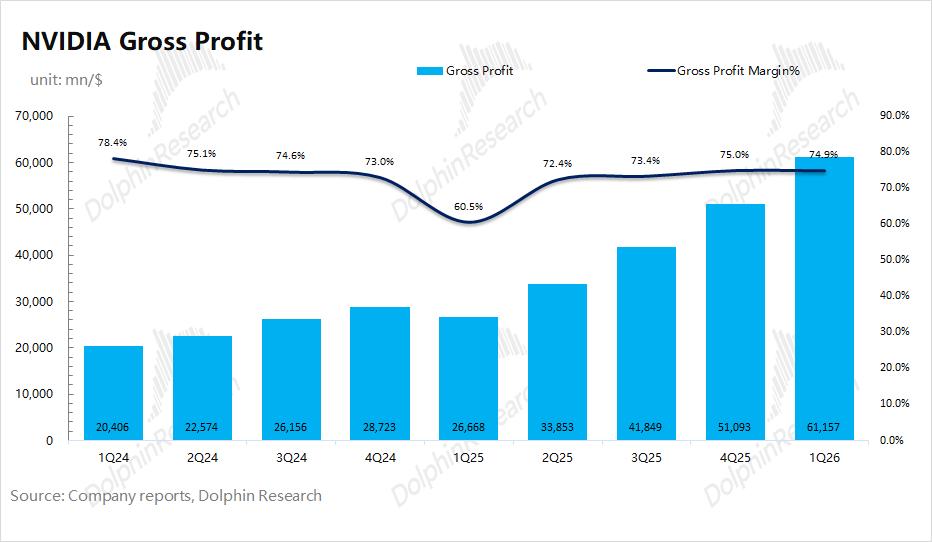
The gross profit margin this quarter was 74.9%, a 0.1 percentage point decrease quarter-on-quarter, basically in line with the market expectation (75%). With the mass production ramp-up of B300, the company's gross profit margin has rebounded to around 75%.
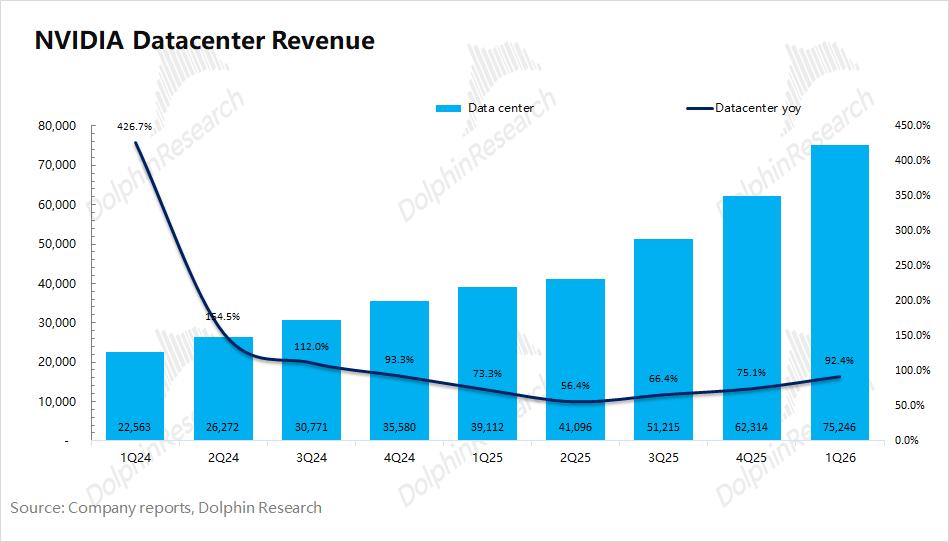
2. Data center: The revenue this quarter was $75.2 billion, with a quarter-on-quarter increase of $12.9 billion. This was mainly due to the increased delivery volume of the B300 series of chips, and the Blackwell architecture has become the dominant product covering all customer categories.
The company adjusted its disclosure scope this quarter, changing from the original breakdown of "computing business and network business" to "hyperscale customers and other cloud customers". Specifically, the revenue from hyperscale customers this quarter was $37.9 billion, a quarter-on-quarter increase of $4 billion; the revenue from other cloud customers was $37.4 billion, a quarter-on-quarter increase of $8.9 billion, which was the largest contributor to the company's revenue growth.
In the context of large cloud providers starting to develop their own chips, Dolphin Research believes that the company's breakdown of data center revenue from the customer perspective is mainly to highlight its ability to achieve continuous growth in other cloud sectors (industrial cloud and government cloud).
3. Edge computing business: The company integrated all businesses outside the data center into the edge computing business this quarter, including areas such as personal computers, game consoles, workstations, AI-RAN base stations, robots, and automobiles. The performance of these segments will no longer be disclosed separately.
The revenue from edge computing this quarter was $6.4 billion, a year-on-year increase of 29%. The gaming business is the largest segment in the edge computing business, and the growth this quarter was mainly driven by the growth of the gaming business.
4. Profit: The company's core operating profit this quarter was $53.5 billion, a year-on-year increase of 147%. This was mainly due to the rapid growth in revenue and the gross profit margin returning to around 75% (the gross profit margin "collapsed" in the same period last year due to the H20 ban). The core operating profit margin this quarter also reached 65%.
5. Guidance for the next quarter: The company expects the revenue for the second quarter of fiscal year 2027 (i.e., 2Q26) to be $91 billion, a quarter-on-quarter increase of $9.4 billion. The guidance excludes the revenue from data center computing power in China and is better than the revised buyer's expectation ($89 billion). The gross profit margin (GAAP) for the next quarter is expected to be 74.9%, flat quarter-on-quarter, basically in line with the market expectation (74.8%).
Dolphin Research's overall view: The computing power hegemon is being hunted by "cost-effectiveness"
Jensen Huang once again raised the company's outlook for the AI business at the GTC conference, expecting the cumulative revenue of the data center business from 2025 - 2027 to reach $1 trillion (compared to $500 billion given at last year's GTC conference). The market is not really worried about the company's performance in fiscal years 2027 and 2028. Therefore, a slight beat of expectations in the short-term financial report will not significantly boost the company's stock price.
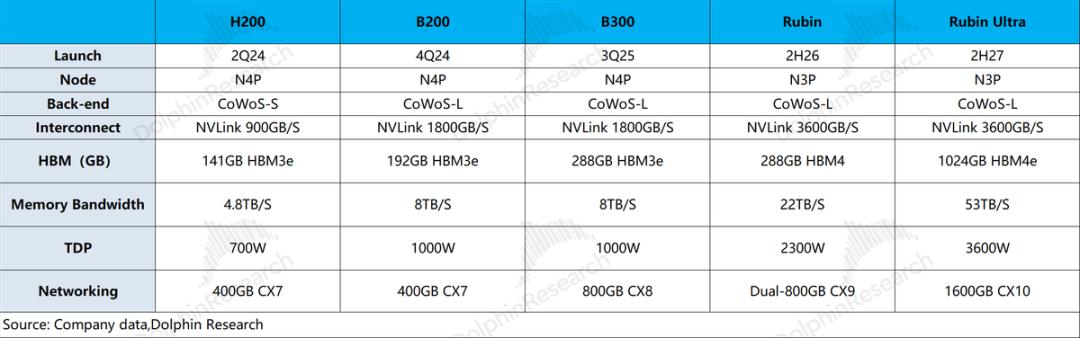
Of course, large companies' capital expenditures are still increasing, NVIDIA's market share in the AI chip market is also rising, and NVIDIA has also provided a more suitable computing power solution for the Agentic workflow in the Vera Rubin solution :
a. Develop an in-house inference context memory platform (ICMS) to alleviate the "memory wall" problem;
b. Introduce the Groq 3 LPU to accelerate the Decode (decoding output stage);
c. Use the in-house Vera CPU to take over task scheduling to improve efficiency)
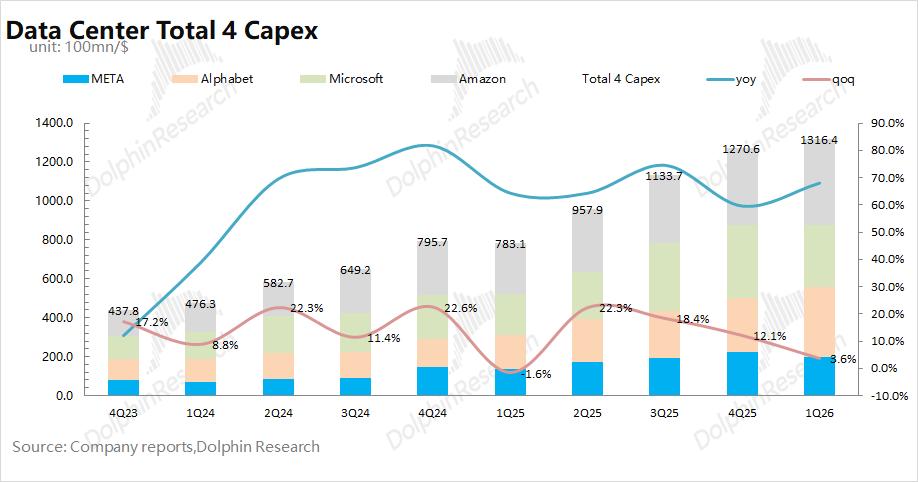
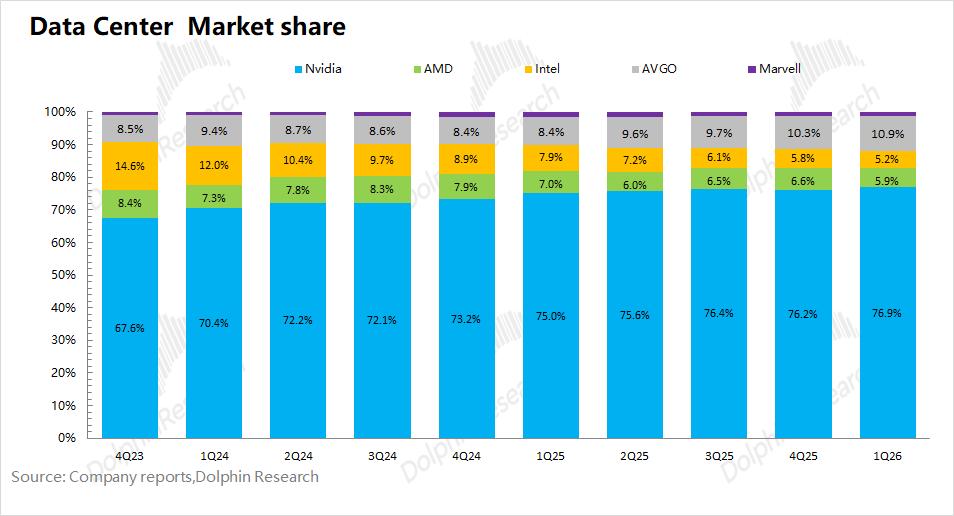
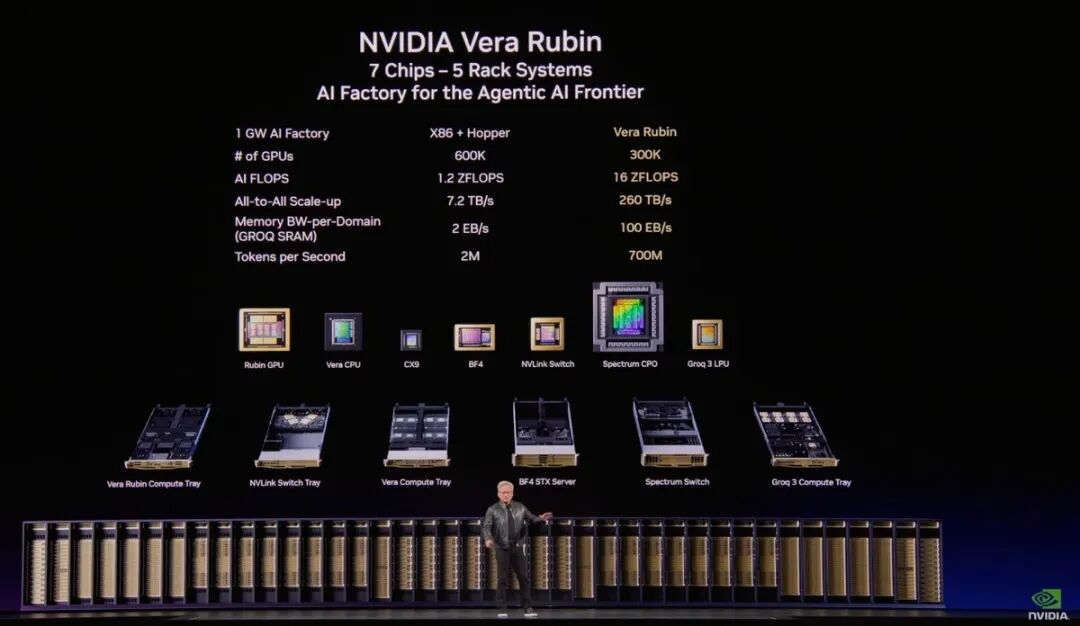
However, NVIDIA's monopoly premium is gradually weakening. The model is divided into two stages: training and inference. In the training stage, NVIDIA still has an obvious advantage. In the inference stage after training, the same calculations need to be repeatedly performed, and more attention is paid to token throughput, latency, and cost. This is also the area that large companies' self-developed chips want to replace.
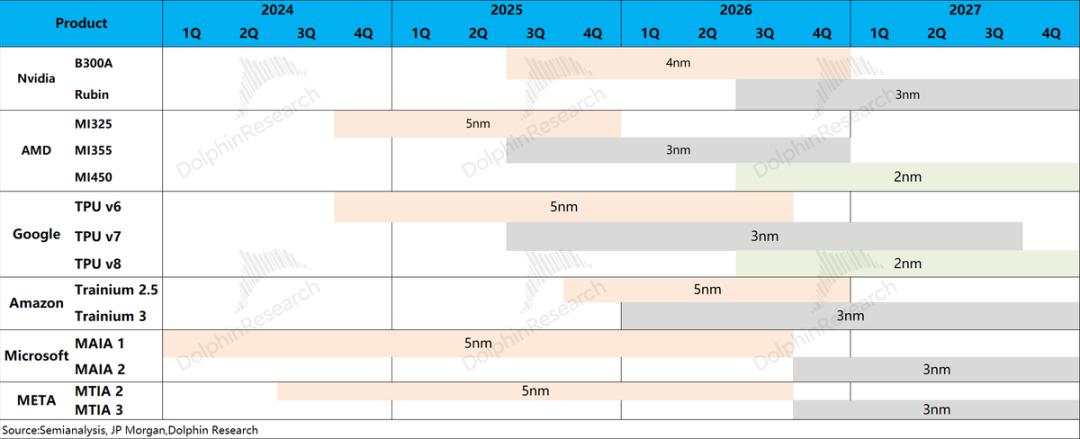
Especially when inference moves from Chatbox to Agentic inference, which is the current trend in the Harness project, the bottleneck of pure computing power is weakening, and assets such as memory and CPU have become more urgent bottlenecks.
That is to say, NVIDIA's products and system-level solutions still represent a significant lead in the industry. However, when the importance and bottlenecks of "memory, CPU, connection + cost-effectiveness" in AI technology become more prominent, and cloud providers have "alternative" solutions for inference computing power, NVIDIA's unique barriers and premium power in the training era have weakened.
Of course, with the industry's beta and the large-scale production of Blackwell, NVIDIA is currently in an undoubted period of performance release. The stock price will naturally rise with the shipment volume of Blackwell and the Vera Rubin, which is more suitable for the inference market in the second half of the year.
If the shipment of Vera Rubin exceeds expectations, NVIDIA may still have room for growth. However, it is becoming more difficult for NVIDIA to achieve a double-click on valuation and performance as it did in the past two years. In 2026, the stock price may only be supported by EPS growth. A more detailed value analysis has been published in the article with the same title in the "Dynamic - In - depth" section of the Changqiao App.
The following is a detailed analysis
I. NVIDIA's business situation
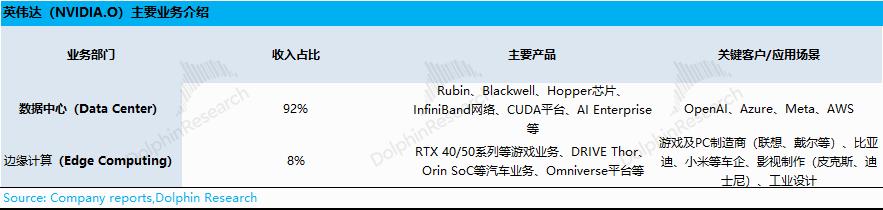
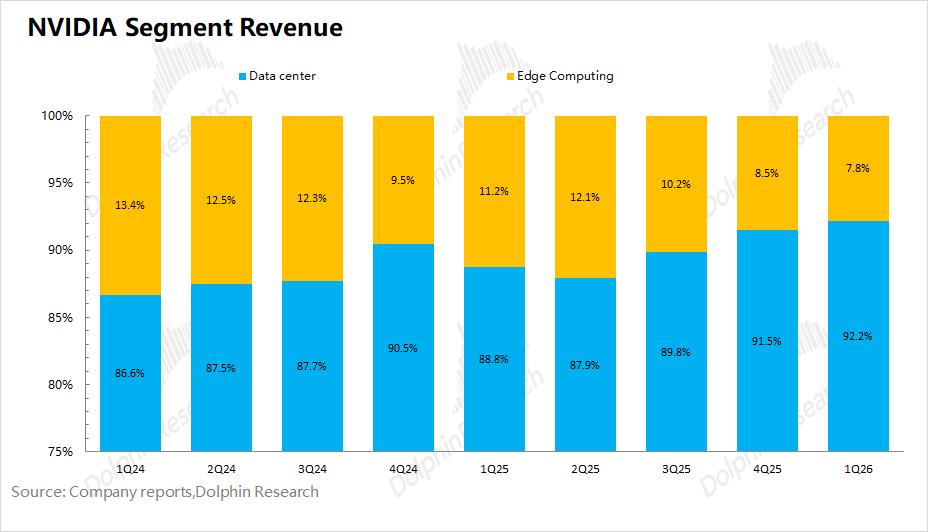
With the continuous growth of NVIDIA's data center business, it has now become the largest contributor to the company's revenue, accounting for more than 90%. The company adjusted its financial statements this quarter, integrating businesses such as gaming and automotive into the new "edge computing" business, and will no longer disclose them separately.
Looking at the specific businesses:
1) Data center business: This is the current main focus. Its main products include the Blackwell computing power chips and InfiniBand networks. The company's core customers are large cloud service providers such as Amazon, Microsoft, and Google.
The company's data center business is currently in the Blackwell product cycle, and the main products are B300/GB300. With the mass production of the Rubin new product in the second half of the year, the company's product cycle will shift from the Blackwell series to the Rubin series.
2) Edge computing business: This includes areas such as personal computers, game consoles, workstations, AI - RAN base stations, robots, and automobiles. The performance of each sub - business will no longer be disclosed separately.
In the edge computing business, the gaming business is the largest segment. The company's current main products are the RTX40 and RTX50 series, and the main customers are game players and PC manufacturers.
II. Core performance indicators: Slightly exceed market expectations
2.1 Operating revenue: In the first quarter of fiscal year 2027 (i.e., 1Q26), NVIDIA achieved an operating revenue of $81.6 billion, a year - on - year increase of 85%, better than the revised buyer's expectation ($78 - $80 billion). The $13.5 billion quarter - on - quarter increase this quarter almost all came from the data center business and the mass production ramp - up of the Blackwell series.
Looking forward to the next quarter, the company has given a revenue guidance of $91 billion, a quarter - on - quarter increase of $9.4 billion, better than the revised buyer's expectation ($89 billion). The company's growth in the next quarter will still be mainly driven by B300/GB300, and the Rubin new product will start mass production in the third quarter of 2026.
2.2 Gross profit margin (GAAP): In the first quarter of fiscal year 2027 (i.e., 1Q26), NVIDIA achieved a gross profit margin (GAAP) of 74.9%, basically in line with the market expectation (75%). The "collapse" of the company's gross profit margin in the same period last year was mainly due to the H20 ban.
The company expects the gross profit margin (GAAP) for the next quarter to be 74.9%, flat quarter - on - quarter, in line with the market expectation (74.8%). With the mass production ramp - up of Blackwell, the company's gross profit margin has returned to around 75%.
The company's management mentioned in previous communications that the target gross profit margin for fiscal year 2027 is 75%. This has given the market some confidence to a certain extent, but the market still worries about the risk of a decline in the gross profit margin after fiscal year 2027.
III. Core business progress: Cloud customers outside large companies contributed the main growth
Driven by AI capital expenditures, the revenue of NVIDIA's data center business (Compute + Networking) accounts for more than 90%. The combined share of other businesses has been squeezed to less than 10%. The company integrated these businesses into the edge computing business this quarter and will no longer disclose them separately.
3.1 Data center business: In the first quarter of fiscal year 2027 (i.e., 1Q26), NVIDIA's data center business achieved a revenue of $75.2 billion, a year - on - year increase of 92%. The data center business remains the company's main focus. The growth this quarter was mainly driven by the increased mass production of the Blackwell series of products, which was promoted by accelerated computing and artificial intelligence.
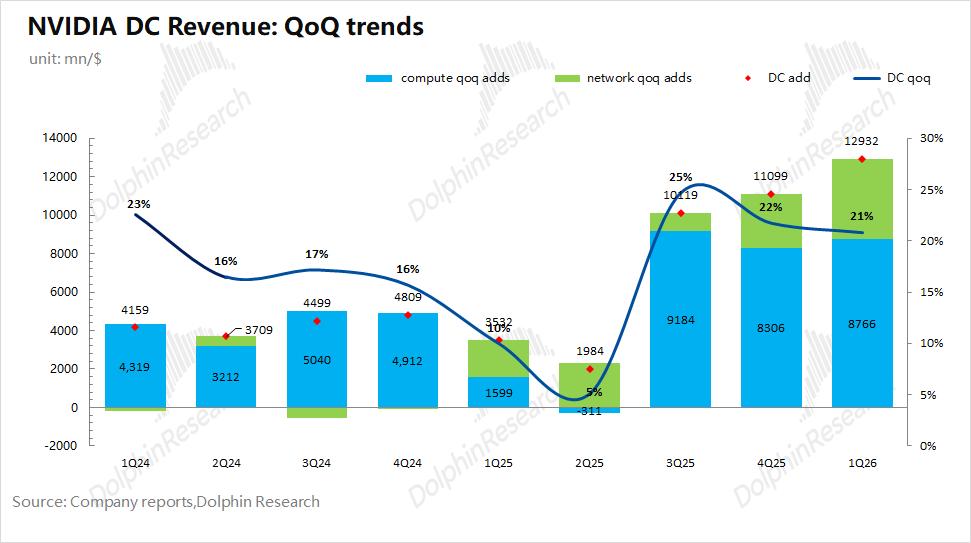
Specifically: ① The revenue from the computing business this quarter was about $60 billion, a quarter - on - quarter increase of $8.7 billion, and the growth in the shipment of B300 contributed the main increase; ② The revenue from the network business this quarter was about $15.1 billion, a quarter - on - quarter increase of $4.2 billion.
Currently, cloud service providers are still the largest buyers of the company's AI chips. Therefore, the capital investment of downstream cloud providers forms the