Held in China for the first time, Lisa Su of AMD appeared in Shanghai.
On May 19th, Advanced Micro Devices, Inc. (AMD.US, hereinafter referred to as AMD) held an AI Developer Day in Shanghai. As in previous years, there was a continuous stream of audiences and developers. Audiences without seats stood in row after row at the back.
During the keynote speech session, Lisa Su, the Chairwoman of the Board and CEO (Chief Executive Officer) of AMD, emphasized intelligent agents and further extended the view she had been stressing since the previous earnings report: the CPU (Central Processing Unit) is becoming increasingly crucial. Lisa Su believes that the ratio of CPU to GPU (Graphics Processing Unit) in traditional data centers is currently 1:4, and by 2026, this ratio will change to 1:1.
Notably, throughout the event, the frequency of appearance of Chinese technology companies, such as Lingyiwanwu, StepFun, Wuwenxinqiong, Xiaomi, and Alibaba, either on - site or in the speeches of guests, was comparable to that of words closely related to AMD's performance, such as CPU and intelligent agents.
AMD's senior management also tried to attract more Chinese customers, stating that top Chinese developers spend millions of yuan each year on API (Application Programming Interface) calls for complex coding tasks and daily intelligent agent tasks. If they can run data - center - level foundation models locally on an AMD workstation on their desks, they can significantly reduce costs. In the industry's view, with the rapid development of China's artificial intelligence industry, the computing power demand from leading enterprises to individual users is increasing day by day, and China has apparently become a "potential major customer" for computing power providers.
Emphasizing the Importance of CPU Again
In recent years, the demand for computing power has been outstripping the supply, and the status of manufacturers such as NVIDIA and AMD has risen accordingly. NVIDIA's GTC Conference and AMD's AI Developer Day are also regarded by the industry as the barometers of the artificial intelligence era. At this event, Lisa Su first mentioned the latest situation of the current AI development.
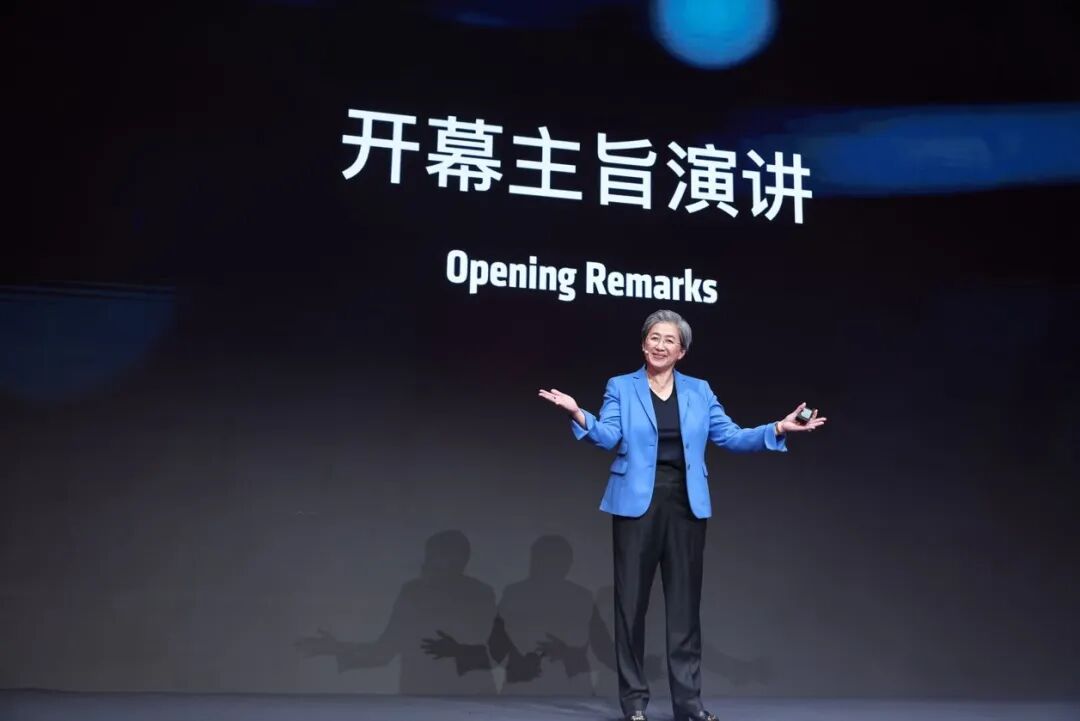
Lisa Su, Chairwoman of the Board and CEO of AMD, delivers the opening keynote speech. Photo provided by the organizer.
In Lisa Su's view, the development of inference and AI intelligent agents has brought about a transformation in computing demand. AI will be everywhere, and it will run on every device. The required performance must be able to scale up and be downward - compatible. "AI is running throughout the entire ecosystem. From large - scale cloud computing to PCs (Personal Computers), and then to physical systems and robots, AI is playing a role," Lisa Su said. She also cited a set of figures - currently, more than 1 billion people around the world use AI daily. Lisa Su predicts that in the next five years (by 2030), 5 billion people will use AI daily.
The arrival of intelligent agents has completely changed the way users use AI. Lisa Su said that the evolution of technology requires not only large - language models but also the ability of inference, learning, and data transfer, and intelligent agents coordinate all of these.
It should be noted that in addition to the GPUs, which have been in short supply since the rise of AI, the operation of intelligent agents also relies on a large amount of CPU computing power. In Lisa Su's view, the current society is entering the "CPU + GPU" era.
Lisa Su further explained this logical chain on - site: from "large - model - centered" to "intelligent agent orchestration", the operation of intelligent agents relies on inference, tool calls, data processing, and goal management, and each step heavily depends on the CPU. The GPU still does what it is good at, but the workload of the CPU has increased significantly in the inference scenario, and its role has changed from auxiliary to equal.
This is not the first time AMD has emphasized the importance of the CPU. On May 5th, AMD announced its financial results for the first fiscal quarter of 2026. The company's revenue was $10.25 billion, and the net profit was $1.38 billion, both exceeding expectations. At that time, AMD raised its long - term market space forecast for server CPUs, expecting the scale to exceed $120 billion by 2030. In addition, AMD expects the mid - point of its revenue in the second fiscal quarter to be $11.2 billion, and the revenue from server CPUs to increase by more than 70% year - on - year.
It should be noted that AMD has the EPYC product line in the CPU field and the Instinct series in the GPU field. If the 1:1 prediction holds true, AMD will be one of the few manufacturers that can supply products in both categories and will welcome the formation of this trend.
Behind Chinese Enterprises Lies a "Huge Mine" of Computing Power Demand
Since the Developer Day was moved from North America to China, it is natural to mention the Chinese market. Lisa Su said that China has the most active AI ecosystem in the world. "AMD has been deeply involved in China for more than 30 years. We regard China as the core of our driving roadmap, including silicon wafers, AI software, and platform engineering. We do this because we believe that we must be here to interact with the world's best AI practitioners in multiple fields."
Lisa Su emphasized that AMD's main R & D center in the Greater China region has more than 4,000 engineers, and the AMD Shanghai R & D Center is one of the company's largest global R & D centers. "We believe that the company must be rooted here to communicate with some of the world's top AI practitioners. From an AI perspective, our investment is not limited to R & D but truly covers every layer of the entire technology stack, including silicon software systems."
Notably, on the afternoon of May 18th, Lisa Su said in Beijing that she was deeply honored to visit China this time, and the Chinese market is extremely important. In a conversation with Ren Hongbin, the President of the China Council for the Promotion of International Trade, Lisa Su said that computing power has become the key to AMD's business, and she is very fortunate to maintain a stable and good cooperative relationship with major Chinese partners in this field. "I always look forward to the continuous deepening of cooperation between the two sides and the expansion of cooperation in more fields."
In addition, many entrepreneurs also appeared at the conference, such as Li Kaifu, the founder and CEO of Lingyiwanwu and the chairman of Sinovation Ventures; Zhu Yibo, the co - founder and CTO (Chief Technology Officer) of StepFun; and Wang Yu, the initiator of Wuwenxinqiong. Among them, Li Kaifu was present for the longest time. AMD also announced a joint project with Lingyiwanwu to build an enterprise intelligent agent all - in - one machine, which attracted the attention of many media and audiences.
Notably, in addition to the Chinese enterprises on stage, AMD also "quietly" mentioned many domestic technology companies this time. Jack Huynh, the senior vice - president and general manager of Computing and Graphics at AMD, showed and quoted the words of Luo Fuli, the person in charge of Xiaomi's MiMo large - model at the event: "The era of agents does not belong to those who burn the most computing power but to those who use it most wisely." Nick Ni, the senior director of AMD's Artificial Intelligence Division, also hinted at possible cooperation opportunities.
Nick Ni said that as he understands it, top Chinese developers spend millions of yuan each year on API calls for complex coding tasks and daily intelligent agent tasks. If they can run data - center - level foundation models locally on an AMD workstation on their desks, they can significantly reduce costs. He also revealed that AMD has optimized Chinese cutting - edge models such as Xiaomi MIMO, StepFun, and MiniMax. Using vLLM to run them locally, the speed exceeds the human reading speed, there is no cloud delay, there is no need to pay API bills, and the data stays locally. Nick Ni also announced that AMD is launching the first public AI developer cloud for Chinese AI developers, and it is free. In addition, through cooperation with ModelScope and Alibaba Cloud, AMD GPUs can also be directly used in the ModelScope Creation Space.
In recent years, China's artificial intelligence has developed rapidly. The more intense the competition among leading enterprises, the more resources are consumed, which has made them "potential major customers" for computing power providers. According to the latest data from OpenRouter, from April 27th to May 3rd, the total global AI large - model call volume was 23.9 trillion Tokens, an increase of 8.6% compared with the previous week, rising for two consecutive weeks. Among the listed AI large - models, the weekly call volume of Chinese AI large - models rose to 7.942 trillion Tokens, a month - on - month increase of 81.7%; the weekly call volume of US AI large - models was 3.258 trillion Tokens, a month - on - month decrease of 34.6%. After two weeks, the weekly call volume of Chinese AI large - models exceeded that of the US again.
This article is from the WeChat official account "NBD Daily". Author: Yang Hui. Editors: Cheng Peng, Zhang Yiming, Du Hengfeng. Proofreader: Liang Luyue. Republished by 36Kr with authorization.