Weibo has launched a picture search function, and the price may be the loss of the "feeling of real people".
Recently, Weibo announced the official launch of the image search function.
It is understood that this function includes three core capabilities: intelligent image recognition, discovery of similar images, and traceability of blog post screenshots. In terms of intelligent image recognition, Weibo's image search can accurately identify public figures, anime characters, popular scenic spots and other content, and parse the scene origin and background information with one click. The ability to discover similar images can help users match relevant content of the same series, the same character, and the same scene. The screenshot traceability ability means that after users upload blog post screenshots, they can directly reach the original post with one click.

From the perspective of product functions, Weibo's image search is not an innovative move. Many current Internet platforms have already implemented similar functions. Moreover, the development of AI technology also provides support for the experience of such functions. However, considering Weibo's current situation, this move may not just be to keep up with competitors.
Although the net profit attributable to shareholders in 2025 increased by 49% year - on - year, in terms of revenue, Weibo's performance remained basically the same year - on - year, and businesses such as advertising and value - added services continued to be under pressure. More importantly, Weibo's users are still continuously leaving. It is understood that in December 2025, Weibo's monthly active users were 567 million, compared with 590 million in the same period of the previous year, and the daily active users were 252 million, compared with 260 million in the same period of the previous year.
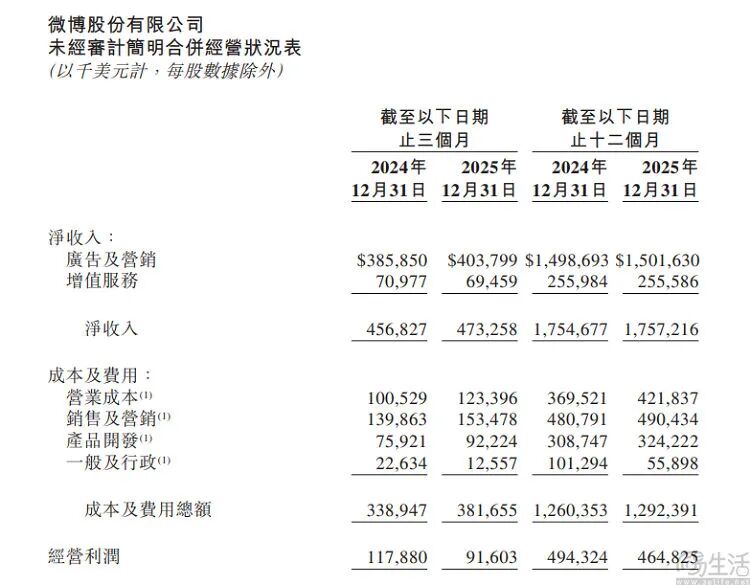
The reason is that compared with the current strong performance of short - video platforms, communities like Weibo rely more on interesting content to keep users. Coupled with the usage habit of "short - time browsing and leaving after use", it is difficult to form a regular content consumption habit. This is also the underlying logic of its weak revenue growth and continuous user loss.
Facing this shortcoming, Weibo needs to start from the content ecosystem. For a long time, users' content retrieval on Weibo has highly relied on keyword search. However, in the current mobile - end content consumption scenario, images, image - text, and short - videos have already become the mainstream. This means that a large amount of high - quality content cannot be accurately retrieved through text, resulting in a large amount of content assets being idle.
Therefore, Weibo's launch of the image search function this time obviously hopes to improve the content retrieval matrix, extend from text to images, lower the threshold for users to find content, so as to activate a large amount of existing image - type content, and at the same time, increase users' stay time and browsing frequency. Moreover, from a commercial perspective, more user search behaviors naturally mean more advertising spaces. For example, when a user searches for a photo of a celebrity at the airport, the same - style clothing and cosmetics can be accurately recommended. When searching for a photo of a scenic spot, OTA advertisements can be seamlessly embedded.

Furthermore, Weibo is now trying to change the content distribution logic.
Previously, at the end of July 2025, Weibo completed the architecture switch of the core home - page information stream, changing the content stream mainly based on follow - up relationships to a new - version home page mainly based on interest recommendation. Behind this change, Weibo hopes to create reasons for users to stay beyond hot topics. However, the implementation of the interest - based distribution logic not only requires algorithm optimization for content recommendation but also needs to meet users' needs, so as to form a two - way content consumption closed - loop of "passive recommendation + active retrieval".
If there is only passive interest recommendation and a lack of efficient active retrieval tools, users' personalized needs cannot be fully met, and the content ecosystem naturally cannot be activated. Therefore, from the logic of product iteration, Weibo's layout this time fully conforms to the refined operation thinking of Internet products. It takes user needs as the core, activating existing assets as the goal, and commercial increment as the foothold. From experience optimization to ecosystem improvement, and then to commercial implementation, the logic is self - consistent and progressive.
However, it should be noted that, considering Weibo's product attribute of an open square and the fan - circle - concentrated ecosystem, the image search function may face multiple unavoidable challenges after its launch.
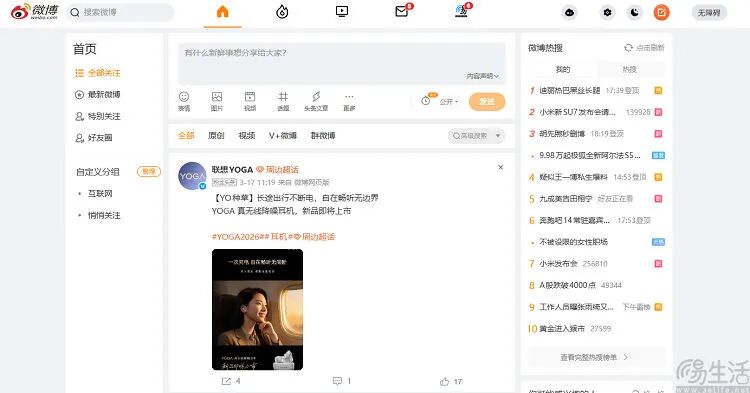
For example, while the screenshot traceability function is expected to help combat false image - text rumors and purify the public opinion environment, it may also become a new tool for malicious attacks in the fan circle. After all, in the past, for "anti - fans" and "negative remarks", it was still necessary to manually screen IDs and search through blog posts. Now, it is possible to accurately trace the origin through blog post screenshots and directly reach the original post with one click.
More importantly, this move may also bring new challenges to user privacy protection. It should be noted that the isolation between online anonymity and offline real identity is an important factor for Weibo to survive as a public expression space, and it also provides users with the possibility of "speaking under a different identity". However, image search may erode this firewall.
Some people may think that Weibo is an open platform and all the content posted is public, so what's the privacy problem? But this logic ignores a key fact, that is, public information does not equal authorization for arbitrary association. Some people may be willing to discuss a certain hobby under a net name on Weibo, but may not want this identity to intersect with reality; some people may be willing to post a photo of a scenic spot, but do not want others to locate their other content through this photo and piece together their complete life trajectory.
A more intuitive risk is the outbreak of the chaos of "acquaintance snooping". That is, after users post photos of their lives on Weibo, they may be located by colleagues, classmates, ex - partners, and relatives through image - to - image search. Once an anonymous account is accurately locked by an acquaintance, the user's private emotions, personal preferences, niche hobbies, negative emotion venting and other private content may be snooped by acquaintances, which will not only cause the leakage of personal emotional privacy but also easily lead to real - life problems.
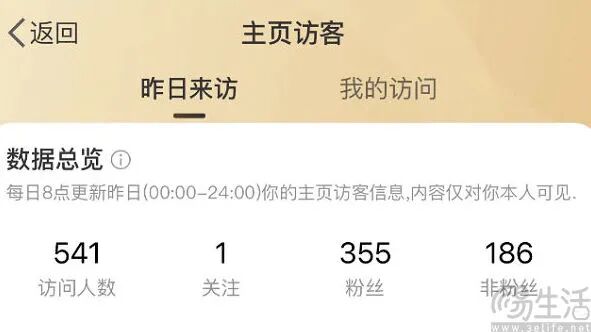
In fact, this is not the first time Weibo has faced such doubts. The visitor record function it previously launched has caused a lot of users' dissatisfaction. It seems that Weibo is a bit path - dependent on meeting users' voyeuristic needs.
This article is from the WeChat public account "3eLife" (ID: IT - 3eLife), author: 3eLife. Republished by 36Kr with permission.