Weibo hat die Bildsuchfunktion eingeführt, aber der Preis dafür könnte das Verlust des "Lebendigkeitseindrucks" sein.
Recently, the Weibo team announced that the image search function has officially gone online.
It is known that this function includes three core capabilities: intelligent image recognition, discovery of similar images, and tracking of blog screenshots. In intelligent image recognition, the image search on Weibo can accurately recognize public personalities, anime characters, popular tourist attractions and other content, and analyze the scene and background information with one click. The ability to discover similar images helps users find related content from the same series, with the same character or in the same scene. The screenshot tracking function means that users can directly access the original post after uploading a blog screenshot.

Considering the product functions, the image search on Weibo is not an innovation. Many Internet platforms have already implemented similar functions. The development of AI technology also supports the user experience of such functions. However, in the current situation of Weibo, this measure may not only aim to keep up with the competitors.
Although the net result for shareholders in 2025 increased by 49% compared to the previous year, Weibo's revenue growth remained essentially the same. Businesses such as advertising and value - added services are still under pressure. More importantly, the number of Weibo users continues to decline. It is known that the monthly active users of Weibo in December 2025 were 567 million (590 million in the same period of the previous year), and the daily active users were 252 million (260 million in the same period of the previous year).
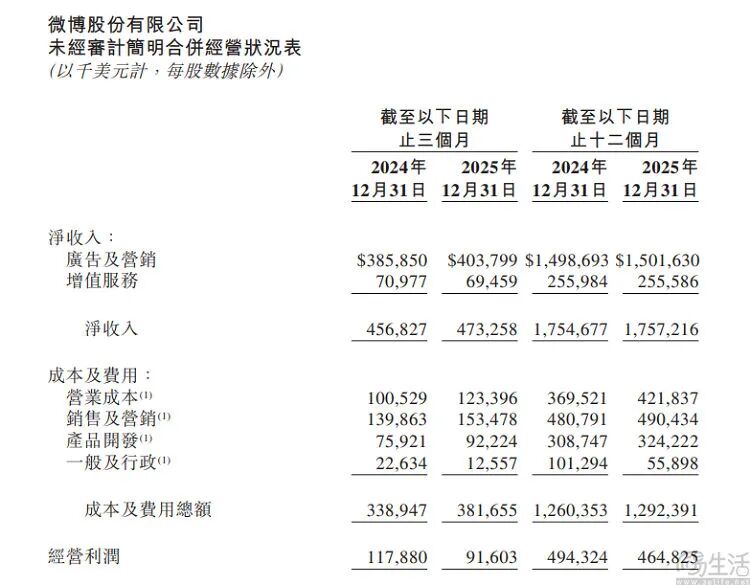
The reason is that compared with the strong performance of short - video platforms, Weibo as a community is more dependent on interesting content for user engagement. Together with the usage habit of "surfing briefly and then leaving", it is difficult to establish normal content consumption. This is also the underlying logic for the weak revenue growth and continuous user loss.
In view of this weakness, Weibo must start from the content ecosystem. For a long time, users' content search on Weibo has been highly dependent on keyword search. However, in today's mobile content consumption, images, image - text combinations and short - videos are already the mainstream. This means that a large amount of high - quality content cannot be accurately searched through texts, which leads to the inactivity of a large number of content resources.
Therefore, by introducing the image search function, Weibo obviously intends to improve the content search matrix, expand from texts to images, and reduce the difficulty for users to find content. This is intended to activate the large amount of existing image content, while increasing the user's stay time and search frequency. From a commercial perspective, more user search activities naturally mean more advertising space. For example, when a user searches for a photo of a star at the airport, suitable clothing and cosmetics can be accurately recommended. When searching for an image of a tourist attraction, OTA advertising can be seamlessly embedded.

Furthermore, Weibo is currently trying to change the logic of content distribution.
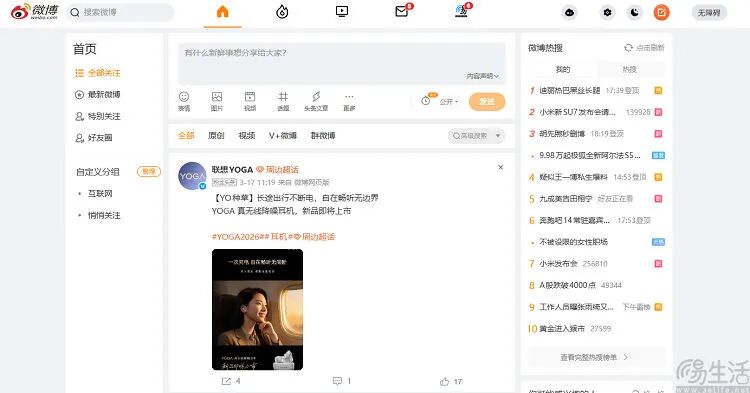
At the end of July 2025, Weibo changed the architecture of the core homepage stream and transformed the content stream, which was mainly based on the follower relationship, into a new homepage with interest recommendations. Behind this change is Weibo's intention to create reasons for users to stay on the platform. The implementation of the interest distribution logic not only requires the optimization of content recommendation through algorithms, but also the consideration of user needs to form a two - way content consumption cycle of "passive recommendation + active search".
If there are only passive interest recommendations and no efficient active search tools, the individual needs of users cannot be fully met, and the content ecosystem cannot be activated. From the perspective of product iteration logic, Weibo's current strategy fully conforms to the concept of the refined operation of Internet products. With user needs as the core, the activation of existing resources as the goal, and commercial improvement as the focus, from improving the user experience to perfecting the ecosystem and then to commercial implementation, the logic is consistent and progressive.
However, it should be noted that in view of the characteristics of Weibo as a public platform and the "fan circle" ecosystem, the image search function may have to face several inevitable challenges.
For example, although the screenshot tracking function can help combat false image - text rumors and purify the public opinion environment, there is also the possibility that it will become a new tool for malicious attacks in the "fan circle". So far, "anti - fans" and "negative opinions" had to be manually filtered by ID and blog posts searched. Now, however, one can accurately track through blog screenshots and directly access the original post.
More importantly, this measure may bring new challenges to the protection of user privacy. The separation between online anonymity and offline real identity is an important factor for the existence of Weibo as a public expression space and gives users the opportunity to "speak under another name". However, the image search could attack this protective wall.
Some may argue that Weibo is a public platform and all published content is public, so there are no privacy problems. However, this idea ignores a key fact: Public information does not mean that arbitrary linkage is authorized. Some people may like to discuss a hobby under a username, but may not want this identity to be associated with reality. Some may post a landscape photo, but do not want others to access their other content through this photo and reconstruct their entire life track.
An even more direct risk is the emergence of "peeping by acquaintances". When users post life photos on Weibo, these can be located by colleagues, classmates, ex - partners or relatives through the image search. Once an anonymous account is accurately identified by acquaintances, private emotions, personal preferences, niche hobbies, negative emotions and other private content can be viewed by acquaintances. This can not only violate the privacy of personal emotions, but also cause real problems in real life.
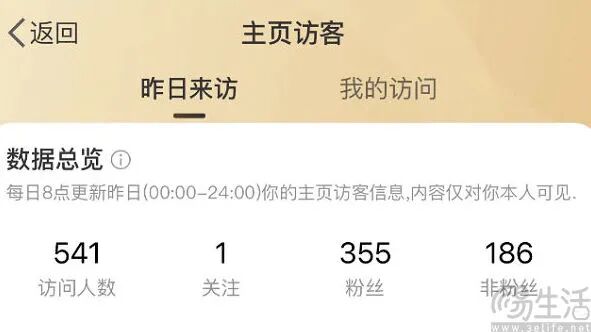
In fact, Weibo is not facing such doubts for the first time. The visitor record function introduced earlier has already irritated many users. It seems that Weibo is somewhat path - dependent in satisfying users' curiosity.
This article is from the WeChat account "3e Life" (ID: IT - 3eLife), author: 3e Jun, published by 36Kr with permission.