Altman exchanges tokens for equity, which can only last for 45 days. Donating 2 billion tokens to his alma mater is only worth $100: Have tokens really become "money"? Who benefits more?
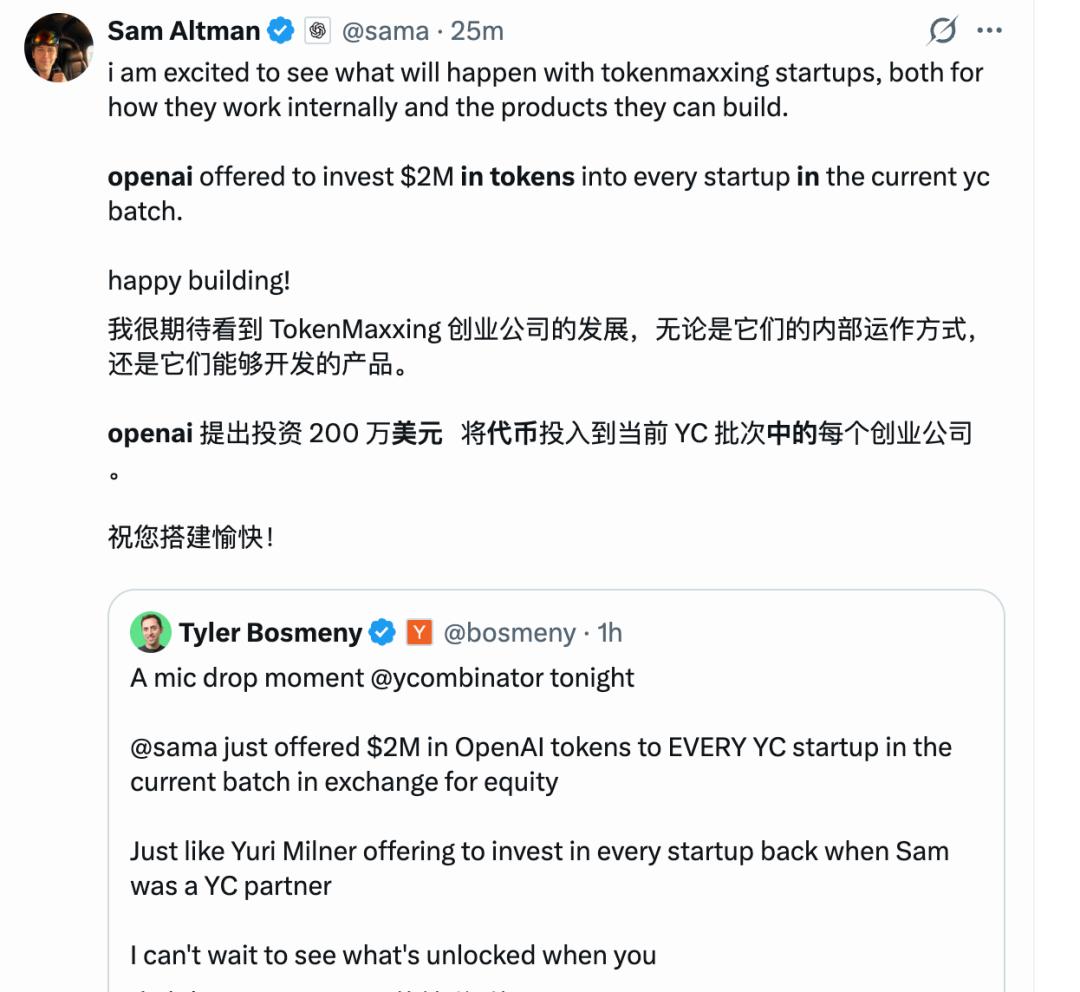
Today, YC partner Tyler Bosmeny stated on X that Sam Altman has just offered each startup in YC's current batch an exchange of 2 million US dollars' worth of OpenAI tokens for equity.
Bosmeny said, "This is a bit like when Sam was still a partner at YC, and Yuri Milner proposed to invest in every startup. I can't wait to see what will be unlocked when you let those most driven, creative, and tough founders make the best use of these tokens."
In response, Altman also replied on X, "I'm really looking forward to seeing what changes will happen to these startups that make the most of the tokens, whether it's in their internal working methods or the products they can develop."
Two million US dollars sounds like a large sum, but once converted into tokens, the situation is different.

It is reported that Peter Steinberger, the founder of OpenClaw, which is now under OpenAI, spends 1.3 million US dollars' worth of tokens in just one month, and this bill is paid by his employer, OpenAI. Peter said that most of the expenses are used for the development of OpenClaw, and he spends nearly 20,000 US dollars per day. Calculated this way, 2 million US dollars' worth of tokens is only enough for the "Father of the Lobster" for one and a half months.
For a startup aiming to maximize token usage, assuming the usage rate is the same as Peter's (theoretically it should be higher), would you agree to let OpenAI take a portion of your equity in exchange for providing you with free tokens for one and a half months?
"Two million US dollars' worth of tokens sounds like a lot, but once you connect the agent to a long tool trajectory, you'll find it's not that exaggerated," said individual builder ByteCrafter.
"Our triage agent running on four platforms consumes tokens much faster than I expected, mainly because the tool outputs keep consuming the context. Later, we added an inexpensive Haiku summarizer before each output re - enters the context, which really helped us save a significant amount of cost." He then asked: Has anyone actually tracked token costs at the task granularity level? Or is it still mainly based on intuition for most people?
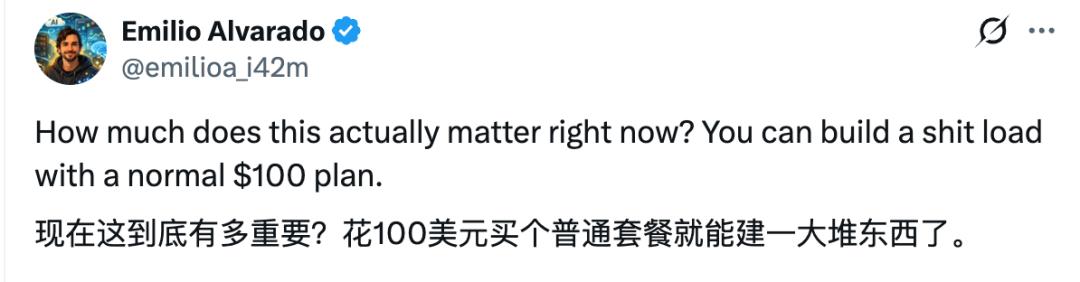
Of course, not everyone has Peter's level of consumption. A developer said that his entire AI expense is just 200 US dollars per week on Codex, and it runs out in just two or three days. "Two million US dollars' worth of tokens is roughly equivalent to 192 years of my bill. I really want to see what a team can achieve when they no longer have to scrimp on tokens." But this situation may not be considered "token - maximizing".
In any case, this is definitely a good deal for OpenAI.
Some netizens said that this is basically the ultimate version of the vendor - lock - in strategy. Offering a 2 - million - dollar free quota ensures that an entire generation of YC startups builds their core infrastructure on a closed ecosystem. By the time the subsidy runs out, they won't be able to afford the migration cost and will be dependent on this system.
Some netizens also pointed out that this is a smart and low - risk decision: directly grabbing competitive chips from Anthropic. Once a YC startup succeeds, it will use more and more OpenAI tokens. In this way, OpenAI can not only get back the 2 million US dollars but also make even more. Moreover, it will form a group of startups with strong stickiness because they will always remember that they got to where they are today because of your help back then. In addition, OpenAI gets equity.
"Has the token really become a financial security?" a netizen couldn't help asking.
But this kind of thing doesn't only happen in Silicon Valley.
Different from the traditional alumni donations of libraries, scholarships, or teaching buildings, three post - 2000s choose to donate tokens worth 2 billion to their alma mater.
According to media reports, on the afternoon of May 13th, in the lecture hall of the School of Foreign Languages at Zhengzhou Sias University, hundreds of "Token Egg" blind boxes were quickly snapped up by students. These blind boxes don't contain ordinary gifts, but a total of 2 billion AI tokens. These tokens can be used on the cross - border business AI workbench, Accio Work, and are expected to cover the usage fees of about 500 students for a month.
The donors of these tokens are three post - 2000s entrepreneurs who graduated from Zhengzhou Sias University: He Jiakun, Li Jiale, and Wang Teng. They all entered the cross - border e - commerce field either during their school days or after graduation, and some of them have achieved an annual foreign trade sales volume in the tens of millions of dollars.
"I didn't have AI when I started my business three years ago. If I had, the speed from 0 to 30 million would have doubled," He Jiakun said at the entrepreneurship sharing meeting. In addition to donating tokens, the three also shared on - site the application methods of AI skills suitable for "one - person companies", novice foreign trade workers, and student entrepreneurs, trying to turn their experience into replicable tools and processes.
Two billion tokens also sounds like an intimidating number, but some netizens said that calculated at 5 yuan for 100 million tokens according to ds4, it's equivalent to donating 100 yuan to the alma mater. "After all this, 2 billion tokens are not even worth the donation certificate in hand," they commented.
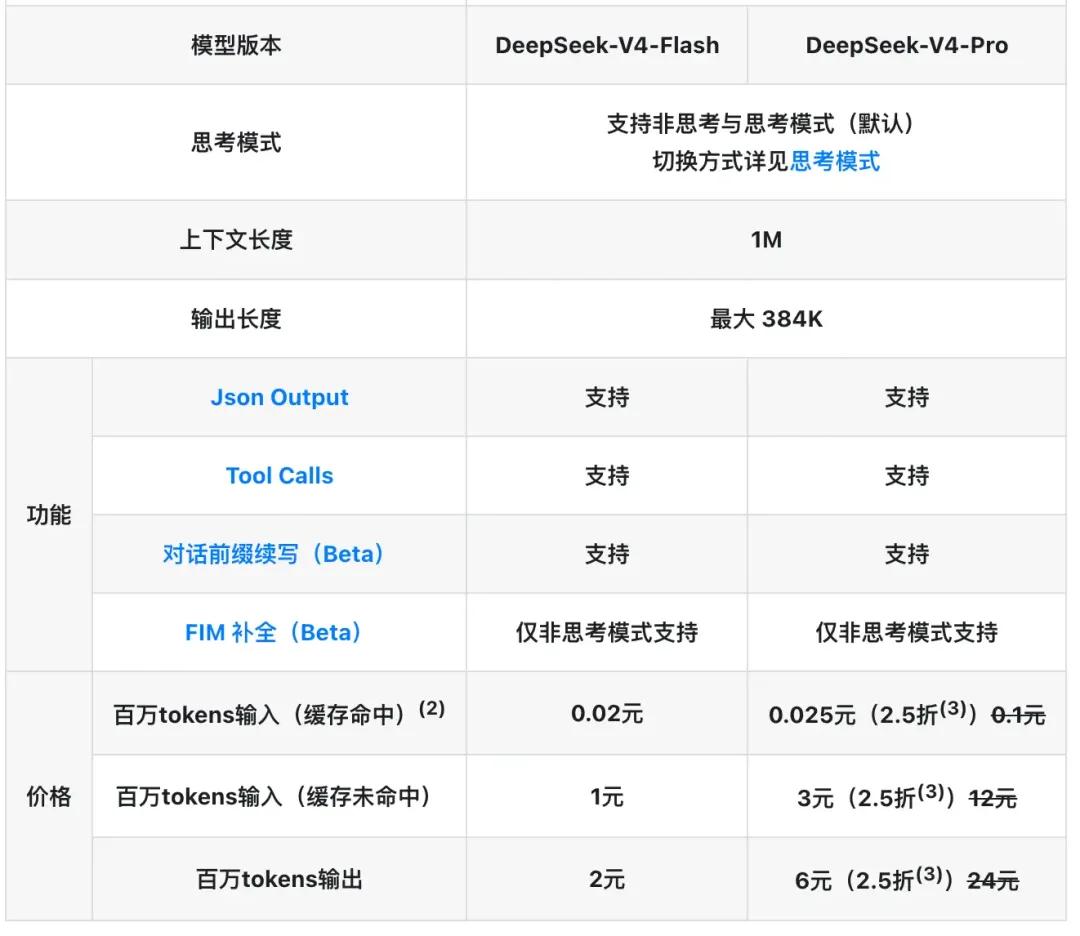
Price list of two DeepSeek models. The deepseek - v4 - pro is now on a 25% discount, and the offer is valid until May 31st.
On Zhihu, netizen "The Man in Gerard's Pen" said, "Two billion tokens in the world of large models is roughly equivalent to billions of Chinese characters. This is like asking an AI to read the entire 'Romance of the Three Kingdoms' thousands of times. For most people, they won't be able to write or read that many characters in their lifetime. But in the workplace, for example, a programmer who connects to the API of a large model to clean data, write code, and test code every day will find it easy to use hundreds of millions of tokens a day. This is why many office workers, when they see 2 billion, first wonder what this amount can do and think it will run out in just two days."
Feel left behind in AI? Then go for "token - maximizing"!
Welcome to the era of "token - maximizing".
If you're worried that you're falling behind in AI, developer Sigrid Jin has a piece of advice: use AI extensively until your monthly bill is comparable to your rent. Jin believes that "token - maximizing" is the best way to understand the value of AI, and he himself has used 50 billion tokens in a year.
Jin became popular at the end of March. At that time, Anthropic accidentally leaked the source code of Claude Code, and he then rebuilt the Claude Code repository. To avoid having it taken down due to copyright issues from this AI lab, he rewrote it in Python. This token - maximizing effort did pay off: Jin created the fastest - growing GitHub repository in history, called Claw Code. After that, Jin received job offers from several AI labs, but he decided to focus on his personal projects. He plans to start a startup next month.
Jin thinks that most people haven't really experienced the full value that AI can offer because they're only using the free version or a monthly subscription package worth 20 US dollars. He said that those who only use the basic version of AI are missing out on the "higher intelligence" that the 200 - dollar package can provide, and these higher - tier packages can offer a clearer return on investment.
"If you want to know what the future of AI looks like, try token - maximizing," he added, and also said that he would advise his friends, "Spend as much on AI as you pay for rent each month" to get a "return on investment".
This return could manifest as "running multiple businesses simultaneously" or delegating common daily tasks to AI agents. Jin said that there's no one - size - fits - all way to measure the cost - effectiveness of AI. Each company and individual uses this technology differently, so they need to establish their own benchmarks to measure the return.
Meanwhile, more and more companies are spending more on AI bills than on paying their human employees. But the problem is that the revenue brought by AI must exceed the token cost to justify these expenditures, especially for enterprise users.
The pressure to increase token consumption won't subside in the short term. When asked if he felt pressure to use more tokens, Jin replied, "Yes, of course."
This obsession with token - maximizing also appears in enterprises, where employees have to inflate their token usage, just like some Taobao merchants who inflate their sales volume.
Previously, The Information reported that some Meta engineers are competing to consume tokens just to make it onto an employee - created "Claudeonomics" dashboard leaderboard. This dashboard tracks usage and allows employees to compete for titles like "Token Legend".
"Ranking engineers by token consumption is like ranking my marketing team by who spends the most. Don't mistake high spending speed for high success rate," wrote Cristina Cordova, COO of Linear, on X.
It's reported that companies like Meta, OpenAI, and Anthropic all have internal token leaderboards.
This has also gradually become a way to show off. Founders and cutting - edge engineers will post their token consumption on X to show their level of investment in AI. An xAI employee wrote that the tech industry is turning every good idea into a "show".
Someone wrote on X, "I personally spend thousands of dollars on tokens every week... It feels crazy, but I can't stop token - maximizing."
Garry Tan, CEO of YC, also seems to agree with this approach. He retweeted a post criticizing companies for being "stingy" with tokens and wrote, "We've been token - maximizing for longer than most people."
Is token - maximizing a good incentive? There are significant differences within the tech circle on this issue.
Jon Chu, a partner at Khosla Ventures, said on X that using token consumption as a measurement method is an "absolutely stupid policy". He wrote, "Many of my friends at Meta told me that because of this policy, some people are writing robots to run in loops and burn tokens as fast as possible."
Edwin Wee Arbus, an employee at Cursor, is more cautious. He said that this metric is a "useful and quick proxy metric but has some flaws". He compared it to the body mass index (BMI): BMI can provide some health references but can't reflect muscle mass or bone mass.
Some people hold the opposite view.
"Token - maximizing is the craziest heuristic metric I've ever heard. In fact, I think better engineers should be able to solve problems with fewer tokens," a user wrote on X.
Gergely Orosz, the author of "The Pragmatic Engineer", thinks this approach is wasteful. He wrote, "As long as a metric is linked to more bonuses or promotions, developers will find a way to inflate it. This is no exception."
Someone summarized the problem of token - maximizing in one sentence: "Token - maximizing without token - verification is just token - wasting." In other words, if you just burn tokens without verifying the results, you're just creating a pile of token waste.
In Silicon Valley, a huge token budget is becoming a kind of "medal of honor" among developers. But it's very strange to use it to measure productivity because token consumption measures input, while what you really care about should be output. If your goal is to encourage employees to use AI more or if you're selling tokens, this metric might make sense; but if your goal is to improve efficiency, just looking at token consumption doesn't make much sense.
Engineers have to go back and modify AI - generated code
However, the ones most qualified to answer this question may be the big token consumers: software engineers.
Currently, a group of companies focusing on "developer productivity insights" have found that after using tools like Claude Code, Cursor, and Codex, developers do submit and retain more code. But at the same time, they've also found that engineers then have to go back and modify the accepted code more frequently.
This weakens the claim that "AI significantly improves productivity".
Alex Circei, CEO and founder of Waydev, said that engineering managers usually see an AI code acceptance rate between 80% and 90%, but they often ignore the rework and modifications that occur in the following weeks. Engineers have to revise the code repeatedly, which lowers the actual effective acceptance rate to between 10% and 30%.
The industry data is pointing to a conclusion: more code is being written, but a significant portion of it doesn't really settle down.
GitClear released a report in January this year stating that AI tools do improve productivity, but "developers who use AI frequently have an average code attrition rate 9.4 times that of developers who don't use AI". This attrition rate is more than twice the productivity improvement brought by these tools.
The report of the engineering analysis platform Faros AI in March used two - year customer data. The results showed that in an environment with high AI adoption, the code attrition rate (the ratio of deleted lines of code to newly added lines of code) increased by 861%.
Jellyfish, an intelligent platform for AI - integrated engineering, collected data from 7,548 engineers in the first quarter of 2026. The platform found that engineers with the highest token budgets did produce the most pull requests (PRs), but the productivity improvement wasn't proportionally amplified. They spent 10 times the token cost but only got twice the throughput. That is to say, these tools bring more "quantity" but not necessarily more "value".
These statistical data are consistent with the real feelings of many developers. While developers enjoy the freedom brought by new tools, they also find that code reviews and technical debt are piling up. A common phenomenon is that there's a significant difference between senior engineers and junior engineers: the latter are more likely to accept AI - generated code and thus have to bear more rewriting and rework later.
Large companies are still exploring how to use AI tools efficiently. For example, last year, Atlassian acquired another engineering intelligence startup, DX, for 1 billion US dollars, aiming to help customers understand the return on investment (ROI) of programming agents.
However, even though developers are still trying to figure out what their AI tools are actually doing, they don't think the industry will quickly return to the past.
"This is a new era of software development, and you have to adapt. As a company, you're also forced to adapt. It's not like a passing fad," Circei said.
The token frenzy is too expensive, and the economics are in jeopardy
However, the token frenzy at home and abroad still hasn't made economic sense.
"Currently, for the vast majority of people involved, AI is not economically viable," Ed Zitron, CEO of EZPR, directly pointed out in his latest article.
He believes that the real money - makers are not AI application companies or large - model labs, but construction companies, NVIDIA, and the hardware supply chain that benefits from data center construction. The entire industry is betting on an unproven profitable future with an almost irrational optimism.
In the past three years