What is OPC? What are some successful OPC business models?
OPC (One-Person Company) is a new type of entrepreneurial paradigm that has emerged in the AI era. Adopting the 1+N model of "1 founder + N AI digital employees", it transforms entrepreneurship from being capital-intensive to cognition-intensive. This article systematically breaks down the definition of OPC and its six successful business models (professional services/high-end services/knowledge products/digital products/creative content/platform integration). It also analyzes how ordinary people can seize this wave of AI dividends by referring to real cases of entrepreneurs such as Dan Koe, Peter Steinberger, and domestic OPC entrepreneurs.
The other day, I was stunned when I saw a piece of data.
As of June 2025, the stock of one-person companies across the country reached 16 million, accounting for 27.4% of the total number of enterprises. The growth rate of newly registered one-person companies was 47%. That is to say, one out of every three newly registered enterprises is a one-person company.
16 million.
What does this number mean? It's almost equivalent to the total population of Australia all becoming bosses of one-person companies in China.
My first reaction was, is there something wrong with this data? Where did so many one-person companies come from?
But then I thought about it carefully, and it seemed that I was wrong.
In the past two years, many of my friends around me have quietly turned their companies into the "one-person model". Some are engaged in AI cross-border marketing, some in content products, and some simply run a SaaS tool and earn a stable income in US dollars every month.
They have one thing in common: almost all of them are using AI.
It's not just "occasionally using ChatGPT". They really regard AI as the core productivity and even as "employees".
This is how the concept of OPC came about.
I thought about it and realized that this matter might be much more important than many people thought. So today, let's talk about what OPC really is and what OPC business models have been successfully implemented.
First, let me give my own definition of OPC.
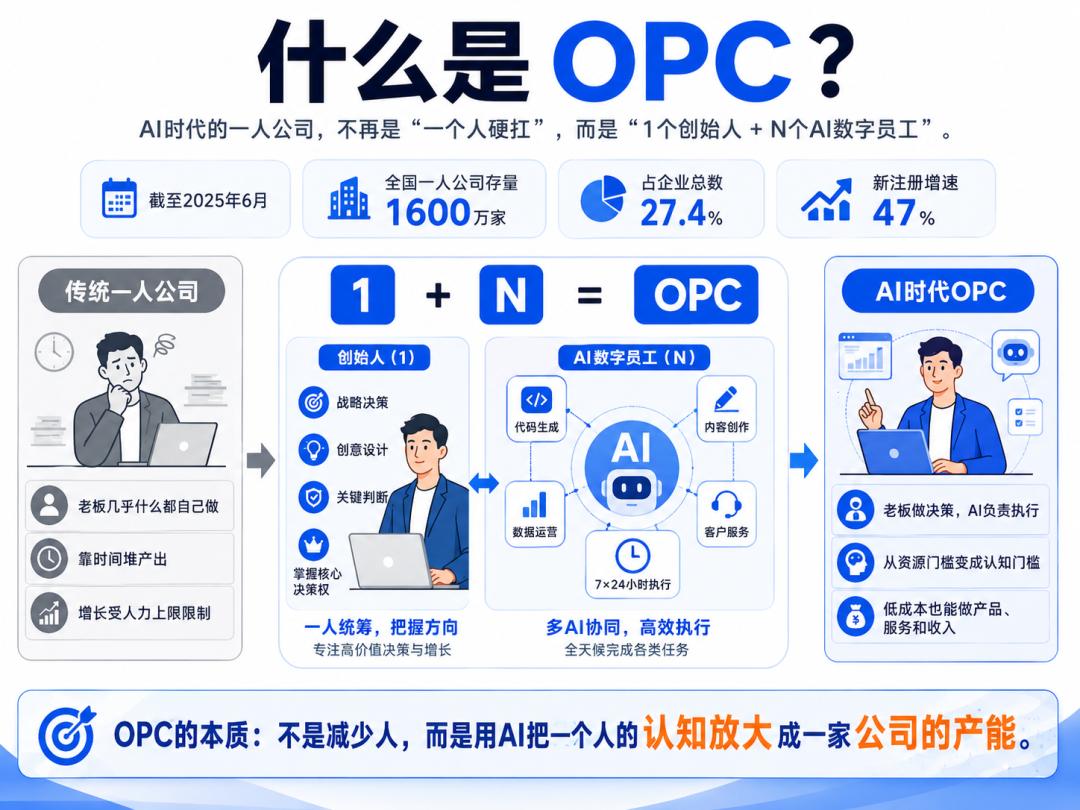
OPC, short for One-Person Company, is called a one-person company in Chinese. However, the OPC people talk about in 2026 is different from the traditional one-person company.
What was a traditional one-person company like? There was a boss who did everything by themselves, including taking orders, working on projects, issuing invoices, and doing accounting. They had to stretch themselves thin.
What is an OPC in 2026 like? There is a boss plus N AI digital employees. The boss is responsible for decision-making, creativity, and judgment, while the AI is responsible for execution, production, operation, and customer service, working 24/7 without rest.
So the key to this definition is not "one person", but "one person + AI computing power".
The report from smartcity.team calls this the "1+N model", which I think is very accurate.
The "1" represents the founder, who makes strategic decisions, creative designs, and key value judgments, and holds the core decision-making power.
The "N" represents AI digital employees, who undertake standardized and repetitive tasks such as code generation, content creation, data operation, and customer service, significantly improving execution efficiency.
The core advantage of this model is that entrepreneurship has shifted from being capital-intensive to cognition-intensive.
You don't need to raise millions of dollars and hire dozens of people. You only need to have a deep enough understanding of a certain field and know how to use AI to turn this understanding into products, services, and income.
This would have been unimaginable five years ago.
Five years ago, if you wanted to develop a SaaS, you had to know how to write code or have enough money to hire someone who could. If you wanted to create content, you had to write, edit, and operate it all by yourself. If you wanted to engage in cross-border business, you had to know English, understand overseas channels, and have supply chain resources.
What about now?
Claude Code can write code, Seedance can generate content, AI can provide real-time cross-language translation, and even customer docking can be screened by AI Agents first.
Therefore, the explosion of OPC is not accidental. AI has lowered the threshold of entrepreneurship from the "resource threshold" to the "cognition threshold".
And this is the really noteworthy aspect of this matter.
After discussing the definition, let's talk about something more specific.
What OPC business models have been successfully implemented? I've sorted out six categories, and there are real cases for each category.
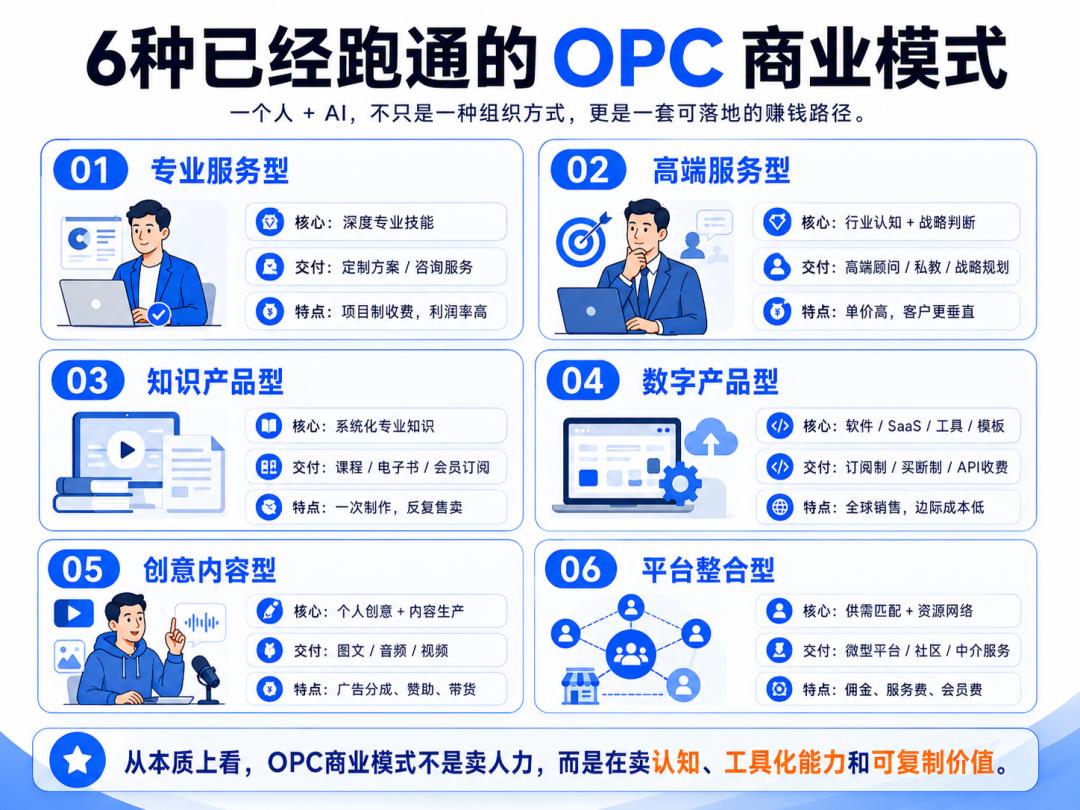
The first category is the professional service type.
This is the most traditional and stable category. The core value lies in your in - depth professional skills, and the delivery form is customized solutions or consulting services, charged on a project - by - project or hourly basis.
For example, there is a person named Wu Peiwen who provides AI cross - border marketing services. He is not from a technical background, but he understands cross - border business and marketing, and knows how to combine the two with AI. His charging model is based on projects, with each project worth tens of thousands of yuan. He runs the business alone and has a very high profit margin.
The core barrier of this model is your professional depth. AI can help you improve efficiency, but it can't replace your understanding of the industry.
The second category is the high - end service type.
This category is a bit similar to the first one, but the fees are higher, and the target customers are more niche. The core value is your industry knowledge and strategic judgment ability, and the delivery form is high - end consulting, private coaching, and strategic planning services.
Wang Rui's business consulting service is an example. He doesn't provide consulting services for ordinary people. Instead, he serves business owners of a certain scale, helping them with strategic planning for AI transformation. Each project is worth hundreds of thousands of yuan. He doesn't get many projects in a year, but the income is very considerable.
The core barrier of this model is your cognitive height. AI can help you organize materials and generate reports, but strategic judgment still depends on you.
The third category is the knowledge product type.
This is the category I'm most optimistic about because the marginal delivery cost approaches zero. The core value lies in systematic professional knowledge, and the delivery form is standardized digital products such as courses, e - books, and membership subscriptions.
There is a finance and taxation IP who created a "Guide to Avoiding Pitfalls in Tax Planning for Small and Medium - Sized Enterprises". Once it was created, it could be sold repeatedly. It took some time to create, but after that, each sale was pure profit, without the need for further time investment.
The core barrier of this model is your ability to structure knowledge. You need to turn a complex field into something that others can use directly. AI can assist in this process, but the framework design, case selection, and tone control still need to be done by humans.
The fourth category is the digital product type.
This is the category with the highest technical content, but also the one with the greatest potential for scale. The core value lies in reusable software or digital tools, and the delivery form is SaaS, applications, plugins, and templates. The profit models include subscription - based, one - time purchase, and API call fees.
There is a case that impressed me deeply. Peter Steinberger from Austria developed an open - source AI agent framework called Clawdbot (that is, Moltbot) by himself. After its launch, it quickly attracted the attention of global developers. This open - source project developed by a single person is now valued at the level of a "one - person company worth one billion US dollars".
There is also a domestic example. Su Kui developed an AI skeletal animation creation platform called "Longgu Animation". The domestic version is on a subscription basis, with a monthly fee of 20 yuan and an annual fee of 200 yuan, and there are about 300 paying users. The overseas version is free to attract global users, and it explores annual sales of millions of yuan relying on OPC community resources, with a monthly operating cost of only a few thousand yuan.
You read that right. The monthly operating cost is only a few thousand yuan, while the annual sales reach millions of yuan.
This is the power of the digital product type. Once developed, it can be sold globally, and the marginal cost approaches zero.
The fifth category is the creative content type.
This is the type with the lowest threshold but also the highest ceiling. The core value lies in your personal creativity and content production ability, and the delivery form is multimedia content such as text, audio, and video. The profit models include platform advertising revenue sharing, content payment, brand sponsorship, and live - streaming e - commerce.
There is a person named Guo Guo who has no technical background. Relying on AI tools, she developed a goal - punching app and earned nearly 9,000 yuan in just over a month. She also operates an account with 66,000 followers, generating income from both content and products.
The core barrier of this model is your content ability and the sense of connection with your fans. AI can help you improve efficiency, but AI can't replace "who you are".
The sixth category is the platform integration type.
This is the type that is most like a "business". The core value lies in the ability to match supply and demand and the resource network, and the delivery form is a micro - platform, community, or intermediary service. The profit models include transaction commissions, platform service fees, and membership fees.
There is a supply - demand matching platform called "OPC Order - Taking Bar" that specifically connects OPC entrepreneurs with projects and orders and takes a commission from the transactions. It sounds crazy that one person can run a platform, but AI makes it possible, which was unimaginable in the past.
The above six categories are the most mainstream OPC business models I've seen so far.
You may ask, these models all sound great, but has anyone really made them successful and achieved a large - scale operation?
Yes. And there are more cases than you think.
Let me share a few that impressed me the most.
The first one is Dan Koe.
I believe that those who follow the AI circle have heard of him to some extent. He is an American content creator who handles personal branding, courses, and consulting services all by himself.
According to the data in 2025, his annual revenue exceeded 5 million US dollars, with a profit margin of 98%.
98%.
You read that right. Because what are his core costs? Just his own time and the subscription fees for a few AI tools. There are no office rents, no employee salaries, no social security and housing funds, and no other miscellaneous expenses.
One person, with an annual revenue of 5 million US dollars and a profit margin of 98%.
What shocked me the most about this case is not the numbers, but the fact that it proves that "the business ceiling for one person" is much higher than everyone thought.
Previously, you might think that for a single - person company, an annual revenue of 1 million yuan would be quite good. Dan Koe has raised this ceiling to 5 million US dollars.
And he is not an exception.
The second case is about a Chinese - Australian entrepreneur.
He and two partners developed 24 SaaS products using AI, forming a product matrix. AI undertakes the entire process of code development, SEO optimization, advertising placement, and social media operation. In the past 30 days, they consumed more than 6.5 billion Tokens, completed major updates for 6 products, and had a monthly turnover of about 100,000 US dollars.
Note that his team only has 3 people.
3 people, 24 SaaS products, and a monthly turnover of 100,000 US dollars.
According to the standards of traditional software companies, at least hundreds of people would be needed to develop 24 products. But now, 3 people can handle it.
The third case is about Chen Kuihan from Suzhou.
He is working on a lightweight robotic arm project. Relying on the technologies of "tactile sensors + diffusion models + reinforcement learning", he has created a low - cost and easy - to - use lightweight robotic arm suitable for education and small - scale manufacturing scenarios. In less than a year, he has received orders from laboratories and started cooperation discussions with well - known home appliance enterprises.
One person has completed a hardware + AI project that usually requires a technical team of more than a dozen people.
The fourth case is about Ouyang Chenxi from Nanjing.
With a background in biomedicine, he single - handedly completed the design of medical imaging algorithms, the construction of a platform, and the development of the front - end UI with the help of AI. The implementation cost is low, and he has connected with the needs of multiple medical institutions through the OPC community.
This case is particularly interesting because he is not from a technical background but from biomedicine. However, he used AI to "translate" his professional ability into a product, and there are people willing to pay for it.
After reading these cases, you may think that this matter seems quite close to you?
To be honest, I also think it's close to me.
Moreover, I think this may be the biggest opportunity that ordinary people can seize in the next five years.
However, although OPC sounds appealing in theory, it's a completely different story in practice.
The data in the 2026 China OPC White Paper is quite harsh in some aspects.
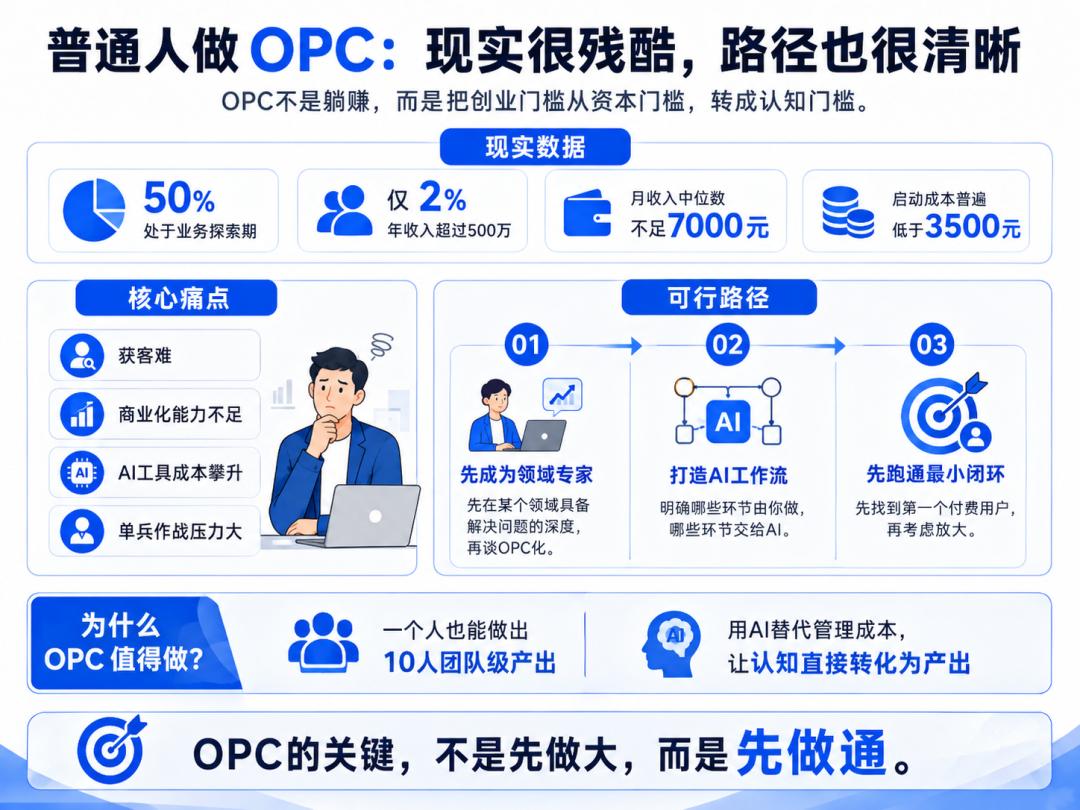
50% of OPCs are in the business exploration stage, and only 2% of OPCs have an annual income of more than 5 million yuan.
The median monthly income is less than 7,000 yuan.
The startup cost is generally less than 3,500 yuan, and most people's income is indeed commensurate with this startup cost.
The core pain points are difficult customer acquisition, insufficient commercialization ability, rising costs of AI tools, and high pressure of working alone.
So OPC is not a "get - rich - quick" scheme. It just changes the threshold of entrepreneurship from capital to cognition, but in fact, cognition is rarer than capital.
If you have 10 million yuan, you can invest it blindly, and there will be someone to manage it for you. But if you have in - depth industry knowledge, this knowledge can't be transferred; you have to develop it on your own.
So for ordinary people, if they want to move in the direction of OPC, is there a relatively feasible path?
I've sorted out a few ideas, which may not be entirely correct, and we can discuss them together.