Dissecting the Dreame Universe: The Four-Tiered Structure Behind 955 Companies
Why does a technology company founded less than a decade ago establish 200 business units and register nearly 1,000 subsidiaries?
This question has become the biggest doubt surrounding Dreame Technology in the outside world recently.
Since officially proposing to become a "boundaryless ecological enterprise" in 2025, Dreame has been on a rapid development path. Yu Hao, the founder of Dreame, has plans to build cars, develop manned aircraft and satellite networks, and even jointly build airplanes with Commercial Aircraft Corporation of China.
Since 2026, Yu Hao's high - profile stance has attracted external attention. He said, "The Dreame ecosystem will become the first company ecosystem worth one trillion US dollars in human history." More than a month ago, he put forward more specific figures on Weibo: the revenue should exceed 100 billion yuan this year, 300 billion yuan next year, and aim for one trillion yuan the year after. According to reports from media such as Caixin, Dreame's revenue just exceeded 40 billion yuan in 2025.
Simultaneously with these figures, Dreame's rapidly expanding equity map is advancing: automobiles, mobile phones, robots, chips, trendy toys, coffee... According to Qichacha data, as of May 19, the number of member enterprises of Dreame Technology has reached 955. According to Securities Times, data from Zhizhong ZERONE shows that the management scale of the Sky Workshop Venture Capital Fund associated with Dreame reaches 25.2 billion yuan. Behind the 29 funds under it, there is almost the participation of local state - owned assets, covering more than 10 cities.
People tend to understand Dreame as an infinitely expanding large company. However, after we penetrated Dreame's equity layer by layer, we found that it is not a behemoth that puts all businesses into the same entity, but a precise system built around the founder, core business, and capital platform. Behind different businesses and brands, there are different controlling entities, which are relatively independent of each other but closely connected in terms of resources.
We attempt to disassemble this system. Taking equity and investment relationships as clues, we start from four levels: the companies directly controlled by Yu Hao himself, the enterprises held by the main body of Dreame, the layout of each business line and external investment, and the "Sky Workshop" of the industrial fund system - to restore the design logic of this framework and answer several questions: What exactly does Dreame want to do? How does this design operate? What kind of risks is it accumulating?
Yu Hao's control
In the four - layer equity structure design of Dreame, the first layer is Yu Hao himself. At the top of the complex network of 955 companies, the end - points of most chains point to Yu Hao and his affiliated parties. To understand Dreame, we must first understand this layer: How does Yu Hao hold the control in his own hands, and through which entities does he exercise this control?
In September 2025, when rumors of Dreame's bankruptcy spread, Yu Hao revealed in his WeChat Moments that in the past two years, the company and he personally took out 5 billion yuan to repurchase old shares. His shareholding ratio in Dreame Technology (Suzhou) Co., Ltd. - the parent company of the Dreame system - increased from 45% to 70%. Qichacha shows that Yu Hao's current shareholding ratio is 62.3%.
A 62.3% shareholding means that Yu Hao's control over this "building" is difficult to be diluted.
The companies actually controlled by Yu Hao can be divided into three categories. One category is the parent companies of investment platforms without actual business, mostly starting with "Sky", such as Sky Surfing Technology (Beijing) Co., Ltd., Sky Soaring Technology (Shanghai) Co., Ltd., etc. The registered capital is not much, all at 1 million yuan. A common idea is that these companies can be used for shareholding, equity transfer, or introducing new shareholders in the future, which are a kind of "capital tools".
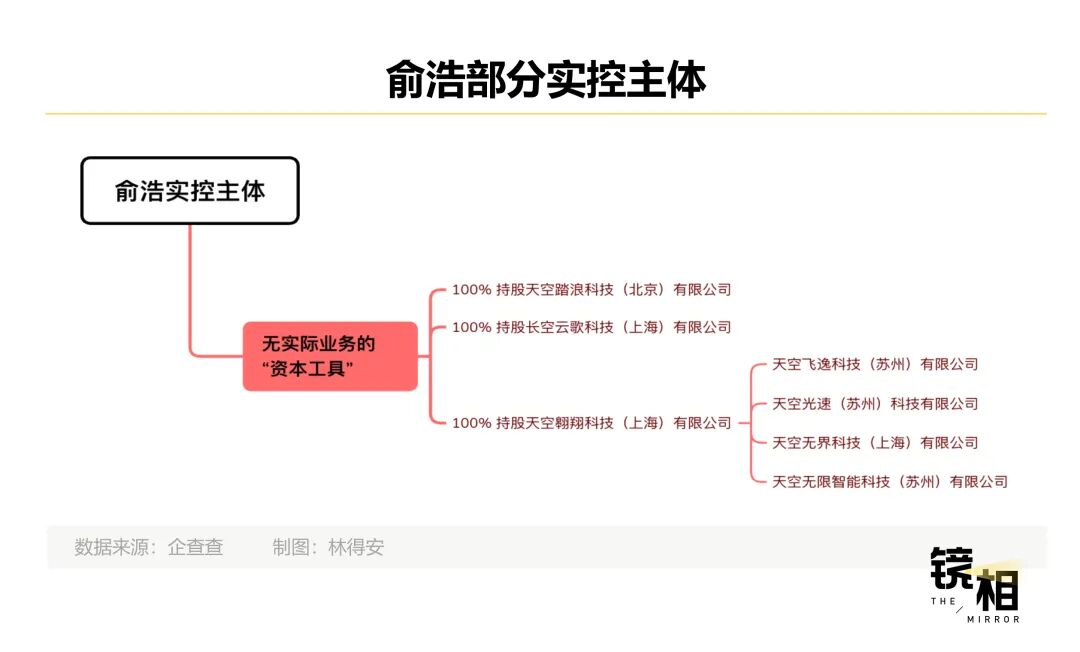
The second category is companies with actual business but parallel to the main body of Dreame, including Zhuanxin Jingjie Intelligent Technology (Nanjing) Co., Ltd. which focuses on washing and drying, Bingke Jiyuan Intelligent Technology (Nanjing) Co., Ltd. which focuses on refrigerators, and Xingchen Zhigu Innovation Technology (Nanjing) Co., Ltd. - which bought a piece of land in Nanjing in 2025 and, according to information released by the local government's WeChat official account, will be used to build the intelligent home appliance headquarters base of Dreame Technology.
Ketting Technology (Suzhou) Co., Ltd., which makes garden mowing robots, is also such a parallel company. Moreover, it has a special status - it is the partner with the highest capital contribution ratio among the six partners of Zhuyue Hongzhi. At the end of 2025, Yu Hao spent 2.282 billion yuan to acquire 25.42% of the shares of A - share listed company Jiamei Food Packaging (Chuzhou) Co., Ltd. through Zhuyue Hongzhi, becoming the actual controller of Jiamei Packaging.
Jiamei Packaging was listed on the Shenzhen Stock Exchange in December 2019. Its main business is food and beverage cans, which has no direct connection with Dreame's main business. The outside world often interprets this as Dreame's attempt to "back - door list".
In this regard, Jiamei Packaging stated in its announcement that as of now, Zhuyue Hongzhi has no plan to change the main business of the listed company or make major adjustments to the main business of the listed company within the next 12 months; there is no plan for asset restructuring such as selling, merging, cooperating with others, or the listed company's plan to purchase or replace assets of the listed company or its subsidiaries within the next 12 months.
However, three months before the acquisition of Jiamei Packaging, Yu Hao posted in his WeChat Moments that starting from the end of 2026, multiple businesses under the Dreame ecosystem will conduct batch IPOs on various global exchanges "like dumplings".
This is partly interpreted in the market as Dreame not only focusing on the listing of a single entity but hoping to gradually promote the capitalization of multiple businesses. Although Jiamei Packaging is most likely not the "shell" for the main body of Dreame, it is very likely to be the "shell" for other companies in the ecological chain.
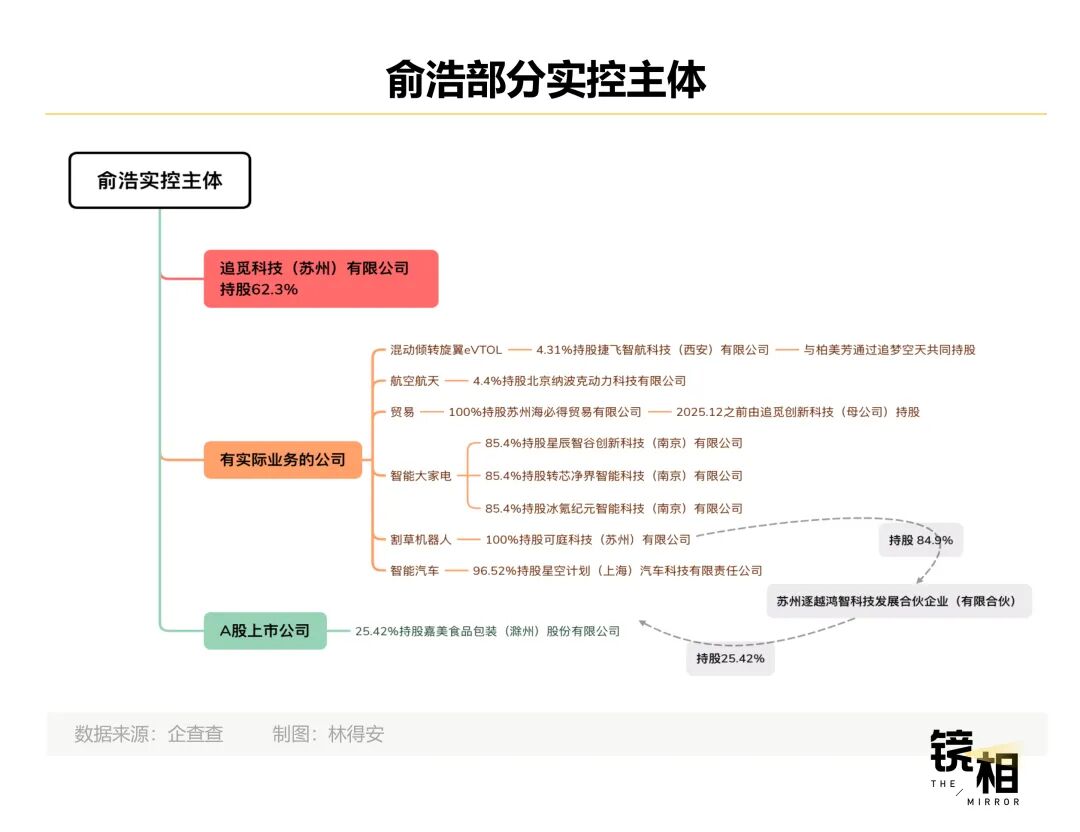
The third category of enterprises directly controlled by Yu Hao is the car - making business, which he values most subjectively.
Currently, Yu Hao has two new energy vehicle brands. One is the "Dreame Auto" brand, with the main body being Xingchen Future (Suzhou) Automobile Technology Co., Ltd., and the actual controller is Bai Meifang, the only natural - person shareholder other than Yu Hao in Dreame Technology (parent company).
The other is the "Star Project", with the main body being Star Project (Shanghai) Automobile Technology Co., Ltd., and the actual controller is Yu Hao himself, with a capital injection of 1 billion yuan. It has many subsidiaries, among which the solid - state battery company Jinghe Energy, the steer - by - wire company Xingsu Changkong, and the range - extended power company Xingjing Qianyue have their main products and brands. Both of the latter two completed tens of millions of angel - round financing this year, and the leading investor is the Sky Workshop Venture Capital Fund associated with Dreame.
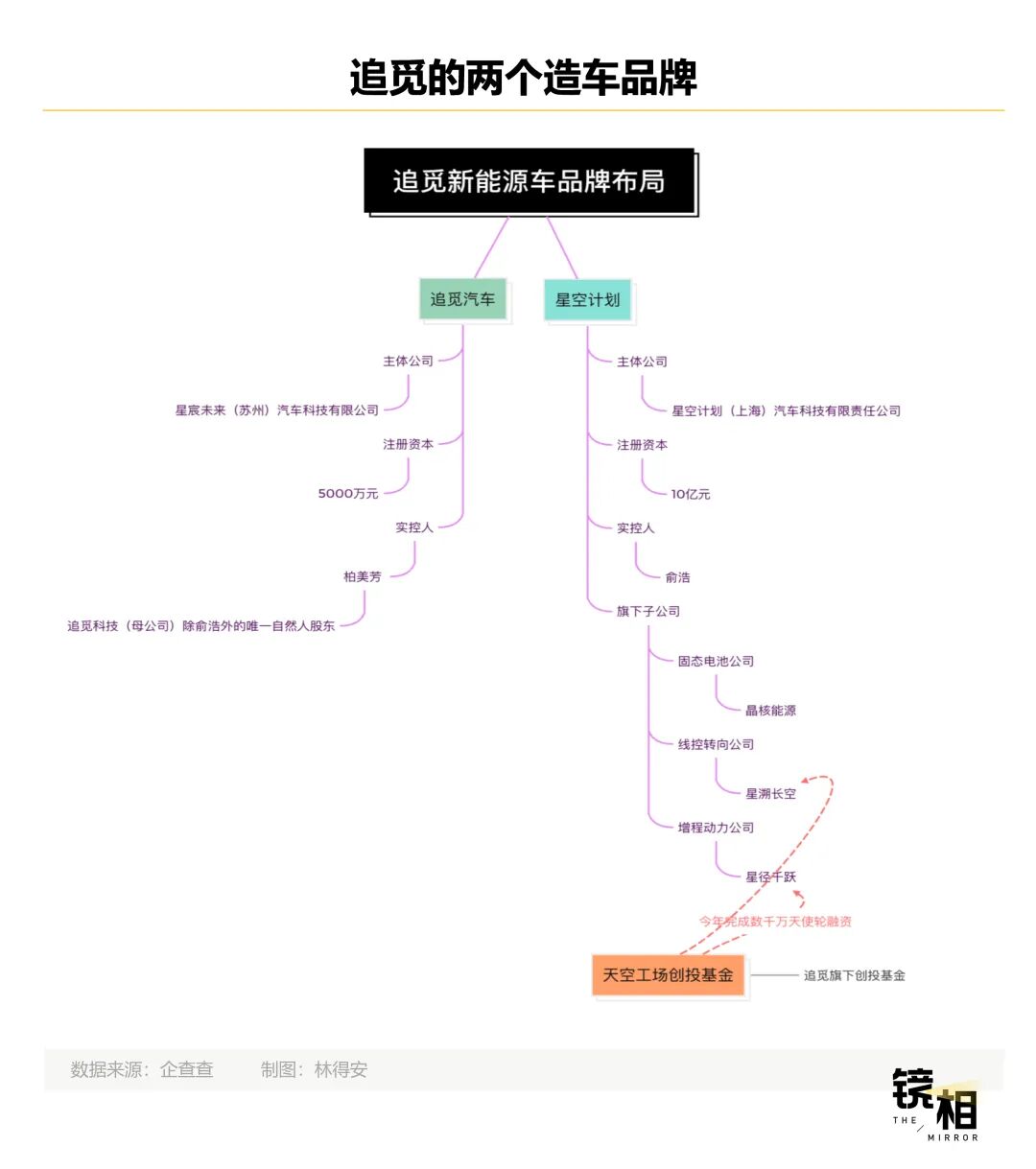
The positioning of the two brands is also different: according to public information, the Star Project mainly targets models like the Cullinan and Bentley; Dreame Auto mainly targets models like Bugatti, with an internal name of "Dreame - Bugatti", and there are electric and range - extended versions. In September last year, some media learned from informed sources that Yu Hao values the Star Project targeting Bentley more. He once said internally that "it can completely outperform Li Auto, and can crush from L9 to L8, L7, L6."
This "value" is also confirmed by the equity adjustment. One month after the establishment of the Star Project, the equity changed from Bai Meifang to Yu Hao. In March this year, Yu Hao's ultimate beneficial share increased from 77.7575% to 96.6602%. In April, Yu Hao said that the Star Project is advancing financing at a valuation of 64 billion yuan (about 10 billion US dollars).
At the beginning of this year, the first concept car Nebula Next 01 of the Star Project was unveiled at the CES exhibition. In April, Dreame Technology held a four - day global press conference in San Francisco with the theme of "DREAME NEXT", which also included the "rocket car" Nebula NEXT 01 JET Edition of the Star Project. Ma Junye, the president of the Star Project, said that Yu Hao "communicates with the car team in the corporate internal group almost every day at a high frequency."
Yu Hao's obsession with car - making may be traced back earlier. He said on Weibo that in 2011, he drafted a "White Paper on the Development of Electric Vehicles" and carried out cooperation with institutions such as Tongji University. In 2020, after Dreame established a foothold in the Xiaomi ecosystem with high - speed digital motors, he had already established an early - stage electric vehicle R & D team. Cars are the most direct projection of Yu Hao's personal will.
But why does Yu Hao separate the Star Project, Ketting Technology, and Jiamei Packaging and directly control them himself, instead of putting them in the parent - company system of Dreame like other businesses?
One explanation is that by directly holding shares personally, Yu Hao can bypass the voting restrictions of the Dreame Technology board of directors, and other financial investors do not need to bear the risks of new businesses. At the same time, when the company succeeds, Yu Hao can directly enjoy the maximum capital appreciation without being diluted by numerous shareholders at the parent - company level of Dreame Technology.
Only by understanding this layer can we understand the starting point of Dreame's entire framework. The design at the individual level answers the question of "who has the final say". Then the next question is: When Yu Hao puts the most imaginative businesses under his own name, what role does the "parent" of Dreame actually play in the system?
Light parent, heavy platform
Except for the companies directly funded and controlled by Yu Hao, Dreame has numerous other businesses.
After sorting out its equity structure, we found that Dreame Technology (parent company) is the "cash - flow center" of the entire system. According to Caixin Weekly, in 2025, Dreame's business revenue with the sweeping robot as the main revenue item exceeded 40 billion yuan, and the net profit exceeded 3 billion yuan. It is the main body for the collection of control rights and equity of the entire "Dreame system", and also the "accounting department" for coordinating assets and profits.
Specifically, the number of enterprises directly and indirectly invested by Dreame Technology reaches 367 (including those that have been deregistered), and its shareholding ratio shows an obvious polarization:
There are 129 companies with a direct or indirect shareholding ratio of over 99%, all without separate associated products, and they revolve around the main cleaning business, including stable - profit projects such as sweeping robots, floor cleaners, vacuum cleaners, and hair dryers.
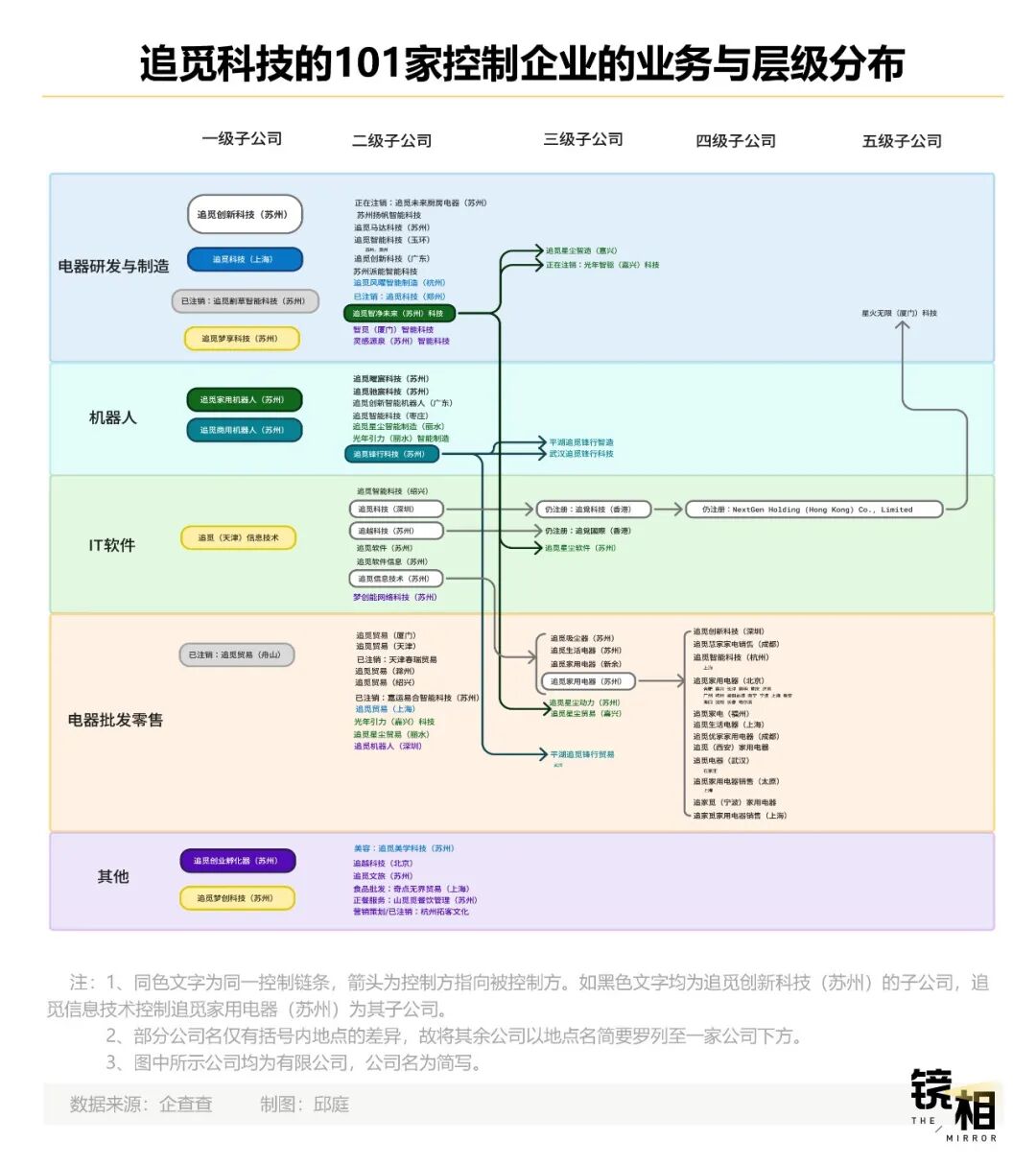
There are 214 companies with a shareholding ratio of less than 6.7%, among which 47 have separate associated products, and most of them have nothing to do with the main cleaning business. Take the trendy toy brand MOMOTOY Space Magic Box Cultural and Creative (Suzhou) Co., Ltd. as an example. Dreame Technology only holds 2.0746% of the shares, and the remaining 95% is invested by a subsidiary of Sky Boundless Intelligent Technology (Suzhou) Co., Ltd., which is 99.99% controlled by Bai Meifang. There are also 24 companies with a shareholding ratio of 14% - 69%.
It is worth noting that among the first - level subsidiaries under the parent company, there are two entities that invest in and register multiple secondary subsidiaries, namely: Dreame Innovation Technology (Suzhou) Co., Ltd. (hereinafter referred to as Dreame Innovation) and Dreame Dream Creation Technology (Suzhou) Co., Ltd. (hereinafter referred to as Dreame Dream Creation).
Dreame Innovation's investment model is mainly absolute control, and it actually controls 63 enterprises. Dreame Dream Creation only conducts small - scale equity investments, with 219 directly and indirectly invested companies, covering the subsidiaries with 6.7% equity mentioned above.
Therefore, we can see that as the parent company, Dreame Technology entrusts most of its main businesses to Dreame Innovation for management, while Dreame Dream Creation is responsible for non - main business investments. The registered capital of Dreame Technology is only about 2.41 million yuan, while Dreame Innovation ranks second in the subscribed capital contribution of the enterprises controlled by Dreame Technology, with 310 million yuan; Dreame Dream Creation ranks first, with 2 billion yuan. Together, they form the basic framework of "light parent, heavy platform".
Under this framework, how does money flow to new businesses?
According to Jiemian News, a BU leader revealed that at the beginning of the establishment of each new BU in Dreame, it will first receive internal start - up funds. After achieving certain results, it will then take the BP (business plan) to conduct independent roadshows and financing externally.
The manifestation of this approach is that the company's registration speed is faster than the business maturity speed. According to Qichacha data, we counted that from 2017 to 2023, Dreame Technology newly established a total of 28 controlled enterprises; in 2024 alone, 29 new controlled enterprises were established; in 2025, 37; and before half of 2026 has passed, 7 more have been added. As of May 18, among the 101 controlled enterprises of Dreame Technology, about 72% were established in the past two and a half years.
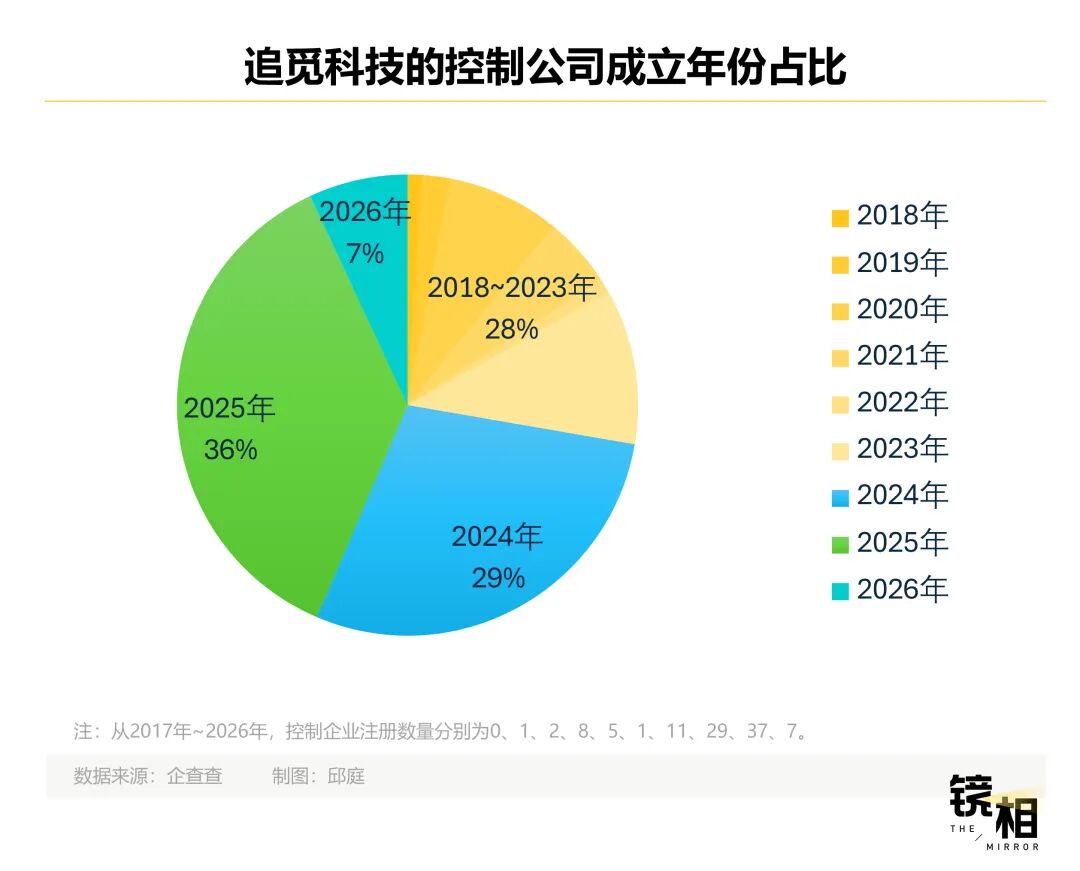
From a chronological perspective, the registration time of these companies is generally earlier than the maturity period of the corresponding businesses - the company is established first, then funds are injected, and then the company is used to carry the business that is still in the incubation stage. This model has extremely strong expansion speed and financing flexibility, but it depends quite a lot on the scheduling and management of the parent company. And Yu Hao is very confident in this, saying, "Our advantage is not that one person is very powerful, but that the overall team has high collaborative efficiency."
Yu Hao and Dreame's senior management have explained the logic of this framework in recent public responses